How to Lower Cyanuric Acid in a Hot Tub Without Draining It

None of these methods replace a partial drain entirely, but they can genuinely help if draining isn’t realistic right now. Start with a CYA reducer or carbon filtration for a moderate reading, lean on reverse osmosis if your levels are seriously high, and don’t be afraid to drain anyway once it becomes the more practical option again. For related planning, see 7 Reasons Why You Need a Smart Touch Digital Hot Tub. When switching from stabilized chlorine, use our dichlor-to-bleach switch calculator to plan the change.
Step-by-Step: How to Lower Cyanuric Acid Without Draining
Here’s the process in order, before we get into the details of each method below. For related planning, see Unraveling the Seinfeld Hot Tub.
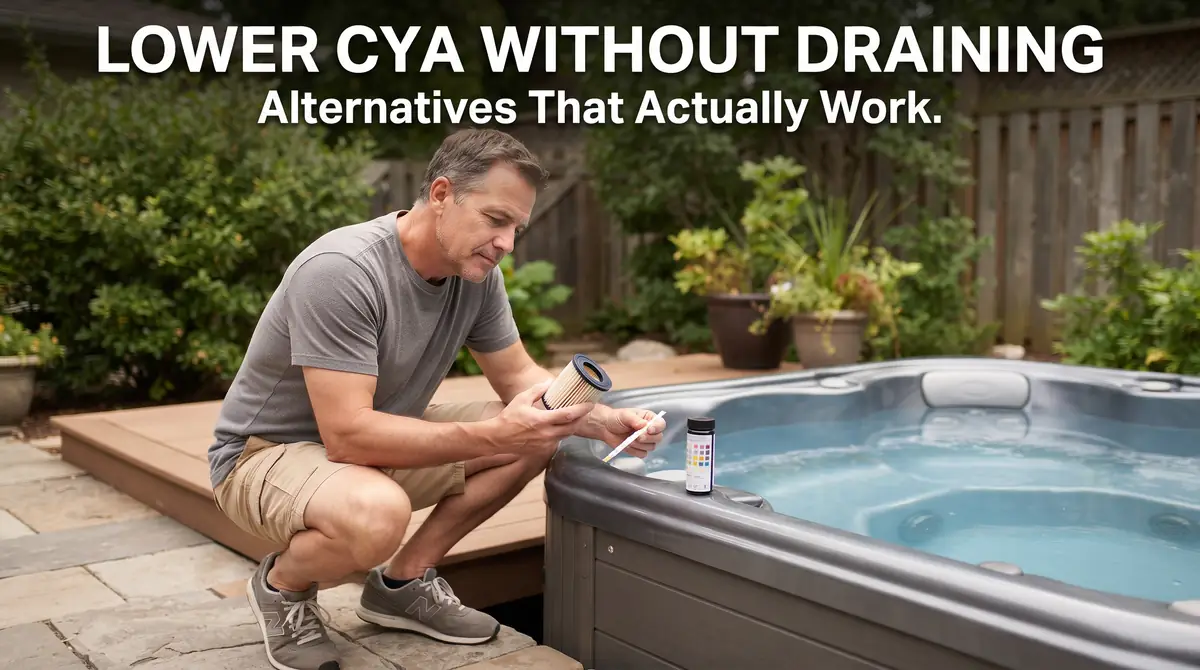
- Confirm your current CYA reading. Test before you start so you have a real baseline to measure progress against, not just a general sense that it’s “high.” For related planning, see 3 Person Hot Tub Spa.
- Judge how far over range you are. A reading in the 50 to 70 ppm range responds reasonably well to reducers or carbon filtration. Anything well above that will be slow going with non-drain methods alone. For related planning, see 7 Hot Tub Outfit Ideas to Make You Look and Feel Fabulous.
- Pick your starting method. For a moderate reading, start with a CYA reducer product or activated carbon filtration. For a significantly high reading, reverse osmosis is worth the extra cost and effort from the start. For related planning, see 7 Seat Hot Tub Installed on the White House Lawn.
- Apply the treatment as part of your regular routine. Dose reducers per the label, keep carbon filtration running continuously, and fold this into your existing regular water maintenance routine rather than treating it as a one-time fix.
- Retest every few days. Track the trend over one to two weeks rather than judging based on a single reading, since these methods work gradually. For related planning, see Celebrating National Hot Tub Day.
- Layer a second method if progress stalls. Combining a reducer with carbon filtration, for example, often pushes past what either does alone. For related planning, see Eco Spa Hot Tub.
- Reassess after two to three weeks. If you’re within a reasonable range, keep maintaining. If you’re still well above 50 ppm, it’s time to consider a partial drain instead of continuing to wait it out. For related planning, see Are Hot Tubs Good for Anxiety.

Testing water isn’t something you want to do from memory, especially when you’re tracking a trend over several weeks. Save this checklist so you can run through the steps, check safe ranges, and compare methods without digging back through the full article every time. For related planning, see 7 Proven Steps.
Why Draining Is Usually the First Recommendation
Cyanuric acid doesn’t break down on its own and it doesn’t evaporate. The only thing that changes its concentration is adding water that doesn’t already contain it, which is exactly what a partial drain and refill does. For related planning, see Keep Your Hot Tub Water Clear.
If you’d like the full rundown on safe CYA levels and how dilution math works, our complete guide to cyanuric acid in hot tubs covers it in detail.
That’s why every non-drain method below is measured against dilution as the baseline. None of them remove CYA as fast, and most only get you partway there. For related planning, see Exploring the Art of Romantic Retreats.
The CDC’s guidance on home pool and hot tub water treatment specifically advises against using cyanuric acid products in hot tubs at all, which is part of why so many owners end up trying to correct it after the fact rather than avoiding it from the start.
CYA Reducer Products
CYA reducers are the most commonly marketed non-drain solution. They work by binding to cyanuric acid molecules and causing them to precipitate out of the water, where your filter can catch some of it. For related planning, see Sauna and Fertility.
In practice, these products tend to bring CYA down by a modest amount rather than restoring it to a target range on their own. They also generate a fine cloudy byproduct temporarily while they work, so don’t be alarmed if your water looks hazy for a day or two after dosing. For related planning, see Hot Tub 1 Week After Tattoo.
Follow the label dosing exactly. Overdosing won’t speed up the process, and it can throw off other chemical readings in the meantime.
Activated Carbon and Charcoal Filtration
Activated carbon filters remove CYA gradually through adsorption, meaning the CYA molecules stick to the carbon surface as water passes through. This is a slow process measured in weeks, not days.
You’ll typically see a modest reduction, often cited around 20 to 30 percent over several weeks of continuous filtration, and results vary depending on your filter setup and how often you run your pump. This works best as a way to chip away at moderately high CYA rather than a fix for a reading that’s way over range. For related planning, see Hot Tub Leaking.
Keep an eye on your regular filter cartridge during this process too, since a clogged filter reduces flow and slows everything down. For related planning, see Is 110 Too Hot For A Hot Tub? Safety Insights.
Our guide on how to clean a hot tub filter walks through keeping it working properly while you’re running carbon treatment alongside it.
Reverse Osmosis Water Treatment
Reverse osmosis is the most effective non-drain option, and it’s the closest you’ll get to dilution-level results without actually draining the tub. An RO system forces water through a membrane that filters out dissolved solids, including cyanuric acid, then that treated water goes back into your tub. For related planning, see 10 Essential Hot Tub Accessories for Maximum Relaxation.
Most hot tub owners don’t own an RO unit themselves. This is usually done by a pool and spa service company with portable equipment, or by renting a unit designed for this purpose. For related planning, see 2 Person Inflatable Hot Tubs.
It costs more than a reducer product or carbon filtration, but it also addresses more than just CYA, since it lowers total dissolved solids at the same time, which can help with other water quality issues.
If your CYA is significantly over range and draining truly isn’t an option, this is the method worth the extra cost. For related planning, see Pros and Cons of Owning a Spa.
Ion Exchange Resin
Ion exchange resin works differently than carbon filtration. Instead of adsorbing CYA onto a surface, it swaps out ions in the water, which some specialty resins are formulated to target for cyanuric acid removal specifically.
This method is less common for home hot tub use and tends to be more expensive per treatment than carbon filtration or reducer products. It’s worth considering if you’ve tried the more accessible options and are still seeing high readings, but it’s not usually where most owners start. For related planning, see must-know facts about green mountain hot tubs reviews insights.
Whatever method you’re running, test your water more frequently than usual so you can actually see whether it’s working. Regular hot tub test strips are enough to track the trend over a few weeks.
Combining Methods for Better Results
Layering methods often gets you further than relying on just one. A CYA reducer product paired with ongoing carbon filtration, for example, tends to outperform either approach used alone.
Even combined, don’t expect these methods to fully match what a partial drain accomplishes in an afternoon. Think of them as tools to bring a high reading down closer to range and to slow how fast it climbs again, not as a complete substitute. For related planning, see Hot Tub Smells Bad? Here’s How to Fix It Fast.
If you do end up needing a partial drain later to finish the job, our hot tub chemical dosage calculator can help you figure out how much fresh water gets you to your target level.
When You Should Just Drain Instead
If your CYA reading is well over 50 ppm, the non-drain methods above will take a long time to bring it back into range, and you may be dealing with weak chlorine effectiveness the entire time. At that point, a partial or full drain is genuinely the faster and more reliable path. For related planning, see 5 Ways To Make The Most of Your Costco Inflatable Jacuzzi.
These methods work best as maintenance tools once you’re closer to your target range, or as a bridge to hold you over until draining is realistic again. If you decide to go ahead with it, this guide on how to drain a hot tub fast covers the process step by step.
Frequently Asked Questions
Do CYA reducers actually work?
Yes, but modestly. They typically lower CYA by a noticeable amount rather than fully correcting a high reading, so they work best combined with other methods or as a bridge until you can dilute the water.
How long does it take to lower CYA without draining?
Most non-drain methods take several weeks to show a meaningful change, compared to an afternoon for a partial drain and refill. Reverse osmosis is the fastest of the non-drain options.
Can a hot tub filter remove cyanuric acid on its own?
A standard filter cartridge won’t remove CYA. You need activated carbon media specifically, run continuously over time, to see any reduction through filtration.
Is reverse osmosis worth it for a hot tub?
If your CYA is significantly high and draining isn’t possible, yes. It’s the most effective non-drain method and also helps with other dissolved solids in your water, though it typically requires a service provider or rental equipment. For related planning, see Hot Tub Accessories That Actually Improve Your Soak (2026 Guide).
Will lowering CYA without draining fully restore chlorine effectiveness?
It should improve as your CYA level comes down, but if your reading was very high to start, you may still see some chlorine lock symptoms until the level is solidly back in range.