Most hot tub problems can be traced back to a handful of common causes, including restricted water flow, dirty filters, low water levels, electrical interruptions, or unbalanced water chemistry.
Starting with these simple checks can save time, reduce repair costs, and often get your spa running again without replacing expensive parts.
If the problem continues after completing the troubleshooting steps in this guide, don’t guess by replacing components one at a time. Record the symptoms, note any error codes, and contact a qualified technician for further diagnosis.
Once your spa is back in working order, following a consistent hot tub maintenance routine can help prevent many of these issues from returning.
What Is the Best Way to Troubleshoot a Hot Tub?
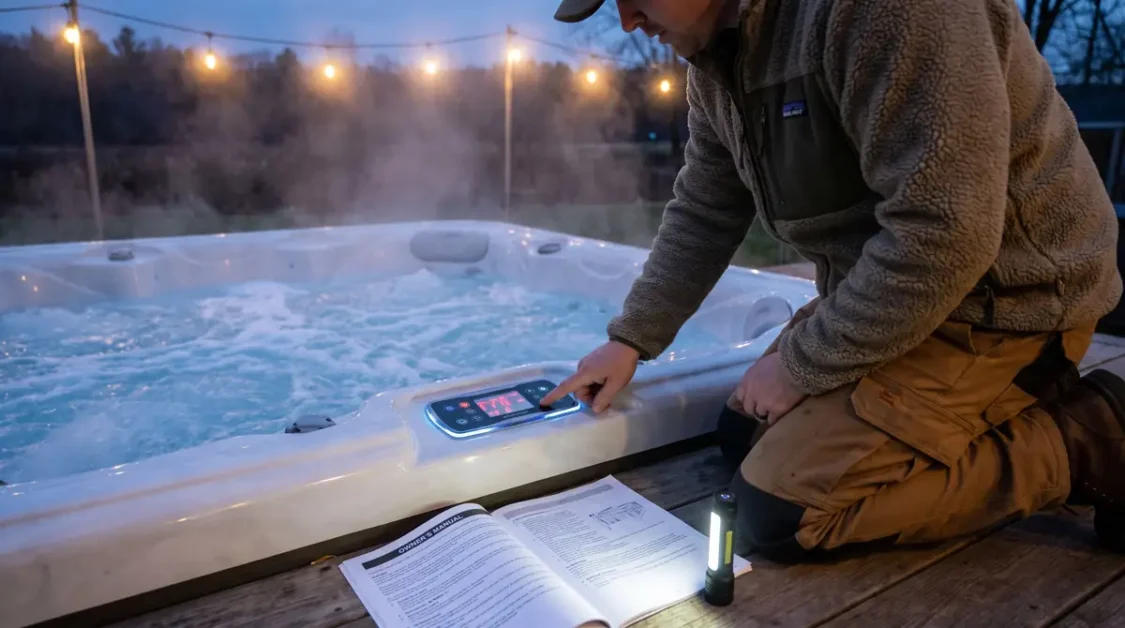
The fastest way to troubleshoot a hot tub is to identify the main symptom first, such as no power, heating problems, weak jets, leaks, cloudy water, or an error code. Start with the simplest checks including the breaker, GFCI outlet, water level, filters, and control settings before assuming a major component has failed.
Many hot tub owners are surprised to discover that a dirty filter, low water level, or tripped breaker is responsible for what initially appears to be a costly repair.
Hot Tub Troubleshooting Quick Symptom Finder
Use this table as your starting point before diving into individual troubleshooting steps.
| If your hot tub… | Check this first | Possible cause |
|---|---|---|
| Won’t turn on | Breaker and GFCI | Power interruption |
| Won’t heat | Dirty filter | Restricted water flow |
| Heats slowly | Cover condition | Heat loss or flow issue |
| Jets are weak | Water level | Low water or clogged filter |
| Makes loud noises | Pump area | Air lock or worn bearings |
| Is leaking | Pump unions | Loose fitting or cracked plumbing |
| Water is cloudy | Sanitizer level | Poor water chemistry |
| Has white flakes | Heater and water hardness | Calcium buildup |
| Shows an error code | Control panel | Flow or sensor problem |
| Trips the breaker | Heater or pump | Electrical fault |
Most problems can be narrowed down in just a few minutes by starting with these basic checks instead of replacing parts immediately.
Before You Start Troubleshooting
Taking a few simple precautions helps protect both you and your hot tub while making the diagnosis easier.
Turn Off the Power Before Opening Equipment
Never remove access panels or inspect electrical components while the spa is energized.
Turn off power at the breaker before:
- Opening the equipment compartment
- Disconnecting pumps
- Inspecting wiring
- Removing the heater
- Working around electrical connections
Water and electricity are a dangerous combination. If you’re uncomfortable working around electrical equipment, stop here and contact a qualified spa technician.
Gather a Few Basic Tools
Most common troubleshooting doesn’t require specialized equipment.
Helpful tools include:
- Flashlight
- Phillips screwdriver
- Garden hose
- Clean towel
- Water test strips
- Wet/dry vacuum (for air lock removal)
- Owner’s manual
- Smartphone to photograph wiring before disassembly
Advanced electrical testing should only be performed if you’re familiar with using a multimeter safely.
Start With the Simple Checks First
A common mistake many hot tub owners make is assuming the most expensive part has failed.
Instead, always check these items first:
- Is the breaker tripped?
- Is the GFCI reset?
- Is the water level above the highest jet?
- Are the filters dirty?
- Is the control panel showing an error code?
- Did the problem begin after draining or refilling the spa?
Working through these simple questions often solves the problem without replacing any parts.
Hot Tub Won’t Turn On
A hot tub that won’t power on is one of the most common service calls, but the cause is often much simpler than a failed control system.
Start with the easiest possibilities before assuming major electrical components have failed.
Check the Breaker and GFCI
A tripped breaker or GFCI outlet is the first thing to inspect.
Open your home’s electrical panel and verify that:
- The spa breaker is fully ON.
- The GFCI hasn’t tripped.
- No other circuits have lost power.
If the breaker trips again immediately after resetting it, avoid repeated resets. Frequent trips usually indicate an electrical problem that needs further investigation.
Verify the Spa Has Power
Sometimes the issue isn’t inside the hot tub at all.
Check for:
- Loose disconnect switches
- Power outages
- Damaged electrical cords on plug-and-play models
- Loose wiring inside the disconnect box
If other electrical devices nearby have also stopped working, the issue may be with your home’s electrical supply rather than the spa itself.
Reset the Hot Tub
Many electronic control systems can recover after a complete power reset.
To perform a basic reset:
- Turn off the breaker.
- Wait about 30 seconds.
- Turn the breaker back on.
- Allow the control system to restart completely.
Watch the display carefully during startup. Any error codes shown immediately after reboot can help narrow down the problem.
Check for Spa Lock or Child Lock
Some control panels include a safety lock that disables operation.
If the display lights up but none of the buttons respond:
- Check the owner’s manual.
- Look for a lock symbol.
- Follow the unlock procedure for your specific model.
Many owners mistake a locked control panel for an electrical failure.
Inspect the Main Fuse
Some hot tubs include replaceable internal fuses that protect sensitive electronics.
A blown fuse may result in:
- Completely blank display
- No pump operation
- No response after resetting the breaker
Only inspect or replace internal fuses after disconnecting all electrical power.
When the Control Board May Be the Problem
If you’ve confirmed:
- Power reaches the spa
- Breaker remains on
- GFCI is working
- Fuses are intact
- Display remains blank
the control board or transformer may have failed.
Control board replacement usually requires professional diagnosis because several components can produce similar symptoms.
Hot Tub Won’t Heat
If your hot tub powers on but the water never reaches the set temperature, the heating system may not actually be the problem.
Most heating issues begin with restricted water flow rather than a failed heater.
Check the Water Flow First
Modern heaters only operate when enough water flows through the heating chamber.
Reduced circulation often causes:
- Slow heating
- Heating that stops after several minutes
- Flow-related error codes
- Heater shutting off unexpectedly
Start by confirming the circulation pump is running normally.
Inspect the Filter
Dirty filters are one of the most common causes of heating complaints.
When filters become clogged:
- Water flow decreases.
- Pressure switches remain open.
- The heater shuts down to protect itself.
Remove the filter temporarily and see if heating improves.
If it does, clean or replace the filter before looking for more complicated problems.
Check the Water Level
Water should remain above the highest jet opening.
Low water allows air into the plumbing system, reducing circulation through the heater.
Signs include:
- Weak jet pressure
- Bubbling noises
- Heater cycling on and off
- Temperature rising very slowly
Adding water is often enough to restore normal circulation.
Look for an Air Lock
Heating problems frequently appear after draining and refilling the spa.
Air trapped inside the plumbing prevents proper circulation.
Common signs include:
- Pump running quietly but little water movement
- Weak or no jet pressure
- Heater not activating
- Gurgling sounds
Air locks can often be removed by briefly loosening a pump union after disconnecting power or by following the manufacturer’s priming procedure.
Pressure Switch Problems
Most hot tubs use a pressure or flow switch to verify water movement before energizing the heater.
If this switch stays open, the heater remains off even though everything else appears to work normally.
Possible causes include:
- Dirty filters
- Weak circulation pump
- Air lock
- Faulty pressure switch
Flow-related error codes often point toward this area.
Thermostat or Temperature Sensor Problems
A faulty temperature sensor may incorrectly tell the control board that the water is already hot enough.
Possible symptoms include:
- Water never reaches the set temperature
- Display temperature doesn’t match actual water temperature
- Heater cycles inconsistently
Temperature sensors generally require testing with specialized equipment before replacement.
Heating Element Failure
Heating elements eventually wear out after years of use.
Signs of a failed heater include:
- Water remains cold despite proper circulation
- Breaker trips when heating starts
- Burn marks inside the heater housing
- No measurable temperature increase after extended operation
Replacing a heater element is usually straightforward for experienced technicians but should always be performed with power disconnected.
When to Call a Professional
If you’ve already:
- cleaned the filters,
- confirmed proper water level,
- removed any air locks,
- reset the spa,
- verified the breaker is working,
and the spa still refuses to heat, professional diagnosis is recommended.
The problem may involve:
- heater element
- pressure switch
- circulation pump
- control board
- temperature sensors
These components require specialized testing to accurately identify the failed part before replacement.ience. By following these troubleshooting tips and maintenance guidelines, you’ll address issues promptly and extend the life of your hot tub. Contact our dedicated support team at Hot Tub Patio for personalized assistance or product recommendations. Happy hot tubbing!
Hot Tub Water Problems
Many hot tub issues that seem like equipment failures are actually caused by unbalanced water chemistry. Changes in sanitizer, pH, or calcium levels can affect water clarity, create odors, and even reduce heating efficiency.
If you’ve already confirmed your equipment is working correctly, inspect the water itself before replacing any parts.
Cloudy Water
Cloudy water is one of the most common problems hot tub owners face. It usually develops when sanitizer levels drop, filters become dirty, or pH moves outside the recommended range.
Common causes include:
- Low sanitizer
- Dirty filter
- High pH
- Heavy bather load
- Poor circulation
Try these steps:
- Test the water chemistry.
- Adjust sanitizer and pH as needed.
- Clean or rinse the filter.
- Shock the water if contaminants are high.
- Run the circulation pump for several hours.
If the water doesn’t clear after these steps, read our guide to fixing cloudy hot tub water for a complete troubleshooting process.
Green Water
Green water usually indicates algae growth or very low sanitizer levels. In some cases, metals such as copper can also discolor the water.
Possible causes include:
- Little or no sanitizer
- Algae growth
- Metals in the source water
- Poor filtration
To correct the problem:
- Shock the spa.
- Balance the water chemistry.
- Brush all interior surfaces.
- Clean the filter thoroughly.
- Drain and refill if the water remains green after treatment.
Brown Water
Brown or rusty-looking water often points to metals or organic debris rather than algae.
Possible causes include:
- Iron in well water
- Rust from aging components
- Dirt entering the spa
Start by testing your source water. If metals are present, use a metal sequestrant designed for hot tubs before adjusting other chemicals.
Foamy Water
Foam usually appears after lotions, sunscreen, body oils, or detergent residue enter the water.
Common sources include:
- Laundry detergent left in swimsuits
- Body oils
- Cosmetics
- Low sanitizer
Reduce foam by:
- Showering before soaking.
- Rinsing swimsuits with clean water only.
- Maintaining proper sanitizer levels.
- Shocking the spa after heavy use.
Persistent foam may indicate it’s time to drain and refill the water.
Bad Odors
A properly maintained hot tub should have very little odor.
Strong smells often indicate:
- Low sanitizer
- Biofilm inside plumbing
- Organic contamination
- Dirty filters
Shock the water, clean the filters, and inspect for biofilm if unpleasant odors continue.
White Flakes
White flakes floating in the water can resemble tissue paper but are often calcium scale breaking loose from plumbing or the heater.
Possible causes include:
- High calcium hardness
- Scale buildup
- Biofilm residue after line cleaning
Test calcium hardness before adding more chemicals. If scale continues forming, a drain and refill may be necessary.
Common Hot Tub Error Codes
Most modern hot tubs display error codes when the control system detects abnormal operating conditions. While the exact code varies by manufacturer, many indicate similar problems such as poor water flow, overheating, or sensor faults.
Always record the error code before resetting the spa. It provides valuable information if additional troubleshooting is needed.
FLO or Flow Errors
Flow errors indicate that water isn’t moving through the heater properly.
Common causes include:
- Dirty filters
- Low water level
- Air lock
- Circulation pump problems
Begin by cleaning the filter and confirming the water level before investigating more complex components.
E02 Error
An E02 error often relates to inadequate water circulation or flow restrictions.
Check for:
- Dirty filters
- Closed valves
- Air trapped in the plumbing
- Weak circulation pump
If your inflatable spa displays this code, see our Coleman SaluSpa E02 error code guide for model-specific troubleshooting.
E90 Error
The E90 code is commonly found on inflatable hot tubs and usually indicates poor water flow.
Before replacing any parts:
- Clean the filter cartridge.
- Inspect the inlet and outlet screens.
- Confirm the pump is circulating water.
- Remove any trapped air from the system.
For detailed instructions, visit our Intex E90 error code troubleshooting guide.
OH or Overheat Errors
An overheat error means the water temperature has exceeded the system’s safe operating range.
Possible causes include:
- Dirty filters
- Poor circulation
- Faulty temperature sensor
- Pump failure
Allow the water to cool naturally before restarting the spa. Never continue operating a hot tub that repeatedly overheats.
Dry or DR Errors
Dry or DR errors indicate that the heater isn’t receiving enough water.
Common reasons include:
- Low water level
- Air lock
- Blocked plumbing
- Circulation pump failure
Correct the water flow issue before resetting the spa to prevent heater damage.
Hot Tub Keeps Tripping the Breaker
A breaker that trips occasionally may be caused by a temporary electrical fault, but a breaker that trips every time the spa starts should never be ignored. The breaker is protecting you and the equipment from a potentially unsafe condition.
Start by identifying when the breaker trips:
- Immediately after turning on the spa
- When the heater starts
- When the jets are activated
- Randomly during operation
The timing often points to the component causing the problem.
Moisture Inside Electrical Components
Water and electricity don’t mix. Moisture inside the control box or electrical connections can create a short circuit that trips the breaker.
Look for:
- Condensation
- Water dripping onto components
- Corroded terminals
- Damaged cable insulation
If you discover water inside the equipment compartment, disconnect power and repair the leak before restarting the spa.
Faulty Heater Element
A worn heater element can develop an internal short.
Common signs include:
- Breaker trips only when heating begins
- Water never reaches the set temperature
- Burn marks around the heater housing
Testing a heater element requires electrical knowledge and should be performed with the spa disconnected from power.
Pump Motor Problems
Pump motors naturally wear over time.
Possible symptoms include:
- Breaker trips when jets start
- Loud humming before shutdown
- Burning smell
- Pump fails to spin
A failing motor usually becomes more frequent over several weeks rather than failing instantly.
Damaged Wiring
Rodents, vibration, and age can all damage electrical wiring.
Inspect for:
- Burned wires
- Loose terminals
- Cracked insulation
- Signs of overheating
If damaged wiring is visible, leave the spa powered off until repairs are completed.
Troubleshooting Inflatable Hot Tubs
Inflatable hot tubs share many of the same problems as acrylic spas, but their integrated pump units introduce a few unique issues.
Fortunately, many can be diagnosed without special tools.
Air Leaks
If the spa gradually loses air, inspect:
- Inflation valve
- Seams
- Air hose connections
- Pump inflation port
A spray bottle filled with soapy water makes small leaks easier to locate because escaping air creates visible bubbles.
Inflation Problems
If the spa won’t inflate properly:
- Confirm inflation mode is selected.
- Inspect the inflation hose.
- Check for damaged valve seals.
- Make sure the pump isn’t overheating.
Avoid overinflating the spa, especially during hot weather, because expanding air increases internal pressure.
Pump Errors
Integrated pump units may display error codes before shutting down.
Start with these checks:
- Clean the filter cartridge.
- Verify proper water level.
- Remove debris from intake screens.
- Restart the pump after allowing it to cool.
Many pump errors are caused by restricted water flow rather than electronic failures.
Heating Problems
Inflatable hot tubs typically heat more slowly than permanent spas.
If heating stops completely:
- Check the filter.
- Confirm water is circulating.
- Inspect for flow-related error codes.
- Verify the cover is fully closed during heating.
Heat loss from an open or poorly fitted cover can make it seem like the heater isn’t working.
Water Loss
Water loss doesn’t always indicate a plumbing leak.
Check for:
- Splash-out after heavy use
- Evaporation from an uncovered spa
- Loose drain cap
- Pump connection leaks
Dry the area completely before looking for fresh water. This makes it much easier to identify the actual source.
DIY Repairs vs. When to Call a Professional
Many hot tub problems can be solved with basic troubleshooting, but electrical repairs and major component replacements should be left to qualified technicians.
| Problem | DIY Friendly | Professional Recommended |
|---|---|---|
| Dirty filter | ✓ | |
| Low water level | ✓ | |
| Air lock removal | ✓ | |
| Water balancing | ✓ | |
| Loose union fitting | ✓ | |
| Jet cleaning | ✓ | |
| Heater replacement | ✓ | |
| Control board replacement | ✓ | |
| Pump motor rebuild | ✓ | |
| Electrical wiring repairs | ✓ | |
| Persistent breaker trips | ✓ | |
| Refrigerant or specialized equipment | ✓ |
When in doubt, choose safety over convenience. Replacing the wrong part can become much more expensive than paying for an accurate diagnosis.
If your spa is operating normally after repairs, following a regular hot tub maintenance routine can help reduce the chances of future breakdowns.
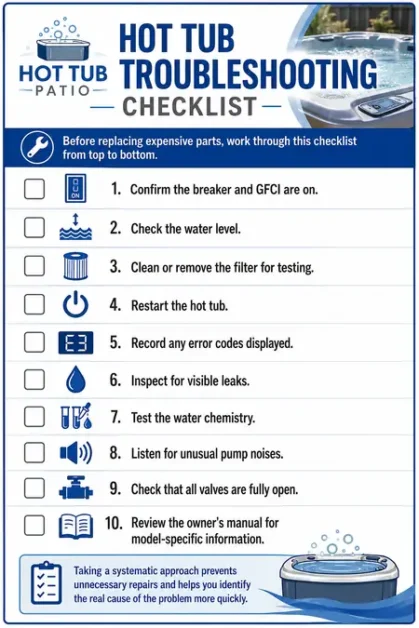
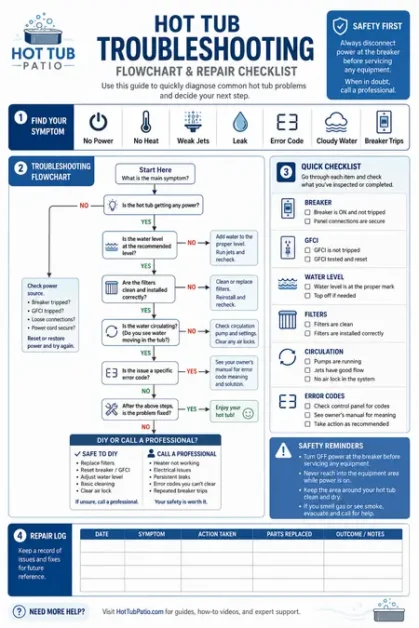
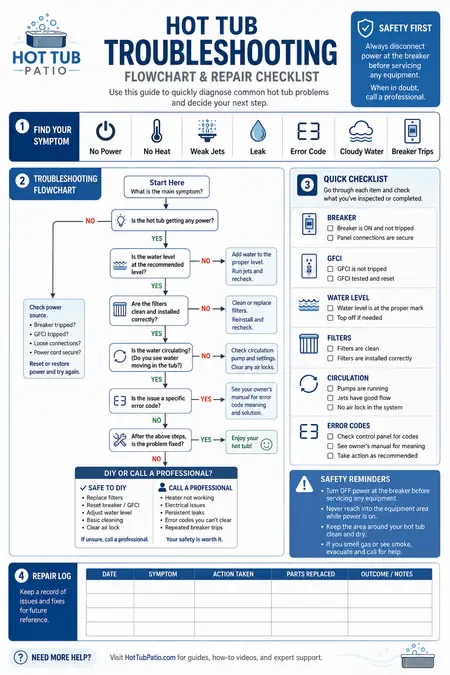
Hot Tub Troubleshooting Checklist
Before replacing expensive parts, work through this checklist from top to bottom.
- □ Confirm the breaker and GFCI are on.
- □ Check the water level.
- □ Clean or remove the filter for testing.
- □ Restart the hot tub.
- □ Record any error codes displayed.
- □ Inspect for visible leaks.
- □ Test the water chemistry.
- □ Listen for unusual pump noises.
- □ Check that all valves are fully open.
- □ Review the owner’s manual for model-specific information.
Taking a systematic approach prevents unnecessary repairs and helps you identify the real cause of the problem more quickly.
Tailored Action Plan
When your hot tub develops a problem, resist the temptation to replace parts immediately. A structured troubleshooting process usually leads to a faster and less expensive repair.
Use this simple workflow:
- Identify the primary symptom.
- Complete the basic safety checks.
- Eliminate the easiest causes first, such as low water, dirty filters, or a tripped breaker.
- Record any error codes before resetting the spa.
- Test one possible solution at a time instead of changing multiple things at once.
- Keep a small maintenance and repair log with dates, symptoms, and completed repairs.
- Contact a qualified technician if electrical components or major equipment require testing.
Keeping notes about previous problems can help identify recurring issues before they become expensive repairs.
Downloadable Resource
Frequently Asked Questions
What is the most common problem with a hot tub?
Water chemistry issues are the most common hot tub problems. Low sanitizer, dirty filters, or unbalanced pH often lead to cloudy water, odors, weak circulation, and heating problems. Testing the water and cleaning the filter are good first steps.
Why won’t my hot tub heat up?
A hot tub may stop heating because of a clogged filter, low water level, air lock, faulty pressure switch, circulation problem, or failed heating element. Always check water flow before assuming the heater needs replacement.
Why are my hot tub jets weak?
Weak jets are usually caused by dirty filters, low water levels, air trapped in the plumbing, or partially closed diverter valves. Cleaning the filter and checking the water level often restores normal jet pressure.
Why does my hot tub keep tripping the breaker?
A breaker may trip because of a faulty heater, damaged pump motor, moisture inside electrical components, or damaged wiring. If the breaker continues to trip after a reset, leave the spa powered off until the cause is identified.
Can I troubleshoot a hot tub myself?
Many common problems can be diagnosed at home, including dirty filters, low water levels, air locks, and basic water chemistry issues. Electrical repairs and major component replacements should be handled by a qualified spa technician.
How do I know if my hot tub pump is failing?
Signs of a failing pump include loud grinding noises, weak jet pressure, overheating, water leaks around the pump, or a motor that hums without circulating water. These symptoms usually become more noticeable over time rather than appearing suddenly.
What should I check before calling a technician?
Before scheduling a service visit:
- Confirm the breaker and GFCI haven’t tripped.
- Check the water level.
- Clean the filter.
- Record any error codes.
- Restart the spa.
- Inspect for visible leaks.
Completing these simple checks may solve the problem or help the technician diagnose it more quickly.
How often should I inspect my hot tub for problems?
A quick visual inspection once a week helps catch small issues before they become expensive repairs. Look for leaks, unusual noises, weak jet pressure, and changes in water clarity while performing your normal spa routine.