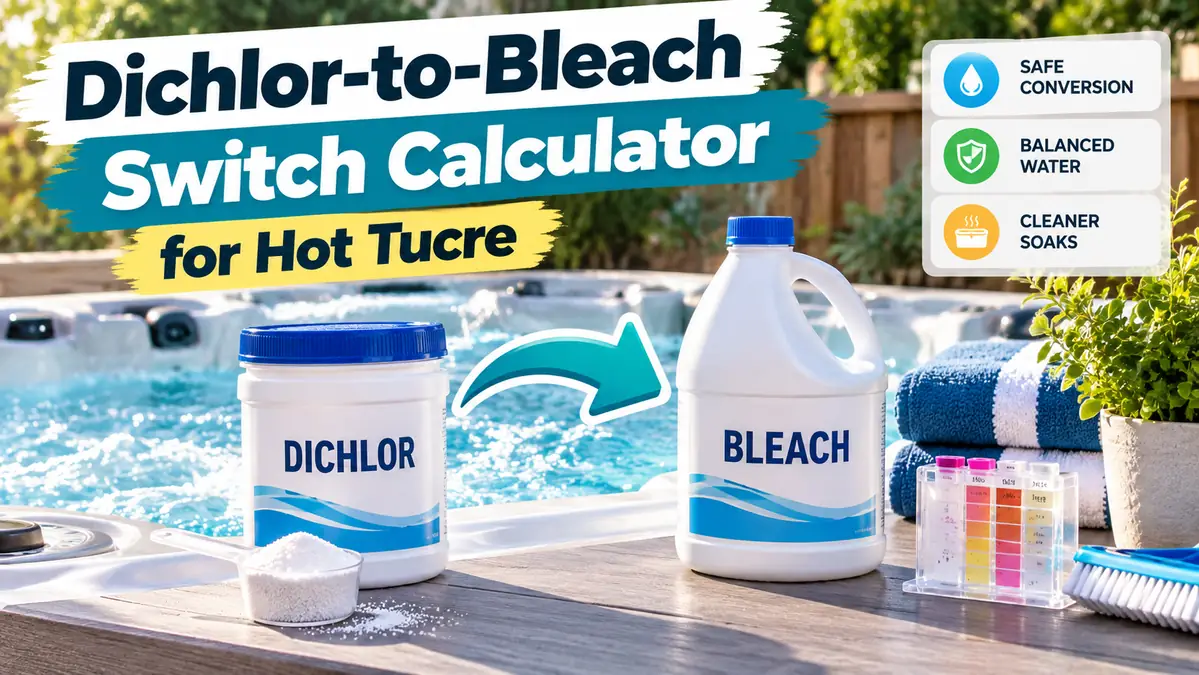
Dichlor-to-Bleach Switch Calculator for Hot Tubs

Switching from dichlor to liquid chlorine or plain unscented bleach can make hot tub water care easier, but the timing matters. Dichlor adds both chlorine and cyanuric acid (CYA). If you continue adding it after CYA has become high, chlorine can become less effective and water changes may be needed sooner.
Use this dichlor-to-bleach calculator to estimate when to make the switch and how much liquid chlorine may be needed for your hot tub. The result is a starting estimate, not a substitute for testing, your product label, or your hot tub owner’s manual.
Dichlor-to-Bleach Calculator
Always test your water, follow the product label, and check your hot tub owner’s manual. Never mix chlorine, bleach, acids, bromine, or ammonia.
For general water balancing, use the hot tub chemical dosage calculator. This tool is specifically for the dichlor-to-bleach transition.
Safety: Never mix chlorine products, acids, bromine, or ammonia. Do not use scented, splashless, gel, or detergent-containing bleach.
What Is the Dichlor-to-Bleach Method?
The dichlor-to-bleach method uses dichlor at the beginning of a fresh water cycle and then changes to a chlorine product that does not add more CYA.
- Fill the hot tub and balance the water.
- Use dichlor to establish a modest CYA level.
- Test the water and estimate or measure CYA.
- Stop using dichlor when the target CYA has been reached.
- Use liquid chlorine or plain, unscented sodium-hypochlorite bleach for ongoing chlorine additions, if approved for your spa.
Dichlor is useful because it dissolves quickly and adds stabilizer. The limitation is that every additional dichlor dose also adds more CYA. Liquid chlorine and sodium-hypochlorite bleach add chlorine without adding CYA.
Why Switch From Dichlor to Bleach?
- To prevent CYA from climbing: high CYA can reduce the practical effectiveness of free chlorine.
- To reduce unnecessary drain-and-refills: stopping the source of CYA buildup can extend a water cycle.
- To make the routine easier to track: chlorine is added without continuously increasing stabilizer.
- To avoid dosing by guesswork: a calculator can scale a dose to your spa volume and product concentration.
Switching products does not remove CYA that is already in the water. If CYA is already excessive, dilution through a partial or complete drain and refill may be required.
When Should You Switch?
Do not switch based on a fixed number of days. The correct timing depends on your water volume, the amount of dichlor added, the product strength, and how much water has been replaced.
Many dichlor-and-bleach routines use a target CYA in the general range of about 20–30 ppm, but your manufacturer or water-care program may specify something different. Use the product label and your owner’s manual as the final authority.
The most reliable process is:
- Test free chlorine, pH, total alkalinity, and CYA.
- Compare the CYA reading with your chosen target.
- Stop dichlor once the target is reached.
- Begin liquid-chlorine dosing gradually and retest after circulation.
If you only have test strips, treat the CYA result as approximate. A reliable drop-count test is usually better for making a sanitizer change.
How the Calculator Works
The calculator estimates two separate things: the amount of CYA contributed by dichlor and the amount of available chlorine needed to raise free chlorine to a target level.
CYA estimate
The CYA estimate uses the amount of dichlor added, the active ingredient strength, and the actual gallons or liters in the spa. Because products differ, the estimate is only as accurate as the product information entered.
Liquid-chlorine estimate
The liquid-chlorine estimate depends on:
- Current free chlorine.
- Desired free chlorine.
- Actual water volume.
- Available chlorine percentage on the product label.
Do not use a dose calculated for 6% bleach with a 10% or 12.5% liquid-chlorine product. Enter the strength printed on the bottle.
Worked Example: A 400-Gallon Hot Tub
Imagine a 400-gallon hot tub with a CYA reading of 20 ppm. The owner wants to stop adding CYA once it reaches approximately 30 ppm. After the next dichlor doses, the owner retests and confirms that the target has been reached.
The owner then enters:
- Water volume: 400 gallons.
- Current free chlorine: the reading from the test kit.
- Target free chlorine: the target recommended by the owner’s water-care program.
- Liquid chlorine strength: the percentage printed on the bottle.
The calculator returns an estimated dose. The owner adds the product with the circulation system running, allows the water to mix, and retests before adding more or using the spa.
This example is intentionally not a universal dose. A different product strength, spa volume, or starting chlorine reading produces a different result.
How to Switch Safely
- Confirm compatibility. Check the owner’s manual and manufacturer guidance before changing sanitizer products.
- Test before dosing. Measure free chlorine, pH, total alkalinity, and CYA when possible.
- Stop adding dichlor. Do not continue using dichlor while also treating the calculator’s result as a bleach dose.
- Use the correct product. If using bleach, choose plain, unscented sodium hypochlorite. Do not use scented, splashless, gel, color-safe, or detergent-containing products.
- Run circulation. Add the measured dose according to the product label while water is circulating.
- Never mix chemicals. Do not combine bleach with acids, bromine products, ammonia, or other sanitizers.
- Retest. Allow the water to circulate for the time stated on the product label, then check free chlorine and pH again.
- Wait before soaking. Use the spa only when sanitizer and pH readings are within the range recommended by your manufacturer or water-care program.
Can You Use Household Bleach in a Hot Tub?
Some water-care programs use plain, unscented sodium hypochlorite as a chlorine source, but household bleach is not automatically suitable for every hot tub. Products vary in strength and may include additives.
Never use:
- Scented bleach.
- Splashless or gel bleach.
- Color-safe bleach.
- Bleach containing detergents or fragrances.
- Any product whose active ingredient or concentration is unclear.
Liquid pool chlorine is also sodium hypochlorite, but it is often stronger and may lose strength during storage. Use the current label concentration in the calculator, store the product as directed, and keep it away from acids and other chemicals.
Will Bleach Damage a Hot Tub?
Damage risk increases when concentrated chemicals are poured onto the shell, added without circulation, overdosed, or mixed with incompatible products. A measured dose that is compatible with the spa’s water-care instructions is different from pouring concentrated product directly onto equipment.
To reduce risk, add chemicals slowly into circulating water, avoid contact with the cover and pillows, follow the label, and never exceed the manufacturer’s recommended sanitizer range.
What If Your CYA Is Already Too High?
Bleach will not lower CYA. It only supplies chlorine without adding more stabilizer.
If CYA is too high:
- Confirm the reading with a reliable test.
- Stop adding dichlor.
- Calculate how much water must be replaced to dilute the CYA.
- Drain and refill as needed.
- Rebalance the new water before restarting a sanitizer routine.
A complete drain and refill may make more sense when the water is old, cloudy, foamy, has a persistent odor, or has accumulated high total dissolved solids.
Troubleshooting
| Problem | Possible cause | What to check |
|---|---|---|
| Chlorine disappears quickly | Heavy use, contamination, or high chlorine demand | Test sanitizer, clean the filter, and follow an appropriate shock procedure. |
| CYA keeps rising | Dichlor is still being used | Check the product label and stop dichlor at the target CYA. |
| Water is cloudy | Low sanitizer, poor filtration, or high bather load | Test the water, clean the filter, and inspect circulation. |
| pH keeps rising | Aeration, high alkalinity, or water-care imbalance | Test total alkalinity and adjust gradually. |
| The calculator dose looks unusually high | Incorrect volume or product percentage | Recheck gallons, current chlorine, target chlorine, and label strength. |
| Test strips disagree with the calculator | Old strips or limited strip accuracy | Confirm with a fresh strip or a reliable liquid test kit. |
Frequently Asked Questions
How many days should I use dichlor before switching?
There is no universal number of days. Switch according to CYA, dichlor usage, spa volume, and your water-care instructions.
Does bleach lower CYA?
No. Bleach adds chlorine without adding CYA. Water replacement is the usual way to reduce excessive CYA.
Can I switch directly from dichlor to bleach?
Many routines switch once the desired CYA level is established, but you should test first and confirm that the method is compatible with your hot tub.
Is liquid chlorine the same as bleach?
Both commonly use sodium hypochlorite, but concentration, freshness, labeling, and additives can differ. Always use the exact percentage printed on the product.
Should I drain the hot tub before switching?
Not always. A drain may be needed if CYA is already too high, the water is old, or water quality remains poor after testing and filtration.
Can I use this method in a bromine hot tub?
Do not assume so. Bromine systems use a different sanitizer routine. Follow the bromine product instructions and your manufacturer’s guidance.
How often should I test after switching?
Test more often during the first week of the transition. Once chlorine demand is understood, establish a schedule based on usage, temperature, and your water-care program.
Related Hot Tub Water-Care Tools
- Hot Tub Chemical Dosage Calculator
- Chlorine Shock for Hot Tub
- Hot Tub pH Down Calculator
- Hot Tub and Pool Bromine Calculator
Final Takeaway
The dichlor-to-bleach method is not about replacing one chemical with another at random. It is about using dichlor long enough to establish the desired CYA level, then using a compatible chlorine source that does not continue adding stabilizer.
Measure your water volume carefully, enter the actual product strength, add chemicals gradually, and retest after circulation. When in doubt, follow your hot tub owner’s manual or consult a qualified water-care professional.