Used Sauna Buying Guide: Inspection, Costs & Red Flags

A used sauna can look like a bargain until you discover that the heater is obsolete, the cabin cannot fit through your doorway, or an electrician needs to rebuild the installation. The asking price rarely tells you what a secondhand sauna will actually cost to use.
Quick answer: Buy a used sauna only after identifying its exact model, checking for recalls, inspecting its condition without opening electrical equipment, confirming that replacement parts and installation instructions are available, and pricing transport, reassembly and professional electrical work. If a seller cannot verify a safety-critical detail, do not treat the unit as ready to operate.
This used sauna buying guide focuses on the decisions that make secondhand purchases different from new ones. If you are still choosing between infrared and traditional heat, start with our home sauna buying guide; return here when you have a particular used unit in mind.
Is Buying a Used Sauna Worth It?
It can be, especially when the seller has clear documentation, the room is dry and structurally sound, the heating system has an identifiable service history, and you can move the unit without damage. The useful question is not whether used saunas are cheaper at the listing stage. It is whether a specific used unit remains cheaper after safe installation and necessary repairs.
| Used sauna situation | Practical decision |
|---|---|
| Identifiable model, manual, complete parts and clean inspection | Proceed to an installed-cost comparison. |
| Cosmetic scuffs or replaceable accessories, with priced parts | Consider negotiating after checking functionality. |
| Unverified electrical modifications or damage from overheating | Stop: obtain a qualified inspection before considering purchase or operation. |
| Suspected structural rot, persistent moisture or extensive contamination | Usually pass unless a specialist confirms a safe, economic repair. |
| Open recall without a confirmed manufacturer remedy | Do not buy or operate it as an ordinary usable sauna. |
A showroom unit, homeowner’s cabin and heavily used commercial sauna can have different wear histories. Ask how and where the unit was used rather than assuming that age alone predicts condition.
Before Visiting: Seven Questions to Ask the Seller
Request clear photographs and written answers first. A seller who cannot supply basic identification may still own a workable unit, but you will need to price the cost of uncertainty before arranging pickup.
- What are the brand, model and serial number? Ask for readable photos of the manufacturer label on the cabin, heater or control system. For custom builds, identify each major component separately.
- Can I get the original manual and parts list? Check the manufacturer’s official support site for instructions covering that generation, not merely a similar-looking current model.
- When and where was it used? Find out whether an indoor-rated cabin was exposed to outdoor weather, whether it was used commercially, and how long it has been stored.
- Has anything been replaced or modified? Request receipts for new emitters, heaters, controls, wiring, glass and water-damage repairs.
- Is every component included? Confirm the roof, floor panels, benches, door, heater guard, sensors, controller, power components, fasteners and model-specific hardware.
- Can the unit be demonstrated safely? The seller should be able to explain its current working condition and show normal operation only where no recall or other hazard is suspected.
- Who handles disassembly and removal? Confirm whether it comes apart in panels, who pays for loading, and whether the route out of the property is accessible.
Ask for current photographs of the actual item rather than stock images. The FTC’s online marketplace advice also recommends getting sale terms in writing and keeping messages and payment records.
Check the Exact Model for Recalls Before Negotiating
A working controller is not proof that a product has no known safety defect. Search the U.S. Consumer Product Safety Commission recall database using the brand, model and relevant product names. Read the specific notice: a recall can apply to certain model families, components, dates or identifiers rather than every sauna bearing the brand.
For example, a September 17, 2026 Sauna360 recall covers specified infrared saunas, hybrid saunas and infrared kits because panels may short-circuit and overheat. The remedy described by the CPSC is a professional repair, and affected owners were instructed to stop using the product until it is remedied. Do not assume that every Sauna360 product is affected, or that a verbal claim of repair resolves a specific recalled unit.
Bench safety matters too. Sauna360 also issued a September 17, 2026 expanded recall notice for certain Tylö Halmstad and Kiruna Hybrid sauna benches because affected benches can collapse. The manufacturer instructs affected owners to stop using the sauna and arrange the updated professional remedy. Check the model and serial number against the current notice rather than assuming that a sound-looking bench, or an older repair, closes the issue.
If a listing matches a recall, ask the manufacturer to confirm the exact unit’s eligibility and completed remedy using appropriate documentation. The CPSC warns that selling recalled products without the required remedy is unlawful in the United States. If the seller cannot substantiate a completed remedy, do not proceed.
Used Sauna Inspection: What to Check in Person
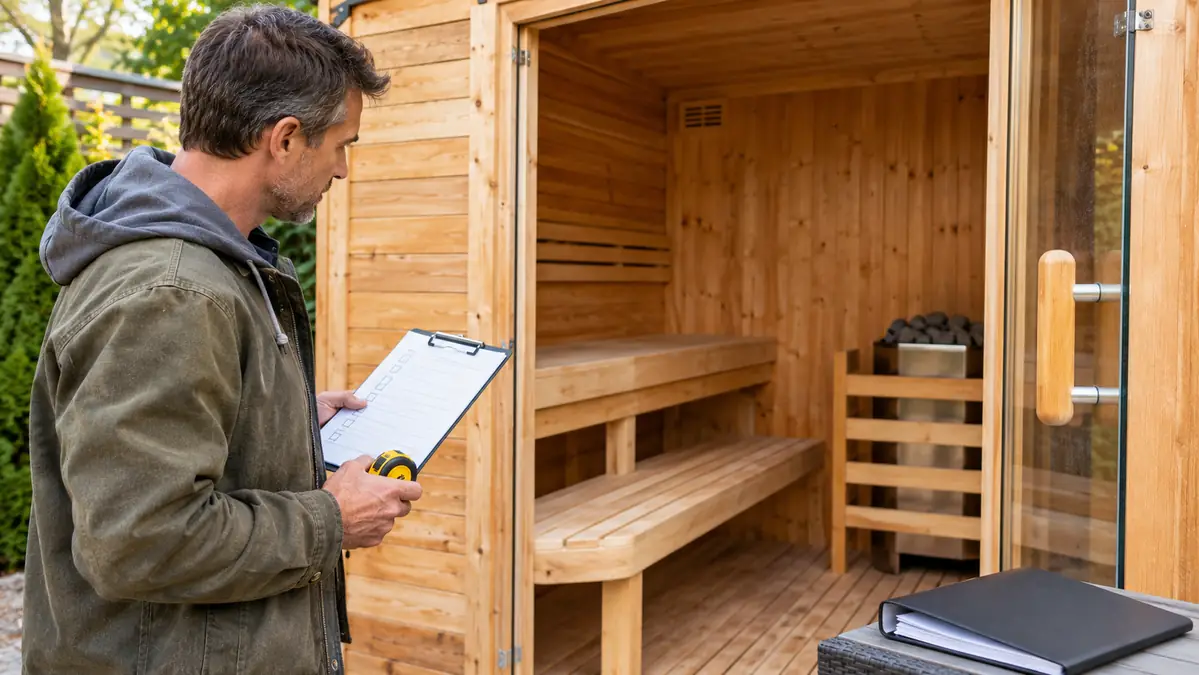
Inspect the sauna cold, dry and with the power safely off before any permitted demonstration. Bring the model information, a flashlight, a tape measure and this checklist. Do not remove electrical covers, touch heater elements, alter wiring or disassemble a hot heater. For unresolved faults, use a qualified sauna technician or electrician.
Wood, benches, floor and roof
Look closely at the lower walls, under benches, around the door threshold and at any floor section that may have collected water. Surface scratches and ordinary color variation differ from softened wood, sagging supports, loose joints or persistent musty smells. Do not diagnose dark staining by color alone.
- Check whether the benches feel stable and their fasteners appear complete.
- Look for peeling finishes, warped panels and openings where panels no longer meet.
- On outdoor units, inspect roof edges, flashing, corners, floor supports and any signs of recurring leaks.
- Ask how the seller dried and maintained the cabin after use.
Moisture problems deserve more attention than cosmetic wear. The EPA explains that mold control starts with moisture control and that porous materials may be difficult to clean completely. A questionable secondhand cabin may need specialist assessment rather than a quick wipe-down. Our sauna mold guide explains inspection and prevention in more detail.
Door, glass and ventilation
Open and close the door several times. Look for sticking, loose hinges, broken handles, cracked or chipped glass and damaged frames. Check that the door and escape arrangement match the exact model’s instructions and applicable local requirements. Inspect visible ventilation openings for blockages or obvious alterations; the correct airflow layout varies with the heating system.
Traditional electric heater and stones
Record the heater’s make and model, then check the exterior for heavy corrosion, scorch marks, missing guards or unapproved alterations. Do not lift stones from a hot or powered heater, remove heater housing or handle electrical components during an inspection. Ask whether the stone type and amount match the manual.
For some Harvia electric heaters, disintegrated or tightly stacked stones can limit airflow and contribute to an overtemperature protector tripping. The manufacturer’s heater troubleshooting guidance also advises electrician review when protection trips repeatedly. For model-specific stone care, see our sauna stones inspection guide. An unknown, faulty heater is a repair estimate, not a discount to accept on trust.
Infrared panels, controls and accessories
Check visible infrared panels or emitters for cracking, deformation, discoloration or signs of heat damage without touching them. Confirm the controller, timer, lights, door sensor where fitted, audio and app features belong to the listed model. An older app-connected sauna may rely on discontinued software or hardware, so ask the manufacturer about support before you pay.
Not every infrared panel heats identically or visibly glows. Compare any demonstration with that model’s instructions rather than diagnosing one snapshot of its operation. A panel that stays cold, a persistent error or unusual smell should trigger professional evaluation, not an owner-performed electrical repair.
Wood-burning outdoor saunas
A wood-burning sauna adds combustion equipment, chimney components and fire clearances to the decision. Check that the stove and flue are identifiable and that installation records are available. Rust-through, damaged doors, staining around the flue or uncertain clearances require a qualified stove/chimney professional. Do not light an unknown system just to demonstrate that it produces heat.
Ask for a Safe Demonstration, Not an Electrical Experiment
A normal operating demonstration can reveal problems that photos miss, but it is appropriate only when the unit has no unresolved recall, visible damage, repeated breaker trip, suspected wiring modification or other warning. Have the seller operate the sauna according to its manual while you observe from outside the equipment.
- Confirm that the displayed model and controller functions match the documentation.
- Ask the seller to show the normal start sequence, settings and any manufacturer-provided status indicators.
- Observe operation through a reasonable manufacturer-described warm-up, without forcing hotter settings or prolonged operation.
- Record error messages, unexpected shutoffs, unusual odors or noises without attempting repairs.
- If any concern appears, stop the demonstration and get a professional opinion before deciding.
If the sauna is already dismantled or disconnected, it cannot be fully evaluated in the ordinary way. Treat the lack of a demonstration as an unknown in your budget. Do not energize loose panels or reconnect wires for the sake of a sale.
Used Sauna Red Flags: Stop, Verify or Negotiate
| What you find | Decision | Why it matters |
|---|---|---|
| Affected by an unresolved recall | STOP | The manufacturer remedy and unit status must be verified before use or sale. |
| Melted wiring, scorching, tampered heater, recurring trip | STOP | Electrical or fire risk needs qualified diagnosis. |
| Soft framing, persistent moisture, major roof leaks | STOP / specialist review | Hidden material replacement can exceed the apparent saving. |
| No legible model or usable manual | VERIFY | Installation, parts and recall matching may be impossible. |
| No live demonstration available | VERIFY | Heating and controls remain untested; price and inspection accordingly. |
| Missing proprietary control, sensor or door hardware | VERIFY | Replacement may be unavailable even if the cabin is sound. |
| Scratched wood or worn removable accessories | NEGOTIATE | Cosmetic issues may be manageable when the structure is sound. |
| A few damaged approved heater stones | NEGOTIATE / service | Replacement may be straightforward if the heater is otherwise safe and compatible. |
A useful boundary: “Verify” does not mean operate the sauna to find out. It means obtain documentation, a manufacturer response or qualified assessment. An unresolved safety-critical problem is not a do-it-yourself bargaining opportunity.
Calculate the Real Cost of a Used Sauna
Compare the total installed cost of the used unit with a genuinely comparable new sauna, not with the most expensive showroom model you can find. Include the electrical work required at your property in both comparisons when it applies to both choices.
Interactive buyer tool: Use the calculator below to test a seller’s price, include your own moving and repair quotes, and see whether the offer meets your savings goal. The printable worksheet that follows remains available if you prefer to calculate by hand.
Used Sauna Cost & Offer Calculator
Enter your actual quotes to estimate the total installed cost, how much you might save against a comparable new sauna, and the highest seller offer that still meets your savings target. The safety check below can override any attractive price.
Cost comparison and offer ceiling
Important: This is a budgeting and decision aid, not an inspection, market valuation or safety certification. An unresolved recall, unsafe installation or major structural hazard is a STOP regardless of calculated savings. No personal amounts are submitted by this tool.
| Cost line | Write your quote or estimate |
|---|---|
| Seller’s asking price | $________ |
| Disassembly and packaging | $________ |
| Pickup, loading, transport and insurance | $________ |
| Reassembly and site preparation | $________ |
| Electrician inspection and installation | $________ |
| Required permits or inspections, if applicable | $________ |
| Approved replacement parts and necessary repairs | $________ |
| Contingency for unknowns | $________ |
| Total used sauna installed | $________ |
| Comparable new sauna installed | $________ |
| New total minus used total | $________ potential saving |
Illustrative example, not a market price estimate: A seller asks $1,900. You estimate $450 for moving, $350 for disassembly and setup, $600 for professional electrical work, $200 for parts, $150 in other necessary costs and $250 as a contingency. The resulting used-unit budget is $3,900. If a comparable new unit installed at the same property would cost $4,300, the apparent saving is only $400 before any further surprise. Replace every number with actual quotes for your model and location.
A low asking price is especially misleading when a major control board, discontinued infrared panel, cracked glass door or heavy moving equipment is needed. Check our sauna repair cost guide to organize repair categories, then confirm the specific parts and labor with a supplier.
Moving and Reinstalling a Secondhand Sauna
The move is part of the purchase decision. Panel-built cabins, fixed outdoor buildings and barrel saunas have very different removal needs. Ask for the largest separate panel dimensions, overall weight or manufacturer transport instructions when available, and the exact path from the existing installation to the vehicle and into your home.
- Measure door openings, hallways, stair turns, gates and delivery access before placing a deposit.
- Ask whether the sauna was designed to be disassembled and moved. A custom site-built room may not be reusable intact.
- Photograph component placement, label hardware and protect glass and controls during approved disassembly.
- Keep wooden components dry and protected; inspect panels again after transport.
- Have the electrical system and required clearances checked for the new location before energizing it.
The original installation is not automatically suitable for your building. An electrician should determine the required supply, protection, connection method and compliance with local rules using the actual model documentation. Our sauna installation checklist explains the broader planning and contractor handover.
Check Warranty, Parts Availability and Seller Terms
Do not assume an unexpired original warranty follows a secondhand sauna to its next owner. For example, Sun Home states that its listed warranty coverage is for the original purchaser and is non-transferable. Terms differ by manufacturer, product, purchase date and region. Get a written answer for your exact model before counting on coverage.
Ask the manufacturer or authorized distributor whether the replacement controller, emitters, stones, heating elements, sensors, door parts and proprietary connectors can still be ordered. Request prices and estimated availability, not a vague assurance that parts are probably obtainable.
Confirm what is included in the sale and who is liable for damage during removal. For marketplace purchases, review the return terms and available payment protections. The FTC recommends keeping copies of the listing, messages, payment information and promised terms.
Printable Used Sauna Inspection Scorecard
Copy this worksheet into your notes before visiting. Mark each row PASS, VERIFY or STOP, with evidence next to it. It is a buyer decision tool, not an electrical safety certificate.
| Inspection item | Your status | Evidence or follow-up |
|---|---|---|
| Model, serial number and correct manual | PASS / VERIFY / STOP | ____________ |
| CPSC recall search and remedy status | PASS / VERIFY / STOP | ____________ |
| Cabin, benches, floor and moisture condition | PASS / VERIFY / STOP | ____________ |
| Door, glass, guards and visible vents | PASS / VERIFY / STOP | ____________ |
| Heater or infrared emitters and controls | PASS / VERIFY / STOP | ____________ |
| Electrical requirements and installer review | PASS / VERIFY / STOP | ____________ |
| Parts availability and written warranty terms | PASS / VERIFY / STOP | ____________ |
| Moving route, disassembly and installed-cost quotes | PASS / VERIFY / STOP | ____________ |
Decision rule: Any unresolved STOP on a safety-critical row means no purchase as a ready-to-use sauna. VERIFY means you still need evidence or a professional quote. Only compare prices once there is a credible path to safe installation. A numerical score cannot compensate for a serious hazard.
Used Sauna Deal Gate: Document the Transfer Before You Pay
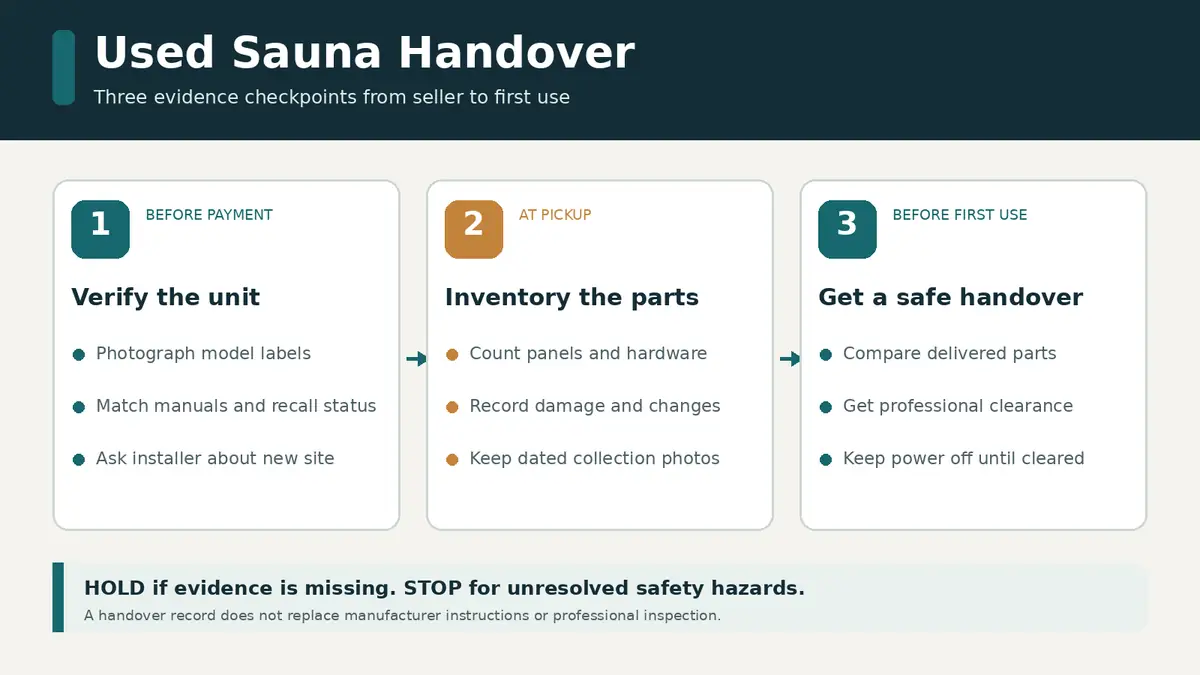
Most used-sauna checklists end when the buyer says yes or no. A secondhand sauna has another failure point: the unit that looked complete in the seller’s room can arrive with missing hardware, a changed heater, or installation needs that no one has priced. Use the following three-checkpoint handover record to connect the physical sauna you inspected to the equipment that actually arrives and gets installed. This is an original buyer workflow, not a certification, warranty or substitute for a qualified inspection.
Checkpoint 1: Pre-payment identity and compatibility
Make one folder for this specific listing, identified by a simple purchase reference such as Sauna A. Save the listing and timestamped photographs of the cabin label, heater label, controller, wiring-rating label (visible externally), manual cover, and any documented modifications. Ask the manufacturer to confirm model identity, relevant recall status and parts support; keep the dated reply. If the cabin, heater and controller are different brands, record each model separately instead of assuming one cabin label covers all the components.
Send the correct manuals and your proposed installation location to a licensed electrician or qualified installer for a preliminary compatibility review. Ask which site facts they still need: available electrical supply, protective devices, clearances, ventilation, access and any local permits. The previous owner’s working setup does not prove that your new location is suitable. See our sauna permit planning guide for the questions that depend on jurisdiction.
Checkpoint 2: Pickup-day custody and inventory
Before loading, compare the physical items to the photos, original manual and agreed bill of sale. Record what is present, missing, damaged or untested; take wider photographs of each packed group and label hardware bags to their matching panels. If a material part or model number differs, stop the handover long enough to agree on the discrepancy in writing. A verbal promise that missing parts will be shipped later is not the same as having them.
Checkpoint 3: Arrival and first-operation hold
After transport, compare the delivered panels, heater, controller, guards, stones, glass, floor pieces and loose fittings with the pickup record. Note damage before assembly. Keep the sauna unpowered until any necessary qualified installation, electrical verification, recall remedy and manufacturer-required safety checks are completed. Ask the installer to document the work performed, unresolved defects and the point at which the equipment may be used. For an outdoor wood-burning system, include a qualified chimney/stove review as applicable.
| Transfer checkpoint | Evidence to keep | Status / owner |
|---|---|---|
| Before deposit | Cabin, heater and controller models; recall and parts responses; manual; proposed-site review | PASS / HOLD / STOP — ________ |
| At collection | Dated condition photos; itemized component count; agreed missing items; collection receipt | PASS / HOLD / STOP — ________ |
| At your property | Delivery damage log; assembled inventory; professional installation/inspection record; unresolved items | PASS / HOLD / STOP — ________ |
| First permitted use | Manufacturer instructions available; remedy and safety matters closed; installer handover details | PASS / HOLD / STOP — ________ |
Record rule: HOLD means information or a required step is missing; STOP means an unresolved safety-critical issue. Neither status gives permission to operate. A signed receipt documents what changed hands but cannot certify that electrical equipment or a stove is safe.
Reverse the budget: calculate your maximum seller offer
Most buyers begin with the asking price and add costs. Try the calculation in reverse: decide what total spend still makes the used purchase worthwhile compared with a comparable new unit installed at your property, then subtract costs that apply only to the used option. Count costs shared by both options only once when comparing the totals.
Maximum seller offer = comparable new installed total − used-only moving and installation costs − used-only repair quotes − uncertainty reserve − the savings you require. This is a personal decision ceiling, not a market valuation or a promise that any price is safe.
| Input for your exact listing | Your amount |
|---|---|
| A. Comparable new sauna installed at your location | $________ |
| B. Extra used-only removal, transport and reassembly costs | $________ |
| C. Quoted used-only repairs, missing parts and professional checks | $________ |
| D. Reserve for unresolved but non-safety-critical unknowns | $________ |
| E. Minimum saving you want for buying used | $________ |
| Maximum seller offer = A − B − C − D − E | $________ |
Illustrative example only: If a comparable new sauna would cost $5,200 installed, your used-only moving and reassembly cost is $650, quoted repairs and checks are $450, your uncertainty reserve is $500, and you want at least $900 in savings, the maximum offer is $2,700. These are fictional worksheet inputs, not surveyed prices. If the seller asks $3,100, the deal misses your target by $400 before any newly discovered problem. A lower offer does not make an unsafe unit acceptable.
Use actual supplier and installer quotes for the completed calculation. If the maximum offer comes out negative, you cannot meet your savings target even with a free sauna. If the seller cannot supply documentation or a professional cannot resolve a safety concern, mark the decision STOP regardless of the formula.
Copy-and-send seller confirmation message
“Before I arrange collection, please confirm the exact sauna cabin, heater and controller model numbers; every panel and accessory included; known faults or alterations; any recall repair documentation; and who is responsible for removal damage. I will compare this with the unit at pickup. Any unverified safety issue will need to be resolved with the manufacturer or a qualified technician before I buy or operate it.”
This is the difference between a nice-looking used sauna and a documented purchase: the photo record, equipment identities, price ceiling and installation handover travel together. Keep the folder for future service calls and resale, but store personal documents and serial-number photographs privately.
When Buying New Makes More Sense
A new sauna deserves consideration when the used candidate has unknown model details, no parts support, expensive moving needs or little remaining savings after installation. New may also make more sense when you want a clearly documented electrical specification, straightforward warranty eligibility and a manufacturer-supported installation workflow.
A well-documented secondhand unit can still win if it passes the checks and the total savings remain meaningful. Keep your decision tied to the exact product and the costs of owning it, not to generic promises about how much anyone can save by buying used.
Frequently Asked Questions About Buying a Used Sauna
Is a used infrared sauna worth buying?
It can be if the correct model is identifiable, its recall status is resolved, the emitters and controls are supported, the cabin is sound, and the installed cost is competitive. Missing or discontinued electronic parts make the purchase much riskier.
Can I plug a used sauna into a normal household outlet?
Only if the exact model is designed for that supply and the installation meets the manufacturer’s instructions and local requirements. Do not guess from plug appearance, change the plug or use extension cords to make an unsuitable circuit work.
Do sauna warranties transfer to second owners?
Not necessarily. Many are limited to the original purchaser; ask the manufacturer for the exact terms in writing before giving the warranty any value in your purchase calculation.
Should I buy a sauna if the seller cannot demonstrate it?
Treat the heating system as unverified. Request model documentation, a specialist inspection or a price that reflects an unknown repair, and pass if the risk cannot be assessed safely.
Can I buy a previously recalled sauna after it has been repaired?
A completed manufacturer-approved recall remedy may change the unit’s resale status, but you need documentation matching the affected product and its remedy. Confirm the exact notice and details with the manufacturer rather than trusting appearance or seller assurances.
Can I move a secondhand outdoor sauna intact?
Sometimes, depending on construction, weight, access and transport requirements. Get a qualified mover’s assessment and confirm that the foundation, roof, flue and electrical reinstallation can be handled safely.
The Purchase Decision to Make Before Paying
Ask for the model plate, manual, recall confirmation, condition photos, repair documentation and realistic moving and installation quotes. Fill in the scorecard before paying a deposit. A used sauna is a good buy only when the discount survives these checks and the equipment has a credible, manufacturer-consistent path to safe operation.