
Does Homeowners Insurance Cover a Sauna? What to Verify

You have chosen an indoor sauna cabin or a backyard sauna building, and the next question is whether homeowners insurance will actually cover it. A contractor may confirm that the heater meets the installation instructions, but that does not tell you how an insurance company will classify the sauna.
Quick answer: Homeowners insurance may cover a sauna, depending on whether it is built into the house, detached from it, or movable; how you use it; and the policy’s limits, exclusions and covered causes of loss. Ask the insurer to confirm the exact setup in writing before you buy or install it. This article is about U.S. residential property insurance, not health-insurance reimbursement.
The practical task is to determine which coverage applies, check whether its limits are adequate, and collect the documents that make that answer specific to your sauna rather than a general assurance.
Does Homeowners Insurance Cover a Sauna? Quick Answer
A standard homeowners policy is organized by what is insured and what caused the loss. The National Association of Insurance Commissioners (NAIC) distinguishes dwelling, other structures, personal property, personal liability and medical payments coverage. None of these general categories guarantees that every type of sauna is insured.
| Sauna situation | Coverage to ask about | What must be confirmed |
|---|---|---|
| Built into a house or attached room | Dwelling coverage (often Coverage A) | Whether sauna equipment and permanent alterations are included in replacement value |
| Detached backyard sauna cabin | Other structures (often Coverage B) | Eligibility, shared limit, valuation terms and covered causes of loss |
| Plug-in or movable sauna cabin | Personal property or another classification | Whether it is considered movable property or part of the building |
| Sauna used for paid guest sessions | Business/commercial coverage may be required | Residential exclusions and whether separate insurance applies |
This table is a starting point for a policy question, not a definitive classification. Attachment, construction, electrical connection, local rules and insurer wording all matter. If you already own an infrared unit and mean a medical plan paying for the purchase, see our separate infrared sauna insurance reimbursement guide.
Indoor, Outdoor and Portable Saunas: Which Coverage Applies?
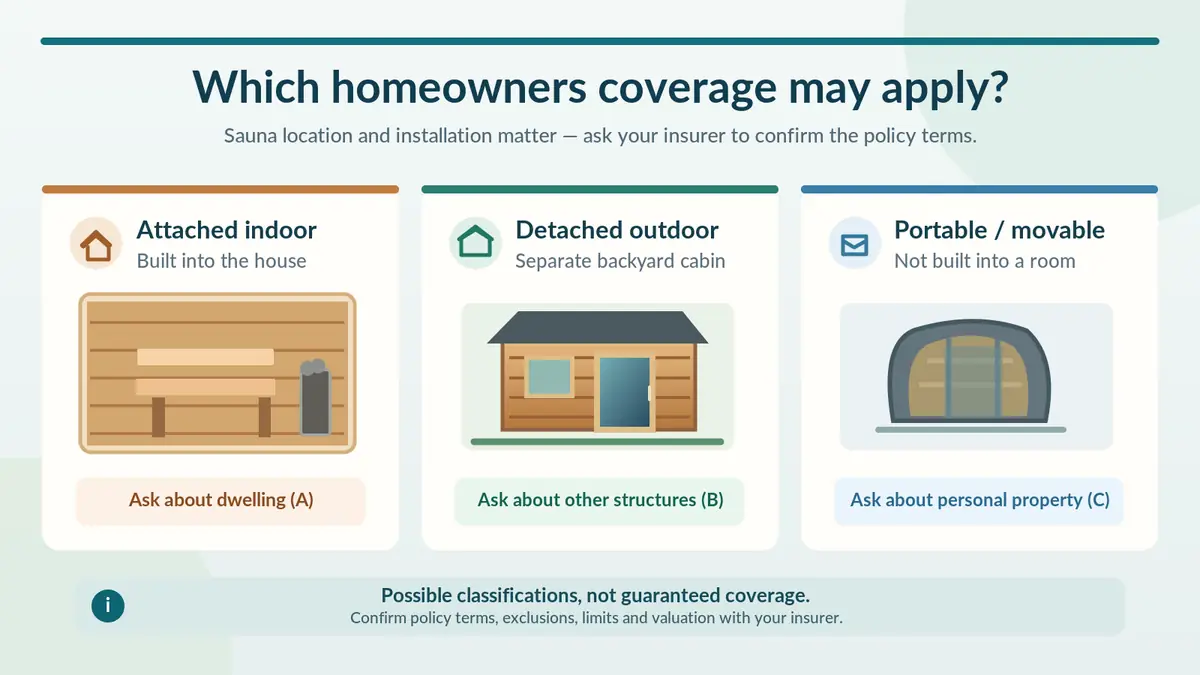
A built-in indoor sauna
An enclosed sauna incorporated into the home may be treated like other permanent improvements under dwelling coverage. The key is whether the insurer sees the cabin, paneling and heating system as part of the insured building. Ask how the added value affects the dwelling replacement-cost estimate. A kit installed in a spare bedroom may not be classified exactly like a custom sauna built into a renovated bathroom.
A detached backyard sauna
A freestanding structure with its own roof and foundation is the clearest reason to review other-structures coverage. Progressive’s Coverage B explanation includes detached garages, sheds and gazebos as examples, and notes that policies often set their combined limit at 10% of dwelling coverage. It does not promise that every sauna qualifies. Ask the insurer how a barrel cabin, shed conversion or sauna building on your specific property is treated.
A portable or removable infrared sauna
A sauna that can be unplugged and moved may raise a personal-property question instead of a building question. Ask the agent to examine its size, whether it has been permanently installed, and the policy definition of covered property. Do not assume that a product marketed as ‘portable’ automatically falls under Coverage C.
If you have not decided where to place your unit, the home sauna buying guide compares indoor and outdoor choices, while the sauna electrical requirements guide explains why the exact model and its installation documentation matter.
Is Your Detached Sauna Fully Insured?
Other-structures insurance is usually a shared limit, not a separate amount reserved for the sauna. The same limit may need to account for your detached garage, fencing, shed, gazebo and any other eligible structures. Insurers may allow it to be increased. Amica’s other-structures guidance discusses this issue when owners have high-value outbuildings.
Fictional example: Suppose your policy shows a $40,000 Coverage B limit. You estimate $28,000 to rebuild your other eligible structures and $19,000 for your planned sauna, giving a combined $47,000. That is a $7,000 potential limit shortfall if those structures share that limit. It does not mean a future claim would pay $40,000, or that all the structures have been accepted for coverage.
Also ask how a loss would be valued. The NAIC explains the difference between replacement cost and actual cash value (ACV). A policy could value one class of property differently from another, and depreciation, deductibles, special sublimits or other settlement conditions may apply even when your limit looks adequate.
- Find the actual Coverage B amount on your declarations page rather than applying a general 10% rule.
- Estimate replacement cost using a comparable sauna, electrical work, site preparation and reasonable contractor quotes, not resale value alone.
- Include other detached structures that may share the limit, and ask if any are separately scheduled or insured.
- Confirm covered causes of loss and how the sauna would be valued. The limit alone cannot answer those questions.
Does a Wood-Burning Sauna Change Your Insurance?
Wood-fired sauna heaters involve a fire and chimney exposure that differs from a plug-in infrared cabin. Insurers already evaluate some wood-burning appliances as distinct risks: Progressive describes wood-stove insurance requirements that can include installation records, inspections, photographs, surcharges or eligibility limits.
Important distinction: Those published examples concern household wood-burning stoves, not a universal rule for sauna heaters. Do not automatically transfer a wood-stove premium percentage or inspection requirement to every wood-fired sauna. Ask your insurer about the exact sauna stove, flue/chimney, clearances, fuel storage and location.
Keep the heater manufacturer’s manual, installation invoice, relevant chimney or fire-safety review and photographs of the completed system. The sauna fire safety guide covers practical prevention measures, but it is not a substitute for the insurer’s acceptance or a qualified installer.
Do Permits and Electrical Inspections Affect Coverage?
Permits and inspections may matter as evidence that a project was installed through the required process. They do not create a blanket rule that an unpermitted sauna is automatically uninsured or that a permitted sauna has guaranteed claim coverage. Insurance decisions depend on the actual policy, applicable law and facts of any loss.
Before installation, give the agent the model number, heater type, intended location and proposed electrical or chimney work. Ask what must be disclosed, documented or approved. Keep your contractor’s scope, receipts, signed inspection documents and photographs together. The insurer may ask questions about alterations to the dwelling or new detached structures.
Use our sauna permit planning checklist to identify local building, electrical and zoning questions. The Insurance Information Institute recommends contacting your agent after major home improvements and new outdoor structures, and keeping records of the work.
Does a Sauna Increase Homeowners Insurance Premiums?
There is no reliable nationwide dollar or percentage surcharge that applies to all home saunas. An insurer may consider the replacement value of added structures, the type of heater, installation details, fire protection, location, existing limits and claims-related risk. Another policy might not change the premium in the same way.
The NAIC’s consumer homeowners guide identifies construction, fire protection, amount of coverage and deductibles among home-insurance rating factors. That does not establish a sauna-specific price change.
When asking for a quote, request both the new annual premium and any changes in deductible, coverage limit, exclusions, endorsements or inspection requirements. Compare the full policy change, not only the monthly difference. Keep the quote date and an effective date for any adjustment.
What If a Guest Gets Injured in Your Sauna?
Property coverage for the sauna building is different from personal liability insurance. Personal liability may respond if you are legally responsible for a covered guest injury or property damage. Medical payments to others can sometimes address smaller qualifying guest medical bills without establishing fault, subject to policy terms and limits. Amica describes medical payments to others as different from personal liability.
Ask your insurer if the setup affects liability requirements, particularly when friends or visiting family will use it. Consider safe access, secure controls, a usable exit, manufacturer instructions and whether the insurer expects particular safeguards. No article can promise coverage for a hypothetical sauna injury without the policy and circumstances.
If the sauna is offered for paid sessions, rentals, retreats or business activities, do not rely on ordinary residential liability limits. Review business-use exclusions and appropriate commercial coverage. Our mobile sauna operator insurance checklist addresses a different, commercial insurance task.
Common Exclusions Homeowners Overlook
A sauna can be listed as property under a policy and still suffer a loss that is excluded. The NAIC notes that standard homeowners policies generally exclude floods and earthquakes unless other coverage is purchased. Insurers also commonly distinguish accidental covered damage from ordinary wear and maintenance problems. Exact terms vary by policy and state.
| Situation | Why to ask | Useful follow-up |
|---|---|---|
| Flooding or earth movement | Commonly excluded or separately insured | Is separate flood or earthquake protection available for the sauna? |
| Rot, repeated moisture or deterioration | Maintenance-related loss may be excluded | What are the conditions and limitations on water damage or mold? |
| Fire or electrical damage | Coverage depends on cause and policy terms | Do sauna-specific exclusions, conditions or required inspections apply? |
| Theft or damage to movable equipment | Personal-property limits and valuation may differ | Are controls, portable units and accessories covered and to what limit? |
| Renting the sauna to paying guests | Business-use exclusions may change coverage | Do we need commercial property and liability insurance? |
Before relying on a general answer, read the exclusions and endorsements sections of the policy. The NAIC policy-reading guide explains why the declarations page, insuring agreement, exclusions and conditions all matter.
Sauna Insurance Coverage Gap Calculator
The calculator below helps you ask a sharper question: if the sauna and other detached structures share the same Coverage B limit, does that amount cover their estimated replacement values? It does not estimate a claim payout, confirm coverage or replace the insurer’s answer.
Sauna Insurance Coverage Gap Calculator
Compare your actual policy’s other-structures limit with estimated replacement costs. Then record whether your insurer has confirmed the sauna belongs under that limit. This is a limit-planning worksheet, not a prediction of a claim payment.
What the number does not tell you: It cannot confirm eligibility, covered causes of loss, deductibles, special sublimits, replacement cost versus depreciation, policy conditions, or how multiple structures are valued following a covered loss. Never interpret $0 gap as proof of insurance coverage. No entered data is sent to Hot Tub Patio by this calculator.
A zero result means only that your entered replacement estimates do not exceed your entered limit. If the agent has not confirmed the sauna’s classification, loss valuation and covered causes of loss, the correct next step is still verify before installation. For the broader project budget, our home sauna installed-cost worksheet can help gather expenses to discuss with an agent.
Questions to Ask Your Insurer Before Installation

Send the information in one batch so the insurer can assess the actual equipment. A phone call is a start, but save the response in writing and request the applicable policy wording or endorsement when needed.
- Identify the sauna: location (attached, detached or movable), make/model, heating method, dimensions, estimated replacement cost and intended private or business use.
- Ask whether it belongs to dwelling, other structures, personal property or another category, and request the exact policy section that supports the answer.
- Confirm the current limit, whether it is shared with other structures, any special sublimit and ACV versus replacement-cost treatment.
- Ask about required permits, electrician or chimney work, photographs, inspection records, fire protection and maintenance conditions.
- Ask what incidents would not be covered, especially fire-related restrictions, flood, earth movement, gradual deterioration and business use.
- Request a quote for any needed limit increase, endorsement or separate policy and confirm the effective date.
- Save the insurer’s reply and corrected declarations or endorsement before treating the issue as closed.
Copyable email to your insurance agent
Subject: Confirm homeowners coverage for proposed home sauna
Hello, I am considering a sauna at my insured property. It would be [attached indoor / detached outdoor / movable], with a [electric / infrared / wood-burning] heater. The make and model are [details], and my estimated installed replacement cost is [amount].
Please confirm in writing which section of my policy would cover the sauna; whether the other-structures limit is shared; any deductibles, sublimits, exclusions, ACV/replacement-cost terms, liability considerations, notification or inspection requirements; and whether a premium change, endorsement or separate policy would be needed. Please identify the policy wording and effective date for any change. Thank you.
Keep a response log
| Question or record | Answer / date / document |
|---|---|
| Insurer, policy number and agent | ________________________ |
| Sauna type, model, heater and location | ________________________ |
| Confirmed property coverage category | ________________________ |
| Current limit and shared-structures rule | ________________________ |
| Replacement cost versus ACV treatment | ________________________ |
| Exclusions, safety or inspection conditions | ________________________ |
| Quoted premium or endorsement and effective date | ________________________ |
| Written insurer confirmation received? | Yes / No — date: ______ |
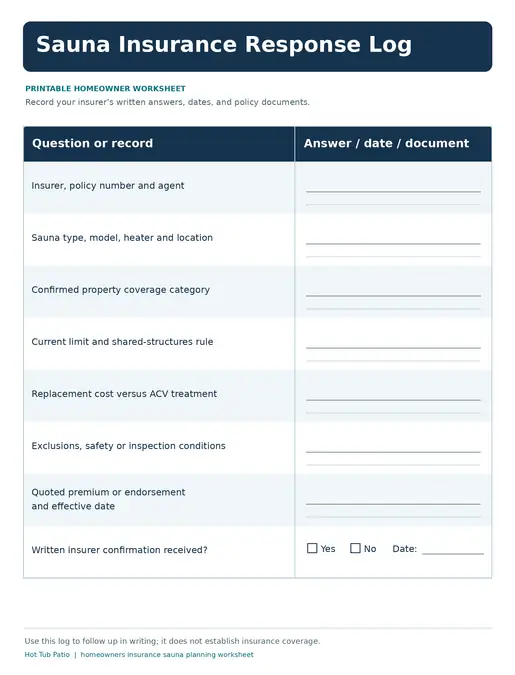
Keep your insurer’s answers together: Download the blank response-log image to print or fill out using your device’s image markup tools.
Download Printable Response Log (WEBP)If the image opens instead of downloading, use your browser’s Save image option. The worksheet does not confirm any insurance coverage; obtain an insurer’s written response.
Store policy and serial-number documents privately. A screenshot of a general insurer web page is not the same as a response about your specific property.
What If Your Insurer Declines or Limits Coverage?
Ask exactly what is being declined. Is the sauna itself ineligible, is the limit inadequate, or is an endorsement unavailable? The remedy depends on the reason. A limit shortfall may have a different solution from an insurer refusing a particular heater or a rented sauna.
- Request the applicable policy wording and any underwriting requirements in writing.
- Price an eligible alternative: a different location or heating system may change the review, but confirm that with the insurer before redesigning.
- Compare appropriate additional coverage or quotes from other insurers; do not assume the same requirements apply everywhere.
- Contact your state’s insurance department if you need help understanding consumer rights or a dispute with an insurer. The NAIC insurance overview provides a starting point for state-regulated coverage questions.
Do not omit the sauna from a later insurance application to obtain a lower quote. Describe the equipment accurately, provide requested documentation and wait for a written outcome.
Frequently Asked Questions
Does homeowners insurance automatically cover a detached sauna?
Not necessarily. Other-structures coverage is a common starting point, but the insurer must confirm that your sauna qualifies and that the applicable coverage, exclusions and limits meet your needs.
Do I need to tell my insurer before installing an indoor infrared sauna?
Ask before installation, particularly if it changes electrical wiring, home value or permanent fixtures. The insurer can explain its notification and documentation requirements.
Is there a standard premium increase for a backyard sauna?
No verified universal surcharge applies to all saunas. Ask for a written quote for your heater, site, insurer and policy rather than assuming a percentage from an unrelated hot-tub or wood-stove article.
Does a permit guarantee the insurer will pay after a fire?
No. A permit can document compliance with local requirements, but payment depends on the policy and facts of the covered loss. Obtain both installation records and written policy clarification.
Will homeowners insurance cover a portable sauna tent?
It might be assessed as personal property rather than a building, but classification and exclusions need to be confirmed. Ask specifically about the equipment and how a loss would be valued.
Can guests use my sauna under homeowners liability coverage?
Guest injuries may raise a personal liability or medical-payments issue, subject to the circumstances and policy. Paid access or rentals should be disclosed because business-use coverage may differ.
Before You Buy or Build: Get the Insurer’s Answer in Writing
The useful outcome is a documented decision, not a vague assurance that saunas are usually covered. Identify your equipment and location, verify the policy category, run the coverage-limit comparison, and ask for a written response about exclusions, valuation, liability and any required endorsements.
Once the agent confirms the details, keep that reply alongside your sauna purchase records, contractor invoices and permits. That folder will be more useful than a generic coverage percentage when you renew the policy or need to document a future loss.