Sauna Stones Guide: Types, Stacking, Replacement & Care

Sauna stones are not decorative gravel. In a traditional heater, they store heat, help distribute it, and create the familiar burst of steam when water meets the hot stone surface. The wrong size, damaged stones, or a tightly packed pile can restrict airflow around the heater.
Quick answer: Buy only the stone type, size, shape, and amount your specific heater manual permits. Check stones for cracking and crumbling, and re-stack them on the schedule your manufacturer recommends. Never collect random rocks outdoors or assume every heater accepts the same stones.
This sauna stones guide gives you a buying check, a safe restacking workflow, and an inspection log you can use before the next replacement. The manufacturer manual remains the controlling instruction for your model.
What Do Sauna Stones Actually Do?
Stones sit in the heater’s designated stone compartment. In many traditional electric heaters, heating elements warm the stones and the air moving through the heater. In wood-burning designs, the stove heats the stones through a different arrangement. Pouring a suitable amount of clean water over approved traditional heater stones produces löyly, the humid burst associated with Finnish-style bathing.
The stone bed also matters when no water is used. If fragments accumulate, air cannot move as designed. Harvia’s guidance links compacted stones and poor ventilation through the heater with slower heating and possible element overheating. See Harvia’s heater-stone care guide for the manufacturer explanation.
Infrared emitter panels are different from traditional stone heaters. Do not place rocks on infrared panels or pour water on them. If you are still comparing sauna styles, the sauna type selector explains the tradeoffs.
How to Choose the Right Sauna Stones
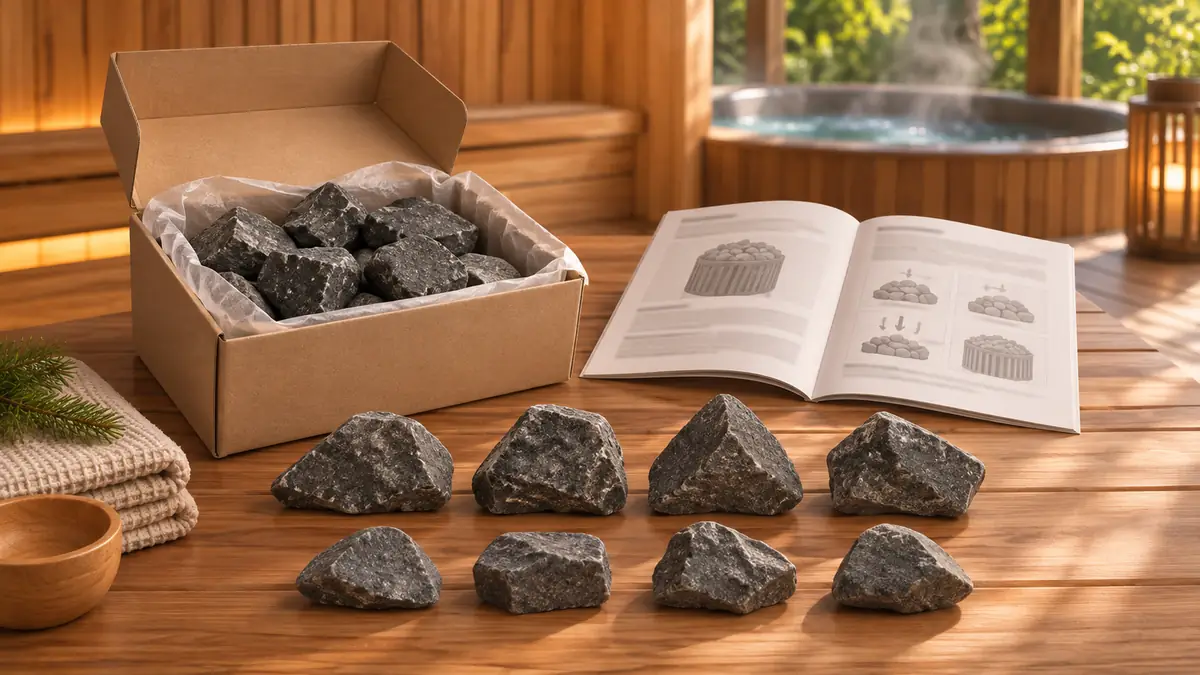
Start with your heater’s exact brand and model number, not an online listing labeled “universal sauna rocks.” The manual should specify the stone type or approved equivalents, the size range, the total stone quantity, and sometimes a required arrangement. These specifications differ among open-frame towers, wall-mounted electric units, and wood-burning stoves.
| Check | What to verify | Why it matters |
|---|---|---|
| Heater model | Photograph the model label or find the product manual | Prevents guessing from appearance |
| Stone size | Use the specified size range, not a nearby-looking substitute | Affects spaces for circulating air |
| Stone material | Check allowed stone types and any manufacturer restrictions | Not every rock tolerates repeated heating |
| Shape | Some models require a particular shape or layering method | The pile must suit the heater geometry |
| Quantity | Check the stated capacity or weight for that model | Too few or too many stones may cause problems |
| Water use | Verify whether this heater is designed for water on stones | Infrared units and other appliances are not interchangeable |
Common stone materials and finishes
Purpose-made heater stones include products sold as olivine diabase and other heat-resistant stone types. Manufacturers also sell rounded or specialty stones for selected heater designs. A polished-looking stone is not automatically suitable, and stones marketed for landscaping, aquariums, fireplaces, or outdoor fire pits are not replacements for manufacturer-approved sauna stones.
Harvia notes that some models, including its Spirit line, have specific rounded-stone requirements; other heaters require different sizes or heavy-duty grades. Its stone-selection and stacking guidance is useful as an example, but verify your own heater manual rather than applying Harvia instructions to another brand.
How to Stack Sauna Stones Without Blocking Airflow
This is a routine maintenance task only where the manufacturer permits owner handling. Before touching the heater, switch it off, follow the manual’s power-isolation instructions, and allow the entire heater and stones to cool completely. A stone that looks dark and cold can still retain heat. Never move stones while the unit is operating.
- Read the exact stacking diagram. Find any special directions for the stone sizes, lower layer, upper layer, or exposed heating elements.
- Remove the old stones carefully. Keep the heater off. Avoid striking elements, sensors, shields, or wiring. Stop if parts look damaged.
- Clear loose debris as permitted. Remove grit and broken fragments from accessible stone areas without opening electrical covers.
- Rinse accepted stones and let them dry. Use the cleaning method specified by the manufacturer. Discard cracked or visibly crumbling pieces.
- Arrange stones loosely and deliberately. Leave the required air spaces. Do not force stones into gaps or wedge them tightly against electric elements.
- Finish below the permitted fill profile. Do not build a decorative tower or load stones onto parts of the heater that are not designed to carry them.
- Inspect before restarting. Confirm no element is bent or displaced and no stone touches a prohibited component. Contact a technician when damage is visible.
Harvia’s guidance says stones should support each other rather than rest their weight on the heating elements. It also warns against a tall mound on top of the heater. These are useful general cautions, but the specific placement scheme in your model manual comes first.
When Should Sauna Stones Be Replaced?
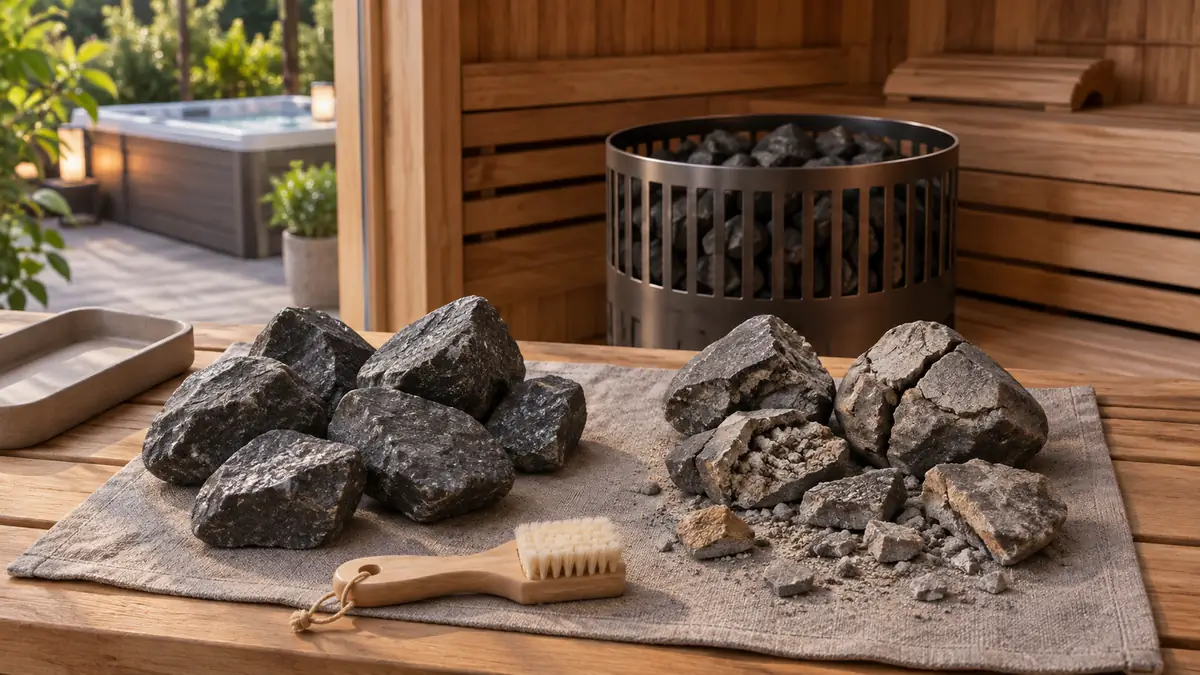
Replace stones because their condition or the manufacturer’s schedule calls for it, not because a fixed date magically makes all rocks unsafe. Visible splitting, gritty fragments, crumbling, substantial discoloration, and a stone bed that has settled tightly are all reasons to inspect. Do not keep cracked pieces merely because they still appear hot.
| What you notice | Possible meaning | Next step |
|---|---|---|
| Broken pieces or dust under the heater | Stones deteriorating with repeated heat cycles | Turn off, cool, inspect and replace damaged pieces |
| Stones have compacted or pile has sunk | Air passages may be restricted | Re-stack according to the manual |
| Some stones remain intact and clean | They may still be reusable if permitted | Inspect each one before returning it |
| Heating is uneven or slower than before | Stone packing is one possibility among several | Inspect the pile; if unresolved, follow heater troubleshooting guidance |
| Bent, scorched or visibly damaged element | Potential heater defect, not just old stones | Stop using it and contact authorized service |
How often is a sensible inspection interval?
A manufacturer can give a more useful interval than a generic blog. Harvia’s family-sauna FAQ gives an example of annual replacement when a sauna is used about twice weekly, alongside periodic restacking. Its broader maintenance advice recommends at least yearly restacking, with more frequent attention under heavy use. That is Harvia guidance, not a universal rule for every brand or commercial heater.
For a rarely used sauna, condition and the manual may matter more than a calendar. For a shared or commercial sauna with many daily heating cycles, maintenance may need to be more frequent. Record actual observations rather than assuming an advertised lifespan fits every heater.
Common Sauna Stone Mistakes That Cost More Later
- Buying by appearance alone: A stone can be attractive but incompatible with your heater.
- Using river or garden rocks: Unapproved stones may fracture under heat and are not a safe cost-saving substitute.
- Overpacking: A solid-looking pile can restrict airflow and increase stress on heater parts.
- Adding stones without clearing the bottom: Broken fragments can remain trapped beneath the new layer.
- Restacking a hot heater: Residual heat can burn even after the unit is turned off.
- Ignoring heating problems after maintenance: Stones are only one possible cause. Controls, sensors, heater sizing and electrical issues need their own checks.
If the heater is still underheating after properly approved stone care, see the separate infrared troubleshooting guide only for infrared models; a traditional electric heater requires a different diagnostic approach.
Sauna Stone Buying and Maintenance Worksheet
Use this worksheet before ordering stones. It is intentionally a blank record: the correct specification must come from the actual heater documentation rather than an estimated online number.
| Item to record | Your heater information |
|---|---|
| Brand and complete model | ____________________________ |
| Manual or manufacturer support link | ____________________________ |
| Approved stone type or product code | ____________________________ |
| Permitted size range | ____________________________ |
| Required quantity or weight | ____________________________ |
| Date last inspected | ____________________________ |
| Cracked or crumbled pieces found | ____________________________ |
| Next check based on manual and use | ____________________________ |
| Authorized service contact | ____________________________ |
For a full ownership budget, pair this record with the annual sauna maintenance cost worksheet. Stone replacement should be a separate maintenance line rather than an unexpected heater expense.
FAQs About Sauna Stones
Can I use any rocks in my sauna heater?
No. Use only the stone types and sizes approved for your particular heater. Ordinary decorative or collected rocks are not a reliable substitute.
Should sauna stones be packed tightly?
No. The manufacturer’s stacking pattern should preserve airflow and avoid stressing heating elements. Follow any model-specific exceptions.
Do I have to replace every stone each year?
Not necessarily. Check your manufacturer’s schedule and inspect each stone. Some heaters recommend a full scheduled replacement; other maintenance instructions permit retaining intact stones.
Can water be poured on any sauna stones?
Only if the heater is designed for that use and the manual permits it. Never pour water onto infrared emitters, electrical controls, or an appliance not designed for water.
Why is my sauna taking longer to heat?
Compacted or deteriorated stones can reduce airflow, but damaged elements, controls, ventilation or heater sizing can also contribute. Do not troubleshoot live wiring.
The Practical Next Step
Before buying a new bag of sauna stones, identify your exact heater model and read the stone-loading section of its manual. Choose the specified material and size, log an inspection date, and arrange qualified service if you notice damaged heating components. An orderly, compatible stone bed is more valuable than a taller or more decorative pile.