
Waterlogged Hot Tub Cover: Repair, Dry, or Replace?

A hot tub cover that suddenly feels too heavy can turn a quick soak into a two-person job. You might find a puddle on top after rain, notice one half sagging, or discover that the cover stays damp even on a dry day.
A waterlogged hot tub cover is usually worth replacing when the foam has become heavily saturated, the lid sags, or the cover no longer seals. Small exterior tears or an accessible vapor-barrier puncture may be repairable if the foam is still dry. Drying slightly damp foam is sometimes possible, but it is not a reliable quick fix for a badly waterlogged cover.
Before spending money, work through the inspection below. You’ll be able to distinguish surface water from moisture inside the foam and decide between a small repair, replacement cores, and a new cover.
First: Is Your Hot Tub Cover Actually Waterlogged?
A typical insulated spa cover has an outer jacket, rigid insulating foam panels, and a protective vapor barrier around the foam. The outer fabric or vinyl handles weather; the foam helps retain heat; the barrier limits moisture reaching the foam.
There are three situations that can look similar but need different responses:
- Surface water: Rain or melted snow is sitting on top. The cover returns to its usual feel after that water is removed.
- Normal underside condensation: Droplets collect under the cover because warm spa water produces moisture. Droplets alone do not prove that the foam is saturated.
- Internal waterlogging: Moisture has entered the foam or its protective wrapping. The cover stays unusually heavy after the outside dries, may sag, and can become difficult to handle.
Caldera Spas lists unusual weight, sagging, puddles, and a poor perimeter seal as reasons to consider replacement in its official cover replacement guidance.
Quick Clues You Can Check Without Forcing a Heavy Lid
Look for these signs before trying to move the cover:
- Persistent extra weight. It used to open easily; now you need help, even when the surface is dry.
- One half looks lower. A wet foam panel, bowed core, or broken core may be responsible.
- Rain pools in a depression. A bowed or damaged panel may no longer shed water.
- Gaps appear around the rim or center hinge. The cover may have lost its shape or no longer seal properly.
- The jacket has tears, cracked seams, or an open zipper. These create possible paths for moisture.
- A musty odor keeps returning. Moisture may be trapped, although odor alone cannot tell you whether the foam is saturated.
If the cover is too heavy to control safely, do not lift it alone or depend on the cover lifter to hold it. Arrange help from a dealer or service provider. Keep children and pets away from the spa whenever the cover is moved or removed.
Why Hot Tub Covers Become Waterlogged
The foam does not normally sit in direct contact with spa water. Problems begin when moisture gets past the layers that protect it.
The Foam’s Vapor Barrier Has Been Damaged
A small puncture, split seam, or aging protective wrap can admit water vapor and liquid moisture. Once water accumulates inside the protective system, the cover may get progressively heavier.
Hot Spring describes waterlogging as a sign of vapor-barrier failure in its spa cover replacement advice.
Sagging Creates a Place for Rainwater to Collect
Covers are normally shaped to shed water. A bowed or broken foam panel can form a dip that catches rain or melted snow. That extra load can worsen sagging and put stress on the hinge and jacket.
Do not stand on the cover to flatten a dip or push pooled water out. The extra load can damage the foam further.
The Outer Jacket, Stitching, or Hinge Deteriorates
Sun exposure, abrasion, repeated folding, and aging can damage the exterior. A small cosmetic crack is different from a failed center hinge or extensive split seams.
The material matters. For example, cleaning and conditioning instructions for vinyl and outdoor-fabric covers differ. Our hot tub vinyl cover buying and care guide explains those differences.
Heat, Moisture, and Poor Handling Add Up
Everyday steam exposes the cover’s underside to a warm, damp environment. Dragging a cover, pulling it by decorative handles, or leaving heavy objects on top can accelerate wear.
Proper chemistry, manufacturer-approved venting after chemical treatment, and gentle handling help protect the cover. They cannot reverse a foam core that has already absorbed substantial water.
Waterlogged Hot Tub Cover: Repair or Replace? Decision Matrix

Use the actual condition of the foam, outer jacket, hinge, and locks together. Repairing one small tear makes sense only if the rest of the cover is still doing its job.
| What you find | Best next step | Why |
|---|---|---|
| Rainwater on top; normal weight after drying | Remove surface water and monitor | Surface wetness is not the same as saturated foam |
| Condensation underneath; no extra weight | Clean/dry the accessible underside as the maker directs | Some underside condensation is normal |
| Small jacket tear; foam dry and cover sound | Ask about a compatible patch | Early repair may stop additional damage |
| Small accessible vapor-barrier puncture; foam still dry | Manufacturer-approved repair or new barrier | A sealed barrier helps protect otherwise sound foam |
| Slightly damp removable core; structure sound | Ask supplier about controlled drying and rewrapping | Recovery may be possible, but can take a long time |
| One foam panel saturated; jacket and hinge excellent | Compare replacement core plus new vapor barrier | Some covers allow component replacement |
| Persistently heavy, sagging, or deformed cover | Replace the cover | Lost shape and insulation can make repairs poor value |
| Cracked jacket, failed hinge, loose locks, and heavy foam | Replace promptly | Multiple failures affect fit, handling, and security |
Decision rule: The more problems you find beyond a single localized defect, the less sense it makes to spend on a partial repair.
This table is a decision aid, not a substitute for the cover manufacturer’s warranty or repair requirements.
Can You Dry Out a Waterlogged Hot Tub Cover?
Sometimes. The extent of the moisture damage changes the answer.
A cover that is wet only on the outside can dry normally. A removable foam insert with limited moisture exposure might be recoverable if its manufacturer approves the process and the vapor barrier is repaired or replaced.
America’s SPA-MART says drying a moisture-affected foam core can take a month or longer, and the core needs a new vapor barrier before being returned to service. Other suppliers recommend replacing heavily saturated cores instead of attempting to dry them. These positions are not necessarily contradictory: slightly damp, structurally sound foam is a different situation from foam that is badly saturated and falling apart. See SPA-MART’s cover care guidance.
When Drying May Be Worth Asking About
A controlled drying attempt may be reasonable only when:
- The cover maker permits removing the foam inserts without damaging the assembly or affecting warranty coverage.
- The foam is only mildly affected, still firm, and retains its original shape.
- The outer jacket, hinge, and stitching remain sound.
- You can arrange proper moisture protection for the spa while the core is out.
- A compatible replacement vapor barrier is available.
Ask the cover supplier what drying, handling, and rewrapping method they approve. Do not cut open a sealed foam pack or heat the foam with a space heater, heat gun, or other improvised heat source.
When Drying Is Unlikely to Be Worth It
Replacement is usually the better route when the lid has become extremely heavy, the foam feels saturated, panels are broken, or the cover has already sagged out of shape.
A sunny afternoon might dry the outer vinyl. It does not guarantee that moisture deep inside the foam has been removed.
Be wary of advice that promises to restore a fully waterlogged cover in a day or two. Even if some water escapes, an unrepaired vapor barrier lets the problem return.
Can You Replace Only the Foam Core?
For certain traditional zippered spa covers, yes. The foam inserts may be separate components that can be replaced without discarding the outer jacket.
But replacement cores are not universal. A successful repair requires the correct core shape, dimensions, taper, protective wrap, hinge construction, and compatibility with the existing cover.
A Foam-Only Replacement Makes Sense When
- The jacket is still flexible, clean, and intact.
- Zippers and seams work without tearing.
- The hinge and handles are structurally sound.
- Straps and locking hardware remain serviceable.
- The manufacturer or supplier offers matching cores and vapor-barrier protection.
- The total installed cost makes sense compared with a complete replacement.
A Full Cover Is More Sensible When
- The vinyl or fabric has become brittle or extensively cracked.
- The center hinge is torn or distorted.
- The old cover no longer sits flat on the spa.
- The skirt, stitching, and locking straps are all deteriorating.
- Only an improvised or poorly fitting replacement insert is available.
A core replacement can look less expensive until you include new barrier material, any shipping or labor, and the risk of damaging an old jacket during reassembly.
Before buying inserts, compare a written quote for the complete repair with a written quote for a new cover. Some manufacturers recommend full replacement once the existing jacket is older or worn, even if replacement foam is technically available.
Can You Patch the Cover Instead?
Patching works best when the damage is limited and the insulation behind it is still dry.
Small Tear in Vinyl or Fabric
Use only a patch or repair product approved for that specific cover material. Clean and dry the surface as directed, repair the tear, and inspect it again over time.
A patch can stop further surface damage. It cannot remove water already trapped inside the foam.
For material-specific cleaning before any repair, see our hot tub cover cleaner guide.
Small Tear in the Vapor Barrier
Some manufacturers permit a compatible barrier tape for small, accessible punctures before the foam becomes wet. Ask whether the original barrier can be repaired or needs replacement.
Never assume ordinary household tape restores the factory moisture seal. An old barrier with widespread pinholes may need complete replacement rather than a spot patch.
Broken Straps or Latches
Check whether the maker supplies approved replacement straps or locking hardware. Hardware repair can be sensible on an otherwise sound cover.
Until the locking components work as intended, do not treat the cover as secure. A standard insulated cover is not automatically a certified child-safety cover or a substitute for required barriers and supervision.
Tailored Action Plan: What to Do This Week
Choose the track that matches your cover, rather than ordering parts on the first sign of dampness.
| Your cover today | Action | What to avoid |
|---|---|---|
| Rain puddle, no lasting weight change | Remove surface water safely; inspect the contour | Assuming all puddles mean foam saturation |
| Minor tear, dry foam | Check warranty and use a maker-approved repair | Patching over hidden structural damage |
| Heavy but jacket looks good | Ask supplier to inspect/quote cores and barriers | Forcing the cover onto a lifter |
| Heavy and sagging | Plan for a correctly fitted new cover | Spending on repeated cosmetic repairs |
| Failed straps or weak hinge | Restrict access and arrange hardware/service evaluation | Relying on a damaged cover for safety |
| Poor fit after replacement | Recheck shell dimensions and supplier specs | Copying dimensions from a warped lid |
Cover Inspection Worksheet
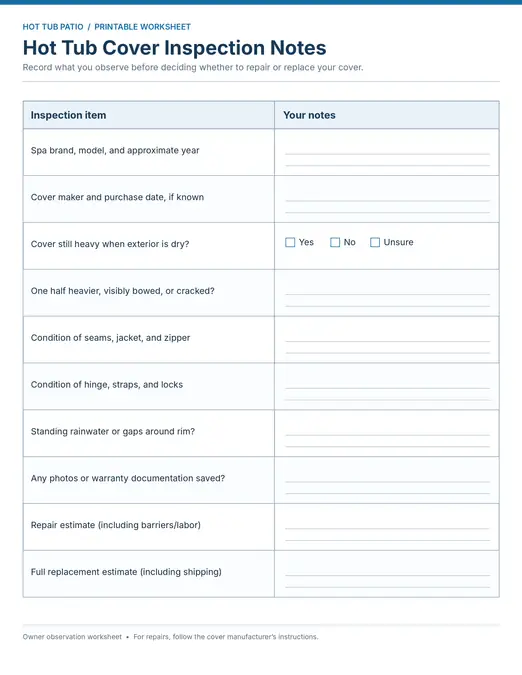
Free printable inspection worksheet: Save or print the one-page worksheet to record visible cover damage, foam condition, hinge and lock problems, warranty information, and repair-versus-replacement quotes. Use the completed worksheet when speaking with a cover supplier.
Free PDF · US Letter, one page. Check with your cover maker before opening, repairing, or replacing foam and vapor-barrier components.
| Inspection item | Your notes |
|---|---|
| Spa brand, model, and approximate year | __________________ |
| Cover maker and purchase date, if known | __________________ |
| Cover still heavy when exterior is dry? | Yes / No / Unsure |
| One half heavier, visibly bowed, or cracked? | __________________ |
| Condition of seams, jacket, and zipper | __________________ |
| Condition of hinge, straps, and locks | __________________ |
| Standing rainwater or gaps around rim? | __________________ |
| Any photos or warranty documentation saved? | __________________ |
| Repair estimate (including barriers/labor) | __________________ |
| Full replacement estimate (including shipping) | __________________ |
Five checks before deciding: Is the foam dry? Is the structure straight? Is the jacket sound? Do all locks work? Will the repaired cover fit and insulate reliably?
If any answer is unclear, ask the supplier for help before ordering parts.
Measuring for a Replacement Hot Tub Cover

An old cover that has warped or shrunk can give you the wrong dimensions. Start with the spa model and the actual spa shell when the old cover no longer fits.
What to Record Before Ordering
- Brand, model, and year, plus a photograph of the spa’s full top surface.
- Overall shape and size at the correct rim or lip specified by the cover supplier.
- Corner radius for rounded rectangles or other corner shapes.
- Fold direction, so the new cover opens away from the control panel and works with your available space.
- Skirt length, with the supplier’s definition of where it should hang.
- Hinge construction, cover taper, and thickness options appropriate for the spa and local weather.
- Strap and latch positions, including whether new hardware will need installation.
- Any unusual shape, speakers, raised controls, or cutouts that need a model-specific template.
Don’t add arbitrary inches or use a universal corner-radius formula. Suppliers specify their own measuring and manufacturing allowances.
SpaDepot recommends measuring the shell rather than a distorted cover and provides diagrams for corner radius, skirt length, and fold direction.
For a new cover, confirm the supplier’s current construction choices, warranty, compatible materials, and any model-specific installation requirements before ordering.
Check the Lifter Before You Replace the Cover
A waterlogged cover can overload a lifter that was designed for a normal-weight lid. Before attaching the replacement, check the lifter’s compatibility, capacity, mounting points, and clearance.
Our hot tub cover lifter comparison explains the major styles and fit considerations.
Can a Waterlogged Cover Raise Heating Costs?
It can. When the foam insulation is compromised or the lid bows away from the rim, the cover may lose heat faster.
A poor seal also allows more air and moisture to escape, which can increase the energy required to keep the water at temperature. That does not prove every high electricity bill is caused by the cover; outdoor temperature, spa settings, equipment condition, and usage also matter.
Replacing a damaged cover may improve heat retention, but the savings will vary by spa and climate. Avoid buying based on a seller’s guaranteed payback claim without reliable assumptions.
A floating thermal blanket is sometimes used as an additional evaporation barrier, but it does not repair saturated foam or replace the main insulated cover. See our thermal blanket guide for where that accessory fits.
How to Prevent Your Next Cover From Becoming Waterlogged
Good maintenance focuses on protecting the vapor barrier and structure rather than trying to keep every drop of condensation off the underside.
Clean It With the Right Product
Rinse away dirt gently and use cleaner approved for the cover material. Avoid abrasive scrubbing, high-pressure washing, or chemicals not recommended by the maker.
Hot Spring recommends gentle cleaning and explains material-specific care in its cover replacement and maintenance guidance.
Protect the Cover After Water Treatment
Follow your spa manufacturer’s instructions about ventilation after adding treatment chemicals. Do not close a cover prematurely when the product or spa instructions require ventilation, and never leave an uncovered spa accessible to children.
Remove Heavy Loads
Clear snow, leaves, and standing water in a way that doesn’t tear or bend the lid. Don’t sit, stand, or store equipment on it. Avoid dragging it across the patio or pulling it by fragile areas.
Watch the Hinge and Locks
Inspect zippers, seams, handles, hinges, and latches periodically. Address a small tear before it exposes the insulation. If any lock fails, repair it promptly and follow all separate child-access safeguards.
Watch for Repeat Mold or Odor
A musty surface doesn’t automatically mean the foam is waterlogged. Clean the cover with approved methods and assess whether the problem is recurring or coming from inside the assembly.
For that separate problem, our hot tub cover mold prevention guide explains cleaning and moisture-control steps.
Mistakes That Make a Bad Cover Worse
- Trying to dry a fully saturated core in direct heat. Surface drying and internal moisture removal are not the same thing.
- Patching only the exterior. If the protective wrap or foam has already failed, cosmetic repairs will not restore insulation.
- Buying foam without checking construction. Thickness, taper, and barrier protection all matter.
- Using a stronger lifter to compensate for water weight. Heavy covers can still deform hinges or strain mounting hardware.
- Ordering from the old lid alone. A warped cover may no longer match the shell.
- Ignoring a broken lock. Damaged latches are a security problem even if the foam remains dry.
Frequently Asked Questions
Can a waterlogged hot tub cover be fixed?
Minor exterior damage or a small accessible vapor-barrier tear may be repairable when the foam is dry. Heavily saturated, sagging, or distorted foam usually makes replacement more practical.
How do I know if the foam inside my spa cover is wet?
A cover that remains much heavier after its exterior dries, especially with sagging or poor fit, may have water in the foam. Have the supplier assess removable cores if the condition is uncertain.
How long does it take to dry a waterlogged cover?
There is no dependable quick drying time. SPA-MART says affected foam cores can take a month or longer to dry and need a replacement vapor barrier before reuse; heavily saturated cores may not be practical to recover.
Can I replace only one side of my hot tub cover foam?
Some covers use separate foam panels, but parts must match the cover’s shape, taper, and barrier system. Ask the manufacturer whether an individual replacement panel is offered and compatible.
Does condensation under the lid mean the cover is ruined?
No. Some condensation is normal over warm spa water. Persistent excess weight, sagging, or moisture inside the foam assembly is more concerning.
Will a thermal blanket fix a waterlogged cover?
No. A floating blanket may reduce evaporation, but it cannot dry saturated foam or repair a broken seal or hinge.
Should I measure the old cover when ordering a replacement?
Use the spa shell when the old cover is distorted or fits poorly. Confirm the supplier’s measurement method for the lip, corner radius, skirt, and fold direction.
Should I keep using a very heavy cover?
Do not force it or rely on a lifter that cannot support it. Ask for help with removal and replacement, maintain child-access precautions, and follow the spa manufacturer’s instructions while the cover is damaged.
The Decision to Make Before Spending Money
Start with one question: Is the problem only on the outside, or has the foam and structure failed?
Surface moisture and small early tears may call for cleaning or a compatible repair. A persistently heavy lid, a broken foam core, large gaps, or multiple failing parts usually points toward replacement.
Use the inspection worksheet, compare a full repair quote with the cost of a correctly fitted new cover, and check the manufacturer’s requirements before ordering. A cover that is easier to handle, seals properly, and keeps its insulation is a better outcome than another patch on a failing lid.