
Sauna Warranty Guide: Coverage, Exclusions & Claims

Two sauna sellers both promise a long warranty, but one covers replacement parts only while the other has different rules for controls, service labor and shipping. The difference may not be obvious until something stops working. A sauna warranty is useful only when you understand its actual terms for the exact model you are buying.
Quick answer: Most sauna warranties are written promises about specified defects, not unlimited protection against repairs. Cabin materials, heaters or infrared emitters, control electronics, lighting and accessories may each have separate terms. Check the start date, who qualifies, exclusions, claim process and who pays labor or freight before choosing a sauna.
This page focuses on comparing warranty contracts and making a claim. For the larger decision about type, space and budget, use the home sauna buying guide.
What Does a Sauna Warranty Cover?
Warranty coverage is usually organized around defects in materials or workmanship under stated conditions. The crucial words are which components, for how long, under which conditions, and what remedy. A marketing line such as “long-term protection” is not enough to answer those questions.
The Federal Trade Commission’s warranty guidance recommends examining coverage, length, claims arrangements, repair costs and the party responsible for honoring a warranty before buying. It also recommends saving the warranty and proof of purchase.
For example, an indoor infrared cabin may have one term for cabinetry and heaters, another for controls, and shorter coverage for audio or glass. A traditional heater may be separately warranted by its manufacturer even when a different company sold or assembled the cabin. That can create two contacts and two sets of conditions.
| Part or obligation | Questions the document must answer | Why it matters |
|---|---|---|
| Cabin, benches, wood | What counts as a defect? Are natural checking, cosmetic changes and weathering excluded? | Wood changes over time; cosmetic appearance is not the same as a structural failure. |
| Traditional heater or infrared emitters | Are heating elements covered? How do electric and wood-fired models differ? | Some terms exclude consumable components or assign them separate durations. |
| Thermostat, control panel and sensors | Are control electronics included in the same term as the heater? | A working cabin can still be unusable when controls fail. |
| Glass, door hardware, lighting and audio | Which accessories are listed by name? | Shorter or separate coverage is common in manufacturer policies. |
| Labor, testing, freight and service calls | Are diagnosis, technician travel, shipping and removal/reinstallation paid? | A free replacement part does not necessarily mean a free repair. |
| Remedy and claim response | Repair, replacement or refund? Who approves the claim? | The warrantor’s duty may be narrower than the buyer expects. |
How Actual Manufacturer Warranties Differ
Consider two current manufacturer examples as evidence of why the full document matters, not as a recommendation to purchase either brand.
Example: Sun Home Saunas
Sun Home’s published warranty policy separates component terms by product line and by residential versus commercial use. In its terms for certain models purchased on or after March 2, 2026, it describes limited lifetime coverage for some cabinetry and heater components, shorter periods for controls and accessories, and a limited window for included labor and shipping. It defines “limited lifetime” for specified components rather than using the consumer’s lifetime.
The same policy says coverage may depend on original ownership, proper installation, correct electrical supply and other model-specific conditions. Earlier orders have different terms, which is why a product name alone cannot tell you which contract applies.
Example: Finnleo and Harvia
Finnleo’s warranty registration page asks eligible purchasers to submit a form within 60 days of original installation and says its stated warranty is non-transferable. Its eligibility language also references authorized sellers, proper installation, maintenance and residential use.
Harvia provides a separate official warranty portal with detailed terms applicable to the product and region. The published warranty documents discuss use and maintenance instructions, approved heater stones, wear parts and other exclusions. Read the current regional version and model manual rather than borrowing a warranty period from another market.
Source check: These are examples of policies available at the time of this article’s preparation in November 2026. Manufacturer terms, product lines, regional rules and purchase-date cutoffs can change. Obtain the exact version offered at checkout.
What Does a Limited Lifetime Sauna Warranty Mean?
“Limited lifetime” does not automatically mean every repair is free as long as you own the sauna. The written warranty may define the product’s expected usable lifetime, cover only particular components, limit eligibility to the first owner, or exclude certain service expenses.
In the United States, the FTC’s federal warranty guidance explains the distinction between written warranties designated “full” and “limited.” The label “limited” tells you that at least one standard for a full warranty is not met; it does not, by itself, describe the exact duration or every exclusion.
- Find the written definition of “lifetime,” if the warranty uses that word.
- Identify the covered parts and their separate expiration dates.
- Confirm whether replacement parts, labor, diagnostics and freight are included.
- Read how the document addresses original owners, business use and transfers.
- Ask what happens if an identical replacement part is discontinued.
Federal warranty rules and state consumer-rights laws may provide protection beyond the wording of a particular limited warranty. This article is a shopping checklist, not an interpretation of your legal rights in a specific dispute.
Exclusions and Costs Buyers Often Miss
Many problems that occur during ownership are not necessarily manufacturing defects. The exact line between normal wear and a covered failure must come from the applicable document and, if disputed, relevant law.
Wear, weather and wood
A cabin warranty may distinguish natural wood movement, minor surface checking or color variation from structural defects. Outdoor exposure, standing water, failed site drainage and misuse may appear in exclusions. Look for restrictions that apply to indoor models installed near showers or other moisture sources.
Improper installation or electrical supply
Manufacturers may condition coverage on following the installation manual, keeping required clearances and using the electrical setup specified for the model. A seller’s assurance that “any outlet will work” is not a substitute for the nameplate and instructions. Our sauna electrical requirements guide explains how to gather the right specifications for a qualified electrician.
Labor, freight and the hidden repair bill
A replacement control unit might be supplied free of charge, yet the owner may still be responsible for a technician’s visit or shipping after a certain date. Ask for the breakdown before paying a deposit; a parts-only warranty may be a reasonable offer, but it should not be confused with complete service coverage.
For planning what routine ownership costs may include beyond warranty coverage, see the sauna maintenance cost breakdown.
Does a Sauna Warranty Transfer to a Second Owner?
Do not assume it does. Finnleo and Sun Home publish terms limiting the referenced warranties to an original purchaser. A seller might also advertise an aftermarket service plan, which is a different agreement from the manufacturer’s warranty.
Before buying a secondhand unit, request the exact model number, purchase date and original sales receipt, then ask the manufacturer in writing if any coverage can transfer. Do not treat an unexpired sticker or a seller’s recollection as proof.
Our used sauna inspection and purchase guide covers inspection and safe transfer questions, which are separate from warranty-contract interpretation.
Registration, Maintenance and Warranty Eligibility
First identify which step is mandatory in the written terms. Some manufacturers ask for prompt registration, others may use a purchase record, and the applicable legal effect of registration requirements can depend on jurisdiction and the circumstances. Keep the receipt even after registering.
- Download or photograph the current warranty terms and the model’s installation manual before purchase.
- Record the exact cabin and heater model numbers plus serial numbers after delivery.
- Save the invoice, delivery date, dealer details and installation/inspection documents in one folder.
- Complete any stated registration step or contact the manufacturer for clarification if eligibility is unclear.
- Keep dated maintenance records where the instructions require routine care.
- Before altering wiring, controls, heating elements or wood finishes, check manufacturer instructions and seek qualified advice.
Warranty conditions should not encourage unsafe troubleshooting. Never disassemble electrical equipment just to produce evidence for a claim. The sauna heater troubleshooting guide explains which external checks are appropriate and when a technician is needed.
How to File a Sauna Warranty Claim
A good claim starts with the right recipient and a clear record. The seller, manufacturer and installer may have different duties. Check the current written warranty for its contact channel and requirements instead of sending the claim to every company at random.
- Stop unsafe operation. If a heater, wiring, door or control behaves abnormally, stop use and follow the owner’s safety instructions. Do not bypass any safety device.
- Locate documents. Find the receipt, model and serial numbers, warranty version and relevant installation records.
- Document symptoms. Note when the problem began, what happens, and any visible condition you can photograph without opening energized equipment.
- Use the stated claim channel. Ask who will determine eligibility and who coordinates diagnosis or authorized service.
- Request the total proposed cost in writing. Clarify parts, labor, shipping, removal, inspection and any deductible or service charge.
- Keep correspondence and resolution records. Note what was approved, the dates, and the effect of any replacement on remaining coverage.
If a company refuses coverage, ask for the specific written clause and factual reason. For US consumer purchases, the FTC’s consumer warranty resource explains possible complaint and consumer-protection routes. Requirements and remedies vary by location.
Sauna Warranty Comparison Worksheet
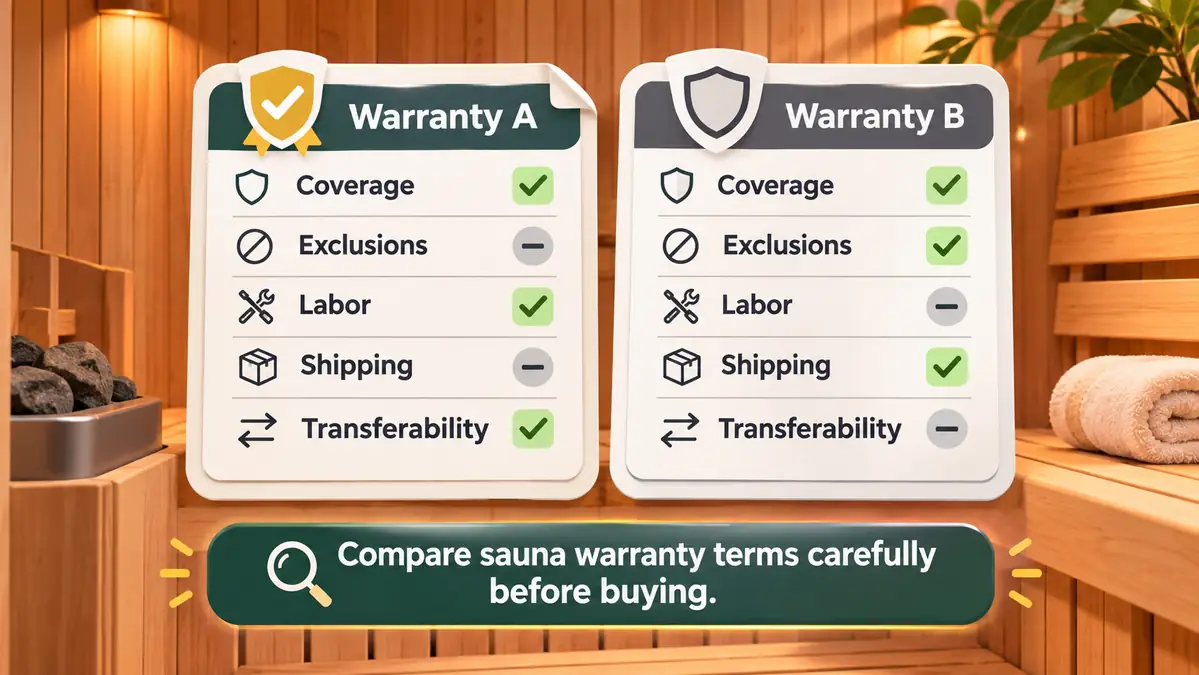
The decision is clearer when two offers are assessed against identical questions. This original worksheet helps you record what the documents actually promise; it is not a hidden scoring system that declares one warranty better without considering the product, buyer and region.
Compare Two Sauna Warranties
Copy the actual written terms from each product into the fields. Leave a field blank if the seller has not documented it. This worksheet does not decide legal rights or guarantee a claim.
Option A
Option B
Entries stay in this page until downloaded or printed; the worksheet does not send entries to the site. Avoid sensitive information.
Prefer paper? Download the blank three-page comparison worksheet and fill it out using the written warranty terms for each model.
Questions to Ask Before Paying a Sauna Deposit
- Can you send the warranty PDF or full policy for this exact model and purchase date?
- Does it cover the cabin, heater, control panel and door hardware for different periods?
- Who handles a broken heater when the cabin and heater come from different companies?
- If a covered part fails, who pays for diagnosis, shipping, technician travel and labor?
- Are installation, electrical work or a specific dealer required for eligibility?
- Is residential use required? Would short-term rental, commercial or shared use change the terms?
- Is the warranty transferable, and how do I register or prove ownership?
- If a part is discontinued, what replacement, repair or refund terms apply?
- Will you put any extra dealer or installer promises in the sales contract?
Compare the answers alongside total purchase and installed cost. A longer headline warranty does not automatically compensate for an unsuitable heater, missing parts support or installation expenses. Our home sauna cost guide helps make that wider budget explicit.
Sauna Warranty FAQs
Does a sauna warranty usually cover heater stones?
Do not assume so. Some manufacturer documents classify stones as wear items or require approved stones to be used. Check the heater-specific policy and instructions rather than relying on the cabin warranty.
Will a warranty pay for an electrician or service visit?
Not always. Parts, labor, diagnostics, shipping and travel can have different terms or exclusions. Ask for the written division of responsibility before purchase and again before authorizing a repair.
Does registering a sauna extend its warranty?
Some warranty programs use registration for eligibility or a stated extension, but rules vary. Finnleo publishes a registration deadline on its policy page. Check your exact brand and regional terms.
Can I get warranty service after buying a used sauna?
Only if the applicable warranty, seller agreement or law provides a route. Many manufacturer warranties are limited to the original buyer, so get a direct written answer before relying on coverage.
What if the seller and heater manufacturer disagree?
Keep the purchase contract, manuals and communications together. Ask each company to identify its contractual responsibilities in writing, and consult a local consumer-protection resource if the dispute is not resolved.
The Best Warranty Is One You Can Actually Use
Before paying, choose a specific sauna model, obtain its current written warranty and fill the worksheet using confirmed terms. Pay particular attention to heater coverage, labor, freight, ownership and exclusions. Those details make a promise useful when something fails; a large “lifetime” label by itself does not.