

How Often Should You Use a Sauna? Frequency, Recovery & Safety

Your gym has a sauna, and you like the feeling of winding down after a workout. Should you use it every day, stick with weekends, or leave rest days between visits? The answer depends on how you tolerate heat, what else your body has done that day, and any medical factors that change the risk.
Quick answer: There is no proven best number of sauna sessions per week for everyone. A beginner can consider a modest, short-session routine and reassess after each visit rather than aiming for daily use. More frequent bathing appears in long-term Finnish health studies, but those observational findings are not a prescription. Skip sessions when you are unwell, dehydrated, unusually fatigued or experiencing warning symptoms.
This guide focuses on how often you should use a sauna across a week, not on pushing the temperature or stretching out a single session. Use the editable seven-day tracker below to record what fits your schedule and how you feel afterward.
How Often Should You Use a Sauna? Start With a Sustainable Routine
If you are healthy, accustomed to heat and comfortable afterward, a few weekly visits may fit your routine. A first-time user should be more cautious. Some people prefer one visit; others make sauna part of a regular social or relaxation habit. Neither frequency is automatically a medical treatment.
Make a distinction between planned sessions and completed sessions you recovered from comfortably. A plan for Tuesday and Saturday is not a promise that both days will be suitable when they arrive. Exercise, hydration, illness, weather, medication changes and the sauna’s temperature can change your tolerance from one visit to the next.
The Cleveland Clinic’s sauna safety guidance recommends listening for weakness, dizziness, breathing difficulty and discomfort; it also advises newcomers to keep sessions brief. That is more useful than forcing a weekly quota. For session length rather than frequency, use our sauna duration guide.
Once, Twice, Three Times or Every Day? Compare the Tradeoffs
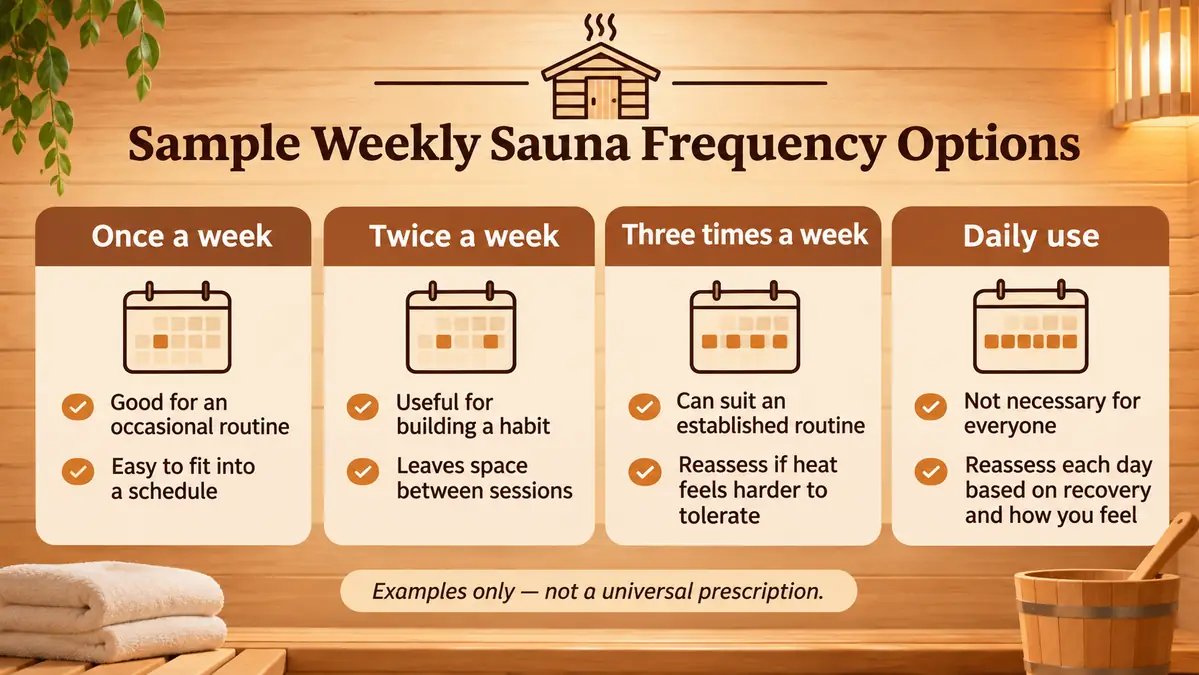
| Weekly pattern | Why someone might choose it | Main check before the next visit |
|---|---|---|
| Once a week | Easy to fit around work or a shared sauna schedule; room to learn personal tolerance | Did the single session feel comfortable, including afterward? |
| Twice a week | Allows time between planned visits for someone establishing a routine | Did exercise, sleep and hydration change between visits? |
| Three times a week | May suit an established routine when heat remains comfortable | Are sessions becoming longer or hotter just to meet a target? |
| Four to six times a week | A frequent habit for some experienced sauna users; not proven necessary | Can heat exposure still fit alongside recovery and medical needs? |
| Every day | A cultural or personal preference for some; not a research-validated goal | Does each day’s condition justify another session, or should it be skipped? |
The rows are routine options, not recommended doses. The real decision is how much heat you can tolerate comfortably within your medical circumstances and the manufacturer’s instructions. More visits do not make overheating, dehydration or symptoms acceptable.
There is also no reason to double the length of one session just because you missed another. If you skipped a day, leave it skipped. The sauna safety checklist is a better reference for safety questions than any generic number-of-days rule.
What the Research Says About Sauna Frequency
The Finnish observational studies
A widely cited 2015 Finnish cohort study in JAMA Internal Medicine followed 2,315 middle-aged men. Researchers grouped participants by self-reported sauna use: once a week, two to three times a week, and four to seven times a week. More frequent sauna use was associated with lower cardiovascular and all-cause mortality over follow-up.
This is an association, not proof of cause. People reporting frequent sauna use may differ in health status, social behavior, exercise, diet and other factors that a statistical adjustment cannot fully remove. The study also focused on men in Finland with established traditional-sauna habits; it cannot provide a personalized weekly schedule for beginners, women, or people using infrared cabins.
A separate 2018 Finnish study involving men and women also reported a frequency-related association with cardiovascular mortality. It broadened the participant group, but it remained observational. Neither study randomly assigned people to an everyday-sauna habit and proved the habit caused a longer life.
What randomized studies can and cannot establish
A 2025 systematic review and meta-analysis of 20 randomized trials evaluated repeated passive-heating interventions, including sauna, hot-water bathing and other forms of heating. Most pooled cardiometabolic outcomes did not show statistically significant improvements. Some subgroup findings for systolic blood pressure looked promising but came with limitations and heterogeneity.
Because the trials mixed heating methods and protocols, they do not settle an exact sauna frequency either. The evidence does not support telling every reader to use a sauna four to seven times weekly to prevent disease. Relaxation and personal enjoyment can be valid reasons to use a sauna, without making unsupported health promises.
A Beginner’s Weekly Sauna Routine: An Adjustable Example
For a healthy adult with no known reasons to avoid heat, an example is to consider one short visit, note how you feel during and afterward, and only consider another day if the first was comfortable and your circumstances allow it. A two-day plan with space between sessions can be a convenient scheduling illustration, not a validated medical protocol.
- Before the first visit: read the sauna’s instructions, check how you feel that day and avoid alcohol. Do not start while feverish, ill or dehydrated.
- During the visit: start conservatively, choose a tolerable heat level and leave promptly if you become weak, dizzy or uncomfortable. New users may begin with around five minutes according to Cleveland Clinic guidance; that is not a guarantee of safety.
- Afterward: cool down gradually, rehydrate as appropriate and note your energy, comfort and any unusual symptoms.
- Before a second session: review the first visit. If symptoms occurred or something medically relevant changed, do not simply repeat it or increase the heat.
- After a week: keep, reduce, pause or reconsider the schedule based on tolerance and circumstances. Missing sessions is not failure.
A sauna should fit your week, not determine it. The tracker below can record each visit without pretending to prescribe the ideal number.
Is It Safe to Use a Sauna Every Day?
Daily sauna bathing is practiced by some people, but ‘daily’ does not mean ‘safe for everybody.’ Tolerance depends on the sauna type, temperature, session length, hydration, medical conditions, medications and other heat exposures on the same day. A healthy experienced user who feels comfortable still needs to reassess rather than assume yesterday’s tolerance carries over unchanged.
There is no good evidence that skipping a day cancels the benefits of a comfortable routine. Do not turn a relaxation habit into a challenge to endure increasing heat. A frequency count cannot tell whether an individual session was safe.
People with cardiovascular disease, blood-pressure problems, conditions affecting sweating or heat tolerance, pregnancy, or medications affecting hydration or blood pressure should seek individual medical advice before adopting frequent sessions. More broadly, Cleveland Clinic advises speaking with a healthcare professional when relevant medical conditions are present.
Do You Need Rest Days Between Sauna Sessions?
Research has not established a universal mandatory number of rest days between saunas. That is different from saying recovery does not matter. Heat exposure can add to fluid loss and leave someone feeling tired, lightheaded or uncomfortable, particularly after exercise, hot-weather activity or another heat session.
Consider a day off when you have unusual fatigue, trouble replenishing fluids, lingering discomfort, poor sleep, illness or a demanding day that already involved significant heat. If you repeatedly become dizzy, faint, experience palpitations or feel unwell, stop and seek medical assessment rather than using ‘rest days’ as an untested fix.
Track the situation that preceded the session, not only its duration. For hydration questions, our sauna and electrolytes guide explains why individual sweat loss matters more than blindly adding drinks or supplements every sauna day.
Sauna Frequency After Workouts: Avoid Adding Stress Automatically
The workout you have just finished changes the decision. A short, easy session after light activity may feel different from adding heat immediately after intervals, a long run or strenuous work outside. More frequent sauna use is not a substitute for adequate rest, food, fluids and training recovery.
Before entering, check whether your heart rate has settled, you feel steady on your feet, you have cooled down enough and your hydration is reasonable. Do not use the sauna to compensate for a missed workout or assume sweating means more muscle recovery.
The sauna before or after workout guide addresses timing and post-exercise warning signs in more depth. On a day when training has already taken a lot out of you, a sauna-free evening can be the more sensible choice.
Traditional vs. Infrared Sauna: Can You Copy the Same Weekly Schedule?
Many traditional Finnish saunas heat the room air to higher temperatures than many infrared cabins, while infrared systems create a different combination of air temperature and radiant heat. Model design, ventilation, time inside and the individual user still affect the total heat load. A lower thermometer reading is not proof that longer or more frequent exposure is harmless.
The famous Finnish frequency findings largely reflect traditional sauna bathing. They should not be converted into a specific infrared schedule or a recommendation to stay in infrared heat longer. Follow the infrared sauna guide and your exact manufacturer’s instructions rather than treating all devices as equivalent.
For any sauna type, adjust to your actual response and stop when you feel unwell. A weekly number without information about conditions, symptoms and time inside is too crude to compare exposures.
Signs You May Be Using the Sauna Too Often
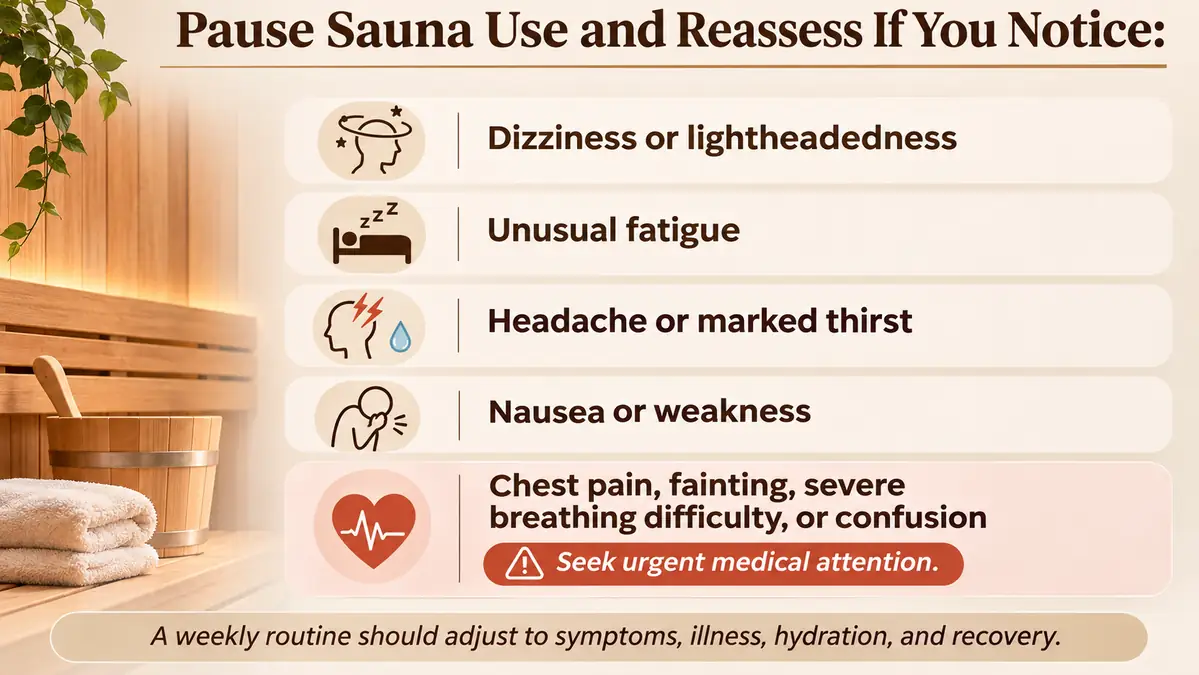
There is no diagnostic ‘too many sauna days’ threshold. The concern is symptoms and context, especially if you are repeating sessions despite feeling worse. Watch for these patterns:
- Dizziness or lightheadedness while sitting, standing or cooling down.
- Unusual fatigue that does not improve as expected, especially when heat is added to hard exercise.
- Headache, marked thirst or reduced urination that could suggest inadequate fluid replacement or another issue needing evaluation.
- Nausea, weakness or feeling excessively hot during a session.
- Chest pain, fainting, severe breathing difficulty or confusion, which require urgent medical attention.
If you feel dizzy or unwell, leave the sauna, move to a safe cooler place and seek appropriate medical advice; do not keep using the sauna to ‘train through’ symptoms. Serious symptoms need urgent medical attention. The dizziness after sauna guide explains common causes and why repeat episodes deserve assessment.
Interactive 7-Day Sauna Frequency & Recovery Planner
Use this original worksheet to compare the schedule you planned with the sessions you actually completed. You can log minutes, comfort, fatigue, dizziness and hydration or recovery notes. It will warn you when a recorded symptom calls for pausing rather than increasing frequency.
The Download 7-day log (CSV) button exports the entries for your own records. It is not a clinical screening tool, and a ‘comfortable’ selection does not guarantee that continuing the same routine is safe.
7-Day Sauna Frequency & Recovery Planner
Choose session days, then record what actually happened after each visit. This planner does not recommend a number of days or prove that longer sessions are safer or more beneficial.
Days are labels only, not scheduled notifications. Information stays in this browser page until you leave or export it; no entries are sent to the website.
Monday
Tuesday
Wednesday
Thursday
Friday
Saturday
Sunday
Safety: If dizziness or feeling unwell happens, stop sauna use and seek appropriate medical advice, especially if symptoms recur. Chest pain, fainting, severe breathing difficulty or confusion call for urgent medical attention. A log is not an assessment of medical fitness or a safety clearance; never increase frequency just to reach a number.
How to Use Your Weekly Log to Make a Decision
At the end of the week, read your notes before looking at the session count. If one visit felt comfortable and another left you unusually tired, the useful question is what changed: the workout, air temperature, session length, hydration, sleep, recent illness or medication. This is a prompt to review circumstances, not evidence that any one factor caused the symptom.
| What the log shows | Reasonable next step |
|---|---|
| Sessions felt comfortable and no safety concerns are known | Keep a manageable routine if you want; no need to increase solely for a target. |
| A planned session was skipped because of illness, fatigue or dehydration | Keep it skipped; do not make it up with a hotter or longer session. |
| A completed session left you unusually tired | Consider a break and reassess. Seek medical advice if the symptom persists. |
| Dizziness, feeling unwell or repeated concerning symptoms | Pause sauna use and seek medical assessment. |
| Chest pain, fainting, severe breathlessness or confusion | Seek urgent medical care rather than relying on the log. |
A simple log is more useful than a generic ‘seven-day transformation’ challenge because it records what the reader actually experienced. Do not use it to infer that sauna has treated a condition or to change medical advice.
Who Should Speak With a Healthcare Professional Before Regular Sauna Use?
Medical suitability is not determined by age or fitness alone. Get personalized guidance if you are pregnant; have cardiovascular or significant blood-pressure issues; experience recurrent fainting or dizziness; have an illness affecting temperature regulation; or use medicines that alter blood pressure, sweating, alertness or fluid balance.
Avoid sauna use with fever or acute illness, when significantly dehydrated, or after drinking alcohol. Check any recent surgery or other treatment restrictions directly with the relevant clinician. The sauna safety overview provides general warning signs, but it cannot replace an individual assessment.
A clinician may ask what type of sauna you use, how hot it is, how long you stay, when symptoms occur and which medicines you take. A factual symptom log is more helpful than saying only that you sauna ‘often.’
Common Weekly Sauna Routine Mistakes
- Copying a Finnish study group as a prescription. Participants’ self-selected frequency categories were observational, not a randomized treatment dose.
- Increasing time and frequency simultaneously. You lose track of which exposure changed and may increase heat stress.
- Ignoring the workout before the sauna. A hard training day can change hydration and fatigue even when the sauna settings stay the same.
- Counting sweat as progress. Sweat primarily helps regulate temperature; it is not a scoreboard for detox, fat loss or longevity.
- Trying to make up a missed session. A schedule should accommodate normal life rather than reward overexposure.
- Keeping the plan despite symptoms. Warning signs override any calendar target.
For a calm evening habit, our sauna before bed guide discusses wind-down routines and why direct sleep-benefit claims need caution. Keep the weekly plan focused on what you can comfortably sustain.
Frequently Asked Questions About Weekly Sauna Use
Is two or three times a week enough?
It can be a practical routine for someone who enjoys the sauna and tolerates heat. There is no verified minimum weekly count required for relaxation, and research does not establish two or three sessions as a medical dose.
Is a sauna every day better than once a week?
Finnish observational studies found favorable associations in groups reporting more frequent traditional-sauna use, but they did not prove that daily sessions are better for any particular individual. Safety and personal circumstances matter more than matching a study category.
Can I use a sauna on consecutive days?
Some experienced users do. Consecutive days are not automatically safe or unsafe; the decision depends on health status, heat exposure, recovery and any symptoms. Skip a session if you are unwell or depleted rather than treating a streak as necessary.
Should I use the sauna twice in one day?
There is no established general health benefit from doubling daily sauna visits. Repeated heat exposure can add to fluid loss and discomfort. Avoid stacking sessions simply to increase a weekly number, especially when you have exercised hard or felt unwell.
Does a five-minute sauna session count?
A short visit can still be a chosen sauna experience. There is no medically validated minimum number of minutes that makes a session ‘count.’ Newcomers may prefer a short visit to assess comfort; leave earlier if needed.
Should I change my routine in hot weather?
Hot ambient conditions and outdoor activity may increase overall heat stress. Consider shorter or fewer visits, or skip the sauna when you already feel hot, tired or dehydrated. For seasonal considerations, see our hot-weather sauna safety guidance.
Choose the Week That Fits Your Body, Not a Study Category
The best practical schedule is one you can reconsider when conditions change. Select days that fit your life, keep individual sessions conservative, note your response, and treat warning signs as a reason to stop rather than push through.
Long-term population studies are worth understanding, but they do not prescribe a universal number of weekly sessions. Your next useful step is to record a week of planned and completed visits, then decide whether the routine remains comfortable and appropriate for your health.