

Sauna Electrical Requirements: 120V vs 240V, Breakers & Planning

There is no universal electrical setup for a home sauna. Some infrared cabins are designed for 120V power, while other infrared models and many traditional electric sauna heaters use 240V. The exact voltage, circuit, connection, controls, and installation requirements come from the specific sauna or heater you buy.
The most useful planning step is to check the sauna electrical requirements before ordering. Download the current manual, identify the exact model, and have the planned location evaluated when new electrical work is involved. That can prevent buying a sauna that fits the room but creates an unexpected electrical project.
Manufacturer specifications checked October 14, 2026. The examples below use current Sunlighten, Clearlight, and Harvia product information to show how requirements vary by model. They are examples for planning, not universal wiring instructions.
What Electrical Requirements Does a Home Sauna Need?
A home sauna’s electrical needs can depend on the sauna type, heater output, voltage, controls, optional accessories, and the electrical system already available at the property.
Before deciding where the sauna will go, collect these specifications:
- Sauna manufacturer and exact model
- Heater manufacturer and exact model
- Rated voltage
- Rated watts or kilowatts
- Rated current when published
- Manufacturer circuit requirement
- Plug/receptacle or fixed-connection requirement
- Controller, sensor, lighting, and accessory requirements
- Indoor or outdoor installation location
The exact model matters more than a broad label such as “infrared sauna” or “traditional sauna.” Two models from the same manufacturer can use different electrical supplies.
If the heater itself has not been selected yet, the sauna heater guide explains the main heater choices before you plan the electrical side.
120V vs 240V Sauna: What Changes?
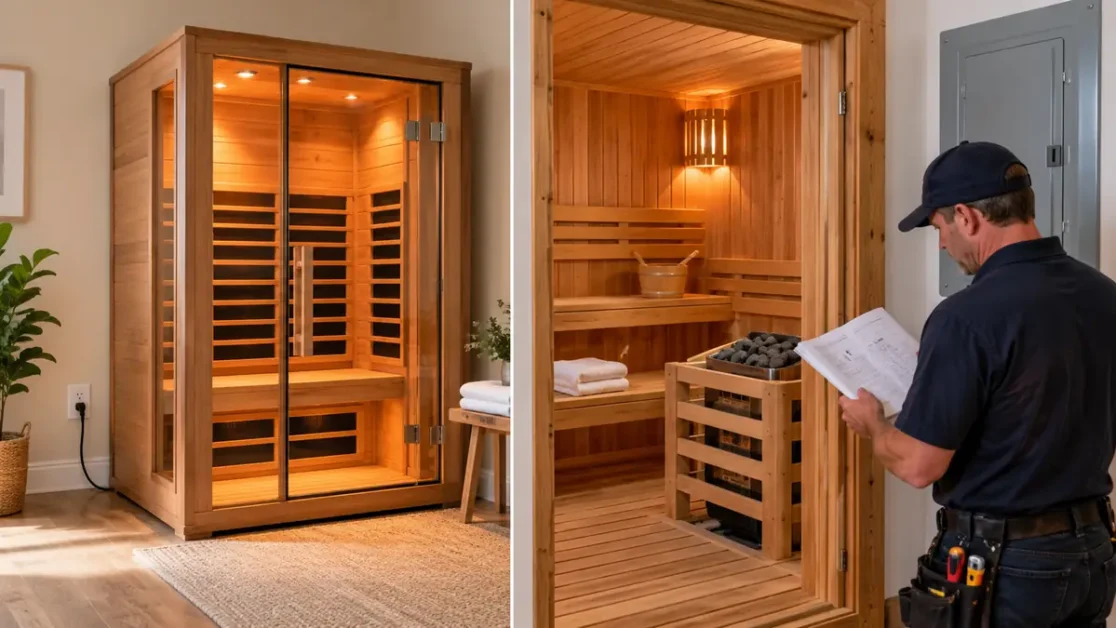
For a homeowner, the practical difference between 120V and 240V is not simply “small sauna versus big sauna.” It is the electrical supply the specific equipment was designed to use and what work is required to provide that supply safely.
A 120V sauna may be designed to connect through a receptacle, but that does not automatically mean any convenient household outlet is suitable. The manufacturer may specify a dedicated circuit and a particular receptacle.
Sunlighten’s current Signature I specifications, for example, list 120V, 1,350W, and a dedicated 20A circuit with a NEMA 5-20 connection. Its larger Signature III remains a 120V model while listing 2,250W and the same dedicated 20A circuit requirement.
Infrared systems can also use 240V. Clearlight’s current electrical-requirements page lists several Sanctuary models at 120V and several others at 240V, with requirements changing again when certain upgrades are added.
Traditional electric heaters commonly use 240V in North American residential applications. Harvia’s current KIP80B product page, for example, identifies that exact 8 kW household heater as 240VAC single phase and publishes model-specific electrical data.
| Current manufacturer example | Published supply | What it demonstrates |
|---|---|---|
| Sunlighten Signature I | 120V, dedicated 20A circuit | A 120V sauna can still require a dedicated circuit |
| Sunlighten Signature III | 120V, dedicated 20A circuit | A larger infrared cabin does not automatically mean 240V |
| Clearlight Sanctuary 3 | 240V | Infrared cabins can also use 240V |
| Harvia KIP80B | 240VAC single phase | Traditional heater requirements are published by exact model |
Use this table to understand the variation, not to choose a circuit for a different sauna.
How to Read a Sauna Electrical Specification Sheet
The specification sheet and installation manual are the starting point for an electrical quote. Look for the following fields before contacting an electrician.
Supply Voltage
Confirm whether the product is designed for 120V, 240V, 208V, or another supply. Do not assume an international version uses the same electrical configuration as the North American model.
Rated Power
Infrared cabins may list watts, while traditional heaters commonly list kilowatts. Power helps describe the load, but it is not a complete circuit specification on its own.
Rated Current
Some manufacturers publish amperage directly. When only watts and volts are provided, basic electrical math can help you understand the approximate current: watts ÷ volts = amps. Use that calculation for understanding only. It does not replace the manufacturer’s circuit requirements or an electrician’s final design.
Circuit and Connection Requirements
Look for language such as dedicated circuit, receptacle type, plug type, fixed connection, power unit, or separate control system. If the manual specifies a particular electrical arrangement, do not substitute a generic internet chart.
Controls, Sensors, and Accessories
The heater may not be the only electrical component. A sauna system can also include an external control panel, power unit, temperature sensor, safety sensor, lighting, Wi-Fi controller, or manufacturer-approved accessories. These need to be included in the planning before walls or finishes are closed.
The broader sauna installation guide explains how electrical planning fits with ventilation, site preparation, flooring, permits, and assembly.
Can Your Electrical Panel Support the Sauna?
An empty breaker position does not by itself prove that the home’s electrical system can support the sauna. Panel capacity and available space are different questions.
An electrician may need to consider:
- Existing electrical service
- Current household loads
- Available panel spaces
- Sauna voltage and load
- Distance from the panel to the sauna
- Indoor or outdoor routing
- Whether additional panel or service work is required
- Local permit and inspection requirements
This is one reason to check electrical feasibility before paying a non-refundable deposit. A model that is straightforward in one house can require substantially more electrical work in another.
Location Can Change the Electrical Scope
A sauna installed near the electrical panel is a different project from a detached backyard sauna at the far side of the property. A longer route can add labor, routing decisions, outdoor work, or other site-specific requirements.
For a detached structure, review the electrical route alongside the base, drainage, delivery access, and overall site plan. The outdoor sauna site-prep guide covers those related planning decisions.
Sauna Breaker and Wire Size: Why the Manual Comes First
Generic breaker-and-wire charts are tempting because they reduce the decision to one heater size and one electrical answer. Real installations are more specific than that.
The correct circuit must account for the exact equipment, manufacturer instructions, electrical design, installation environment, conductor method, route, and local requirements. That is why this guide does not provide a universal “6 kW equals this breaker and this wire” table.
Harvia’s current KIP80B page illustrates the better approach: it publishes electrical information for that exact model and tells users to check the product manual for updated information. Sunlighten does the same by publishing a specific circuit and receptacle requirement for each Signature cabin.
Use model-specific electrical tables as evidence for that model, not as installation instructions for another sauna.
Electrical Planning by Sauna Type
Compact Infrared Sauna
A compact infrared cabin may be one of the simpler installations, but check the voltage, plug type, receptacle, dedicated-circuit requirement, and accessory requirements before choosing the room.
The common planning mistake is seeing “120V” and assuming an existing bedroom or basement outlet is automatically suitable.
Larger Infrared or Full-Spectrum Sauna
Larger infrared cabins can use different supplies even within the same product family. Optional full-spectrum heaters, red-light equipment, or other upgrades can also change the published electrical requirement on some models.
Give an electrician the exact configuration, not just the product-line name.
Traditional Electric Sauna
For a traditional electric sauna, select the heater around the sauna room first, then plan the electrical supply around the chosen heater and controls. The sauna heater size calculator can help with initial room-sizing decisions, but the final heater still needs to match the manufacturer’s guidance.
Before ordering, confirm the heater model, required controls, sensor layout, voltage, and all electrical information published in the current manual.
Outdoor or Detached Sauna
For an outdoor sauna, the electrician needs both the equipment information and the proposed structure location. Distance from the house, routing, weather exposure, and local requirements can affect the installation scope.
When Should You Call an Electrician?
Electrical planning is most useful before the sauna arrives. Professional assessment is especially appropriate when the project involves new electrical work or uncertainty about the existing system.
- The sauna requires 240V
- A new dedicated circuit is specified
- The heater requires a fixed electrical connection
- You do not know whether an existing circuit is dedicated
- Panel capacity is uncertain
- Panel or service changes may be required
- The sauna is outdoors or in a detached structure
- The electrical route is long or complicated
- Separate controls, power units, or accessories need installation
- Permits or inspections may apply
- The manufacturer calls for professional electrical installation
Send the electrician the current manual, exact sauna model, exact heater model, proposed location, and any optional electrical accessories. That is much more useful than asking for a quote for “power to a sauna.”
If installation cost is a major part of the buying decision, add the electrical quote to the home sauna cost estimate before ordering.
Common Sauna Electrical Planning Mistakes
Buying the Sauna Before Checking Power Requirements
A sauna can fit the room physically and still be a poor match for the available electrical system. Check both before purchase.
Assuming Every Infrared Sauna Uses Any Regular Outlet
Some infrared cabins use 120V, but the receptacle and circuit requirements remain model-specific. “Plug-in” does not mean “use any outlet.”
Assuming Every Traditional Heater Uses the Same Breaker
Heater output, voltage, manufacturer requirements, controls, and the specific model all matter. Copying another sauna owner’s circuit is not a reliable installation plan.
Choosing Wire Size From a Generic Chart
A generic chart cannot see the actual heater manual, cable route, installation environment, or local requirements. Use general charts to understand terminology, not to replace the product documentation or professional electrical design.
Forgetting Controls and Accessories
External controls, sensors, lighting, power units, and optional upgrades can affect the electrical plan. Identify them before framing or finish work is complete.
Sauna Electrical Planning Checklist
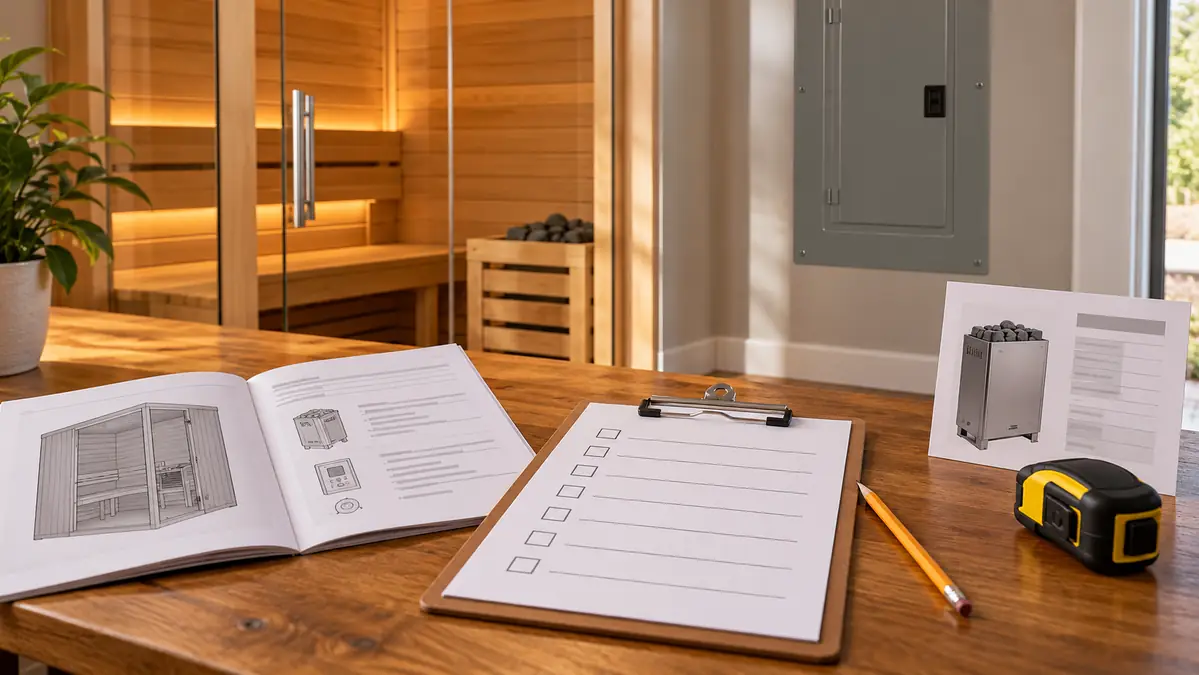
Download the free Sauna Electrical Planning Checklist if you want a printable copy to take into a showroom, use while comparing models, or share with an electrician. It mirrors the planning fields below and keeps unknown items visible until they are verified.
Use this worksheet before ordering the sauna or requesting an electrical quote. If a field is unknown, write verify instead of guessing.
| Planning item | Your project | Who confirms it? |
|---|---|---|
| Sauna manufacturer | __________ | Manufacturer/dealer |
| Exact sauna model | __________ | Manufacturer/dealer |
| Heater manufacturer/model | __________ | Manufacturer/dealer |
| Indoor or outdoor | __________ | Homeowner |
| Rated voltage | __________ | Manufacturer manual |
| Rated watts or kW | __________ | Manufacturer manual |
| Rated current, if published | __________ | Manufacturer manual |
| Dedicated circuit specified? | Yes / No / Verify | Manufacturer manual |
| Connection/receptacle type | __________ | Manufacturer manual |
| Controls/power unit | __________ | Manufacturer manual |
| Optional electrical accessories | __________ | Manufacturer/dealer |
| Current manual downloaded? | Yes / No | Homeowner |
| Existing circuit verified? | Yes / No | Electrician |
| Panel capacity assessed? | Yes / No | Electrician |
| Approximate panel-to-sauna route | __________ | Homeowner/electrician |
| Permit requirements checked? | Yes / No | Local authority/electrician |
| Electrical quote obtained? | Yes / No | Electrician |
Before paying the final deposit, make sure the exact model number, electrical documentation, installation location, and likely electrical scope are all known. Those four checks catch many problems while you can still change the sauna or its location.
Frequently Asked Questions
Does every sauna need 240V?
No. Some infrared sauna cabins operate on 120V, while many traditional electric heaters and some larger infrared models use 240V. Check the exact model rather than deciding by sauna type alone.
Can an infrared sauna use a regular outlet?
Some infrared saunas use a receptacle, but the manufacturer may specify a particular receptacle and dedicated circuit. Sunlighten’s current Signature I and Signature III specifications, for example, call for a dedicated 120V 20A circuit with a NEMA 5-20 connection.
Does a sauna need a dedicated circuit?
Many sauna and heater manufacturers specify a dedicated circuit for their equipment. The requirement must be checked for the exact model rather than assumed from a generic sauna category.
How many amps does a sauna use?
It varies with the equipment. A compact infrared cabin and a multi-kilowatt traditional heater can have very different loads. Use the manufacturer’s published amperage, or use watts divided by volts only to understand the approximate current when amperage is not shown.
What breaker size does my sauna need?
Use the circuit requirements for the exact sauna or heater and have the final installation matched to the electrical requirements that apply at your property. A generic breaker-size table should not override the equipment manual.
Should I call an electrician before ordering a sauna?
It is a useful step when the model requires new wiring, a dedicated circuit, 240V service, a fixed electrical connection, or an outdoor installation. An early assessment can reveal panel or routing issues before the sauna is purchased.
Check the Electrical Requirements Before You Buy
The safest planning sequence is straightforward: choose the exact sauna and heater, download the current manufacturer documentation, record the voltage and circuit requirements, confirm the installation location, and get an electrical assessment when new work is involved.
Do not start with a universal breaker chart. Start with the model number. That keeps the electrical plan tied to the equipment you will actually install and gives you a more realistic project cost before the sauna arrives.