Sauna Heater Not Working? Safe Troubleshooting Guide

Your sauna heater was working yesterday, but today the room stays cold, the controller looks blank, or the heater starts and then stops. These symptoms can look similar while having very different causes. The safest first move is to identify the exact symptom without opening the heater.
Quick answer: For a traditional electric sauna heater that is not working, verify the manufacturer-approved timer or controller settings, check for a displayed fault message, and note whether the dedicated circuit has tripped. Do not repeatedly reset breakers, bypass safety switches, handle exposed wiring, or run a heater with damaged components. A qualified electrician or authorized service technician should handle electrical diagnosis and repairs.
This guide focuses on traditional electric stone heaters. It does not replace the troubleshooting manual for your brand, and it does not cover wood-stove combustion problems or infrared emitter diagnosis.
Start With the Symptom, Not a Repair Guess
Before trying anything, make a simple observation: is the controller dark, is it powered but not calling for heat, does it display an error, or is the room heating more slowly than usual? That description helps a technician avoid treating every fault as a broken heating element.
| What you see | Possible category | Safe next action |
|---|---|---|
| Blank controller and no apparent power | Power supply, external switch or control issue | Check accessible user controls; if power is absent, contact service |
| Controller on but stone heater cold | Timer setting, thermostat, safety cutoff or internal fault | Confirm the manual’s operating mode; record any message |
| Heater starts then stops unexpectedly | Control/sensor/safety issue or power interruption | Stop use, note timing and fault display; arrange inspection |
| Breaker or protective device trips | Electrical fault or circuit problem | Leave it off; call a qualified electrician |
| Heater warms but cabin remains too cool | Incorrect settings, stones, airflow, heater sizing or a damaged element | Review permitted settings and maintenance; use service if unresolved |
| Burning smell, smoke, sparking or melted parts | Potential fire or electrical emergency | Stop using it, move away, follow emergency procedures |
Visible signs are not proof of a specific failed part. For example, a blank display may reflect an upstream supply problem, while slow heat can reflect the sauna room or the heater. Do not buy a replacement element before verifying the diagnosis.
Six Safe Checks Before Calling for Sauna Heater Repair
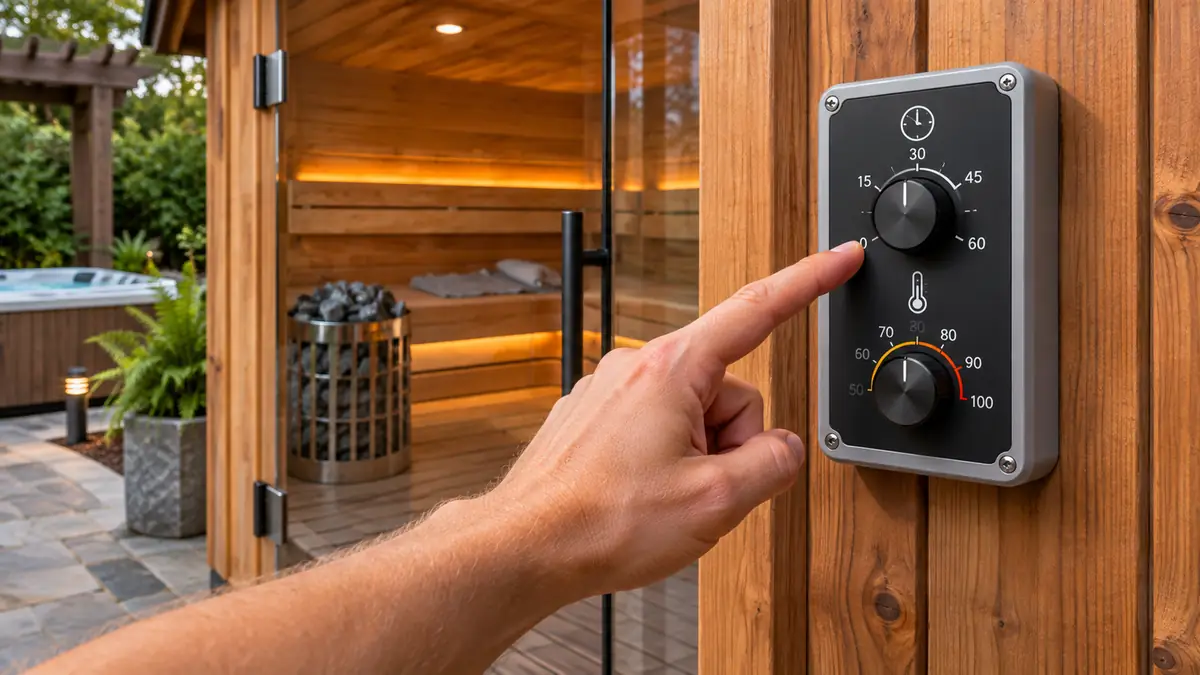
These checks are limited to accessible controls and observations. If the user manual disallows an action, skip it. Do not remove covers, probe electrical terminals, access a live panel or manipulate internal safety devices.
- Identify the brand, model, and controller. Photograph the label from a safe, accessible position. Find the exact owner manual and any documented fault-message list.
- Check the intended start mode. Mechanical timers may have delayed-start ranges. A display may show a schedule or standby state rather than active heating.
- Confirm the thermostat or target setting. Compare the actual setting with the manufacturer’s normal user instructions. Do not alter sensor position or bypass any limiter.
- Look for a fault display. Note the exact wording or code, the time it appeared and whether it changes. Do not assume internet codes for other models are equivalent.
- Check for an obvious external interruption. Note whether power is out to the house or another listed external disconnect is off. If a breaker has tripped, do not keep resetting it to make the heater run.
- Inspect the room from a safe distance. Notice blocked vents, a door that will not close normally, or heavy items resting on the heater guard. Do not reach near a hot or energized heater.
Harvia’s mechanical-timer troubleshooting article shows why model-specific information matters. It discusses supply, timer and overheat-protector issues for that particular control style. The existence of a reset procedure for one model is not permission to reset every heater or ignore the underlying cause of overheating.
Why a Sauna Heater Can Have Power but Produce No Heat
Timer or controller is not actually requesting heat
A dial can be in a delay region, an app may have an active schedule, or a controller may be waiting on a safety condition. Read the heater’s actual control sequence. A normal ticking or buzzing sound is not proof that the elements are energized, and a lit display is not proof that the heater is heating.
Overtemperature protection has operated
Some heaters include a protective cutoff that interrupts heat when a limit is reached. Harvia publishes model-specific guidance for certain mechanical-timer heaters, including conditions associated with an overheat protector. That protective device is a warning to identify the reason for the trip. If your manual calls for service or the device repeatedly cuts out, stop using the heater. Never bypass a temperature limiter.
Heating element, contactor, sensor or connection may have failed
Traditional electric heaters include components that can fail with age or faults. HUUM’s official electric-heater support describes element, wiring and control checks but directs cable checks to an electrician. We do not recommend removing stones while heating, touching exposed elements, or testing electrical components yourself to reproduce those diagnostics.
Contactors, wiring, sensors and thermal protection may need measurements and model-specific testing. A qualified professional should isolate power and work from the manufacturer’s electrical diagram.
What if the Sauna Heater Runs but Does Not Get Hot Enough?
A heater that is slow to warm is a different problem from one that is fully dead. First compare what has changed: room size, cold-weather use, ventilation settings, stone condition, and the time you allow for heating. Some of those factors may be part of normal operation, while others indicate a fault.
| Question | What to check without dismantling equipment |
|---|---|
| Did warm-up change suddenly? | Record previous and current warm-up behavior rather than assuming a universal time |
| Were stones replaced recently? | Confirm model-approved size and arrangement once fully cool and isolated |
| Are air openings blocked? | Check visible vents without altering designed airflow paths |
| Has the room or door changed? | Look for obvious gaps or a door left open; avoid unsafe sealing |
| Was the heater moved to a larger room? | Recheck heater sizing against its own installation manual |
| Does the control display an error? | Save an exact photo for the authorized installer or manufacturer |
Heater stones are a common maintenance variable. If they are damaged or tightly compacted, use the heater manufacturer’s stone inspection instructions for a non-electrical check, with the heater safely off and cool. For intake and exhaust design, consult the separate sauna ventilation guide rather than changing vents randomly.
When to Stop Troubleshooting and Call a Professional
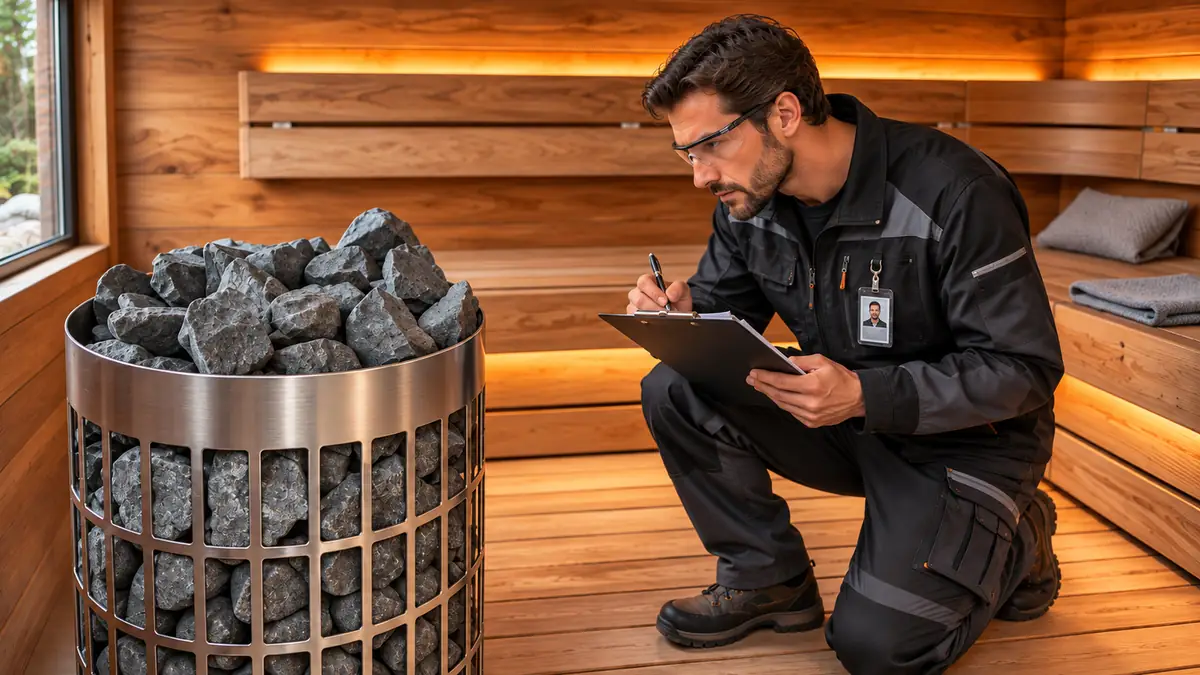
A qualified electrician or manufacturer-authorized sauna technician is the correct next step when an electrical protective device trips, a thermal cutoff repeats, a heater has visible damage, wiring or a sensor is suspect, or a control fault cannot be cleared according to the owner manual. Report the exact symptoms instead of requesting a specific replacement part.
- Leave the heater off after a breaker trips or a strong abnormal smell, smoke, sparking or melting is noticed.
- Do not repeatedly reset protective devices. Repeated tripping can indicate a fault that needs diagnosis.
- Do not bypass door interlocks, sensors or safety controls to see whether the heater will start.
- Do not open covers or inspect energized wiring. Even a heater that seems off can still have dangerous supply voltage.
- Use the official service channel. Keep the model, install date and warranty details available for the technician.
If you are budgeting for service rather than attempting a repair, the sauna repair cost guide separates common categories of expense. Quotes and replacement-parts decisions still depend on your model and location.
Sauna Heater Fault Log: Give the Technician Useful Facts
A short log reduces the need to describe the issue from memory. Fill this out only with observations; never create a problem intentionally to reproduce it. This worksheet is informational and is not a substitute for electrical measurements.
| Record | Write your observation |
|---|---|
| Heater brand/model and control model | ________________________ |
| Installation location and approximate age | ________________________ |
| Last time it heated normally | ________________________ |
| Symptom: no display / no heat / slow heat / stops | ________________________ |
| Exact controller message, if any | ________________________ |
| Any breaker or protective-device trip? | ________________________ |
| Were settings or stones recently changed? | ________________________ |
| Unusual smells, sounds, scorch marks? | ________________________ |
| Manual troubleshooting page consulted | ________________________ |
| Service ticket or installer contact | ________________________ |
Avoid These Sauna Heater Troubleshooting Mistakes
- Assuming a universal reset button: Designs differ, and a safety cutoff may require an underlying fault to be addressed before reset.
- Blaming stones for every symptom: A cold controller or tripping breaker is not solved by restacking rocks.
- Testing with the door or controls bypassed: Interlocks and temperature protections are there for safety.
- Using a larger breaker: Breaker selection and circuit sizing must follow applicable electrical requirements and manufacturer instructions.
- Replacing parts before finding the cause: A replacement may fail again if the source of the fault is not fixed.
- Using instructions from another heater: Even models from the same manufacturer can use different controls and sensor arrangements.
FAQs: Sauna Heater Not Working
Why is my sauna heater on but not heating?
Possible causes include an inactive timer mode, a thermostat or protection condition, a failed element or a control problem. Check only user-facing settings and pass unresolved electrical faults to authorized service.
Can I reset the breaker if my sauna trips it?
Do not repeatedly reset a tripping breaker. Leave the heater off and have a qualified electrician find the cause; follow local electrical safety guidance.
Is the overheat protector safe to reset?
Only follow the exact manufacturer instructions for your model, and do not use a reset to ignore repeated overheating. If there is uncertainty about cause or procedure, contact service.
Could old sauna stones stop a heater from warming properly?
A compacted stone bed can restrict airflow and affect heating, but it is only one possible cause. Inspect or restack only with the heater off, isolated and completely cool as instructed in the manual.
Should I replace the heating elements myself?
Element replacement involves electrical safety and model-specific procedures. Use a qualified electrician or authorized technician unless the manufacturer expressly specifies otherwise and you are qualified to do the work.
What to Do Next
Identify the heater model, write down exactly what the controller and room are doing, check only the permitted external settings, and stop at the first electrical or safety-related warning. A precise symptom log is a better starting point for repair than guessing at parts or repeatedly restarting the heater.