
Infrared Sauna Risks: Side Effects, Contraindications & Safety

Infrared saunas expose the body to heat. Their lower cabin-air temperature does not remove the risks of overheating, dehydration, low blood pressure, burns, or an interaction with a medical condition or treatment.
This page focuses on risk and contraindications. For how the technology works, use the infrared sauna guide.
Common Immediate Risks
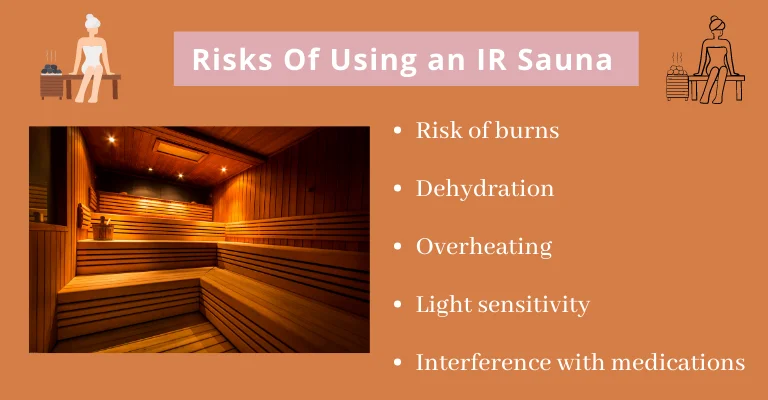
| Risk | What to watch for | What to do |
|---|---|---|
| Overheating | Headache, nausea, unusual weakness, confusion, heavy discomfort, or faintness For related planning, see pregnant hot tub. | Exit immediately, move to a cooler place, and seek medical help if symptoms are severe or do not improve |
| Dehydration | Thirst, dry mouth, dizziness, reduced urination, or worsening fatigue | Stop the session; replace fluids appropriately and get medical advice when symptoms are significant |
| Low blood pressure or fainting | Lightheadedness when sitting or standing, blurred vision, or near-fainting | Sit or lie safely, cool down, and do not walk unassisted if unsteady |
| Burns | Hot emitters, lamps, guards, hardware, controller faults, or prolonged contact in a blanket | Do not touch emitters; stop using damaged equipment and follow first-aid guidance for any burn |
| Falls | Wet flooring, dizziness, cramped exits, or impaired judgment | Keep the exit clear, use stable seating, and never sauna alone when a condition makes fainting more likely |
Medicines and Health Conditions
Ask a clinician or pharmacist about heat exposure if you use medicines that affect blood pressure, heart rate, sweating, fluid balance, alertness, or temperature regulation. Do not stop or change prescribed medicine to make sauna use possible.
Medical guidance is especially important with unstable heart or blood-pressure conditions, fainting history, kidney disease, impaired sensation, autonomic disorders, fever or acute infection, previous heat illness, or any condition that makes it harder to recognize or escape excessive heat.
Pregnancy
Pregnancy changes heat and circulation considerations, and medical recommendations can depend on the individual and stage of pregnancy. Do not use generic website timing or temperature advice; ask the prenatal clinician who knows the pregnancy.
Cancer and Cancer Treatment
An infrared sauna does not treat cancer, shrink tumors, improve survival, “detox” chemotherapy, or substitute for oncology care. Medical hyperthermia is a controlled cancer treatment delivered with specialized equipment, temperature monitoring, and clinical expertise. It is not the same as sitting in a consumer sauna.
The National Cancer Institute explains that clinical hyperthermia is used at selected centers, usually with treatments such as radiation or chemotherapy, and can itself cause burns, discomfort, and other adverse effects. That evidence cannot be used to promote an infrared sauna as cancer therapy.
People receiving chemotherapy, radiation, surgery, hormone treatment, immunotherapy, stem-cell treatment, or palliative care may have dehydration, anemia, infection risk, skin injury, neuropathy, low blood pressure, heart strain, impaired temperature control, or treatment-device considerations. The oncology team should decide whether recreational heat exposure is appropriate and when. Avoid heating an active radiation reaction, surgical wound, catheter, ostomy, implanted port, or treatment area unless the treating team explicitly approves it.
Implanted or Wearable Medical Devices
Heat and electromagnetic compatibility are separate questions. Pacemakers, defibrillators, insulin pumps, glucose monitors, medication patches, hearing devices, and other equipment have product-specific limits. Ask the device manufacturer and treating clinician; a “low EMF” sauna label does not establish compatibility.
EMF Risk Claims
Do not assume ordinary sauna emissions are dangerous—or that a low-EMF model provides proven health protection—based on a single marketing number. Field type, frequency, unit, distance, and measurement method all matter. The World Health Organization reports that current evidence does not confirm health consequences from low-level EMF exposure while research continues.
For product comparison, use the low-EMF measurement guide.
Skin, Eyes, and Heat Sensation
Infrared sauna is not a skin treatment. Active rashes, open wounds, reduced sensation, photosensitivity, recent procedures, or medicines that increase heat or light sensitivity require individual advice. Lamp-based systems can create bright light and very hot surfaces; use guards and eye/skin precautions from the exact manual.
Alcohol and Other Impairing Substances
Do not combine sauna use with alcohol or a substance that impairs judgment, alertness, blood pressure, or the ability to exit. Do not use a sauna as a way to “sweat out” alcohol or drugs.
Stop the Session Immediately If You Notice
- Dizziness, faintness, confusion, nausea, chest discomfort, unusual shortness of breath, severe headache, weakness, or loss of coordination
- Burning skin, a hot electrical smell, smoke, sparking, a damaged cord, repeated breaker trips, or an error code
- A door, zipper, or mobility problem that makes exiting difficult
Call emergency services for severe symptoms, loss of consciousness, chest pain, breathing difficulty, suspected heatstroke, or a serious burn.
Risk-Reduction Checklist
- Use only a correctly installed, undamaged product under its current manual.
- Start conservatively; there is no universal safe temperature, session length, frequency, or fluid amount.
- Keep the exit clear and never bypass timers, thermostats, sensors, guards, or overheat protection.
- Do not use the sauna when ill, intoxicated, unable to sense heat normally, or unable to exit independently.
- Get condition-specific advice instead of using benefit claims as medical guidance.