
Hot Tub Water Change Calculator: When to Drain & Refill

Changing hot tub water on a fixed calendar can feel wasteful when the water still looks clear. Waiting until it becomes difficult to manage is not a great plan either. Spa size and bather load both affect how quickly water ages.
This hot tub water change calculator estimates a drain-and-refill interval from your spa volume and average use, then gives you an estimated next water-change date. Use it as a planning benchmark and compare the result with the schedule in your hot tub owner’s manual.
Hot Tub Water Change Calculator
Enter your normal use, not an unusually busy weekend.
Important: This estimates water age from bather load. It does not test sanitizer, pH, contamination, biofilm, or whether the water is safe to soak in. Follow your spa manufacturer’s instructions and change problem water sooner when needed.
Quick answer: Many residential manufacturers use a routine drain-and-refill schedule around every three to four months, with more frequent changes under heavier use. The calculator adds bather load instead of treating every spa and household the same.
How Often Should You Change Hot Tub Water?
A three-to-four-month schedule is a useful starting point for many residential spas, but it is not a universal countdown. Jacuzzi recommends changing hot tub water about every three to four months on average, with the ideal schedule changing based on use, bather load, water chemistry, and the system in your spa.
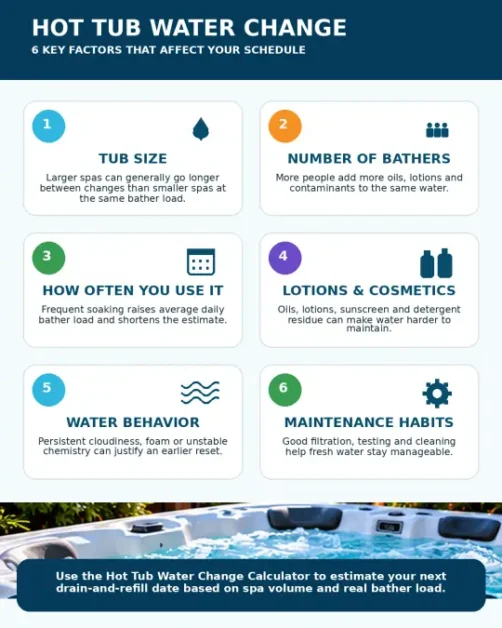
Bather load matters because a 250-gallon spa used by four people most nights has a different workload from a 500-gallon spa used by one person twice a week. Sweat, body oils, cosmetics, and other material enter a relatively small volume of warm water whenever people soak.
A useful schedule needs two checks: how old the water is for your level of use and how the water is actually behaving. Clear-looking water alone does not tell you that sanitizer and pH are where they should be.
How the Hot Tub Water Change Calculator Works
The calculator uses the water-replacement formula published in CDC hot-tub guidance:
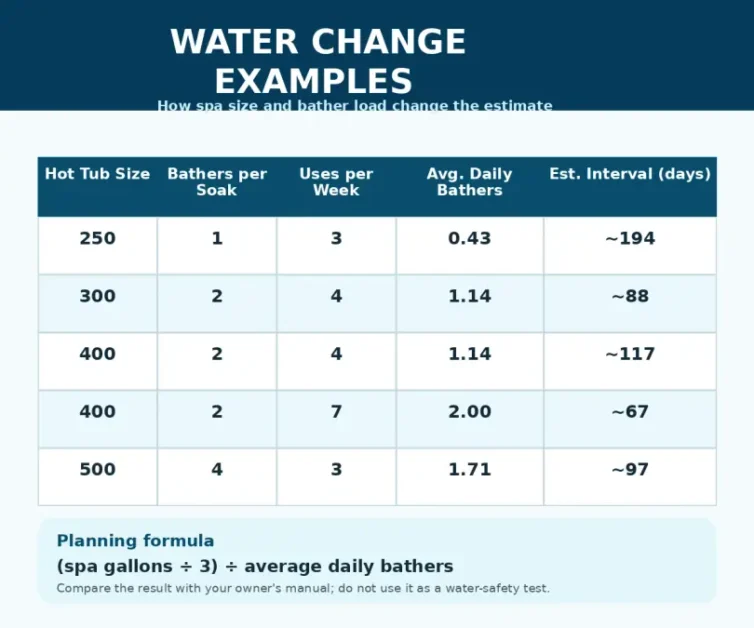
Water replacement interval in days = (spa volume in gallons ÷ 3) ÷ average users per day
The CDC formula is designed for hot-tub water management and bather-load planning, including public aquatic settings. For a residential spa, use it as a consistent planning benchmark rather than a replacement for your owner’s manual, sanitizer testing, or actual water condition.
If you do not know your spa capacity, use our hot tub volume calculator first.
Converting weekly use into average daily bathers
Multiply the average bathers per soak by soaking days per week, then divide by seven. Two people soaking four days a week create eight bather visits per week, or about 1.14 average bathers per day.
Example: 400-gallon hot tub
- 2 bathers × 4 days = 8 bather visits per week
- 8 ÷ 7 = 1.14 average bathers per day
- 400 ÷ 3 = 133.3
- 133.3 ÷ 1.14 = about 117 days
That lands close to four months. The same 400-gallon tub used by two people every day produces a much shorter estimate of about 67 days.
Why Clear Water Can Still Be Due for a Change
The water can look fine while still becoming harder to manage. A filter removes suspended material, but it does not return used water to its original condition forever.
Water-care products, source-water minerals, and material introduced by bathers can accumulate. Evaporation removes water while many dissolved substances stay behind.
Fresh water also gives you a cleaner baseline when chemistry becomes increasingly difficult to manage. Our guide to total dissolved solids in a hot tub explains one measurement associated with water age. Do not use one TDS number as the only reason to keep or dump water.
Change the Water Sooner If These Problems Show Up
A calculated date is a maintenance target, not permission to ignore a problem. Drain and refill sooner when your manufacturer or water-care instructions call for it, or when troubleshooting shows that replacement is the sensible reset.
- Persistent cloudiness: sanitizer, balance, and filtration issues have been addressed but the water will not clear.
- Recurring foam: foam quickly returns after obvious causes such as detergents, lotions, and dirty filters are addressed.
- Chemistry that will not stay manageable: repeated adjustments do not produce stable results.
- Known contamination: follow the appropriate cleaning and disinfection procedure rather than waiting for a routine date.
- Manufacturer-required interval: your spa or water-care system specifies an earlier change.
If the issue is cloudy, green, foamy, or otherwise confusing, work through our hot tub water care troubleshooting guide before repeatedly adding chemicals.
What Makes Hot Tub Water Need Changing Faster?
More bathers and more frequent soaking
Four people add more bather load than one person, and daily use ages water faster than occasional weekend use. Parties and visiting family can create a much heavier load than your normal routine.
Smaller water volume
The same two bathers have a larger effect on 200 gallons than on 500 gallons. This is why knowing the actual capacity of an inflatable or compact spa matters.
Lotions, cosmetics, and detergent residue
Body oils, skin products, and detergent residue from swimwear add to the workload. A quick shower before soaking and keeping heavily laundered clothing out of the tub can reduce what enters the water.
Water-care problems
Old water is not the cause of every chemistry problem. Poor filtration, incorrect pH, inadequate sanitizer, or a dirty filter can create trouble in fresh water too. Our hot tub water chemistry guide covers the core checks.
Water Change Examples by Hot Tub Size and Usage
| Volume | Typical use | Average daily bathers | Formula estimate |
|---|---|---|---|
| 250 gal | 1 person, 3 days/week | 0.43 | About 194 days |
| 300 gal | 2 people, 4 days/week | 1.14 | About 88 days |
| 400 gal | 2 people, 4 days/week | 1.14 | About 117 days |
| 400 gal | 2 people, daily | 2.00 | About 67 days |
| 500 gal | 4 people, 3 days/week | 1.71 | About 97 days |
The 250-gallon example shows why the manufacturer check matters. Low use can produce a formula interval much longer than the routine schedule recommended for some residential spas. Do not automatically stretch your water to that date.
Your Calculator Says It Is Time: What Should You Do Next?
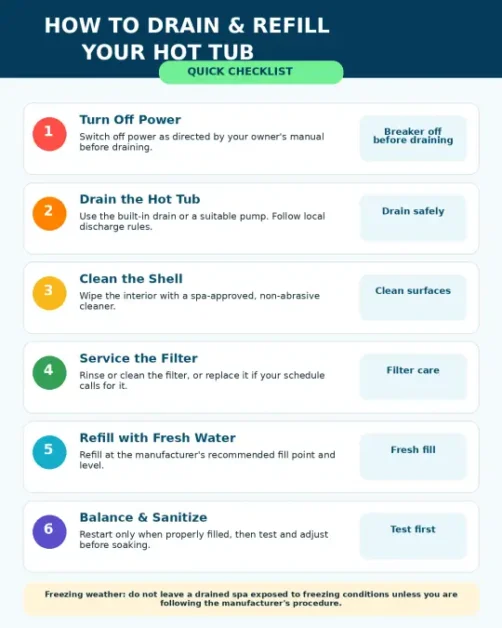
- Read your owner’s manual for model-specific draining instructions.
- Turn off power as directed before draining.
- Drain the old water to an appropriate location allowed by local rules.
- Clean the shell and accessible surfaces with spa-approved products.
- Service the filter if it is due.
- Refill at the manufacturer’s recommended fill point to reduce air-lock problems.
- Restore power only when the spa is correctly filled and your instructions say to do so.
- Balance and sanitize the new water before soaking.
For the refill portion, follow our step-by-step hot tub refill guide. Your model’s manual still takes priority.
How to Make Fresh Hot Tub Water Easier to Maintain
- Test sanitizer and pH on the schedule recommended for your system.
- Rinse and clean filters according to the filter and spa instructions.
- Shower before soaking when practical, especially after workouts or when wearing lotions.
- Avoid fabric softener and heavy detergent residue on spa swimwear.
- Keep the cover closed when the spa is not in use.
- Deal with cloudy water, foam, or unusual sanitizer demand early.
- Record each full drain-and-refill date.
For other maintenance math, use our hot tub calculation tools.
Plan Around Winter Before the Water Is Overdue
Cold-weather timing is a real concern in freezing climates. If your calculated change falls in the coldest part of winter, check the owner’s manual and plan ahead rather than casually leaving the spa empty in freezing conditions. A late-fall change may create a more convenient maintenance window.
Do not extend problem water just to avoid winter work. If a drain is necessary in freezing weather, follow the manufacturer’s cold-weather procedure or use qualified service help.
Track Your Next Hot Tub Water Change
After every refill, save the date, spa gallons, normal weekly bather load, and any unusual problems from the previous fill. On the next cycle, compare the calculator estimate with what actually happened. After a few cycles you may see a useful household pattern instead of guessing when you last dragged out the hose.
Hot Tub Water Change FAQs
How often should I change the water in a 400-gallon hot tub?
Gallons alone are not enough. Two people using a 400-gallon spa four days per week produce a bather-load estimate of about 117 days; two people using it daily produce about 67 days. Compare the result with your manufacturer’s schedule.
Does heavy hot tub use mean I should change the water sooner?
Yes. Higher bather load can shorten the replacement interval because more people and more frequent soaking add more material to the same volume of water.
Can I keep hot tub water longer than three months?
Manufacturer schedules vary, and some low-use calculations extend beyond three months. Follow the instructions for your specific spa and water-care system rather than using the calculator to override them.
Should I change clear hot tub water if the calculator says it is due?
Clarity is only one observation. Clear water does not prove sanitizer, pH, and other water-care conditions are correct. Treat the calculator as a maintenance reminder and compare it with your manual and test results.
Does shocking mean I can wait longer to change the water?
Do not assume so. Shocking or oxidizing serves a different purpose from replacing old water. Follow the shock product and spa water-care instructions.
Does TDS tell me exactly when to change hot tub water?
TDS provides context about dissolved material, but one reading is not a universal countdown. Source water starts with its own TDS, so use the measurement with manufacturer guidance and other signs.
How do I calculate average daily bathers?
Multiply average bathers per soak by soaking days per week, then divide by seven. Two people soaking three days per week equals about 0.86 average bathers per day.
Use the Date as a Maintenance Target, Not a Safety Test
The most useful schedule combines spa volume, real bather load, manufacturer instructions, and what is happening in the water. Run the calculator after each refill and save the estimated date, but keep testing and maintaining the water throughout the cycle.
If the calculator says you have weeks left but the water is persistently cloudy, difficult to sanitize, or otherwise problematic, solve that problem now. If the water looks good on the calculated date, check your owner’s manual before stretching the interval. The calculator makes planning easier; it does not replace water testing or model-specific maintenance instructions.
Sources: CDC: Controlling Legionella in Hot Tubs; Jacuzzi: How Often to Change Hot Tub Water.