
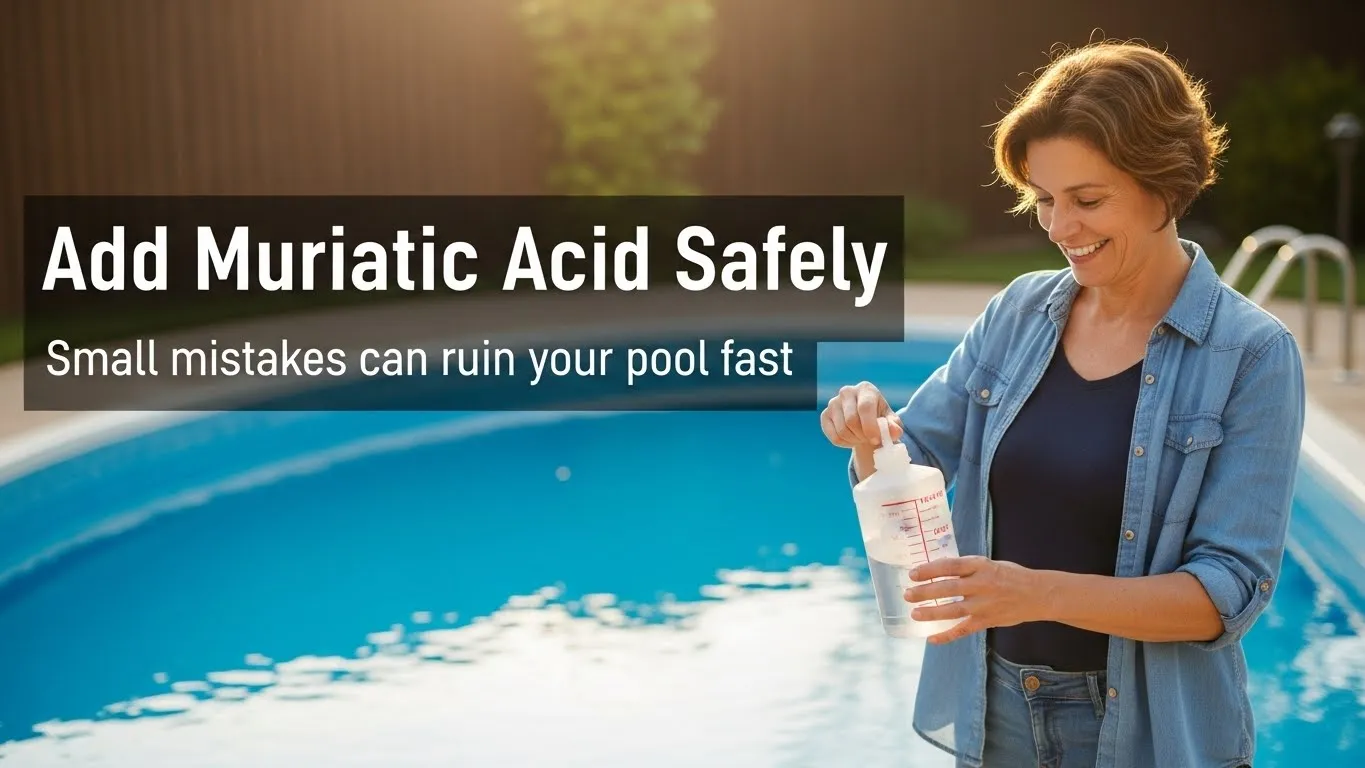
How to Add Muriatic Acid to Your Pool

The Simple Method Most Owners Get Wrong
I didn’t realize how fast a pool’s pH can drift until I watched mine jump from clear and balanced to cloudy in just a couple of days.
And once I saw how a small dose of muriatic acid brought everything back in line, I finally understood why timing and technique make such a huge difference.
The frequency of use of muriatic acid in your pool typically ranges from one to two weeks, but it can vary based on aspects like pool size, bather load, weather conditions, and chemical balance. Regular pH testing will help determine when it’s needed.
When to Add Muriatic Acid
| If Your pH Is… | Action |
|---|---|
| 7.2–7.6 | Do nothing |
| 7.7–7.8 | Recheck soon |
| 7.8+ | Add muriatic acid |
| Cloudy water | Likely high pH, test again |
| Chlorine not working | High pH is usually the cause |
How You Actually Add Muriatic Acid to Your Pool
You use muriatic acid to lower high pH, and you add it by diluting it in a bucket of water, keeping your pump running, then slowly pouring it around the deep end. That’s it.
But the real trick is knowing when your pool needs it.
You add muriatic acid anytime your pH creeps up to 7.8 or higher. Most pools hit that point every 7 to 14 days, especially in summer.
If you’re brand new at this, you can always pull up a bigger pool care guide to get the full picture, like the one over at the pool care guide.
Things that tell you it’s time:
• Cloudy water
• Scale forming around the waterline
• Chlorine suddenly not lasting as long
• Eye irritation after swimming
• Test strips reading 7.8+
You don’t need anything fancy, just a testing kit and a few minutes of patience.


Taylor K2005 High Range Pool Test Kit — Free & Total Chlorine, pH, Alkalinity, Calcium, Acid Demand
Trusted pro-grade kit for accurate pH and alkalinity readings — ideal when you’re dosing muriatic acid.
If you plan to add muriatic acid, don’t guess your numbers. This kit gives the exact pH and alkalinity readings you need to dose safely and avoid overcorrection.
Why Pools Need Muriatic Acid in the First Place
Think of muriatic acid as the reset button for your water’s pH. Over time, pools naturally drift upward thanks to:
• sunlight
• aeration from swimmers
• saltwater systems
• waterfalls or spillways
• high alkalinity
• heavy chlorine use
When pH climbs too high, chlorine gets weak.
You’ve probably heard this stat, but if not, here it is:
Chlorine is up to 90 percent less effective at pH 8.0 than it is at pH 7.2.
That’s why your pool can look clean but still grow algae. High pH also causes:
• cloudy water
• calcium scale
• itchy skin and red eyes
If you like to mess with your water temperature, you already know heat plays a huge role in pH movement. Warming the water speeds up chemical changes. If you’re curious how heating affects your setup, you can check out different options for heating your pool too.
pH Levels and What They Mean
| pH Level | What You’ll Notice | Why It Matters |
|---|---|---|
| 7.2–7.6 | Clear water, comfortable swimming | Ideal range where chlorine works best |
| 7.7–7.8 | Slight cloudiness starting | Chlorine gets weaker and scale begins forming |
| 7.9–8.2 | Cloudy water, itchy eyes | Chlorine loses up to 90 percent strength |
| 8.3+ | Heavy cloudiness, scaling | Very poor sanitation, algae risk skyrockets |
When You Should Add Muriatic Acid
Most pool owners add it:
• when pH rises above 7.8
• after a long stretch of hot weather
• after heavy swimming weekends
• after storms
• before shocking (so chlorine works better)
• when a salt cell pushes pH upward
A few things that make pH rise way faster:
• kids splashing all day
• using aeration features
• saltwater generators
• warm water above 85°F
• high total alkalinity
If you track your levels weekly, you’ll get a feel for your pool’s personality. Some barely move. Others spike like a toddler on gummy vitamins.
If you want more step-by-step educational material, the pool maintenance section in these maintenance guides is a good add-on.
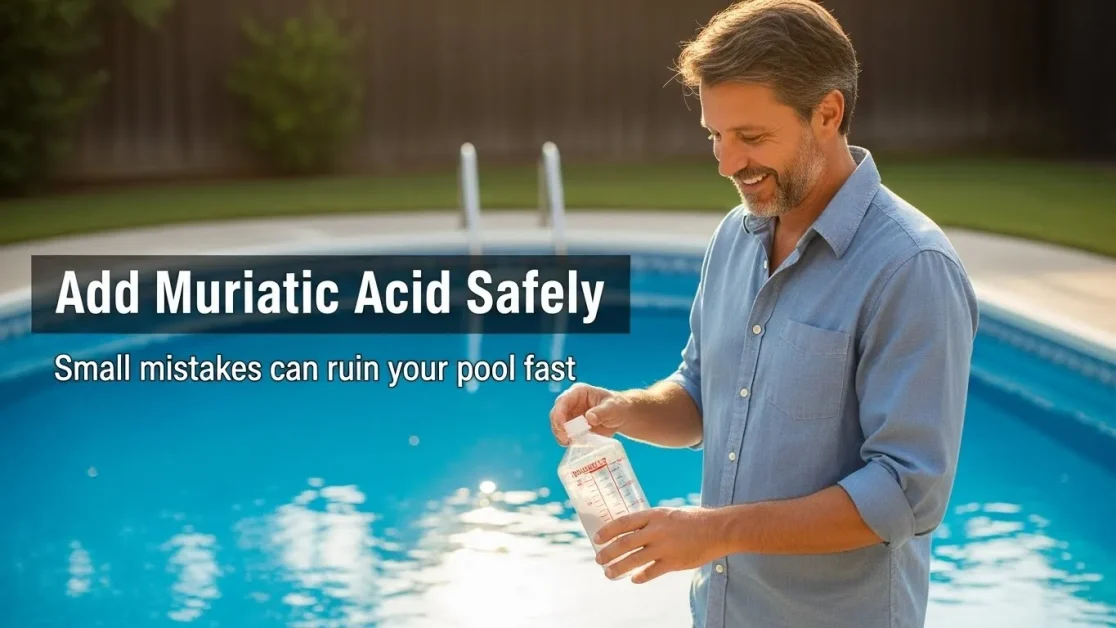
How Often You Need to Add Muriatic Acid
Most pools end up needing a dose every 1–2 weeks, but that’s just the average.
Here’s what really drives the schedule:
Climate Examples
Arizona summer example
A 14,000-gallon saltwater pool can rise from 7.6 to 8.1 in just 3–5 days due to heat and aeration.
Michigan example
A chlorine pool in mild temps might only need acid every 2–3 weeks.
Above-ground pools
These warm up faster and hold fewer gallons, so pH changes hit quicker.
Saltwater pools
These drift upward 20 to 40 percent faster thanks to the generator bubbling away at the cell.
If you’re trying to calculate exact gallons for dosing, the gallons to liters tool makes it easier when converting between measurements.
How Often Pools Typically Need Muriatic Acid
| Pool Type / Condition | Typical Frequency | Why It Changes |
|---|---|---|
| Saltwater pool | Every 5–10 days | Salt cell aeration raises pH faster |
| Chlorine pool | Every 1–2 weeks | pH rises slower than salt pools |
| Above-ground pool | Every 7–14 days | Smaller volume reacts faster |
| Hot climates | Every 3–7 days | Heat, sun, and aeration push pH up |
| Mild climates | Every 10–20 days | Cooler water keeps pH stable |
Further reading:
- Plunge Pool vs. Hot Tub Combo: Dive into the world of plunge pools and hot tub combos. When choosing between these luxurious additions to your outdoor space, you can look at the benefits, features, and considerations.
- Costco Above Ground Pool Guide: Thinking about getting an above-ground pool from Costco? Explore our comprehensive guide, which covers everything from pricing and pool types to installation tips and maintenance recommendations. Make an informed decision for your backyard oasis.
How to Add Muriatic Acid Safely (Beginner-Friendly Steps)
Here’s the friendly, no-stress version.
1. Keep your pump running
Circulation helps move the acid through the water so it doesn’t sit in one spot.
2. Put on basic safety gear
Gloves, eye protection, and clothes you don’t mind sacrificing.
Muriatic acid isn’t a joke.
3. Use the bucket method
Grab a big plastic bucket, fill it halfway with pool water.
4. Add acid into the water, not the other way around
This prevents splashing.
5. Walk it around the deep end
Pour slowly. Give the pump time to distribute it.
If you’re completely new and want broader fundamentals, the pool basics article is a solid companion.

The Bucket Method (Most Common)
This is the safest way because the bucket gives you total control.
How to do it:
• Fill bucket halfway
• Measure your acid
• Pour acid slowly into the bucket
• Stir gently with a plastic tool
• Walk it around the deep end
• Let the pump circulate for at least 30–60 minutes
If you’re the DIY type, you’ll probably enjoy other hands-on projects like the DIY pool upgrades guide too.
The Deep-End Pour Method (Advanced Users)
Some pool techs do a “deep pour” where they just walk the deep end and pour measured acid directly. It’s fine, but only if:
• the pump is running
• the water is moving fast
• you stay upwind
• you pour slowly enough to avoid a cloud of fumes
• you never pour near the steps or shallow areas
If you ever deal with circulation gadgets or cleaning tools, the solar pool vacuum section ties in nicely.
How Much Acid to Add (Simple Math)
A good starting point for most pools:
10,000 gallons
8–16 oz of muriatic acid drops pH by about 0.2–0.3
15,000 gallons
12–24 oz for the same drop
20,000 gallons
16–32 oz
But this assumes your alkalinity is normal.
Higher alkalinity means you’ll need more acid to get the same pH shift.
If you’re shopping for tools to help with this part of maintenance, the pool equipment needs guide is helpful.
How Much Muriatic Acid to Add (Simple Doses)
| Pool Size | pH Drop Needed | Typical Acid Amount | Notes |
|---|---|---|---|
| 10,000 gal | Lower by 0.2–0.3 | 8–16 oz | Most common dose for small pools |
| 15,000 gal | Lower by 0.2–0.3 | 12–24 oz | Adjust if alkalinity is high |
| 20,000 gal | Lower by 0.2–0.3 | 16–32 oz | Larger pools need slower, measured changes |
| 25,000 gal | Lower by 0.2–0.3 | 20–40 oz | Pour gradually to avoid localized damage |
What to Do After Adding Muriatic Acid
You don’t need to babysit your pool after adding acid, but a couple of things matter:
• Let the pump run 30 to 60 minutes
• Retest pH after 1 to 2 hours
• Keep swimmers out for at least 30 minutes
• Avoid adding chlorine or shock immediately after
• Don’t add baking soda in the same hour
• If pH is still high, add a smaller second dose
If you’re shopping for products afterward, the pool product reviews page is a good place to look.
Adding Muriatic Acid to Different Types of Pools
Saltwater pools
They need it more often because of the aeration at the salt cell.
Above-ground pools
Smaller volume means pH swings show up faster.
Vinyl liners
Never pour acid in one spot, it can bleach the liner.
Plaster pools
Handle acid carefully since plaster is more delicate.
If you’re exploring unique pool styles, the plunge pool setups guide has some fun ideas.
Situations Where You Shouldn’t Add Acid Yet
Hold off if:
• swimmers are in the water
• you just shocked the pool
• you can smell strong chlorine
• alkalinity is already low
• winds are strong enough to blow fumes at you
• the pump is off or broken
When in doubt, check your pool supplies and readings first: https://hottubpatio.com/blog/pools-guide/reviews-pools-guide/
When You Should NOT Add Acid Yet
| Situation | Why You Should Wait | Safer Alternative |
|---|---|---|
| Right after shocking | Chemical reaction risk | Wait 12 hours |
| Swimmers still in pool | Skin and eye irritation | Add when pool is empty |
| Strong winds | Acid fumes can blow toward you | Wait for calmer weather |
| Very low alkalinity | pH may crash | Raise alkalinity first |
| Pump is off | Acid will sit in one spot | Turn pump on for 30 min first |
Signs You’re Adding Too Much Acid
This happens more than people admit.
Here’s what it looks like:
• The water suddenly feels “rough” or sharp
• Stainless steel starts to rust
• Eye irritation even when chlorine is low
• pH crashes below 7.0
• Alkalinity drops way too fast
• Plaster looks etched or streaky
To recover, add small amounts of baking soda or washing soda until pH climbs back up.
Safety Tips You Really Don’t Want to Skip
This stuff burns. Here’s what actually matters:
• Store acid away from chlorine
• Keep it in a cool, dry place
• Always stand upwind
• Wear eye protection
• Never mix chemicals
• Never reuse an acid container
• Always dilute slowly
If you’re adjusting your water during warm weather, the warm-weather pool care guide ties in well.
Safety Checklist Before Adding Muriatic Acid
| Safety Step | Why It Matters |
|---|---|
| Wear gloves and eye protection | Prevents chemical burns |
| Stand upwind | Keeps fumes away from your face |
| Add acid to water, never water to acid | Avoids dangerous splashing |
| Keep acid away from chlorine | Prevents explosive reactions |
| Turn pump on first | Helps distribute acid safely |
| Store acid in cool, ventilated area | Stops pressure buildup |
Troubleshooting: When pH Won’t Stay Down
Some pools bounce back up no matter what.
Usually it’s one of these:
• high alkalinity
• salt cell overproduction
• water features causing aeration
• lots of swimmers
• very warm water
Fixes include lowering alkalinity first, adjusting salt cell output, or cutting back aeration.
Troubleshooting When pH Won’t Stay Down
| Problem | Why It Happens | What Fixes It |
|---|---|---|
| pH rises every 1–3 days | High alkalinity | Lower alkalinity first |
| pH rises daily | Salt generator aeration | Reduce salt cell output |
| pH won’t drop enough | Not enough acid added | Increase dose slowly |
| pH drops too far | Too much acid | Add baking soda in small amounts |
| pH bounces up and down | Water features running | Reduce aeration time |
If you’re already a tinkerer, the DIY adjustments section is right up your alley.
How do I add muriatic acid to my pool?
Dilute it in a bucket of pool water and pour it slowly into the deep end with the pump running.
When should I add muriatic acid?
Add it whenever pH rises to 7.8 or higher.
Pump on or off?
Always on.
How long before I can swim?
Usually 30 minutes to an hour.
Can I add acid after shocking?
Wait at least 12 hours.




One Comment