
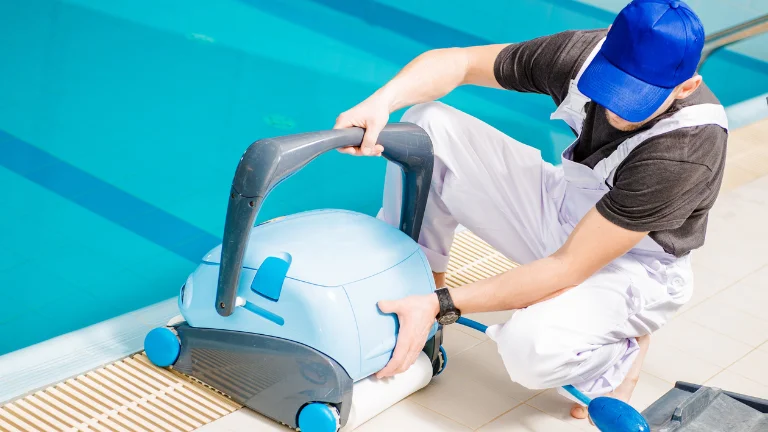
Solar Pool Vacuum Cleaner: What It Cleans and What It Doesn’t

Shopping for a solar pool vacuum cleaner? First check what the product actually cleans. Many products marketed as solar pool cleaners are floating robotic skimmers: they collect leaves, insects, pollen, and other debris from the water’s surface. They do not automatically vacuum the pool floor or scrub the walls.
Quick answer: A solar robotic skimmer can help keep floating debris from sinking, especially in a sunny pool with regular leaf or bug fall. For dirt already on the floor, algae, or wall buildup, you still need brushing, a floor vacuum or pool-cleaning robot, and normal filtration and water care. A solar pool heater is a different device again: it warms water rather than collecting debris.
Solar pool skimmer vs. pool vacuum: what’s the difference?
Product names can be confusing. “Solar pool cleaner” may describe a floating skimmer that uses a solar panel to recharge its battery, while “pool vacuum” usually means equipment designed to remove settled debris from the pool floor. Read the model’s specifications and manual before buying; the word “solar” describes its power source, not the surfaces it can clean.
| Cleaner type | What it is designed to do | What it does not replace |
|---|---|---|
| Solar robotic skimmer | Floats across the surface and collects floating leaves, insects, and similar debris in a basket | Floor vacuuming, brushing, filtration, or water testing |
| Pool vacuum or floor robot | Removes settled dirt from the floor; some models also clean walls or the waterline | Surface skimming unless the model specifically includes that feature |
| Solar pool heating system | Uses solar energy to heat circulating pool water | Any debris cleaning |
How does a solar robotic pool skimmer work?
A floating robotic skimmer uses a small motor to move around the water and draw surface debris into a removable filter basket. Its solar panel replenishes an onboard battery. Depending on the model, it may pause in direct sunlight to recharge, accept a separate plug-in charger, or use app controls and sensors. Features vary, so check the manual for your exact model.
Because it works at the surface, the main benefit is catching debris before it sinks. It can reduce the number of times you reach for a hand skimmer, but it will not remove every item from every corner. Wind, pool shape, steps, ladders, toys, floats, and the machine’s navigation design can affect where debris collects and whether the unit gets stuck.
What can it clean—and what will it miss?
Surface skimmers are generally intended for floating material such as leaves, blossoms, insects, grass, and some visible pollen. They are not a treatment for cloudy water or algae, and a surface basket is not a substitute for your pool’s filter. Fine particles may pass through a particular basket; check the manufacturer’s stated filtration size if fine debris is your main concern.
- Leaves and bugs floating on top: This is the core job of a robotic skimmer.
- Debris on the floor: Use a pool vacuum or a floor-cleaning robot.
- Algae on the surface or walls: Brush affected surfaces and address water balance and sanitizer according to your pool-care instructions.
- Cloudy water: Check circulation, filter condition, and water chemistry; the skimmer alone cannot clear it.
- Fine dust or pollen: Results depend on the basket’s filtration and the pool’s filtration system.
For a broader routine covering skimming, vacuuming, brushing, filters, and water testing, see our pool maintenance and cleaning guide.
Will a solar pool skimmer work on cloudy days or in shade?
It depends on the battery and charging design. A unit with stored battery power may continue running for a while without direct sun, but solar-only models can slow down or stop when they cannot recharge enough. Some models offer a separate charger; others rely on sunlight. If your pool is shaded for much of the day or your area has long cloudy spells, compare the manual’s charging options and stated operating behavior before purchase.
Do not assume every model can run through the night, rain, or prolonged shade just because its product page uses phrases such as “all day” or “continuous.” Look for the battery capacity, charging method, and operating instructions, and contact the manufacturer if those details are unclear.
How to choose one that fits your pool
- Match the job: Decide whether you need surface skimming, floor cleaning, or both. A skimmer does not replace a vacuum.
- Check pool compatibility: Confirm the cleaner is approved for your pool type, finish, shape, water depth, and any salt system you use.
- Consider sunlight: Check how the device charges and whether it has backup charging if your pool is shaded.
- Think about debris load: A yard with heavy leaf fall may require a larger basket and more frequent emptying than a low-debris pool.
- Look at obstacles: Ladders, steps, covers, toys, and narrow corners can affect navigation. Store loose floats and toys when operating the cleaner if the manual recommends it.
- Check retrieval and servicing: Find out how to remove the basket, clear a jam, retrieve the unit, replace parts, and contact support.
- Compare total ownership cost: Include the device, replacement filters or parts, charger if sold separately, warranty, and expected maintenance—not just the sale price.
If you have an above-ground pool, check pool-specific fit and care considerations in our above-ground pool guide. You can also compare useful add-ons in our swimming pool accessories list.
Common problems and practical checks
The skimmer will not turn on or keeps stopping
Check the battery indicator and give the unit time to charge in direct sunlight or use its approved charger, if supplied. Confirm the filter basket is seated correctly and the motor or propellers are not blocked. If an app reports an error, follow that model’s troubleshooting steps rather than opening the sealed housing.
It moves but leaves debris behind
Empty a full basket and inspect the intake for leaves or other obstructions. Clean the solar panel gently as instructed; sunscreen film and dust can reduce charging. If debris gathers in a corner, try the manual’s recommended orientation or control mode. Some areas may still need a hand net.
It gets stuck on a ladder, toy, or pool edge
Remove loose items from the water and check whether the pool has a feature that is incompatible with the model. Obstacle sensors and edge-cleaning behavior differ by product; no navigation system guarantees that the cleaner will never need help.
The basket is dirty or debris is sticking to it
Empty and rinse the basket as often as the debris load requires. A full basket restricts collection, while letting wet debris dry in the filter can make it harder to remove. Follow the manufacturer’s cleaning directions and avoid abrasive tools on solar panels or delicate screens.
Maintenance and safe use
- Empty and rinse the debris basket regularly, especially after windy weather or heavy leaf fall.
- Clean the panel using the method in the manual; a soft cloth or gentle rinse is commonly recommended, while abrasive scrubbing can scratch it.
- Inspect the intake, brushes, wheels, or propellers for tangled debris before restarting.
- Use only the supplied or manufacturer-approved charger, and close any charging-port seal before returning a unit to the water.
- Before winter storage, switch the unit off, dry it as directed, and store it within the manufacturer’s temperature range.
- Keep swimmers clear of a malfunctioning device and follow the manual’s directions for retrieval, charging, and service.
Frequently asked questions
Does a solar pool skimmer vacuum the bottom?
Usually not. A floating solar robotic skimmer collects debris from the surface. Use a pool vacuum or a robot specifically designed for the floor, walls, or waterline. Confirm the surfaces covered in the product specifications.
Can a solar pool cleaner replace my pool pump or filter?
No. A robotic skimmer collects debris in its own basket; it does not provide the pool’s normal circulation, filtration, or sanitation. Keep operating and maintaining the pool system according to its instructions.
Does it reduce the need for pool chemicals?
Do not rely on a solar skimmer to sanitize water or replace chemicals. It collects physical debris. Test and balance the water and maintain sanitizer levels according to your pool-care guidance.
Will it charge without direct sunlight?
Solar charging requires light, and performance in shade or cloudy conditions depends on the battery and charging design. Some models allow plug-in charging; others may need to pause until sunlight returns. Check the exact model manual.
How often should I empty the basket?
Check it daily at first and adjust based on how quickly it fills. Empty it sooner after storms, wind, or heavy pollen and leaf fall. A full basket cannot collect debris effectively.
Is a solar skimmer worth it?
It may be useful if surface debris is a frequent chore, the pool receives enough sunlight for the model, and you are comfortable emptying its basket. It is less useful if you expect one device to scrub algae or vacuum settled dirt, or if your pool is shaded and the cleaner has no backup charging option.
Manufacturer references
Features and maintenance instructions differ across models. For examples of the charging, basket-cleaning, and troubleshooting details to check, consult the Dolphin Skimmi user manual and the Beatbot iSkim product specifications and FAQ. These are manufacturer references, not an endorsement of either product.





3 Comments
Comments are closed.