

Plunge Pool Hot Tub Combo: Types, Costs & Setup

A plunge pool hot tub combo can mean several very different backyard setups: one small pool that changes from cool to warm, a pool with an attached spa, two separate vessels, or a two-zone swim spa. The distinction matters because not every arrangement can provide hot and cold water at the same time.
Before comparing prices or layouts, decide how you want to use the water, how much yard and equipment space you have, and whether independent temperatures are essential. This buying guide walks through those decisions and gives you a practical quote checklist. For the basic vessel choices, see our plunge pool size and installation guide.
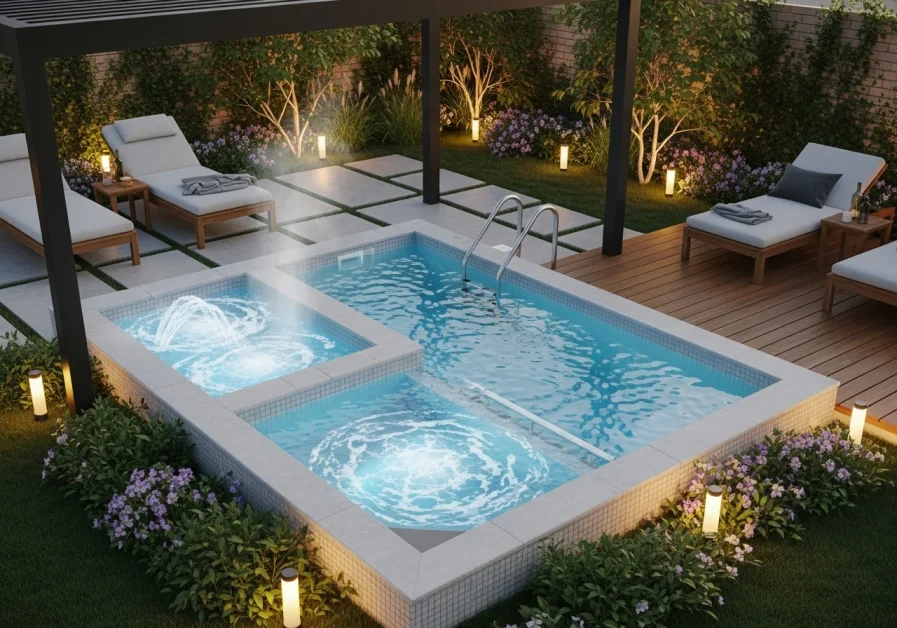
What Is a Plunge Pool Hot Tub Combo?
A plunge pool is a compact pool generally used for dipping, cooling off, or short swims. A hot tub is built for heated soaking. Sellers use “combo” for multiple designs, so the product name alone does not tell you if the water is shared, separately filtered, independently heated, or simply adjusted to a new temperature between uses.
| Configuration | Hot and cool at the same time? | What to check before buying |
|---|---|---|
| Single convertible plunge pool | No—one body of water changes temperature | Rated heating/cooling range, changeover time, jets, cover, operating cost |
| Attached pool and spa with shared water | Not continuously without a specially designed hydraulic arrangement | Valves, spillover mode, heater controls, whether mixed water equalizes temperatures |
| Separate small pool and hot tub | Yes, when each system has suitable independent equipment | Space, two sets of equipment, sanitation and service access |
| Dual-zone swim spa | Yes, on models with genuinely separate temperature zones | Water separation, exact model, electrical demand, delivery access |
If a vendor says “two-temperature combo,” ask for a plumbing diagram and the temperature-control specification—not just photos of two adjacent seating areas.
Four Ways to Combine a Plunge Pool and Hot Tub
1. A single pool you heat or cool as needed
This option has one shell and one water body. It can be economical on space, but changing from cold to hot takes time and energy. A heated plunge pool may not have the seating, jets, controls, or water-temperature capability of a purpose-built hot tub. Plungie, for example, describes optional heating and cooling equipment rather than an automatically included heater; check the exact package and its limitations. Plungie equipment FAQs.
2. A pool with an attached or spillover spa
These installations can look like two connected water features. Some share circulation or water; other designs use specialized equipment and controls. A spillover spa is not automatically an independently heated hot tub beside a cooler pool. Ask how the system works in pool mode, spa mode, and simultaneous operation.
3. Two separate compact water vessels
A compact pool beside an independent hot tub can provide separate temperatures, though it needs more space, equipment, covers, and maintenance planning. It can also let you replace or service each vessel separately. Compare the footprint and budget with the small pool and hot tub layout guide before committing to the design.
4. A genuine dual-zone swim spa
Some large swim spas have a divider and independently controlled water systems. For a documented example, Endless Pools specifies separate swim and spa temperature zones on the X2000; its published overall dimensions are 20 feet long, 89 inches wide, and 58 inches high. That is substantially larger than a typical stand-alone plunge pool. Endless Pools X2000 specifications.
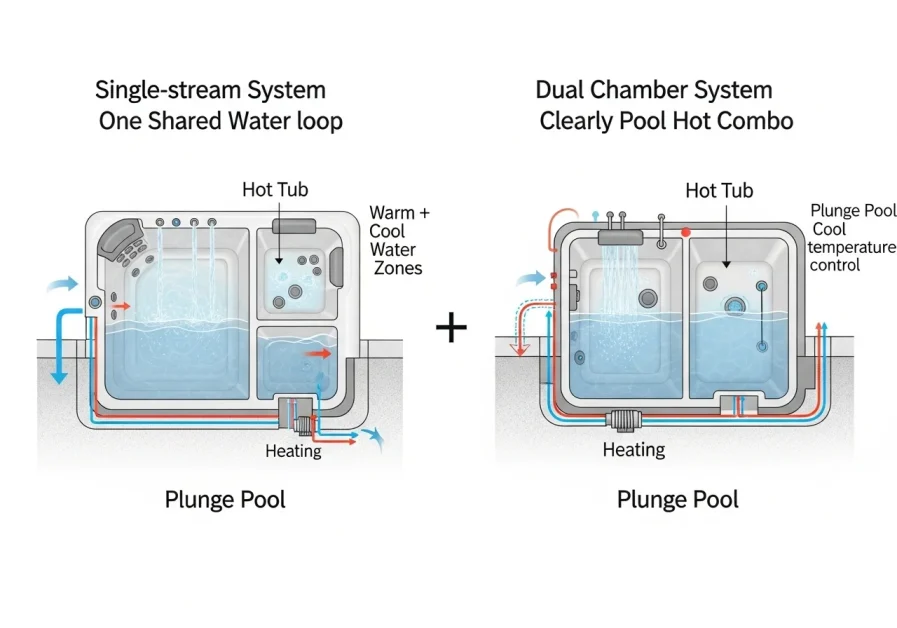
Can a Combo Keep the Pool Cool and the Spa Hot?
Only if the design supports independent water temperatures. A single shared body of water has one temperature at a time, even when it has both bench seating and spa jets. Separate vessels or independently isolated, controlled zones can maintain different temperatures if the heating, circulation, and controls are specified for that purpose.
Ask the dealer to demonstrate a real model or provide a diagram showing the water paths, isolation valves, heaters and filters. Check the manufacturer’s maximum operating temperature and understand what happens during spillover or water-transfer modes. If cold immersion is the main reason you are shopping, our plunge pool and cold plunge comparison explains the differences.
How Much Does a Plunge Pool Hot Tub Combo Cost?
There is no useful universal “combo starting price.” A heated single plunge pool, a bespoke attached pool/spa, a two-vessel installation, and a premium dual-zone swim spa are not interchangeable purchases. The installed cost changes with site access, excavation or foundation work, electrical supply, equipment, permits, labor, finishes, and landscaping.
As one product-only comparison point, Endless Pools listed the X2000 dual-temperature swim spa starting at $59,999 MSRP when checked in October 2026. This is not an installed quote and does not represent the price of smaller convertible plunge pools. Verify the current listing before budgeting. Manufacturer pricing and specifications.
| Quote line item | Questions to ask |
|---|---|
| Water vessel and temperature equipment | Which model, shell, hot/cold controls, filter, pump, heater/chiller and cover are included? |
| Base and structural work | Who designs the pad or foundation and confirms the full operating load? |
| Site access and delivery | Are crane service, gate changes, haul-away, unloading and placement included? |
| Electrical, plumbing and drainage | What service capacity and professional installation are needed? Where can drained water go? |
| Permits, barriers and finish work | Who obtains approvals, and are required barriers, decking, fencing and inspections included? |
| Startup and ongoing ownership | Who tests the system, explains sanitation, and handles warranty or service calls? |
To see how the plunge-pool portion of a project is priced, consult our small plunge pool cost breakdown, but use current local quotes rather than carrying over older price examples.
How Much Space and Structural Support Do You Need?
Measure the water vessel and the space needed for its cover, entry steps, maintenance access, pumps, filters, electrical equipment, and the full delivery route. A feature that fits the visible patio can still fail because a gate is too narrow or there is no access to remove a pump.
- Get the exact manufacturer footprint, height, filled weight and service-clearance drawings.
- Measure gates, paths, overhead wires, turns, slope, equipment-pad space and crane access if necessary.
- Ask a qualified professional to evaluate the site for the combined water, vessel, people and equipment load.
- Plan a safe entry route and a compliant cover or barrier—especially around children.
- Mark the proposed outline on the ground before agreeing to an installation.
A planning aid such as our hot tub filled-weight and load calculator can help you understand the magnitude of water weight. It does not replace a structural design or the manufacturer’s site requirements.
Permits, Electrical Work and Pool Safety
Pools and spas may trigger local building, zoning, electrical, barrier, drainage, or inspection requirements. The rules vary with location and the exact installation; do not assume that all projects above or below one water depth follow the same rule. Check with your local authority before ordering equipment or excavation.
An appropriately qualified electrician should evaluate the actual model’s electrical requirements. The needs of a dual-zone swim spa can be materially different from a small heated plunge pool; do not copy a circuit specification from an unrelated product. Use the model installation manual and locally applicable electrical code.
Children should never be left unattended around pools or spas. The U.S. Consumer Product Safety Commission publishes pool and spa barrier guidance and information on preventing drain-entrapment hazards. For hot-tub-style soaking, CDC advises that water should not exceed 104°F (40°C); follow the manufacturer’s instructions and relevant health guidance. CDC hot tub safety guidance.
Maintenance and Running Costs
A combo is not inherently cheaper or easier to maintain than two separate products. The total depends on the actual circulation and sanitation design, water volume, temperature settings, insulation, equipment runtime and how often the water is used. A dual-zone setup may need separate monitoring for each zone; a shared-water design still needs suitable sanitizer, pH control, filtration and cleaning.
| Ownership question | Why it matters |
|---|---|
| How many separate water systems are there? | Determines how many water balances, filters and service routines must be managed |
| What temperatures will you maintain? | Heating and cooling load is tied to weather, insulation, cover use and setpoints |
| Can pumps, valves and heaters be reached? | Poor service access can increase repair complexity |
| What does the warranty actually cover? | Labor, travel, moving the vessel and landscaping may not be included |
Water can look clear and still be unsanitary. Use the appropriate sanitizer guidance and model-specific care instructions for each vessel; never assume cooling the water replaces filtration or disinfection.
Pool Heating Calculator: A Planning Estimate
The calculator below is part of the original post. It estimates the theoretical energy to raise a rectangular water volume’s temperature. It does not account for heater efficiency, weather, heat loss, insulation, recovery time, or installation price. Real-world energy use may be higher.
This existing tool uses meters and Celsius: feet × 0.3048 = meters; (°F − 32) × 5/9 = °C. Enter the water depth rather than the outside wall height. Use the tool only for heating to a higher target temperature; it does not calculate chilling.
🏊 Pool Heating Calculator
Which Configuration Should You Choose?
| Your main goal | A sensible starting point | Main trade-off |
|---|---|---|
| One small footprint and alternating hot/cold use | A convertible heated/chilled plunge pool | Cannot supply hot and cold simultaneously; changeover takes time |
| A compact pool plus a permanently warm soaking zone | Separate compact pool and hot tub or verified dual-zone equipment | More equipment and more involved installation |
| Swimming exercise and hot-tub seating | A dual-zone swim spa | Long footprint, substantial cost and electrical/site planning |
| A built-in pool/spa aesthetic | A properly engineered attached pool and spa | Water separation and spa operation must be confirmed from the design |
If your dealer’s proposal simply says “spa combo,” ask for the exact manufacturer system configuration in writing. Photos and marketing names cannot substitute for the technical description.
Questions to Ask Before You Sign a Quote
- Can the two areas actually hold different water temperatures at the same time? Show the controls and plumbing diagram.
- What are the delivered dimensions, filled weight and minimum equipment-clearance requirements?
- Does the proposal include heating, cooling, covers, filters, pumps, startup and all necessary controls?
- What is excluded from the total: permits, delivery, crane, base, electrical, drainage, landscaping or barrier work?
- Who is responsible for getting approvals and coordinating qualified contractors?
- What water-testing and maintenance tasks will I need to perform for each separate water body?
- Who handles warranty service in my ZIP code, and what happens if access panels are blocked?
For the physical site-work sequence, our plunge pool installation checklist helps identify access, excavation, drainage and finishing questions before work starts.
Planning note: Prices, available models, code requirements, and equipment specifications depend on the exact product and location. Ask for an itemized installed quote and the current manufacturer’s documents.




6 Comments
Comments are closed.