

Hot Tub Leak Repair Cost: What to Expect

Find a leak in your hot tub is never a fun moment. Your first instinct is probably to wonder how bad the damage is and how much it’s going to cost you. The good news is that most hot tub leaks are fixable, and if you catch them early, the repair cost is often more manageable than you’d expect.
Hot tub leak repair costs typically range from around $100 for a minor seal replacement up to $1,200 or more for a serious plumbing or shell issue.
Where your repair lands in that range depends on a few key factors the location of the leak, the type of hot tub you own, and whether you hire a professional or tackle it yourself.
This guide breaks down exactly what you can expect to pay, what drives those costs up or down, and how to keep your repair bill as low as possible.
What Does It Cost to Repair a Hot Tub Leak?
Hot tub leak repair costs range from $100 to $1,200 or more depending on where the leak is located and how severe it is. Minor leaks around jets or fittings are usually the least expensive to fix, while leaks deep in the plumbing or shell can require significantly more labor and parts.
Most homeowners pay somewhere between $200 and $600 for a professional repair on a moderate leak. That range covers the diagnostic fee, labor, and the cost of any replacement parts needed. If your leak is caught early and the source is easy to access, you may pay even less.
The tricky part with hot tub leaks is that the location matters just as much as the severity. A small crack in an easy-to-reach fitting is a quick fix. A slow drip buried behind the shell liner requires much more labor to locate and repair and that labor time is where costs climb fast.
What Factors Affect Hot Tub Leak Repair Costs?
Several things influence how much you’ll end up paying. Understanding these factors helps you set realistic expectations before you call a repair company.
Location of the leak is the biggest cost driver. Leaks around jets, valves, and surface fittings are accessible and straightforward. Leaks in underground plumbing or deep within the equipment bay take longer to diagnose and fix, which means more labor hours.
Type of hot tub also plays a role. Portable above-ground hot tubs are generally easier and cheaper to repair because the components are more accessible. In-ground hot tubs may require excavation to reach buried plumbing, which adds significantly to the cost.
Labor rates vary by region. Most professional hot tub repair technicians charge between $75 and $150 per hour. Some companies also charge a flat diagnostic or service call fee of $100 to $200, which is often applied toward the total repair cost if you proceed.
Parts and materials add to the final bill. Simple seals and O-rings might cost $5 to $30. A replacement jet costs $20 to $80. Pump components, heater fittings, or specialty plumbing parts can run $100 to $300 or more depending on your hot tub brand and model.
Common Types of Hot Tub Leaks and Their Repair Costs
Not all leaks are created equal. Here is a breakdown of the most common leak types, how difficult they are to fix, and what you can realistically expect to pay.
| Leak Type | Difficulty | Estimated Repair Cost |
|---|---|---|
| Leaking jets or jet fittings | Easy | $100 – $250 |
| Worn O-rings and seals | Easy to moderate | $100 – $300 |
| Plumbing connections and unions | Moderate | $200 – $500 |
| Pump or heater area leaks | Moderate to difficult | $300 – $700 |
| Shell cracks or surface damage | Difficult | $400 – $1,000+ |
| Underground or hidden plumbing | Very difficult | $600 – $1,200+ |
Leaking Jets and Seals
Jets and their surrounding fittings are one of the most common sources of hot tub leaks. Over time, the rubber seals and O-rings inside each jet degrade from constant exposure to hot water and chemicals. When they wear out, water slowly seeps through.
This type of leak is usually easy to spot and fix. A technician can often replace worn jet seals or tighten loose fittings in under an hour. Parts are inexpensive, and if the leak is limited to one or two jets, you’re likely looking at $100 to $250 total.
Plumbing and Pipe Leaks
Plumbing leaks happen when the pipes or unions connecting your pump, heater, and jets develop cracks or loosen over time. These leaks are trickier because the plumbing runs through the equipment bay and sometimes beneath the shell itself.
Depending on how accessible the leaking connection is, a plumbing repair can take one to three hours of labor. Expect to pay $200 to $500 for most plumbing repairs. If the issue requires opening up a larger section of the tub to reach hidden pipes, costs can push higher.
Shell Cracks and Surface Leaks
A cracked shell is one of the more serious hot tub leak situations. These can result from impact damage, freezing temperatures, or age-related wear in the acrylic or fiberglass surface. Small surface cracks can often be repaired with a fiberglass patch or acrylic repair kit. Larger cracks may require professional refinishing.
Professional shell repair typically costs $400 to $1,000 or more. Small DIY patch kits are available for $20 to $50, but they work best on very minor surface damage and should be considered a temporary solution for anything more significant.
Pump and Heater Area Leaks
The pump and heater are the heart of your hot tub’s plumbing system, and they sit in the equipment bay underneath the shell. Leaks in this area often come from worn shaft seals on the pump, loose unions, or degraded fittings on the heater manifold.
These repairs are moderate to difficult because they require opening the equipment bay, draining the tub, and working in a confined space. Labor costs add up quickly here. Budget $300 to $700 depending on how many components need attention and whether any parts need to be ordered.
DIY vs. Hiring a Professional: Which Is Right for You?
For small, accessible leaks, a confident DIYer can absolutely handle the repair. Replacing an O-ring, tightening a union fitting, or applying a sealant to a minor crack are tasks most homeowners can complete with basic tools and a repair kit. Materials for a simple DIY fix typically run $20 to $80, which is a significant saving compared to professional labor rates.
That said, there are situations where calling a professional is the smarter move. If you cannot locate the source of the leak, if the tub is losing water rapidly, or if the leak appears to be in the plumbing or equipment bay, a technician will save you time and prevent the risk of making the problem worse.
It is also worth checking your hot tub warranty before attempting any repair yourself. Some manufacturers void the warranty if unlicensed repairs are made to certain components. Review your documentation or call your dealer to confirm what you can and cannot touch without affecting your coverage.
If you are unsure where to start, connecting with a reputable hot tub repair company can help you get an accurate diagnosis before deciding how to proceed.
How to Find a Hot Tub Leak Before Calling for Repairs
Knowing where your leak is coming from before you call a technician can save you money on diagnostic time. Here is a simple process to help you narrow it down.
- Turn off the jets and watch the water level. If the water level drops with the jets off, the leak is likely in the shell or plumbing rather than the jet fittings themselves.
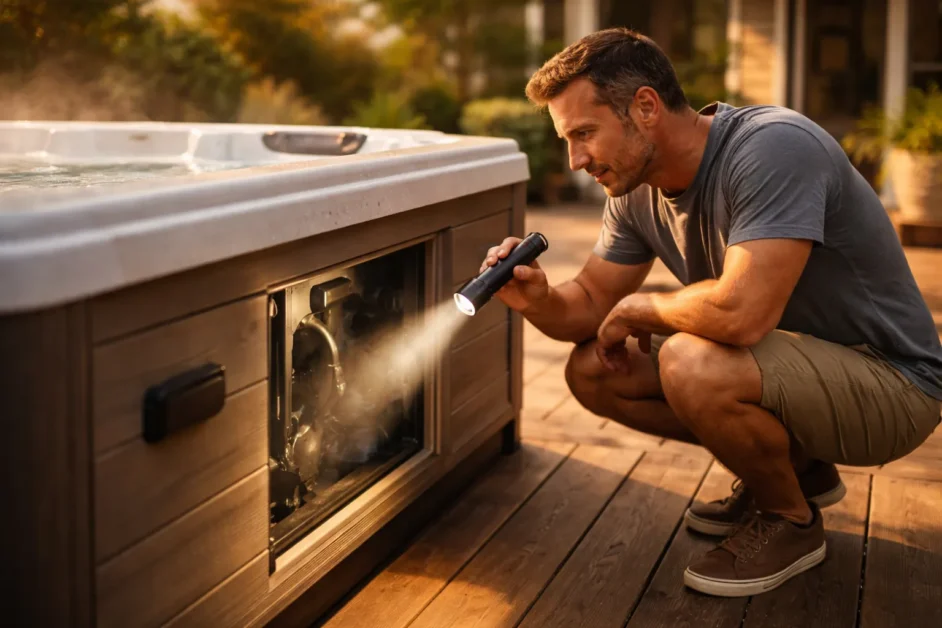
- Check the equipment bay. Open the side panel and look for water pooling, dripping, or moisture around the pump, heater, and pipe connections. Bring a flashlight and inspect each union and fitting carefully.
- Inspect each jet. Run your hand around the rim of each jet while the tub is full. A slight suction break or trickle of water around a jet indicates a bad seal.
- Watch the water level mark. Put a piece of tape on the inside wall of the tub at the waterline. Check it after 24 hours with the jets and pump off. A drop of more than half an inch per day suggests a more significant structural or plumbing leak.
- Check around the base of the tub. Water pooling on the ground directly beneath a specific area of the tub can point you toward the general location of the leak.
- Note when the leak is worst. If water only seems to escape when the jets are running, the problem is almost certainly in the jet fittings or return plumbing. If the tub loses water even when everything is off, the shell or underground plumbing may be involved.
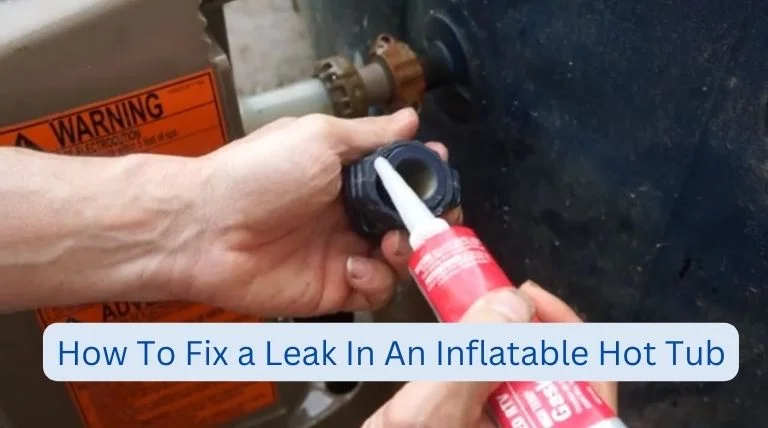
For inflatable hot tubs specifically, the leak detection process is a bit different. You can learn more in this guide on how to find a water leak in an inflatable hot tub.
Tips to Keep Hot Tub Repair Costs Low
The best way to manage leak repair costs is to avoid the conditions that cause leaks in the first place. A few simple habits can make a real difference in how often and how seriously your hot tub leaks.
Check your water chemistry regularly. Water that is too acidic slowly eats away at seals, O-rings, and plumbing fittings. Keeping your pH between 7.4 and 7.6 protects these components and extends their lifespan. Imbalanced water is one of the leading causes of premature seal degradation.
Inspect the equipment bay a few times per year. Opening the access panel and taking a quick look with a flashlight costs you nothing and can catch a slow drip before it becomes a significant problem. Small leaks that are ignored grow into expensive repairs.
Winterize properly if you live in a cold climate. Water that freezes inside your plumbing or shell expands and can crack pipes, fittings, and even the shell itself. Freeze damage is one of the costliest repairs a hot tub owner can face. Following a proper hot tub winterizing process every fall eliminates this risk entirely.
Replace O-rings and seals proactively. These are inexpensive parts that wear out over time. If you are already draining your tub for a seasonal refill, it is worth inspecting and replacing any seals that show signs of wear. A $5 O-ring replaced proactively is far better than a $400 pump repair caused by a blown seal.
Get multiple quotes. If you do need professional help, contact two or three repair companies before committing. Labor rates and service fees vary, and a second opinion can also help you confirm the diagnosis.
When Is It Better to Replace Than Repair?
Most hot tub leaks are worth repairing especially if the tub is less than ten years old and the rest of the equipment is in good shape. But there are situations where the repair math stops making sense.
If a single repair is going to cost more than 50% of what a comparable replacement hot tub would cost, it is worth pausing and thinking carefully. The same is true if your tub has a history of multiple leaks or recurring issues with the same components. Repeated repairs on aging equipment can quickly add up to more than a new tub would cost.
You can learn more about how long hot tubs last to help you make an honest assessment of whether your tub still has plenty of good years ahead or whether its time may be running short. An honest repair technician should also be willing to give you a frank opinion on whether the tub is worth saving.e source of the leak.
Frequently Asked Questions
Is it worth fixing a leaking hot tub?
Yes, in most cases it is worth fixing. If your hot tub is in good overall condition, repairing the leak is almost always cheaper than replacing the entire tub. The older your hot tub is, the more carefully you should compare repair costs against what a replacement would run.
Where do most hot tub leaks happen?
Most hot tub leaks occur around the jet fittings, O-rings, and the plumbing unions near the pump and heater. These areas handle constant water pressure and chemical exposure, so they tend to wear out before anything else.
Do you have to drain a hot tub to fix a leak?
Yes, most leak repairs require draining the tub first. Draining gives you safe access to the problem area and lets you inspect surrounding components for wear. A full drain is almost always needed for a lasting fix.
How long does hot tub leak repair take?
Simple repairs like a jet seal or a loose union typically take one to two hours. More complex repairs involving the pump, heater, or shell can take a full day, especially if parts need to be ordered.
Can I use hot tub sealant to fix a leak myself?
Yes, for small surface leaks. Products like Fix-A-Leak work on minor cracks and pinholes but are best used as a temporary fix. Any leak involving plumbing or equipment should be handled by a professional.
Why is my hot tub leaking from underneath?
A leak from underneath usually points to a problem with the pump, heater, or plumbing connections inside the equipment bay. Open the access panel with a flashlight and look for dripping or moisture around fittings. If you cannot identify the source, call a technician before the damage spreads.
Final Thoughts
A leaking hot tub feels stressful in the moment, but the reality is that most leaks are fixable and most repairs fall within a manageable cost range. The key is catching the problem early, understanding where the leak is coming from, and knowing when to call in a professional.
Minor leaks repaired quickly rarely turn into major expenses. What drives repair bills up is delay a small drip ignored for months becomes a bigger plumbing problem that costs three times as much to fix.
Stay on top of regular inspections, keep your water chemistry balanced, and winterize properly, and you will dramatically reduce the chances of a serious leak developing.
For a full picture of how to keep your hot tub in great shape year-round, the complete hot tub maintenance guide is a great place to start. A little routine care now saves a lot of repair headaches later.








One Comment
Comments are closed.