What a Used or Second-Hand Hot Tub Is Actually Worth (and Why)

There is no official Blue Book for hot tubs, so used hot tub value has to be estimated from the local market, the spa’s condition, and the costs a buyer will take on after purchase.
Two hot tubs from the same year can have very different resale values. A clean spa that is filled, heated, and available for a buyer to test is easier to value than a drained tub with unknown pump, heater, or leak problems.
Current asking prices can give you a starting point, but they are not the same as completed-sale prices. The better approach is to compare similar tubs in your area, inspect the condition of yours, account for removal and repair costs, and then set both an asking price and a lowest acceptable price.
For a preliminary resale estimate, use our hot tub value calculator. Then follow the steps below to check that estimate against local comparable listings and the spa’s actual condition.
Is There a Blue Book Value for Hot Tubs?
No official nationwide Blue Book equivalent exists for used hot tubs.
Unlike cars, used spas do not have a standardized national transaction database that can assign one dependable resale figure based on year, model, and mileage.
Hot tubs are harder to value because the final price can change significantly based on:
- local supply and demand
- brand and model
- age
- condition
- whether the tub can be shown running
- service history
- parts availability
- removal difficulty
- moving costs
- electrical requirements
- warranty status
That means a five-year-old hot tub cannot be valued accurately from age alone.
A buyer may happily pay more for a seven-year-old premium spa that is clean, documented, and running properly than for a newer tub with leaks, a noisy pump, or unknown history.
What Are Used Hot Tubs Asking for in 2026?
Current marketplace data shows just how wide the used-hot-tub market can be.
A September 15, 2026 snapshot from Commonplace reported a $3,250 median asking price for used hot tubs in its U.S. marketplace, with the middle 50% of listings between $1,800 and $6,000. The source clearly identifies these as asking prices, not confirmed sale prices.
That distinction matters.
Asking price is not the same as market value, and market value is not necessarily the final sale price.
A seller can list a spa for $6,000. That does not prove a buyer will pay $6,000.
The same September data also showed substantial variation by brand and location. This is another reason a national average should be treated as context rather than a price tag for your individual spa.
Use Current Market Data as a Starting Point
A better process is:
- Look at current market data for context.
- Find comparable spas near you.
- Compare condition and age.
- Account for removal and setup costs.
- Adjust your asking price accordingly.
Do not price your spa from one national number.
How to Estimate Your Used Hot Tub Value in 6 Steps
A simple valuation process works better than guessing a depreciation percentage.
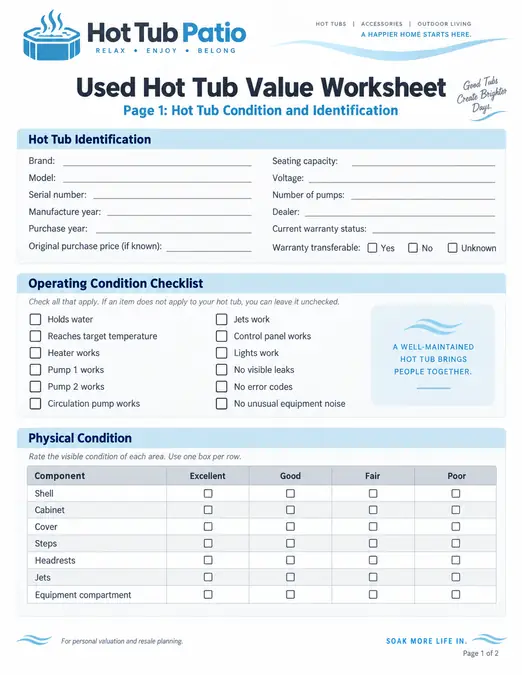
Step 1: Identify the Exact Hot Tub
Start with the basic facts.
Write down:
- manufacturer
- model
- approximate manufacture year
- seating capacity
- voltage
- number of pumps
- major features
- control system
- optional equipment
If you still have the original receipt, manual, warranty paperwork, or dealer invoice, collect those too.
The exact model matters because buyers may search specifically for brands such as Jacuzzi, Hot Spring, Sundance, Bullfrog, Caldera, or other established manufacturers.
Step 2: Verify That the Spa Works
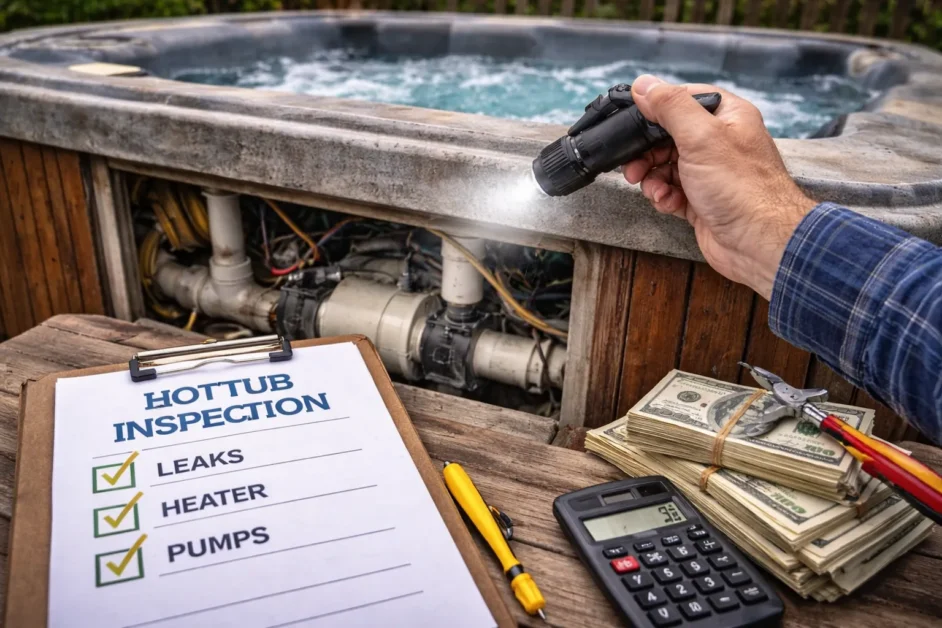
A used hot tub is easier to value when its operating condition can be demonstrated.
Check:
- Does it hold water?
- Does it reach the set temperature?
- Do all pumps run?
- Do the jets work?
- Does the circulation system operate?
- Are there visible leaks?
- Does the control panel work?
- Do the lights work?
- Are there error codes?
- Are there unusual pump or motor noises?
Jacuzzi recommends seeing a used spa operating when possible and checking for leaks, heating performance, missing components, pump or motor noise, and maintenance history.
Do not hide a known problem when selling. A documented defect with an estimated repair cost is easier for a buyer to evaluate than an unexplained problem discovered after pickup.
Step 3: Find Local Comparable Listings
Search for tubs that are as close as possible to yours in:
- brand
- model
- age
- seating capacity
- condition
- equipment
- geographic area
Look at several listings, not just the highest one.
A premium six-person spa should not be compared directly with an entry-level plug-and-play tub simply because both are seven years old.
Step 4: Grade the Condition
Use a simple condition category rather than trying to invent an exact percentage adjustment.
| Condition | What It Looks Like |
|---|---|
| Excellent | Clean, fully operational, no known leaks, good cover, maintenance records available |
| Good | Fully operational with normal cosmetic wear |
| Fair | Operational but has worn components or maintenance coming due |
| Project | Untested, leaking, non-heating, noisy equipment, error codes, or major known defects |
Condition should affect both your price and how you present the listing.
A project spa can still have value to the right buyer, but it should not be priced like a tub that can be demonstrated at full temperature.
Step 5: Account for the Buyer’s Extra Costs
The buyer does not see only your asking price.
They see the all-in cost of getting the spa home and operating.
That may include:
- professional moving
- trailer or equipment rental
- crane service for difficult access
- site preparation
- concrete or structural work
- electrical connection
- replacement cover
- new filters
- water-care supplies
- immediate repairs
These costs can have a large effect on what someone is willing to pay for the tub itself.
Step 6: Set an Asking Price and a Walk-Away Price
Do not use one number for both.
Your asking price gives you some room for reasonable negotiation.
Your walk-away price is the lowest amount you are willing to accept based on the tub’s condition, demand, and your need to remove it.
Write both numbers down before listing the spa.
That makes it easier to respond calmly when a buyer makes an offer.
What Factors Affect Used Hot Tub Value Most?
Age matters, but several other factors can matter just as much.
| Factor | Helps Value | Hurts Value |
|---|---|---|
| Working condition | Filled, heated, fully demonstrable | Drained, untested, or non-working |
| Shell | Clean and intact | Cracked, blistered, or badly damaged |
| Pumps and heater | Quiet and functional | Leaks, noise, heating problems |
| Cover | Dry, fitted, serviceable | Heavy, torn, waterlogged |
| Cabinet | Clean and structurally sound | Rot, cracks, major fading |
| Service history | Receipts and records | Unknown maintenance history |
| Parts availability | Current or well-supported platform | Obsolete controls or difficult parts |
| Access | Easy removal route | Tight gates, stairs, crane requirement |
| Warranty | Verified remaining transferable coverage | Expired or non-transferable coverage |
| Documentation | Model, serial, manuals available | Unknown year or model |
The best resale position is a tub that creates as little uncertainty as possible for the buyer.
How Much Does Hot Tub Age Affect Resale Value?
Age lowers the ceiling on used hot tub value, but condition determines where the spa lands below that ceiling.
An older tub usually has:
- more wear on pumps
- more wear on seals
- older controls
- older insulation
- an older cover
- greater risk of future repairs
But age should not be used by itself.
A well-maintained eight-year-old premium spa may still be attractive if replacement parts remain readily available and the tub can be demonstrated working.
A neglected four-year-old tub with a leaking pump and damaged cabinet can be much less appealing.
For a deeper look at how age affects value, see our guide to hot tub depreciation and why spas lose value.
Why a Running Hot Tub Is Easier to Sell and Value
A tub that can be shown filled and operating removes several major unknowns.
The buyer can verify:
- water stays inside the spa
- heater reaches temperature
- circulation works
- jets operate
- pumps sound normal
- control panel works
- lighting works
- obvious error codes are absent
Jacuzzi recommends asking to see a used spa operate or requesting a wet test because it provides far more information about the tub’s actual condition.
What If the Tub Is Already Drained?
A drained spa is not automatically worthless.
You can reduce uncertainty by providing:
- recent operating videos
- dated photos
- service invoices
- maintenance records
- repair receipts
- model and serial information
- a written list of known issues
Avoid applying a universal percentage discount just because a spa is dry. The actual discount depends on how much uncertainty the buyer sees and how strong the supporting records are.
How Moving Costs Affect What a Buyer Will Pay
A used hot tub may weigh hundreds of pounds even before water is added.
The buyer has to figure out how to:
- disconnect it safely
- get it through your yard
- cross gates or stairs
- load it
- transport it
- unload it
- place it at the new site
- reconnect electrical service
That creates a useful valuation concept:
Buyer all-in cost = hot tub price + moving + installation + electrical work + immediate repairs
Example
This is a hypothetical example, not a national cost estimate.
| Expense | Example Cost |
|---|---|
| Used hot tub | $3,000 |
| Moving | $500 |
| New cover and filters | $600 |
| Site/electrical work | $800 |
| First-stage buyer cost | $4,900 |
The tub may be advertised at $3,000, but the buyer is making a decision closer to $4,900 in this example.
That is why difficult removal access can affect resale value even when nothing is wrong with the spa itself.
Does Hot Tub Brand Affect Resale Value?
Brand can influence what buyers are willing to pay, but it should not override condition.
Current marketplace data shows different asking-price medians among major brands, which suggests buyers and sellers do not treat every spa as interchangeable.
Brand can affect value through:
- original price
- dealer network
- parts availability
- shell and frame construction
- equipment support
- reputation
- documentation availability
Still, a premium logo cannot compensate for serious leaks, an obsolete control system, or a spa that cannot be demonstrated working.
Use brand as one part of the valuation, not the entire valuation.
Does the Hot Tub Warranty Transfer to a New Owner?
Do not assume that the original warranty follows the hot tub when it is sold.
Warranty rules vary by manufacturer, model, region, and purchase terms.
For example, Hot Spring’s current Freeflow warranty applies to the original consumer purchaser and states that coverage is not transferable.
Sundance advises owners to check the exact warranty terms because transferability varies by brand and region.
Jacuzzi also recommends asking about warranty status and whether any remaining coverage is transferable when evaluating a used tub.
Before Advertising “Warranty Remaining”
Confirm:
- exact manufacturer
- model year
- original purchase date
- original purchaser requirements
- transfer rules
- registration requirements
- geographic restrictions
If you cannot verify transferability, do not include warranty coverage in your valuation.
Private Sale Value vs Trade-In Value
The same hot tub may have different values depending on how it is sold.
Private Sale
Selling directly to another owner usually means you handle:
- listing
- photos
- questions
- negotiation
- buyer screening
- scheduling
- pickup coordination
The tradeoff is that you may have more control over the asking price.
For the complete selling process, follow our guide to selling a used hot tub.
Dealer Trade-In
A dealer may make the transaction easier, but the dealer also has to account for:
- pickup
- inspection
- repairs
- cleaning
- storage
- warranty risk
- resale margin
So a trade-in offer should not be expected to equal a private-party asking price.
Compare convenience and net proceeds rather than comparing the two numbers in isolation.can cost more than the tub is worth.
Should You Repair a Hot Tub Before Selling It?
Some repairs improve buyer confidence enough to make sense. Others can cost more than they add to the sale price.
Use this table as a starting point:
| Problem | Consider Fixing Before Sale? |
|---|---|
| Dirty shell | Yes |
| Dirty equipment bay | Yes |
| Old disposable filters | Often |
| Missing documentation | Organize what you have |
| Small cosmetic cleanup | Usually |
| Waterlogged cover | Compare replacement cost with likely price benefit |
| Minor known component problem | Get a repair estimate first |
| Failed pump | Compare repair cost with value increase |
| Failed heater | Compare repair cost with value increase |
| Major plumbing leak | Get professional diagnosis before spending |
| Structural shell damage | May change the entire repair-versus-sell decision |
The useful question is:
Will this repair increase the net amount I keep after the sale?
A $900 repair that raises the realistic selling price by only $400 does not make financial sense unless it is necessary to make the tub sellable.
Before listing, use our hot tub preparation checklist for sellers to handle cleaning, testing, documentation, and presentation.
Used Hot Tub vs New Hot Tub: Compare the Real Cost
Buyers should compare more than sticker price.
| Used Hot Tub | New Hot Tub |
|---|---|
| Lower initial purchase price | Higher initial purchase price |
| Condition needs verification | Known starting condition |
| May need immediate parts or service | Lower immediate repair uncertainty |
| Warranty may be expired or non-transferable | Manufacturer warranty generally included |
| Buyer may arrange moving | Dealer delivery may be available |
| Older technology possible | Current controls and features |
| More depreciation already absorbed | Greater early depreciation |
| Limited choice of models | More choice in size, color, and features |
Jacuzzi notes that refurbished dealer spas may sometimes include dealer-backed coverage, while a private-party used spa may have less predictable history and warranty protection.
The correct comparison is the total first-year ownership cost, not just the purchase price.
When Is a Used Hot Tub Worth Very Little?
A spa can reach a point where its removal burden and repair needs overwhelm its resale value.
Warning signs include:
- serious shell damage
- major structural leaks
- multiple failed pumps
- heater and control problems together
- obsolete control equipment with poor parts availability
- severe cabinet deterioration
- repeated freeze damage
- unknown condition and no way to test the tub
- expensive crane or structural removal
- several costly repairs due at once
An old spa is not automatically worthless.
The key question is how much useful life and reliable operation the buyer is getting after accounting for repairs and logistics.
In some cases, a low price or free pickup arrangement is more realistic than waiting months for an optimistic asking price.
How to Set Your Asking Price
Once you have inspected the tub and researched comparable listings, use this process.
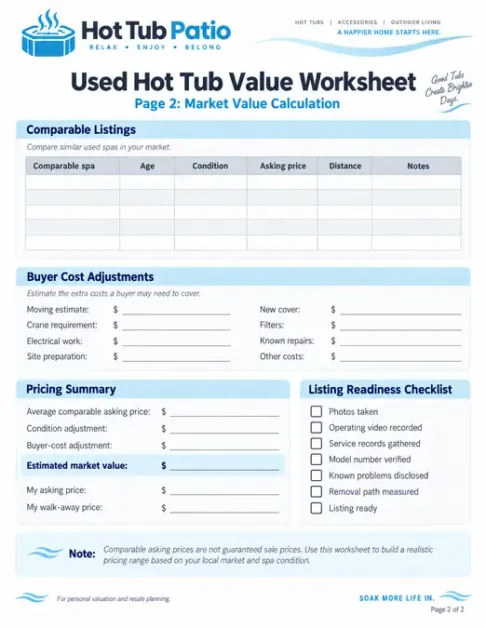
- Gather at least several comparable listings.
- Remove obvious outliers.
- Identify tubs closest to yours in age and condition.
- Adjust for known equipment differences.
- Account for removal difficulty.
- Account for immediate repair needs.
- Decide on your realistic market value.
- Add a modest amount of negotiation room.
- Set your walk-away price separately.
Do not start from what the hot tub originally cost and assume the market owes you a particular percentage back.
The market cares about what the spa is worth now.
Used Hot Tub Value Example
Suppose you have:
- six-person premium-brand spa
- seven years old
- fully operational
- no known leaks
- working heater and pumps
- normal cosmetic wear
- service receipts
- aging cover
- straightforward backyard access
You find several reasonably comparable local asking prices around:
- $2,700
- $3,100
- $3,400
- $3,800
You should not automatically choose $3,800 because it is the highest.
Compare each tub’s condition, equipment, cover, age, and removal situation.
If yours has a worn cover but excellent maintenance records, you might position it near the middle of the local group rather than at the top.
The purpose of comparable listings is to create a reasonable pricing zone, not to discover one mathematically perfect number.
Tailored Action Plan
Use this workflow before listing your hot tub.
If Your Tub Is Running
- Fill and heat it if practical.
- Check every pump and jet.
- Look underneath for leaks.
- Record a short operating video.
- Photograph the control panel at temperature.
- Gather maintenance records.
- Find local comparable listings.
- Calculate buyer removal difficulty.
- Set asking and walk-away prices.
- Keep the spa testable until serious buyers have inspected it, when practical.
If Your Tub Is Already Drained
- Gather recent operating photos or video.
- Find service records and receipts.
- Photograph the equipment compartment.
- Record the exact model and serial number.
- List every known defect clearly.
- Avoid pricing it as though the buyer can verify current operation.
- Decide whether refilling and demonstrating it is practical before listing.
If the Tub Needs Repair
Get a repair estimate before authorizing expensive work.
Compare:
Expected sale price after repair – repair cost
against:
Expected sale price as-is
Choose the option that leaves you with the better realistic net result.
If You Need It Gone Quickly
Price and logistics matter more than squeezing out the highest possible number.
Make removal easy by providing:
- spa dimensions
- estimated dry weight when known
- gate width
- stair information
- photos of the access path
- electrical disconnection status
- crane-access notes if relevant
Removing uncertainty can attract more serious buyers.
Downloadable Resource
Frequently Asked Questions
How much is a used hot tub worth in 2026?
There is no single value for all used hot tubs. A September 2026 marketplace snapshot from Commonplace showed a $3,250 median asking price and a middle-50% range of $1,800 to $6,000, but those figures are asking prices rather than confirmed sale prices.
Is there a Blue Book value for hot tubs?
No official nationwide Blue Book equivalent exists for hot tubs. The most useful valuation combines comparable local listings, age, condition, operating status, brand, removal costs, and expected repairs.
How much is a 5-year-old hot tub worth?
Age alone is not enough to set a price. Compare your five-year-old spa with similar local models, then adjust for condition, brand, maintenance history, equipment, cover condition, and removal difficulty.
How much is a 10-year-old hot tub worth?
A 10-year-old hot tub can still have resale value if it works well, has available replacement parts, and can be demonstrated operating. Value falls sharply when major repairs, obsolete controls, structural leaks, or difficult removal add too much buyer risk.
Is a running hot tub worth more than a drained hot tub?
Being able to demonstrate that the spa heats, circulates, holds water, and operates normally reduces buyer uncertainty. A drained tub can still sell, but records, recent video, and service documentation become more important. Jacuzzi recommends seeing a used tub operate when possible.
Does a hot tub warranty transfer to a second owner?
It depends on the manufacturer and warranty. Some warranties are limited to the original purchaser, while others may have different transfer conditions, so check the exact warranty document before including warranty coverage in the resale value.
How much should moving costs affect used hot tub value?
There is no universal deduction. A buyer considers the combined cost of the spa, removal, transportation, site preparation, electrical work, and immediate repairs, so difficult or expensive removal can reduce what they are willing to pay for the tub itself.
Should I repair my hot tub before selling it?
Repair it when the expected increase in sale value is greater than the repair cost or when the repair is necessary to make the spa marketable. Get estimates for expensive pump, heater, plumbing, or control repairs before deciding.
What is the difference between trade-in value and private-sale value?
A private sale may give you more control over pricing but requires you to manage buyers and removal. A dealer trade-in is more convenient, but the dealer must account for transport, inspection, refurbishment, warranty risk, storage, and resale margin.
Why are some used hot tubs listed for free?
Free or very inexpensive tubs often come with significant removal, repair, or disposal costs. Treat the total cost of moving and restoring the spa as part of its real price.
Set a Price the Market Can Support
A realistic used hot tub value comes from evidence rather than one depreciation percentage.
Identify the spa, verify that it works, compare similar local listings, account for buyer expenses, and be clear about defects. Once you have that information, set an asking price with some negotiation room and decide your walk-away number before buyers start contacting you.
Before doing the full comparison, start with the hot tub resale value calculator, then check the result against your local market, repair needs, and moving costs.