Hot Tub Load Calculator: Filled Weight & PSF

A hot tub load calculator is useful for one job: estimating the weight of the spa, water, and occupants, then showing the average load across the tub’s footprint. That gives you a practical planning number before installation.
It does not tell you whether a deck is structurally safe. Hot tubs create large concentrated loads, and real capacity depends on the framing, support points, connections, footings, condition, local code, and the spa manufacturer’s requirements. Use the calculator for the math, then use the result as an input for installation planning.
Hot Tub Load Calculator
Enter the dry weight and water capacity from the spa’s specification sheet, the number and estimated weight of occupants, and the actual base dimensions. The calculator returns water weight, occupant weight, total loaded weight, footprint area, and average footprint load in both US and metric units.
For other planning tools, see the Hot Tub Patio calculation tools hub.
What Your Hot Tub Load Result Means
The total loaded weight is the useful starting number. It combines the dry spa, the estimated water load, and the occupants you entered. The PSF result then divides that total by the rectangular base area you supplied.
That average PSF can help you describe the project to a contractor, engineer, installer, or building department. It should not be read as a green-light or red-light safety score. A spa may bear on a perimeter frame, molded base, rails, pads, or other support points, so the structure below can experience loads differently from a simple uniform average.
The American Wood Council's prescriptive deck guidance makes this distinction explicit: its DCA 6 deck guide says decks supporting large concentrated loads such as hot tubs are beyond the scope of the document. See the AWC DCA 6 deck guide.
How the Hot Tub Load Calculation Works
The calculator uses three simple steps:
- Water weight: water capacity × 8.34 lb per US gallon.
- Total loaded weight: dry spa weight + water weight + occupant weight.
- Average footprint load: total loaded weight ÷ base area in square feet.
The U.S. Geological Survey uses approximately 8.34 pounds per US gallon for water in its conversion examples. Real water density changes slightly with temperature, so this is an installation-planning approximation rather than laboratory mass measurement.
Worked Hot Tub Load Example
Suppose a spa has a 900 lb dry weight, 400 US gallon capacity, four occupants averaging 185 lb each, and a 7 ft by 7 ft base. The example is only to show the arithmetic; use your model's actual specifications for a real project.
| Part of the calculation | Example | Result |
|---|---|---|
| Water | 400 × 8.34 | 3,336 lb |
| Occupants | 4 × 185 | 740 lb |
| Total loaded weight | 900 + 3,336 + 740 | 4,976 lb |
| Base area | 7 × 7 | 49 ft² |
| Average footprint load | 4,976 ÷ 49 | 101.6 lb/ft² |
The correct takeaway is not “101.6 PSF means safe” or “101.6 PSF means unsafe.” The useful takeaway is that the installation involves about 4,976 lb of loaded spa weight over the stated footprint, which a structural professional can evaluate against the actual load path.
Why PSF Alone Cannot Tell You Whether a Deck Is Safe
A common shortcut is to compare hot tub PSF with a generic deck live-load number. That comparison can provide context, but it is not a structural approval method.
For example, the 2021 International Residential Code lists a 40 psf minimum uniformly distributed live load for exterior balconies and decks. The American Wood Council also explains that DCA 6 framing is based primarily on a 40 psf uniformly distributed live load plus dead load under the IRC framework. Those are design assumptions for distributed loading, not a universal hot-tub pass/fail threshold.
Actual hot tub support can depend on joist spans and spacing, beam locations, posts and footings, ledger and connection details, cantilevers, soil, snow or other environmental loads, deterioration, and where the spa's base transfers weight into the deck. That is why this calculator no longer labels a result “safe,” “reinforcement required,” or “within standard limits.”
If the spa will sit on a deck, use our hot tub deck and patio building guide for the broader planning questions, then confirm the final structural design with the appropriate local professional or authority.
Where to Find the Correct Calculator Inputs
The quality of the result depends more on your inputs than on the formula. Start with the manufacturer's specification sheet or owner's manual whenever possible.
| Input | Best source | Common mistake |
|---|---|---|
| Dry weight | Manufacturer specification sheet | Using shipping weight or guessing from tub size |
| Water capacity | Manufacturer stated operating capacity | Calculating from outside cabinet dimensions as if the spa were an empty box |
| Base length and width | Manufacturer base dimensions or direct measurement | Using deck area instead of the spa's supported footprint |
| Occupants | Your expected or maximum planned use | Leaving people out of the planning estimate |
| Occupant weight | A realistic project-specific estimate | Assuming the calculator's example value matches every household |
If the manufacturer already publishes a clearly defined filled or operating weight, keep that number with your project notes. Do not mix a manufacturer filled-weight figure with this calculator's separate dry-weight and water inputs unless you understand exactly what the published figure includes.
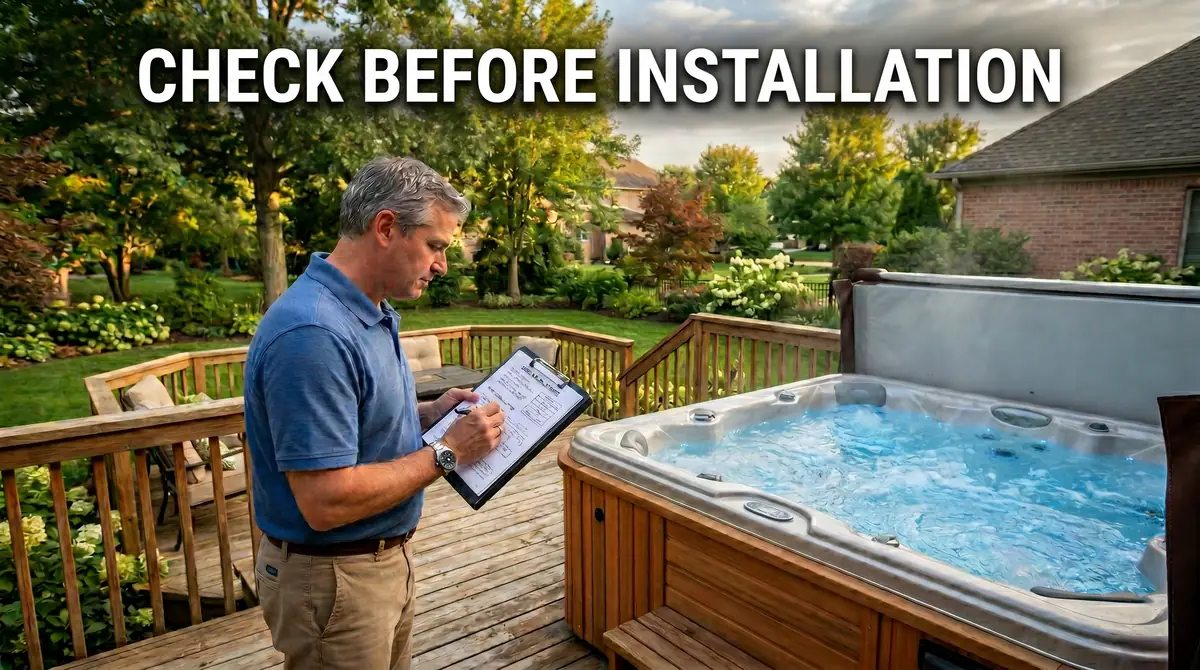
What to Check Before Installing a Hot Tub on a Deck
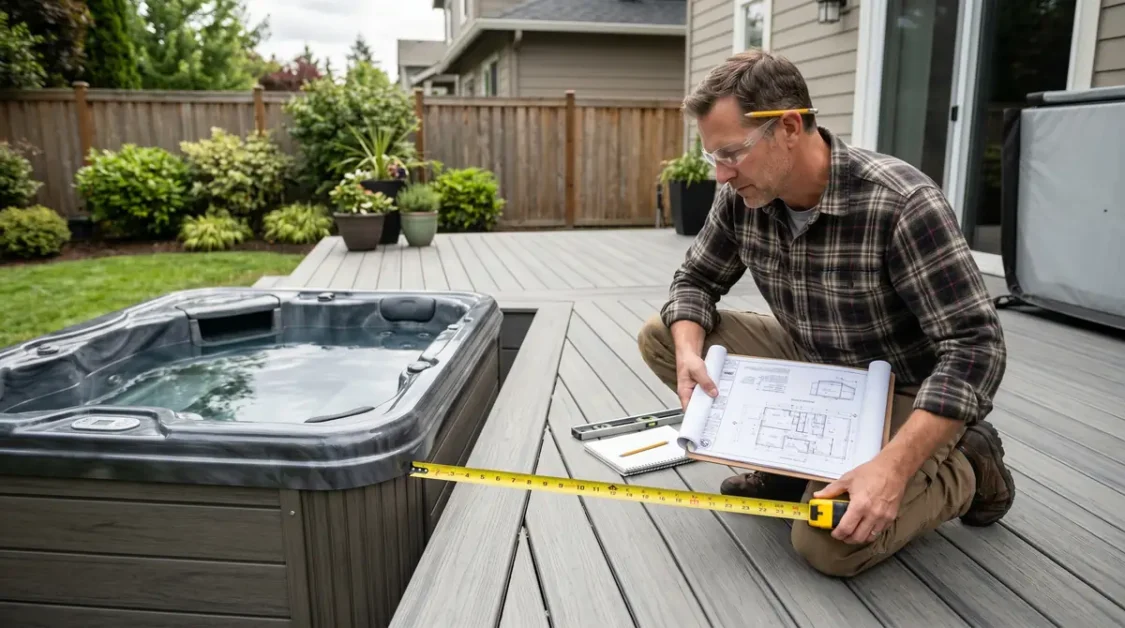
The calculator gives you numbers to bring into the next stage of planning. Before placing a spa on a raised or existing deck, verify the points that the calculator cannot inspect.
- The spa manufacturer's foundation and support instructions.
- Existing deck plans, permits, or structural documentation if available.
- Joist, beam, post, footing, ledger, connection, and cantilever details.
- Visible deterioration such as rot, corrosion, cracking, movement, or damaged connections.
- Local building-code, permit, snow-load, seismic, wind, or other jurisdiction-specific requirements that apply to the project.
- Professional structural review when the load path or existing capacity is not documented.
For the rest of the project sequence, the hot tub installation guide covers site preparation and installation planning beyond this calculator's weight estimate.
Hot Tub Load Planning Checklist
- Verify the model: save the manufacturer spec sheet or manual for the exact spa.
- Record dry weight and water capacity: do not substitute generic size averages when model data is available.
- Measure the supported footprint: use the actual base dimensions that transfer load to the surface.
- Add occupants: use a realistic number and weight estimate for the people expected to use the spa.
- Run the calculator: save the total loaded weight and average PSF as planning numbers.
- Do not self-certify the deck from PSF alone: the load path and structure still need evaluation.
- Confirm before delivery: resolve foundation, deck, permit, and access questions before the spa arrives.
FAQs About Hot Tub Load Calculations
How much does hot tub water weigh?
For planning in US customary units, use about 8.34 lb per US gallon. A 400-gallon water volume is therefore about 3,336 lb before adding the dry spa or occupants.
Can I tell if my deck is safe from the PSF result?
No. The calculator gives an average footprint load, while deck safety depends on the actual structural system and how the hot tub transfers its concentrated load into that system.
What if my manufacturer lists a filled weight?
Use the manufacturer's definition first. Check whether that filled weight includes water only or also assumes occupants, then avoid adding the same component twice.
Does an inflatable hot tub still need a load calculation?
Yes if it will sit on a deck or other structure. A light empty shell can still hold a large mass of water, so the loaded condition matters far more than the package weight.
Can this calculator size joists, beams, posts, or footings?
No. It does not perform structural member design, check connections, account for site-specific loads, or replace code review. Use the result as project information for a qualified professional or local building authority.
Use the Number as a Planning Input, Not a Safety Rating
The useful output from a hot tub load calculator is the estimated loaded weight and average footprint load. Those numbers help you plan and communicate the project, but they do not certify a deck. Confirm the spa specifications first, calculate the load, then have the actual support system evaluated before installation when structural capacity is uncertain.