
How to Heat a Pool Fast: Fastest Methods and Heating Times

The fastest way to heat a pool is usually a properly sized gas pool heater, especially when you need a large temperature increase within the same day. A heat pump can make more sense when you have more time, while a good pool cover helps either system by slowing heat loss.
The actual heating time depends on four things: your pool’s gallons, the current water temperature, your target temperature, and the heater’s BTU output. A small pool that needs another 5°F can warm much faster than a 20,000-gallon pool that needs a 15°F increase.
Not sure what temperature to aim for? Start with our guide to choosing an ideal pool temperature for your swimming habits and weather.
How Long Does It Take to Heat a Pool?
Pool heating time can range from a few hours to several days. The biggest variables are how much water you have, how many degrees you need to add, and how much heat your equipment can deliver each hour.
A useful starting formula is:
BTUs required = Pool gallons × 8.34 × Temperature rise in °F
Then estimate heating time with:
Heating hours = BTUs required ÷ delivered heater BTUs per hour
For example, a 15,000-gallon pool that needs to rise from 72°F to 82°F needs a 10°F temperature increase.
The calculation is:
15,000 × 8.34 × 10 = 1,251,000 BTUs
If the system can deliver 300,000 BTUs of heat to the water each hour:
1,251,000 ÷ 300,000 = about 4.2 hours
That is an ideal baseline. Real heating normally takes longer because the pool is losing heat to evaporation, wind, cooler air, plumbing, and surrounding surfaces while the heater is working.
Pentair also cautions that real heater and heat-pump performance can change with factors such as weather, wind, humidity, pool volume, plumbing, location, and operating conditions.
Pool Heating Time Quick Reference
The table below assumes a 10°F temperature increase and 300,000 BTU/hr of delivered heat. It shows the ideal water-heating time before real-world heat losses are added.
| Pool Volume | BTUs Needed for +10°F | Ideal Heating Time |
|---|---|---|
| 5,000 gallons | 417,000 BTU | 1.4 hours |
| 10,000 gallons | 834,000 BTU | 2.8 hours |
| 15,000 gallons | 1,251,000 BTU | 4.2 hours |
| 20,000 gallons | 1,668,000 BTU | 5.6 hours |
These numbers are planning estimates, not guaranteed warm-up times.
If you are unsure how much water your pool holds, use our step-by-step pool volume guide before doing the heating calculation.
What Makes a Pool Heat Faster or Slower?
Two pools with the same heater can have very different warm-up times. These are the factors that matter most.
Pool Volume
More gallons mean more water to warm.
A 20,000-gallon pool needs twice as much energy as a 10,000-gallon pool to achieve the same temperature increase, assuming everything else is equal.
This is why knowing your actual volume is more useful than estimating heating time based only on pool length and width.
Temperature Increase
Heating from 76°F to 81°F requires a 5°F rise.
Heating from 66°F to 81°F requires a 15°F rise, which takes about three times as much heat energy.
Check the water before starting the heater so you know the actual temperature difference you are trying to cover.
Heater Output
Higher heating capacity usually means a faster warm-up when the heater is correctly sized and operating under suitable conditions.
Pentair notes that many pool heat pumps provide roughly 100,000 to 150,000 BTU of heating capacity, while many gas pool heaters are available around 175,000 to 400,000 BTU. The specific equipment rating matters more than the heater category alone.
Weather and Air Temperature
Cold, windy weather makes heating harder because the pool is losing heat while your heater is adding it.
Heat pumps are particularly affected by ambient conditions because they pull heat from the surrounding air. Gas heaters are generally less dependent on warm outdoor air, which is one reason they are often chosen when faster heating is the priority.
Evaporation and Wind
Evaporation can remove a surprising amount of heat from an uncovered pool.
The U.S. Department of Energy identifies evaporation as the largest source of pool heat loss in its pool-efficiency guidance. A physical cover reduces evaporation and can substantially reduce the energy needed to maintain warm water.
Image suggestion:
Simple homeowner-friendly diagram of a swimming pool showing heat entering from a heater and heat escaping through evaporation and wind, with a second covered pool retaining more heat.
Fastest Ways to Heat a Pool
Choosing the fastest method depends on whether you need the pool warm later today, tomorrow, or several days from now.
1. Gas Pool Heater
A gas pool heater is usually the quickest practical option for heating a residential pool on demand.
Gas heaters are available with high BTU outputs and can continue adding substantial heat even when outdoor conditions are cooler.
They make the most sense when:
- you use the pool occasionally and want to heat it on demand
- you need a large temperature increase
- you need the pool ready within hours rather than days
- your property already has suitable gas service and equipment
A larger BTU number does not automatically mean a heater is suitable for your pool. Pool size, plumbing, gas supply, manufacturer requirements, and local installation requirements still matter.
Gas and electrical heater installation is not a good place to improvise. Follow the equipment manufacturer’s instructions and local code, and use qualified professionals where gas or electrical work is required.
2. Pool Heat Pump
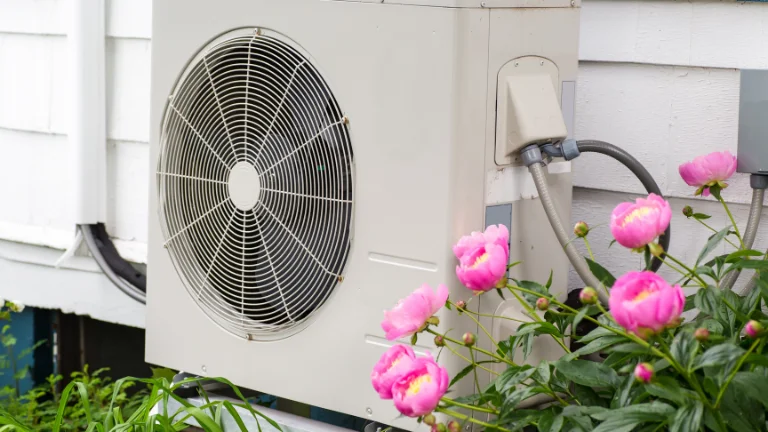
A heat pump is usually slower than a high-output gas heater, but it can be a practical choice for maintaining comfortable water over longer periods.
Instead of creating heat through combustion, an air-source pool heat pump transfers heat from the surrounding air into the water.
Heat pumps work especially well when:
- the weather is mild or warm
- you use the pool frequently
- you can start heating well before swimming
- maintaining temperature matters more than same-day warm-up speed
If a weekend swim is planned, starting the system well in advance is much more realistic than turning it on a few hours before people arrive.
3. Solar Pool Heating
Solar heating can reduce conventional energy use, but it is not normally the method to choose when maximum heating speed is the goal.
Performance changes with:
- available sunlight
- collector area
- roof orientation
- pool size
- weather
- starting temperature
- heat loss overnight
Solar works better as part of a longer-term heating strategy.
For smaller backyard systems and hands-on projects, our DIY solar pool heater guide covers a dedicated solar setup in more detail.
How to Keep the Heat You Add
Heating the water is only part of the job. Holding onto that heat can cut the amount of reheating needed later.
Use a Physical Pool Cover
Cover the pool whenever it is not being used, especially overnight.
The U.S. Department of Energy reports that pool covers reduce evaporation and can produce substantial pool-heating energy savings. Its guidance cites potential heating-cost savings of roughly 50% to 70%, although actual savings depend on the pool and how consistently the cover is used.
A cover does not replace a heater. It makes the heat you already added harder to lose.
Reduce Wind Across the Water
Wind speeds up evaporation.
Fences, landscaping, privacy panels, and other suitable wind barriers can reduce direct airflow across the pool surface. Avoid placing barriers where they interfere with required equipment ventilation or safe access.
Use a Liquid Pool Cover Only When a Physical Cover Is Impractical
Liquid pool covers can reduce some evaporation, but they should not be treated as equal to a properly fitted physical cover.
A DOE-reviewed study cited in federal research found much lower energy savings from a liquid cover than from a conventional physical cover.
For fast heating, prioritize the physical cover when it is practical for your pool.
How Fast Do You Need the Pool Warm?
Your deadline can narrow the choices quickly.
| When You Need It Warm | Practical Approach |
|---|---|
| Later today | Properly sized gas heater plus a pool cover when the pool is not in use |
| By tomorrow | Gas heater, or a suitable heat pump started early under favorable conditions |
| Within several days | Heat pump or solar heating combined with strong heat-loss control |
| No heater available | Use sunlight, a physical cover, wind protection, and a properly designed solar setup |
These are planning approaches rather than guaranteed timelines. Pool size, starting temperature, weather, heater capacity, and heat loss still control the actual result.
How to Heat a Pool Faster Without Buying a Bigger Heater
A few changes can improve the performance of the equipment you already own.
- Measure the starting temperature. You need the real temperature rise before you can estimate a heating deadline.
- Confirm the pool volume. Guessing low can leave you with unrealistic heating expectations.
- Cover the pool when nobody is swimming. This reduces evaporative heat loss.
- Start earlier. A heat pump or solar system may need much more lead time than gas heating.
- Reduce wind exposure. Less airflow across the surface means less evaporative cooling.
- Maintain proper circulation. Follow the heater manufacturer’s required flow and filtration instructions.
- Keep the filter maintained. Restricted circulation can cause equipment problems and may prevent some heaters from operating correctly.
- Avoid heating higher than you need. Every extra degree means more energy and additional heating time.
A consistent pool maintenance and cleaning routine also helps keep the circulation and filtration system in working condition.
Pool Heating Methods Compared
| Method | Heating Role | Relative Warm-Up Speed | Weather Dependence | Running-Cost Tendency | Best Fit |
|---|---|---|---|---|---|
| Gas heater | Active heating | Fast | Lower than heat pump or solar | Usually higher | On-demand and same-day heating |
| Heat pump | Active heating | Moderate | High | Often lower than gas in suitable conditions | Frequent pool use |
| Solar collectors | Active solar heating | Slow and variable | Very high | Low after installation | Sunny locations and longer heating windows |
| Physical pool cover | Heat retention | Does not create heat | Not applicable | Very low | Nearly any heated outdoor pool |
| Liquid cover | Heat-loss reduction | Does not create heat | Not applicable | Low | When a physical cover is impractical |
The fastest equipment is not automatically the least expensive to operate. The right choice depends on how often you heat the pool and how quickly you normally need it ready.
DIY and Low-Cost Ways to Warm a Pool
A heater is not always necessary if you only want a small temperature increase and have enough time.
Useful lower-cost approaches include:
- using a physical solar cover during suitable periods
- reducing overnight evaporation
- installing properly sized solar collectors
- using solar mats designed for compatible smaller pools
- reducing wind across the water surface
- taking advantage of sunny periods rather than trying to heat during cold, windy weather
DIY black-hose systems and homemade collectors can add some heat under favorable conditions, but their output is usually far below a properly sized gas heater or commercial heat pump.
Do not improvise with household electric heating appliances, open flames, or equipment that is not designed for swimming-pool use.
Common Mistakes That Make Pool Heating Take Longer
Leaving the Pool Uncovered Overnight
You may spend hours adding heat during the day and lose a large portion of the gain after sunset through evaporation.
Cover the pool once swimming is finished.
Guessing the Pool Volume
Heating calculations based on the wrong gallon amount can be misleading.
Measure or calculate the pool’s actual volume before deciding how early to start the heater.
Ignoring the Heater’s BTU Rating
Two gas heaters can warm the same pool at very different rates if one has substantially more heating capacity.
Check the equipment label or manufacturer documentation instead of judging by heater size alone.
Expecting a Heat Pump to Behave Like a Gas Heater
Heat pumps can be efficient for regular heating, but their output and dependence on outdoor conditions make them a different tool from high-output gas heating.
Give them enough lead time.
Waiting Until Guests Arrive
A large pool cannot normally gain 10°F instantly.
Calculate the expected heating time the day before a party or planned swim, then add extra time for real-world heat loss.
Ignoring Basic Equipment Maintenance
Dirty filters, circulation issues, or equipment faults can interfere with pool operation.
Correct maintenance problems before blaming the heater itself.
Pool Heating Time Quick Calculator
You can make a useful estimate with four numbers.
Step 1: Find Your Pool Volume
Example:
15,000 gallons
Step 2: Find the Temperature Increase
Current temperature:
72°F
Target temperature:
82°F
Required rise:
10°F
Step 3: Calculate the Heat Required
Formula:
Gallons × 8.34 × Temperature rise
Example:
15,000 × 8.34 × 10 = 1,251,000 BTU
Step 4: Divide by Delivered Heater Output
Example delivered heat:
300,000 BTU/hr
Calculation:
1,251,000 ÷ 300,000 = 4.17 hours
So the ideal baseline is about 4.2 hours.
Step 5: Allow for Real Conditions
Your pool may need additional time because of:
- evaporation
- wind
- cold outdoor temperatures
- heater efficiency and actual delivered output
- pool design
- plumbing
- humidity
- solar exposure
Use the formula to plan when to start heating, not as a promise that the pool will hit the target at an exact minute.
Free Pool Heating Resources
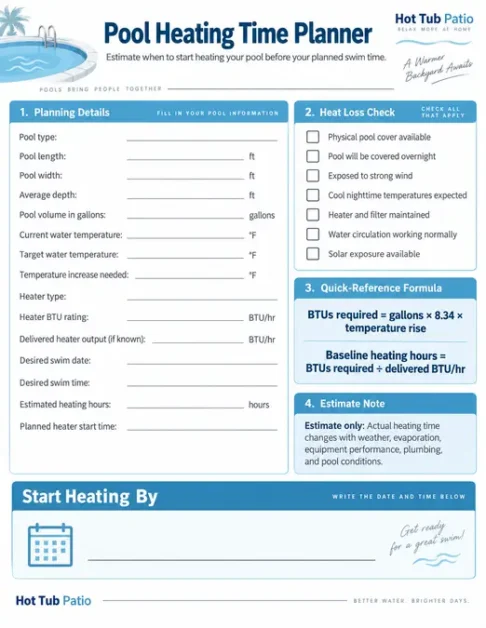
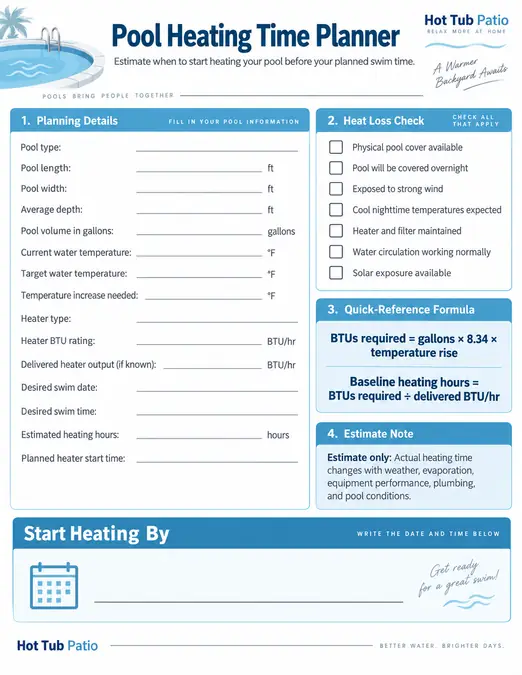
Planning when to start your pool heater is much easier when you know your pool volume, temperature increase, and heater output. Use these free printable resources to estimate heating time and plan your next swim.
Pool Heating Resource Pack
Get the complete printable pack with the heating planner, formulas, reference information, and quick heating checklist in one PDF.
Download Resource PackPool Heating Time Planner
Write down your pool gallons, starting temperature, target temperature, heater BTUs, and planned swim time to work out when heating should begin.
Download Time PlannerPool Heating Quick Reference
Keep the heating formula, example heating times, method comparison, and heat-saving reminders handy while planning your pool warm-up.
Download Quick ReferenceNot sure which one to download? Start with the Pool Heating Resource Pack. It combines the planning tools and quick-reference information in one printable file.
A Simple Pool Heating Plan
For a pool you want ready tomorrow, use this workflow:
- Check the current water temperature.
- Set the target temperature.
- Calculate the temperature difference.
- Confirm your pool volume.
- Check the heater’s BTU rating and manufacturer specifications.
- Estimate the baseline heating time.
- Add extra time for weather and heat loss.
- Run the system according to manufacturer instructions.
- Cover the pool whenever it is not being used.
- Check the water temperature again before swimming.
This approach gives you a much better answer than simply turning the heater to a higher setting and hoping the pool warms quickly.
Downloadable Resource
Frequently Asked Questions
What is the fastest way to heat a swimming pool?
A properly sized gas pool heater is generally the fastest common residential option because gas heaters are available with high heating capacities. Actual warm-up time still depends on pool gallons, required temperature rise, heater output, and heat loss.
How long does it take to raise a pool 10°F?
Calculate the baseline using gallons × 8.34 × 10, then divide by the heater’s delivered BTUs per hour. A larger pool or lower-output heater will take longer, and real conditions usually add time beyond the mathematical minimum.
How fast will a 400,000 BTU pool heater heat my pool?
The answer depends on whether 400,000 BTU/hr refers to heater input or delivered output and on your pool volume. Use the manufacturer’s efficiency and output specifications, then calculate the required BTUs based on gallons and temperature rise.
Can I heat my pool overnight?
Yes, if your heating system is designed to operate that way and you follow the manufacturer’s operating instructions. Using a physical pool cover while the pool is not in use can reduce overnight heat loss.
Does covering a pool make it heat faster?
A cover does not create heat, but it slows heat loss, especially from evaporation. That means more of the heat produced by your heater stays in the water. The U.S. Department of Energy identifies pool covers as an effective way to reduce pool heating energy use.
Can I heat a pool without a heater?
Sunlight, solar collectors, solar mats, and a physical cover can warm or retain heat without a conventional gas heater or heat pump. These approaches are usually slower and more dependent on weather.
Is a heat pump or gas heater faster for a pool?
Gas heaters generally offer higher heating capacity and faster on-demand warm-up. Heat pumps usually make more sense when you can start earlier and want to maintain comfortable water over longer periods.
Fastest Way to Get Your Pool Warm
If speed matters most, start with a properly sized gas heater, calculate how many degrees the water actually needs to rise, and cover the pool whenever nobody is swimming. That combination gives the heater less lost heat to replace.
For regular pool use, a heat pump can be a practical alternative when you have enough lead time. Whatever heating system you use, base your plan on pool gallons, temperature rise, and actual heater output instead of guessing how many hours the job will take.



2 Comments
Comments are closed.