
Types of Infrared Saunas: Near, Mid, Far & Full Spectrum

Infrared-sauna labels—near, mid, far, and full spectrum—describe emitted wavelength ranges, not four proven levels of health benefit. This page stays separate from the main infrared-sauna guide because buyers need help interpreting wavelength claims, emitter designs, and test reports before choosing a system.
Infrared Wavelength Labels
| Label | What it usually describes | What it does not prove |
|---|---|---|
| Near infrared (NIR) | Shorter infrared wavelengths, often emitted by lamps or targeted devices | That a cabin heals wounds, treats skin disease, or improves recovery |
| Mid infrared (MIR) | An intermediate infrared band; definitions and dedicated emitter claims vary | That it uniquely improves circulation or metabolism |
| Far infrared (FIR) | Longer infrared wavelengths used by many panel cabins and heated blankets | That it detoxifies the body, burns fat, or penetrates to a clinically meaningful “deep tissue” target |
| Full spectrum | A system intended to emit across more than one infrared range | That it delivers broader or superior medical outcomes |
Published infrared classifications are not always identical to consumer marketing bands. Compare a manufacturer’s actual spectral-output data rather than assuming every product uses the same definition.
Does Infrared “Penetration Depth” Decide Which Sauna Is Better?
No. Infrared wavelengths interact with tissue differently, but a claim that one band “penetrates deeper” does not establish a superior health result. A sauna’s overall heat load also depends on emitter temperature and placement, distance from the body, exposed area, session conditions, cabin air, and the user.
Do not use a penetration diagram as clinical evidence. Studies of targeted lamps, photobiomodulation devices, medical hyperthermia, and whole-body sauna cabins are not interchangeable simply because all involve infrared energy.
Far-Infrared Panel Saunas
Far-infrared panels are common in wooden home cabins. Carbon-style panels are often designed for broad surface coverage, while ceramic or other emitters may produce a different heat distribution. Those descriptions do not create a universal ranking; check guarded surface temperatures, panel layout, electrical listing, controls, warranty, and repair access.
Near-Infrared Lamp Systems
Lamp-based systems can produce visible light, near infrared, and substantial radiant heat. Lamp surfaces can become very hot, so guards, distance, mounting, voltage, ventilation, and eye/skin precautions must come from the exact manual. A near-infrared sauna should not be equated with a medical red-light or photobiomodulation device.
Full-Spectrum Systems
A full-spectrum cabin may combine panel and lamp emitters or use emitters marketed as covering multiple bands. Before paying a premium, ask:
- Which bands are emitted, and what independent method measured them?
- Can each emitter group be controlled separately?
- Where are the emitters relative to a seated user?
- Are guards, sensors, and overheat protection included?
- Does the exact model have appropriate electrical and product-safety certification?
- Is there reliable service if a lamp, panel, controller, or sensor fails?
Cabin, Portable Tent, or Blanket?
| Format | Decision factors |
|---|---|
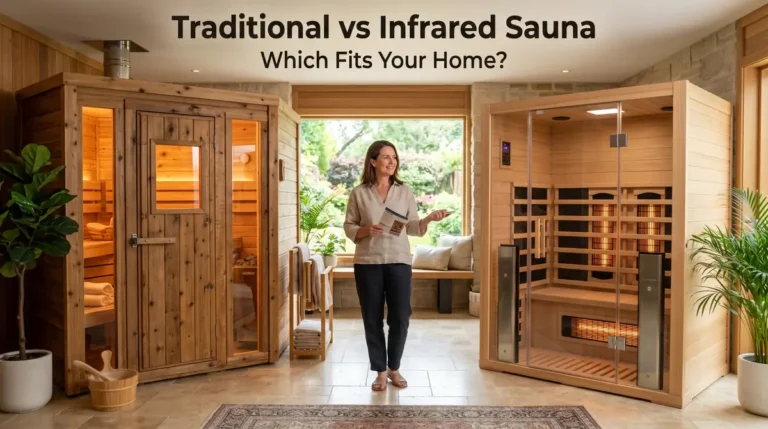
| Wooden cabin | More stable seating and emitter placement; requires dedicated space, correct electrical supply, assembly, and cleaning |
| Portable enclosure | Stores more easily; compare heater type, stability, washable surfaces, ventilation, and electrical instructions |
| Infrared blanket | Direct contact or close proximity to a heated flexible appliance; evaluate fit, exit access, controller, material care, and overheat protection |
See the separate infrared sauna blanket guide before treating a blanket as equivalent to a full-room sauna.
What Matters More Than the Wavelength Label
- Exact model certification, voltage, circuit, plug, grounding, and installation requirements
- Emitter coverage, hot-surface guarding, controls, sensors, timer, and overheat shutoff
- Interior dimensions, seated distance, accessibility, and ability to exit quickly
- Ambient-temperature limits and whether the product is approved for the intended location
- Warranty, return terms, replacement parts, and technical support
- Transparent EMF measurements by field type, distance, and operating condition
Which Type Should You Choose?
Choose the sauna whose heat feels comfortable, fits the space and electrical service, has credible safety documentation, and can be serviced. Do not select a wavelength because it promises detoxification, fat loss, immune boosting, skin treatment, pain cures, or superior cardiovascular results. The current evidence does not justify those wavelength-specific promises.
For research quality and health claims, continue to the infrared sauna benefits guide. For contraindications, see the risk guide.