
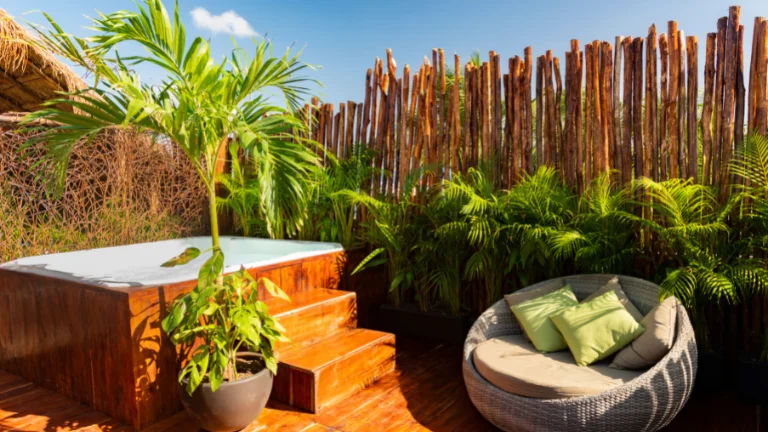
Hot Tub Privacy Ideas: Screens, Plants, Pergolas & More

The best hot tub privacy setup blocks the views that actually make you feel exposed without boxing in the spa or blocking the cover, walking path, or service panels.
Start by finding the problem sightline, then choose the lightest solution that fixes it: a screen for a side view, planting for a softer boundary, or a pergola and shade element when the view comes from above.
This guide compares screens, plants, fencing, curtains, and pergolas by speed, upkeep, footprint, airflow, permanence, and access.
If you are planning the whole backyard rather than privacy alone, see our outdoor hot tub area ideas for layout, lighting, seating, and landscaping inspiration.
Start With the Sightline, Not the Screen
Walk the hot tub area before buying anything. Sit where people will soak, then check what can be seen from neighboring windows, the street, a nearby deck, and your own house. Check again from the steps or entry point, because getting in and out can be more exposed than sitting in the water.
A side view usually needs a side screen. A view from a second-story window may need overhead screening, a pergola, a canopy element, or a carefully placed tree rather than a taller fence. A street-facing opening may be easier to soften with layered planting plus one solid panel than with a wall around the entire spa.
Mark the exposed directions on a quick sketch. That simple step often prevents overbuilding and keeps the yard feeling open.
Hot Tub Privacy Options Compared
| Privacy option | Speed | Footprint | Upkeep | Airflow | Best fit |
|---|---|---|---|---|---|
| Freestanding or slatted screen | Fast | Small | Low to moderate | Good if slatted | One or two exposed side views |
| Fence or fixed privacy wall | Moderate | Small | Varies by material | Lower if solid | Permanent property-edge or street privacy |
| Planters and shrubs | Immediate with large containers; slower in-ground | Moderate | Moderate | Good | Softening views without a hard wall |
| Pergola with curtains or screens | Moderate | Moderate to large | Moderate | Adjustable | Overhead exposure plus flexible side privacy |
| Layered screen + planting | Fast | Moderate | Moderate | Good | Balanced privacy, appearance, and airflow |
The lowest-maintenance choice is not always the most private, and the most private option is not always the most usable. A solid wall can block a view quickly but may also block breeze, light, or access. A layered approach often gives better control.
Slatted Panels and Freestanding Privacy Screens
Slatted panels are useful when one neighbor, window, or walkway creates most of the exposure. They can provide a visual barrier without turning the hot tub into a closed room. Wood, composite, and decorative metal panels can all work, but the support and anchoring matter as much as the panel material.
Freestanding screens are attractive for renters or for testing a layout before committing to a permanent wall. The tradeoff is wind. Do not assume a tall freestanding panel is stable just because it feels heavy on a calm day. Follow the product’s anchoring instructions and local requirements, especially in exposed yards.
Before positioning a fixed screen, confirm the cover-lifter path and the service side of the spa. Bullfrog notes that different cover lifters require different amounts of space around the tub, and Hot Spring publishes model-specific back and side clearances for its lifters. That is why a universal “leave X inches” privacy rule is not reliable.
Check the actual cover system and spa manual first. See Bullfrog’s installation guidance and Hot Spring’s cover-lifter guidance.
Plants and Planters for Natural Privacy
Plants work well when you want privacy without a hard architectural boundary. Large containers can provide useful screening right away and can be repositioned as the yard changes. In-ground shrubs and small trees can create a more permanent living screen, but they need time to mature.
Choose plants for your climate, mature size, root space, sun exposure, irrigation needs, and seasonal coverage. A plant that looks perfect at the nursery may be too wide for a narrow service path in a few years. Deciduous plants may lose much of their screening in winter, while dense evergreens can provide more consistent coverage but still need pruning and site-appropriate spacing.
Debris matters around a spa. Plants that drop heavy leaves, needles, fruit, seed pods, or sticky sap directly over the water can increase cleanup. Keep branches and containers away from removable equipment panels and do not let roots, edging, or raised beds interfere with drainage.
For planting and maintenance ideas beyond privacy, use our hot tub landscaping guide.
Pergolas, Curtains, and Overhead Privacy
A pergola is most useful when privacy has an overhead component, such as a neighboring second story, or when you also want to define the spa area as an outdoor room. The structure alone may not block side views, so many layouts pair a pergola with slatted panels, outdoor curtains, retractable screens, or planting.
Curtains are flexible because they can stay open when privacy is not needed and close only on the exposed side. Use materials intended for outdoor conditions, and plan how the panels will be secured when wind picks up. Avoid hanging fabric where it can drag across the water, interfere with the cover, or obstruct a walking path.

A pergola, gazebo, privacy wall, or other permanent structure may be subject to local building rules, setbacks, wind requirements, or HOA restrictions. Check before construction rather than assuming a prefabricated kit is automatically exempt. Our hot tub permit guide is a starting point, but the local building department has the final requirements for your project.
Fencing for More Permanent Privacy
A fence makes sense when the privacy problem follows a property line or street edge rather than the spa itself. It can solve a larger yard problem at the same time, but a tall solid fence is not automatically better than a targeted panel.
Compare the fence location with gates, drainage paths, electrical equipment, spa access, and future delivery needs. If a fence is being added before the hot tub arrives, make sure the delivery route still works. Our hot tub delivery access checklist covers gates, turns, overhead obstacles, stairs, and crane planning.
Jacuzzi’s pre-installation checklist also recommends checking local gate and fence requirements and confirming that the delivery route remains unobstructed. See the Jacuzzi pre-installation checklist.
Use Layers Instead of One Oversized Barrier
One of the most practical layouts is a short fixed screen at the exposed angle, with planters or shrubs extending the visual barrier. The screen gives immediate privacy; plants soften the hard edge and fill gaps over time.
Another useful combination is a pergola for overhead definition, one side screen for the closest neighbor, and movable planters where views change seasonally. This keeps the rest of the yard open and can preserve better airflow than enclosing all four sides.
If you are coordinating privacy with a deck, patio, or recessed spa design, review the hot tub deck and patio planning guide before setting posts, walls, or built-in planters.
Keep the Hot Tub Accessible
A privacy feature that blocks service access creates a future repair problem. Identify the equipment compartment and removable cabinet panels before placing screens, planters, benches, or pergola posts. Do not permanently trap the spa inside a finished enclosure without a removal and service plan.
Also check the cover in both the closed and fully open position. Some lifters move behind the spa, others need side space, and some are designed for tighter installations. Steps and the normal walking route need their own clear space.
If the hot tub has not been installed yet, privacy planning should happen alongside foundation, electrical, drainage, delivery, and service access. Our hot tub installation guide covers the broader setup sequence.
Hot Tub Privacy Planning Checklist
- Check seated sightlines: look toward neighbors, streets, decks, and windows from inside the tub.
- Check entry sightlines: repeat the test from the steps and the point where people enter or exit.
- Identify overhead exposure: note upper-story windows or elevated neighboring yards.
- Mark the service side: preserve access to equipment and removable panels.
- Open the cover fully: make sure screens, curtains, posts, and plants stay outside the cover-lifter path.
- Check wind exposure: use manufacturer-approved anchoring for freestanding products and permanent structures.
- Plan plant maturity: account for final width, height, roots, debris, and seasonal coverage.
- Protect drainage and paths: do not create a low spot, blocked walkway, or hidden trip hazard.
- Check local rules: verify fence, pergola, setback, HOA, and permit requirements before permanent work.
- Recheck delivery access: do not close off the only practical route for the spa or future replacement.
Frequently Asked Questions
What is the easiest way to add privacy around a hot tub?
For one exposed side, a correctly secured freestanding or slatted screen is often the quickest solution. Movable planters can fill smaller gaps without committing to permanent construction. Choose the option based on the actual sightline rather than trying to enclose the whole spa.
Are plants a good hot tub privacy screen?
Yes, when the plants suit the climate and available space. Check mature size, seasonal coverage, debris, roots, and maintenance before planting near the spa. Containers are useful when you want immediate screening or future flexibility.
Does a pergola provide enough hot tub privacy?
A pergola can help with overhead exposure and define the spa area, but it may do little for side views by itself. Side curtains, louvers, screens, or planting are often needed where neighbors or streets are the main privacy problem.
Can I put a privacy screen right next to the hot tub?
Only if it does not interfere with the cover, steps, service panels, drainage, or manufacturer-required access. Check the exact spa and cover-lifter instructions before fixing a screen in place.
How can I add privacy without making a small yard feel closed in?
Block only the exposed angles. Slatted panels, narrow planters, trellises, and layered planting can create privacy while allowing light and airflow through the rest of the yard.
Block the View That Matters Most
Good hot tub privacy is usually targeted, not total. Find the sightline that makes the spa feel exposed, solve that angle first, and preserve the practical space needed for the cover, service, drainage, and walking access. A screen, planter, or partial pergola may be enough; a full enclosure is only useful when the site truly needs it.




4 Comments
Comments are closed.