
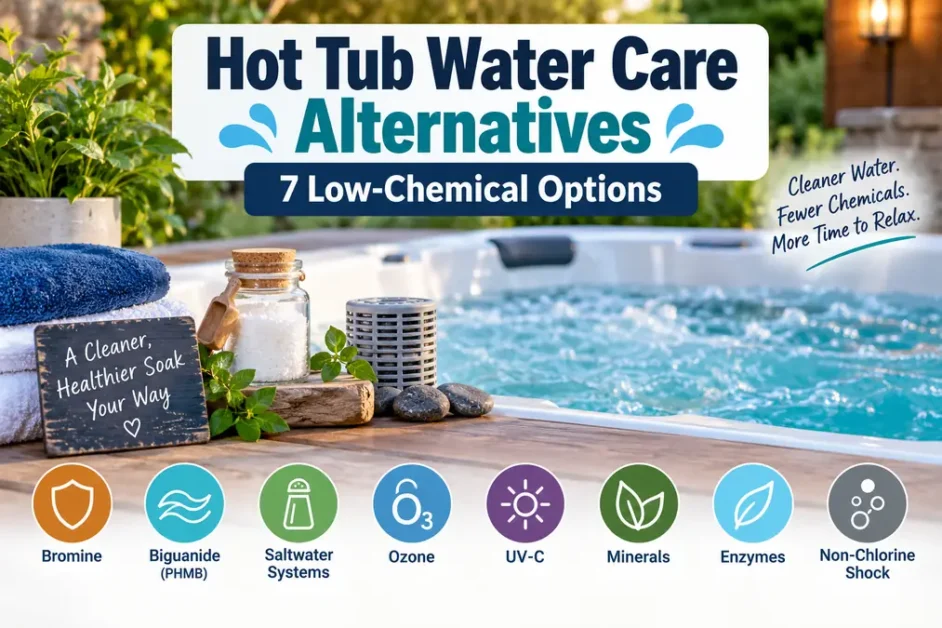
Hot Tub Water Care Alternatives: 7 Low-Chemical Options

If you want cleaner-feeling hot tub water with less chlorine smell, fewer manual doses, or a different sanitizer altogether, you have several options. The key is knowing which systems actually sanitize the water and which ones only reduce the workload on chlorine or bromine.
Quick answer: bromine and properly designed biguanide systems can serve as primary sanitizer alternatives to conventional chlorine programs. Salt systems still make chlorine. Ozone, UV-C, mineral cartridges, enzymes, and non-chlorine shock can reduce sanitizer demand or improve water quality, but they should not automatically be treated as standalone replacements.
For U.S. hot tub owners, the CDC recommends maintaining at least 3 ppm free chlorine or 4–8 ppm bromine, with pH in the recommended range. Always follow your spa manufacturer and sanitizer product label, because some systems have their own approved operating ranges. See the CDC hot tub disinfectant guidance.
Can You Maintain a Hot Tub Without Chlorine?
Yes, you can run a hot tub without adding conventional chlorine granules or tablets, but that does not mean the water can safely go without a proven sanitation system.
There are three different ideas that are often mixed together:
- Chlorine-free: a system that does not rely on chlorine as the primary sanitizer, such as bromine or a compatible biguanide program.
- Low-chlorine: ozone, UV, minerals, or other supplemental systems that can reduce sanitizer demand while a residual sanitizer remains in the water.
- Saltwater: a salt cell converts salt into chlorine, so the water may feel different and dosing is more automated, but it is not chlorine-free.
This distinction matters because warm, aerated spa water can support microbial growth when sanitation is inadequate. Clear-looking water is not proof that the water is sanitary.
Hot Tub Water Care Alternatives at a Glance
| Option | Main Job | Chlorine-Free? | Standalone Sanitizer? | Best Fit |
|---|---|---|---|---|
| Bromine | Residual sanitizer | Yes | Yes, when used correctly | Hot tubs with frequent use and owners who prefer bromine |
| Biguanide/PHMB system | Primary sanitizer system | Yes | Can be, as a complete compatible system | Owners specifically seeking a halogen-free program |
| Saltwater chlorine generator | Generates chlorine automatically | No | Yes, through generated chlorine | Lower-touch chlorine management |
| Ozone | Oxidation and supplemental disinfection | The device adds no chlorine | Usually no | Reducing sanitizer demand |
| UV-C | Treats water passing through a UV chamber | The device adds no chlorine | Usually no | Supplemental microbial control |
| Mineral cartridge/ionizer | Supplemental microbial control | System-dependent | Usually no | Low-sanitizer routines |
| Non-chlorine shock (MPS) | Oxidizes organic waste | Yes | No | Controlling bather waste and helping sanitizer work |
| Enzymes | Break down oils and organics | Yes | No | Scum control and reduced sanitizer workload |
1. Bromine: The Most Direct Alternative to Chlorine
Bromine is a true residual sanitizer and one of the most established alternatives to a chlorine-based spa routine. It remains active in hot water and can be maintained with tablets, granules, or a bromide-bank system depending on the product and spa setup.
Bromine is often chosen by owners who dislike chlorine dosing or who prefer the way a bromine spa feels and smells. Individual skin response varies, so switching sanitizers is not a guarantee that irritation will disappear. Incorrect pH, excessive sanitizer, poor water balance, and contaminants can also cause discomfort.
If you want to use bromine, see our step-by-step bromine hot tub maintenance guide.
2. Saltwater Systems: Less Manual Dosing, but Still Chlorine
A saltwater hot tub uses electrolysis to convert dissolved salt into chlorine. That means saltwater is best understood as an automated chlorine-generation method, not a chlorine-free sanitizer.
The appeal is consistency. Instead of manually adding as much sanitizer, the salt cell generates small amounts over time. Many owners also prefer the water feel. The tradeoffs can include higher upfront cost, replacement cells or cartridges, scale management, and the need to confirm that your spa is approved for a salt system.
Before converting an existing spa, check the manufacturer warranty and materials. You can also compare saltwater hot tub options that are designed for this type of water care from the start.
3. Ozone: A Strong Helper That Reduces Sanitizer Demand
An ozonator creates ozone and injects it into the spa’s circulation system. Ozone is a powerful oxidizer that reacts with contaminants as water moves through the plumbing.
The important limitation is residual protection. Ozone reacts quickly and does not remain throughout the entire body of spa water the way chlorine or bromine does. For that reason, residential ozonators are generally used as a supplement rather than an excuse to stop testing and sanitizing the tub.
Ozone can be a good fit if your goal is lower sanitizer demand, clearer water, and less odor while keeping a conventional residual sanitizer. See our full breakdown of hot tub ozonator pros and cons.
4. UV-C Systems: Effective in the Chamber, Not Everywhere at Once
UV-C systems expose circulating water to ultraviolet light inside a treatment chamber. Microorganisms that pass through the chamber can be inactivated, which can reduce the burden placed on the rest of your water-care system.
But UV-C only treats water while it is passing through the unit. It does not leave a lasting disinfectant residual in the seats, footwell, jets, or water between circulation cycles. That is why a UV system is normally paired with an approved residual sanitizer.
UV can make sense for owners who want a layered system and are comfortable replacing the UV lamp and maintaining the chamber as required by the manufacturer.
5. Mineral Cartridges and Ionizers: Useful for Low-Chemical Routines
Mineral systems commonly use silver, copper, zinc, or combinations of minerals to help control microorganisms. They are sold as cartridges, sticks, in-line systems, or ionizers.
The biggest mistake is assuming every mineral product can replace chlorine or bromine completely. Many are designed to work with a reduced sanitizer level, and the exact requirement depends on the product label and spa manufacturer.
Mineral systems are most useful when you want to simplify a low-sanitizer routine without abandoning residual sanitation. Replace cartridges on schedule and monitor metals if your system uses copper, because excessive metal levels can contribute to staining or discoloration.
6. Biguanide/PHMB: A True Chlorine- and Bromine-Free System
Polyhexamethylene biguanide (PHMB), usually called biguanide in pool and spa care, is one of the few established paths to a chlorine- and bromine-free primary sanitizer system.
It is not a one-bottle substitute. Biguanide programs typically require compatible oxidizer and supporting products, and they should not be casually mixed with chlorine or bromine. Switching may require draining, cleaning, and following the conversion process specified by the product manufacturer.
Before choosing biguanide, confirm that your spa manufacturer allows it and that replacement filters, plumbing materials, and any existing mineral or sanitizer system are compatible.
7. Enzymes and Non-Chlorine Shock: Helpful, but Not Primary Sanitizers
Enzymes and non-chlorine shock solve a different problem from a residual sanitizer.
- Enzymes help break down oils, lotions, cosmetics, and other organic material that can form scum or increase sanitizer demand.
- Non-chlorine shock, commonly based on potassium monopersulfate (MPS), oxidizes contaminants and can support an existing sanitizer program.
Neither should automatically be treated as a substitute for a properly maintained primary sanitizer. They are best used to make the rest of the water-care system work more efficiently.
What About Hydrogen Peroxide, Vinegar, Baking Soda, or Essential Oils?
Be careful with DIY “natural hot tub” recipes. A product being useful for household cleaning does not mean it can safely replace a registered spa sanitizer.
- Vinegar can be useful for certain cleaning tasks when the spa manufacturer allows it, but it is not a primary sanitizer for recirculating spa water.
- Baking soda affects alkalinity; it does not sanitize hot tub water.
- Essential oils can interfere with filtration, create residue, and may damage spa components unless a product is specifically designed for hot tubs.
- Household hydrogen peroxide should not be improvised as a sanitizer. Some specialty systems use peroxide as part of a defined treatment program, but concentration, compatibility, and testing requirements are system-specific.
If sustainability is your main priority rather than sanitizer replacement, see our separate guide to eco-friendly hot tub chemical alternatives. That article focuses on reducing environmental impact, while this guide focuses on choosing a safe water-care system.
Which Hot Tub Water Care System Fits Your Goal?
| Your Priority | Options to Consider | Important Reality Check |
|---|---|---|
| Stop using conventional chlorine | Bromine or an approved biguanide system | Bromine is still a chemical sanitizer; biguanide requires a compatible system |
| Use less sanitizer | Ozone, UV-C, minerals, better filtration | Most setups still need a residual sanitizer |
| Less manual dosing | Saltwater chlorine generator or cartridge-based system | Automation does not eliminate testing |
| Sensitive skin concerns | First correct pH and sanitizer levels; then consider bromine, minerals, ozone, or another approved system | Irritation can come from imbalance, contaminants, or individual sensitivity |
| Lower upfront cost | Traditional chlorine or bromine | Advanced hardware usually costs more initially |
| Chlorine- and bromine-free | Compatible biguanide/PHMB program | Confirm spa and product compatibility before converting |
If skin comfort is the reason you are researching alternatives, also read our guide to hot tub chemicals for sensitive skin.
How to Reduce Chemical Demand Without Sacrificing Sanitation
Before buying new hardware, reduce the contamination entering the tub. These habits can lower sanitizer demand regardless of which system you use:
- Shower before soaking. Removing sweat, lotion, cosmetics, and body oils gives your sanitizer less work to do.
- Keep the cover clean and closed. This limits debris and environmental contamination when the spa is not in use.
- Maintain good filtration. Rinse and deep-clean filters on the schedule recommended for your spa and bather load.
- Test before guessing. Adding more chemicals without testing can create a new imbalance instead of solving the original problem.
- Keep pH in range. Sanitizer performance and bathing comfort both depend on balanced water.
- Address cloudy water early. Cloudiness can signal filtration, sanitizer, bather-load, or balance problems. Use our cloudy hot tub water troubleshooting guide.
- Follow a complete water-care routine. Our hot tub water care guide covers testing, filtration, shocking, draining, and routine maintenance.
How to Switch Water-Care Systems Safely
Do not simply pour a new sanitizer into water treated with an incompatible system. A safer switch looks like this:
- Check the hot tub owner’s manual and warranty for approved sanitizer systems.
- Read the new product’s complete conversion instructions.
- If required, purge plumbing, drain the spa, clean the shell, and clean or replace filters.
- Refill with fresh water and balance alkalinity, pH, and calcium hardness as directed.
- Establish the new sanitizer system exactly as the label specifies.
- Test more frequently during the first week so you can see how the new system behaves with your water source and normal bather load.
Common Mistakes With Alternative Hot Tub Sanitizers
- Calling saltwater chlorine-free. A salt system makes chlorine from salt.
- Assuming clear water is safe water. Water can look clear while sanitizer is inadequate.
- Treating ozone or UV as a residual sanitizer. They work where the water is being treated, but they do not continuously protect every part of the spa water.
- Using non-chlorine shock as the only sanitizer. Oxidation and sanitation are different jobs.
- Mixing incompatible systems. This is especially important when converting to or from biguanide.
- Ignoring the filter. Supplemental systems cannot make up for poor circulation and a dirty filter.
Frequently Asked Questions
What is the best alternative to chlorine in a hot tub?
Bromine is the most direct mainstream alternative because it is a residual sanitizer designed for hot water. Biguanide systems are another option for people seeking a chlorine- and bromine-free program, but they require compatible products and careful conversion.
Can ozone replace chlorine in a hot tub?
Usually not. Ozone is excellent at oxidizing contaminants and can reduce sanitizer demand, but it disappears quickly and does not provide the same lasting residual protection throughout the spa.
Is a saltwater hot tub chlorine-free?
No. A saltwater chlorine generator converts salt into chlorine. The dosing method is different, but chlorine is still the sanitizer.
Can I use non-chlorine shock instead of sanitizer?
Not as a general replacement. Non-chlorine shock mainly oxidizes organic contaminants. Use it according to the label as part of a complete water-care program.
Are mineral sticks enough by themselves?
Many mineral cartridges are designed to reduce the amount of chlorine or bromine needed rather than eliminate it. Follow the specific product label and your spa manufacturer’s instructions instead of assuming all mineral systems work the same way.
Why does my hot tub smell strongly of chlorine?
A strong “chlorine” smell can indicate a water-quality problem rather than simply too much free chlorine. Test the sanitizer and pH, check for combined chlorine/contaminant buildup, and follow your shock and filtration routine. The CDC notes that a properly chlorinated hot tub should have little odor.
Bottom Line
The safest way to use fewer traditional hot tub chemicals is not to eliminate sanitation—it is to choose a water-care system that clearly separates primary sanitizer, oxidation, filtration, and supplemental treatment.
Choose bromine or a compatible biguanide program if your goal is to move away from conventional chlorine. Choose saltwater if you want more automated chlorine generation. Add ozone, UV-C, minerals, enzymes, or non-chlorine shock when they solve a specific maintenance problem and are compatible with your spa. Whatever system you choose, keep testing the water and follow the product label and spa manufacturer’s instructions.
Hot Tub Water Care Guide
We’re here to help.