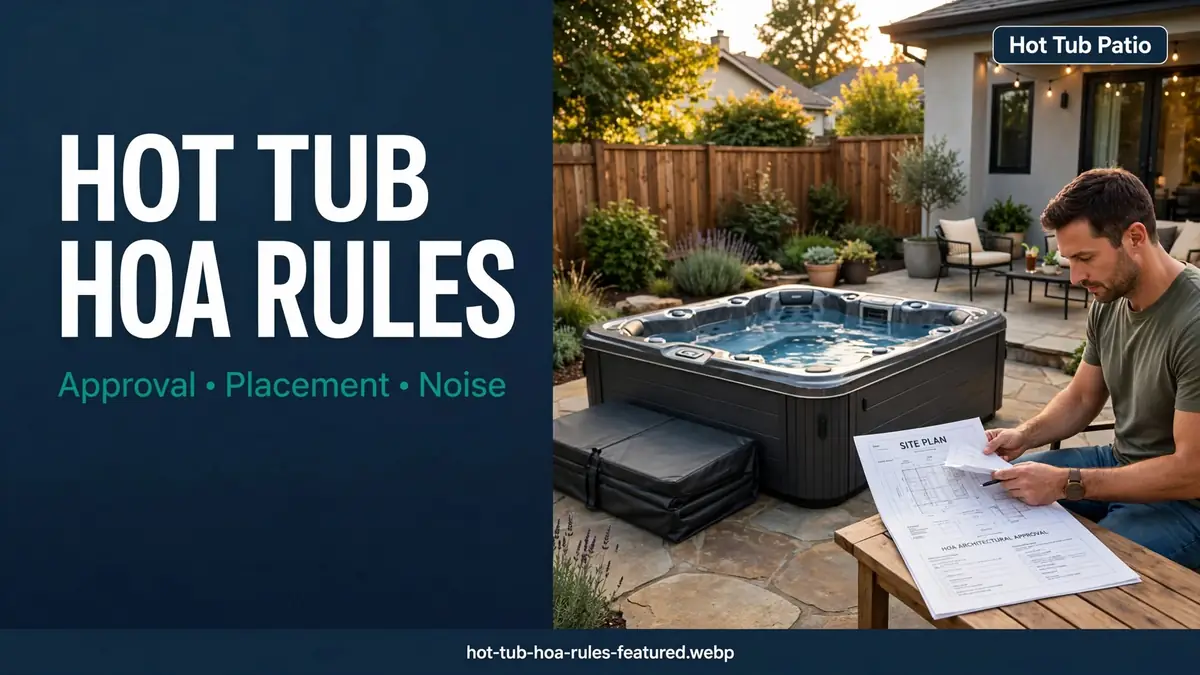
Hot Tub HOA Rules: Approval, Placement, Noise & Neighbor Complaints

You found the hot tub you want, picked a spot on your patio, and started planning delivery. Then someone mentions that your homeowners association needs to approve it first. Does that apply to an inflatable model too? What if your neighbors can hear the pump?
Some HOAs require written architectural approval before a hot tub is installed, including certain portable spas. Placement, screening, equipment visibility, noise, drainage, and guest use may be reviewed. There is no single nationwide HOA rule: your recorded covenants, adopted design guidelines, state law, and local permits determine what applies to your property.
The goal is to get a clear, documented decision before you spend money on installation. Below is a step-by-step request process, examples from actual community rules, a sample email, and an original HOA approval worksheet that you can use alongside your association’s official forms.
Can an HOA Restrict or Ban a Hot Tub?
An HOA may have authority under its governing documents to regulate exterior improvements, and some communities impose strict limits. That does not mean every HOA can prohibit every spa or create restrictions without legal authority. State statutes and the wording of the governing documents matter.
For example, the Muirfield Association’s published hot tub guidelines require design approval before installation and address placement, screening, appearance, and noise. In contrast, Florida Statutes section 720.3035 places specific limits on how covered homeowners associations exercise architectural review authority. Those are examples of different rules, not requirements that automatically apply nationwide.
Before ordering a spa: ask the property manager for the current CC&Rs, architectural standards, application form, and written approval procedure. If a rule sounds unclear, request the specific provision rather than relying on a neighbor’s memory of the rules.
Do Portable and Inflatable Hot Tubs Need HOA Approval?
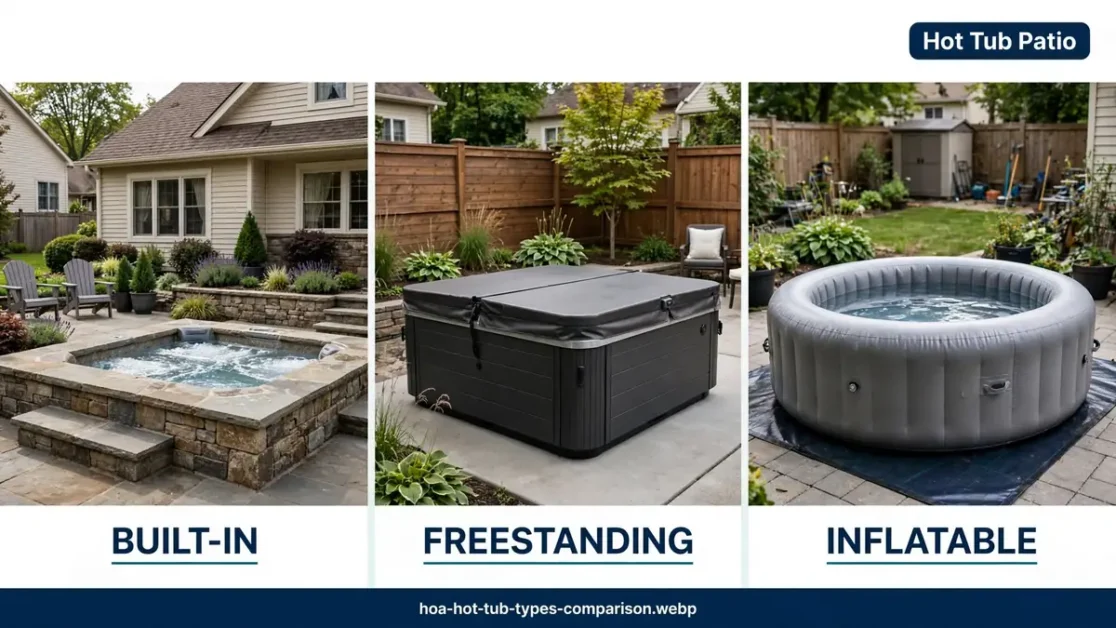
A portable spa is not automatically exempt because it can be moved. Some architectural rules are triggered by outside appearance, location, decking, or the use of the property rather than how permanently the tub is installed.
| Installation type | Why an HOA may review it | Documents to ask about |
|---|---|---|
| Built-in or in-ground spa | Excavation, exterior design, paving, fences, and drainage | Detailed site plan, construction drawings, screening |
| Freestanding hard-shell tub | Visible exterior equipment, patio placement, power supply, and noise | Model specifications, location photos, site plan |
| Inflatable or temporary tub | Appearance, seasonal placement, safety, drainage, and community use rules | Rules for temporary outdoor equipment and whether an ARC application applies |
| Condo patio or balcony | Common elements, structural loading, drainage, building and association control | Written permission from the condo board and appropriate structural/electrical professionals |
The Wilde Lake architectural guidelines call for applications for all hot tubs and whirlpools and request a site plan, appearance information, screening and wastewater-disposal details. Its rule illustrates why a homeowner should check the actual community documents, even for a small unit.
If you are deciding where to put the spa, our hot tub patio planning guide covers space, bases, access, and privacy. The HOA must still confirm what it will accept.
Common HOA Hot Tub Rules: Placement, Screening, and Noise
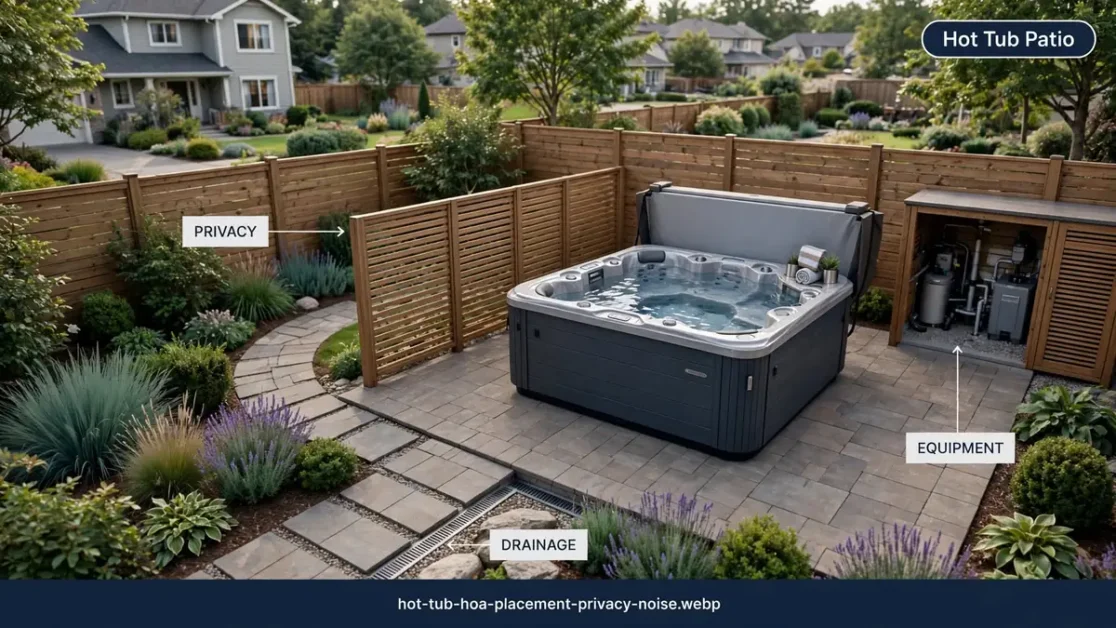
Most application disputes begin with the physical setting. A committee needs to see how the proposed spa fits the property, not just a catalog picture.
| Review item | Questions to resolve before applying |
|---|---|
| Placement | Is the proposed spa in the allowed yard or approved patio area? Does it cross a setback, easement, or common area? |
| Visibility and screening | Does the committee require a fence, lattice, landscaping, or another screening method? |
| Deck and structural support | Will the tub sit on a raised deck? Is an engineer or qualified installer needed to evaluate the filled load? |
| Noise and vibration | Where will the pump face? How close are nearby bedrooms, patios, and property boundaries? |
| Electrical and equipment | Will new electrical work, conduit, equipment boxes, or a disconnect be visible? |
| Drainage and wastewater | Where will drained water go? Could runoff affect a neighbor or common property? |
| Cover, fencing, and access | What locking, barrier, inspection, or safety conditions are required by the HOA and local authority? |
Muirfield’s rules explicitly consider both equipment and user noise as well as screening. Wilde Lake specifically requests a wastewater-disposal explanation. These are useful application checks, not proof that all communities have identical standards.
Screening should still allow manufacturer-required service access, ventilation, and safe entry. The hot tub privacy ideas guide offers options to discuss with the committee, including plants and slatted panels.
How to Apply for HOA Hot Tub Approval
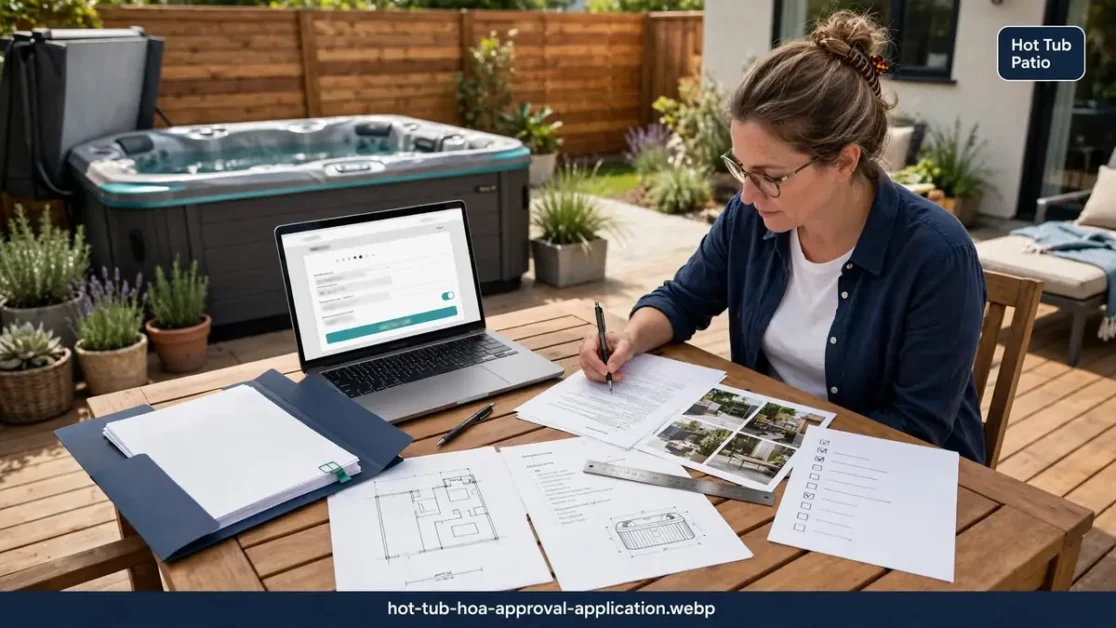
Use your HOA’s own form if one exists. The following sequence is a preparation workflow, not a substitute for its formal process.
1. Read the current governing documents
Find the declaration or CC&Rs, adopted architectural guidelines, application instructions, and any community rules about noise or exterior structures. Check the effective date and ask for the latest version. Some associations call the reviewer an Architectural Review Committee (ARC); others use Architectural Control Committee (ACC) or Design Control Committee (DCC).
2. Confirm exactly what the committee needs
Ask for the submission portal or email, review schedule, filing fee, drawing format, and whether neighbor notice or contractor documents are required. Get the stated response procedure in writing. Do not assume that silence automatically means approval.
3. Prepare a simple site plan
Show the home, lot lines, existing deck or patio, proposed spa location, approximate dimensions, and distances relevant to the association’s rules. Mark nearby windows, access gates, fences, and any easement if shown on your property survey. Do not invent measured setbacks; use your actual site documents.
4. Attach spa and installation details
Include a model brochure or manufacturer specifications showing dimensions, exterior color, and equipment location. Explain whether you are adding a slab, deck, steps, privacy structure, electrical work, or landscaping. Ask a qualified installer about filled weight and support before proposing a deck installation.
5. Address the concerns neighbors will notice
Explain your screening plan, expected equipment location, guest-noise approach, and safe drainage route. A short plan can prevent a request for more information. If an HOA asks for a specific noise limit, obtain it in writing rather than making up a decibel target.
6. Submit, save proof, and track the decision
Save the application, all attachments, submission confirmation, committee contact, and any revisions. Ask whether the approval has conditions, an expiration date, or a separate permit requirement. Do not begin installation until all required authorizations are obtained.
7. Reconfirm if the plan changes
Switching to a larger model, moving the tub closer to a property line, adding a pergola, or altering screening may change the approved plan. Ask whether the new design needs another review before ordering materials.
HOA Approval vs. Building and Electrical Permits

HOA approval is private community review. A permit is government authorization. Approval from one does not necessarily satisfy the other. Both can apply, along with manufacturer installation requirements.
The Prince William County, Virginia, residential pools and spas guide describes governmental plan-review and permit requirements for permanent spas and hot tubs, including building and electrical work. Your own county or city may have different requirements, so use the hot tub permit guide as a starting point for checking local rules.
One state-specific distinction is especially useful. Under Florida’s 2026 section 720.3035(1)(c), an association generally may not demand that a governmental building permit be issued as a prerequisite for the association’s architectural review. That does not eliminate any permit required for the actual construction. Confirm which law governs your property.
If new wiring is planned, our guide to hiring a hot tub electrician can help you identify questions for a qualified contractor. Do not treat HOA approval as an electrical safety inspection.
How to Prevent Hot Tub Noise and Neighbor Complaints
A spa can be quieter than a typical gathering, but even modest pump hum or conversation can bother a neighbor if the equipment faces a bedroom or guests use the tub late at night.
- Before purchase: note the distance and line of sight to nearby homes, especially bedroom windows and shared fences.
- During site planning: ask the installer how equipment placement, support, and vibration isolation affect noise without blocking required ventilation or access.
- During use: keep music and guest voices considerate and follow actual HOA quiet-hour rules where they exist.
- When someone complains: document when the sound occurs and whether it is equipment vibration or people talking. Ask the neighbor or manager for a specific concern you can address.
Avoid promising that a privacy screen will eliminate mechanical noise. Some screens help with sightlines, but vibration can require inspection of the equipment or its support. If the tub makes a new rattling or grinding noise, seek qualified service rather than attempting unsafe repairs.
A short set of household expectations can help hosts. Our hot tub rules for guests provides an example to adapt to your community’s rules.
What If the HOA Denies Your Hot Tub Request?
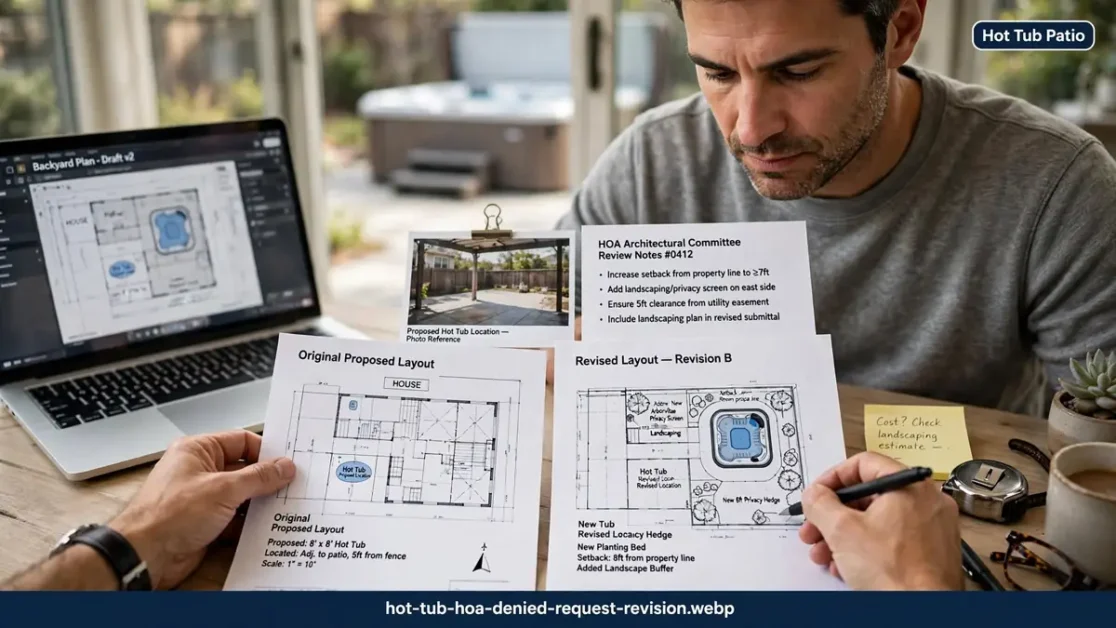
Do not start the installation to test whether the HOA will enforce its decision. Ask for the denial in writing and identify the exact rule, the part of the proposal that conflicts with it, and the procedure for requesting reconsideration or a variance.
- Compare the written denial with your association’s current CC&Rs and approved design standards.
- Ask whether a different location, screening plan, or equipment layout would resolve the concern.
- Check the rules for appeals, hearings, variance requests, and deadlines.
- Keep the complete exchange and request an updated written decision before proceeding.
- If you believe the association is applying rules inconsistently or without authority, seek advice based on your state’s law and governing documents.
For a concrete example, Florida Statutes section 720.3035(4)(a) requires the covered association or committee to give a written denial identifying the specific covenant or rule and the nonconforming part of a proposed improvement. Other states have different procedures. This is general consumer information, not legal advice about a particular HOA.
If the request is still pending, confirm the association’s formal process before relying on an apparent response deadline. Never assume an approval exists simply because nobody replied.
Tailored Action Plan: What to Do Based on Your Situation
| Your situation | Next useful action | Proof to keep |
|---|---|---|
| You have not bought a spa | Check the HOA rules and request a preliminary design discussion | Current guidelines and written questions |
| You own an inflatable tub | Ask whether portable outdoor equipment requires review | Written applicability response |
| You want a built-in spa or deck | Prepare a site plan and ask about both HOA and government review | Plans, contractor details and approvals |
| You have a worried neighbor | Address equipment placement, hours and sightlines | Written response and any agreed conditions |
| Your application was denied | Request the rule-based explanation and appeal procedure | Denial, rules, revisions and dated responses |
| You bought a house with an existing spa | Ask for prior approvals and verify current status before modifying it | Previous permit, HOA documents and ownership records |
The fastest practical start is to fill in the HOA approval packet before you send your first email. If the committee asks for a missing detail, you can see what it is without searching through old messages.
Free HOA Hot Tub Approval Worksheet and Submission Checklist
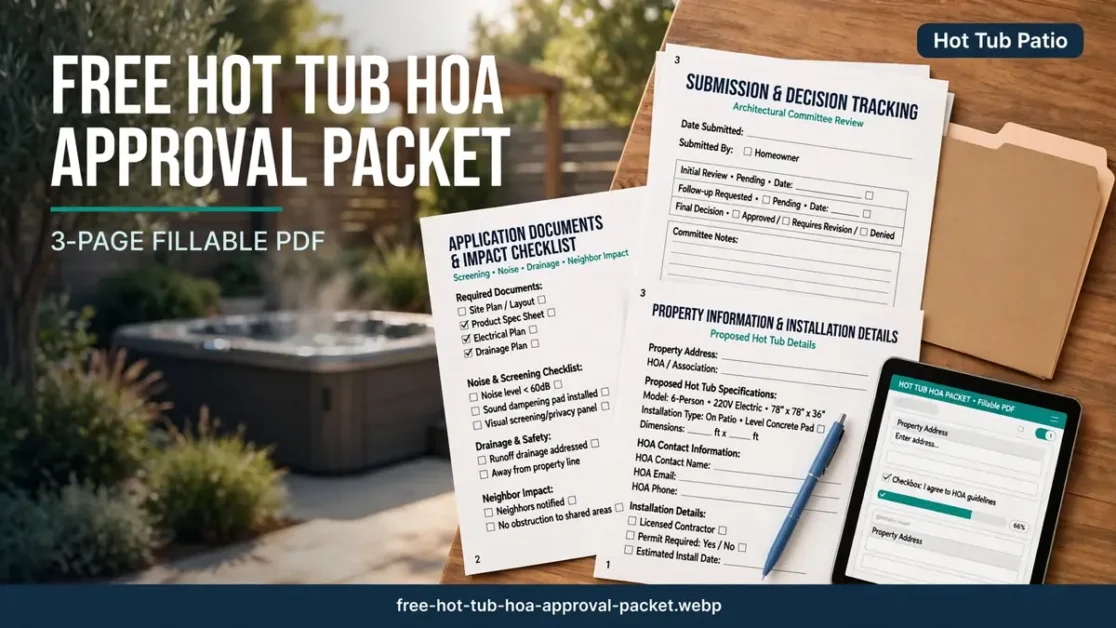
Original resource: Hot Tub Patio’s three-page fillable HOA Approval Packet is designed for owners preparing an architectural review request. It does not replace your HOA’s official application and does not grant permission to install a hot tub.
| Worksheet page | What it helps you record |
|---|---|
| 1. Your proposed spa | Property details, HOA contact, model, spa type, size, location and planned installation |
| 2. Supporting documents | Site plan, model brochure, screening, electrical, drainage and neighbor-impact checklist |
| 3. Decision tracker | Submission date, reference number, committee response, conditions, permit check and final approval record |
Download the free three-page fillable worksheet: Hot Tub HOA Approval Packet (PDF). It helps organize your proposed spa, site plan, screening and drainage details, application documents, and the committee’s written decision. It is a planning record, not the HOA’s official approval.
Copyable pre-application record
| Field | Your answer |
|---|---|
| HOA or committee contact | ____________________________ |
| Spa model, size and type | ____________________________ |
| Exact location and lot-line details | ____________________________ |
| Base, deck and electrical plans | ____________________________ |
| Screening, noise and drainage plan | ____________________________ |
| Required documents collected | ____________________________ |
| Submission date and reference | ____________________________ |
| Written decision and conditions | ____________________________ |
Keep your official application, current drawings, permission email, and any local permits together. A filled worksheet is only a record; written approval still comes from the body authorized under your community rules.
For other owner checklists and planning resources, use the Hot Tub Patio free resources library.
Sample HOA Hot Tub Approval Request Email
Use this as a starting point, then add whatever your HOA’s form specifically asks for.
Subject: Architectural review request for hot tub at [property address]
Hello [committee or manager],
I would like to request review of a [brand/model and type] hot tub planned for [location on property]. I have attached a site plan, equipment specifications, photos, and details of the screening and drainage plans.
Please confirm receipt, the required review steps, any missing documents, and when I should expect a written decision. I will not begin work until the necessary HOA and government approvals have been obtained.
Thank you, [Name and contact information]
Common HOA Hot Tub Mistakes to Avoid
- Buying first and checking restrictions later: the spa may be too large, too visible, or in a prohibited location.
- Confusing a permit with HOA authorization: they are different review processes.
- Submitting only a product photo: a committee may need dimensions, location, screening, and drainage information.
- Assuming an inflatable model never needs approval: ask about rules for temporary outdoor equipment.
- Building a screen that blocks service access: follow the owner’s manual and contractor guidance.
- Ignoring noise and runoff: these affect nearby homes even when the spa looks acceptable.
- Installing after an unanswered email: request a documented decision under the applicable procedure.
Frequently Asked Questions
Can my HOA say no to a hot tub in my backyard?
Possibly, depending on the recorded restrictions, adopted standards, state law, and the proposed installation. Request the governing provision and approval process in writing rather than assuming an unconditional right or ban.
Can an HOA prohibit an inflatable hot tub?
Some communities restrict portable or temporary outdoor equipment. An inflatable spa is not automatically exempt. Read the applicable rules and ask the committee for a written answer.
Do I need HOA approval if the hot tub cannot be seen from the street?
You may. Some communities review all hot tubs or exterior improvements even when hidden from the street. Confirm which review triggers apply.
How long does HOA hot tub approval take?
It varies by community and application completeness. Get the actual published review period, meeting schedule and response process from your association. Do not invent a 30-day rule for your neighborhood.
Can I install a hot tub while I wait for HOA approval?
Do not begin work if approval is required. Wait for the written decision and separately check the government permit process.
Does a plug-and-play 120V spa need approval?
A plug-in electrical connection does not decide HOA approval. Appearance, placement and community rules still matter. Local electrical requirements are a separate question.
Can a neighbor stop my hot tub installation?
A neighbor’s concern may affect review or enforcement under applicable rules, but the neighbor does not automatically have approval authority. Ask the committee which rule and process govern the decision.
What if I buy a house that already has a hot tub?
Ask for the existing HOA approval, permits, and relevant installation records. Avoid assuming a previous owner’s installation was approved.
Can the HOA require hot tub insurance?
Some communities ask for insurance confirmation or special conditions. Ask for the exact requirement and compare it with your policy. Our homeowners insurance and hot tubs guide explains what to verify with the insurer.
What if the HOA changes its standards after I receive approval?
Ask how the new standards and any grandfathering or modification provisions apply to an already-approved installation. Keep the original approval and seek legal advice if the situation is disputed.
Get a Written Decision Before Installation
Start with the rules that govern your own property, then present a clear location plan, spa specifications, and realistic screening, noise and drainage details. Keep the association’s decision with your building and electrical permits.
A complete submission does not guarantee approval, but it makes the request easier to review and gives you an organized record if the committee asks for changes.
Sources checked November 13, 2026: Muirfield Association hot tub guidelines, Wilde Lake architectural standards, Florida architectural control law, Prince William County spa permit guidance, and U.S. Consumer Product Safety Commission pool and spa safety guidance. Requirements differ by state, local government, condominium or HOA documents, and project type. This article is general information, not legal advice or design approval.