Hot Tub Power Outage in Freezing Weather: What to Do

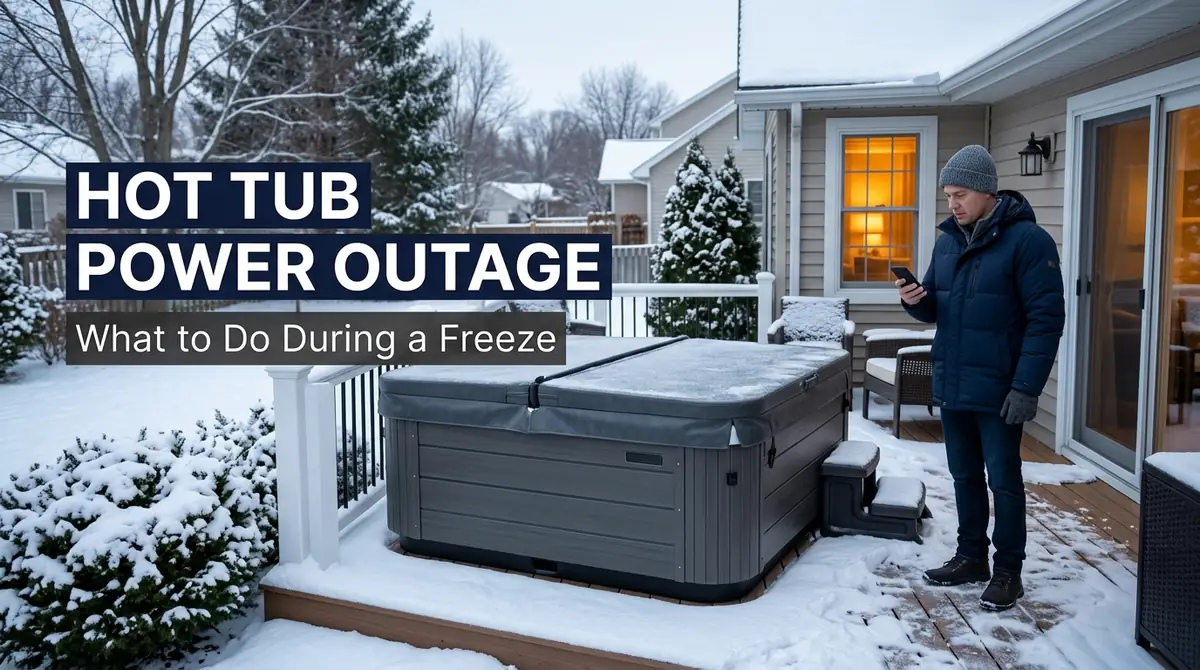
Your hot tub has stopped heating, the display has gone dark, or the neighborhood has lost electricity during a freeze. The immediate job is to retain the heat that is still in the spa, find out whether the outage affects the whole property or only the spa, and get model-specific help before plumbing freezes. The next step depends on what has actually failed.
Quick answer: Keep the insulated cover fully closed and latched, check the utility outage status and any safe, visible warning signs, and contact your spa dealer promptly if heat or circulation cannot be restored. Do not drain the shell, repeatedly reset a tripping GFCI, improvise a heater inside the cabinet, or start equipment that may be frozen. A warm-looking water surface does not prove that the pump and plumbing are safe.
These steps cover electric hot tubs during an unplanned power or heating failure. A planned seasonal shutdown is a different job, and inflatable, wood-fired and some swim spas have different requirements. Keep the owner manual handy and use the decision table below rather than a generic freeze countdown.
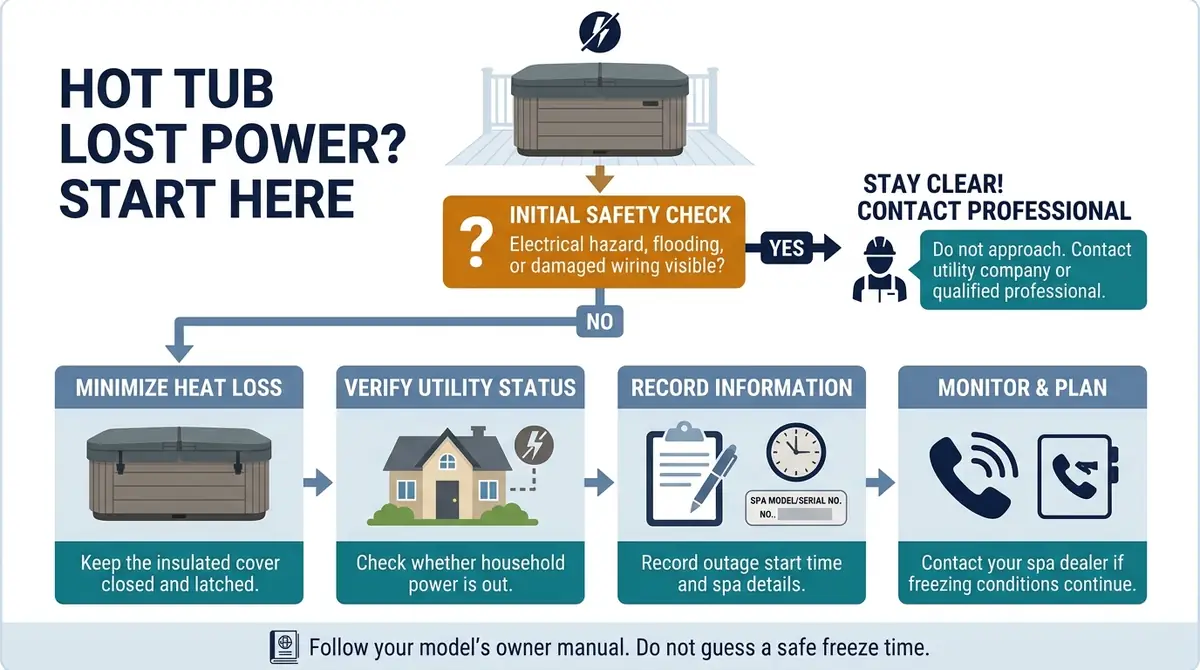
Hot Tub Lost Power in Freezing Weather? Start Here
Safety comes before the hot tub. Stay away from downed electrical wires, flooded outlets, burning smells, damaged cords and wet electrical equipment. Call the utility or emergency services as appropriate. Do not enter the spa while the electrical condition or water temperature is uncertain.
- Leave the cover closed and secured. Every unnecessary opening releases heat. Jacuzzi’s outage guidance recommends keeping the cover on to slow heat loss.
- Record the time and conditions. Note when power was first lost, the forecast, last known water temperature and anything visible on the controls. An approximate outage start is useful, but it is not a prediction of freeze safety.
- Find out what lost power. Check whether nearby indoor lights or other circuits are also out without touching unsafe equipment. Read the utility’s official outage map or notification.
- Contact the dealer early if freezing weather will continue. Tell them the model, symptoms, outside conditions and whether anyone can monitor the property. Ask which emergency steps the owner manual permits.
- Do not improvise a shutdown. Draining the shell can leave water trapped in pumps and plumbing, which may freeze sooner than water in the covered spa.
The Bullfrog emergency support article specifically tells owners not to drain their spa during this failure scenario. It also describes specialized cabinet-warming methods for its own equipment. Those methods should not become a general DIY instruction for every model; heat sources near foam, wiring or plastic can create fire or equipment hazards.
Is It a Neighborhood Outage or a Spa Equipment Failure?
You can make a useful first distinction without opening an electrical cabinet. A dark neighborhood and a dark spa point toward the utility supply. A normal house with one dead spa circuit may point toward a breaker, GFCI, wiring or equipment problem. A lit control panel with no water movement is a separate circulation or heating problem.
| What you notice | What it could mean | Safer next action |
|---|---|---|
| Other rooms or houses have also lost power | Utility outage or neighborhood supply problem | Check the utility’s outage notice; keep the spa covered; contact the dealer about freeze protection if the outage continues |
| House has power, spa display is dark | Spa-only supply, breaker, GFCI or internal fault | Look for visible trouble and note it; follow the manual; contact a qualified electrician or service technician |
| GFCI trips immediately or repeatedly | Possible electrical fault or moisture issue | Stop resetting it; keep clear of electrical components and request qualified electrical service |
| Spa display works but heat or circulation is missing | Heater, pump, flow, sensor, control or protection issue | Record error codes; stop using the spa; contact the dealer |
| Water level is unexpectedly low or a leak is visible | Possible plumbing leak, pump fault or damaged fittings | Do not run the spa dry or force equipment to operate; get technical help |
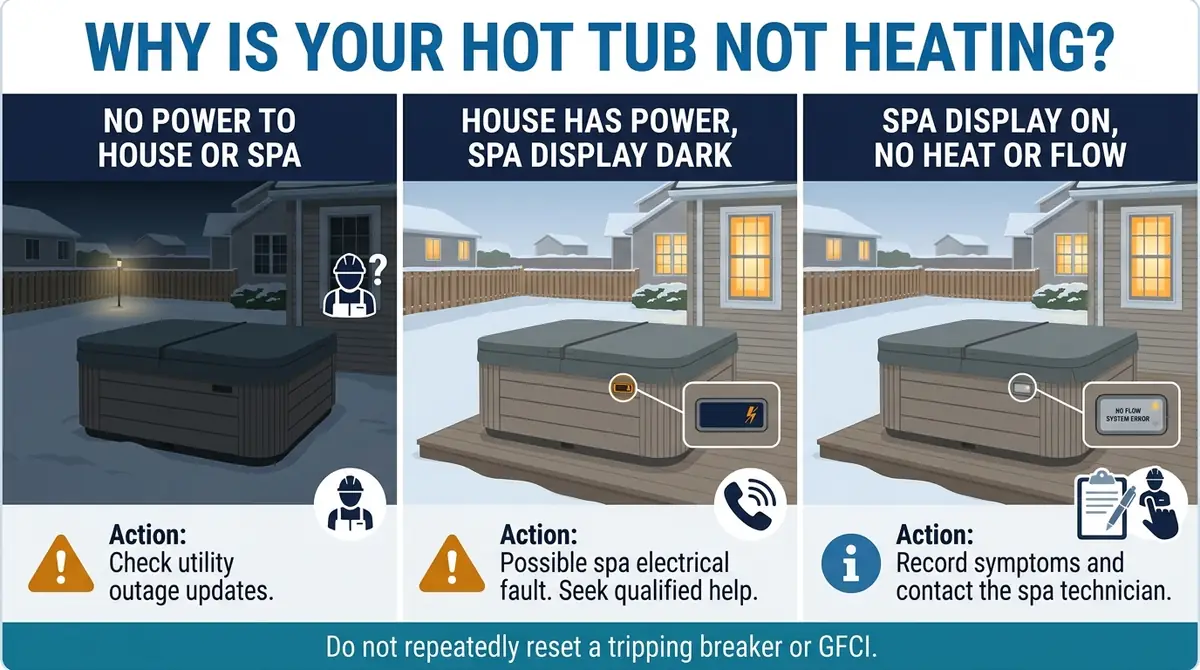
A single control-panel message is not a complete diagnosis. Take a photograph if it is safe, record the exact characters, and identify your model before clearing the error. Our spa pump and GFCI reset guide explains owner-visible checks and when to stop. During freezing weather, repeated resets are not a substitute for fixing a fault.
What about the breaker or GFCI?
Do not handle a wet breaker, open spa electrical panels, or repeatedly flip a device that will not stay on. If your manufacturer provides a routine, owner-permitted reset and everything is dry and undamaged, follow that specific instruction once as directed. A repeated trip, smell of burning, visible damage, shock or unexplained fault calls for a qualified electrician or spa technician.
A spa that has power at the display but no heater or circulation should still be treated as a freeze risk. Automatic freeze-protection features cannot compensate for failed parts, blocked flow or a protection mode that is not functioning.
How Long Can a Hot Tub Stay Without Power?
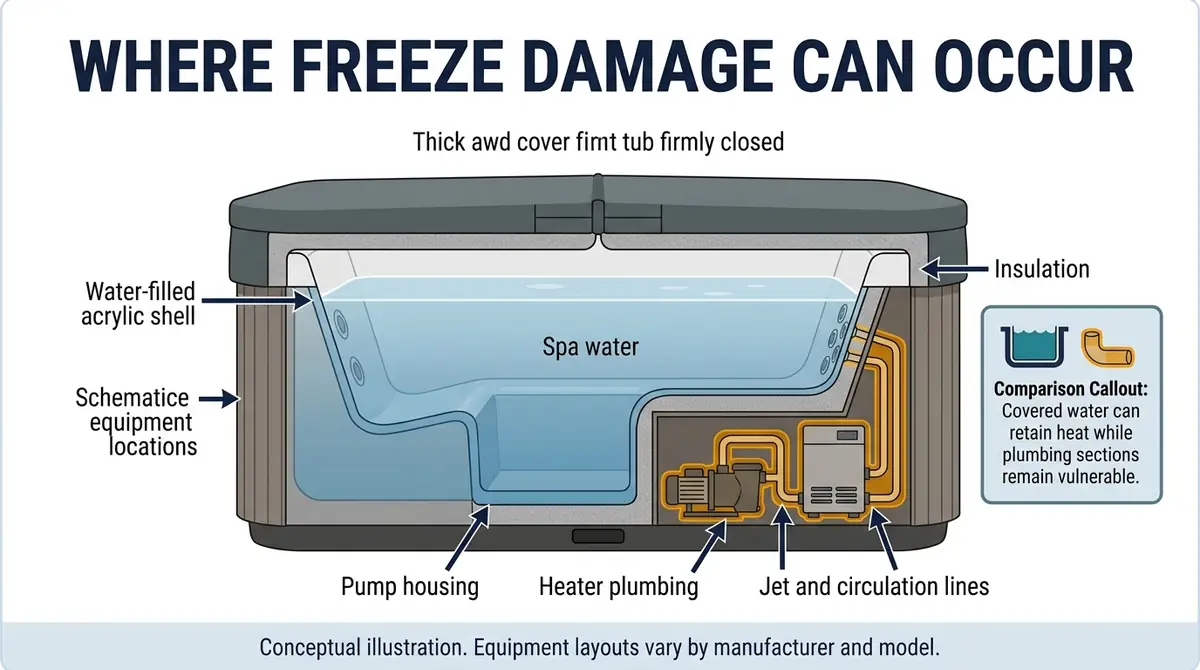
There is no reliable universal number of hours. The answer changes with starting water temperature, tub volume, cover seal, insulation, wind exposure, outside temperature, cabinet design and whether small sections of plumbing are exposed. A large covered shell may stay relatively warm while a narrow pump passage or external line becomes vulnerable sooner.
Do not use an online anecdote that promises two days, three days or an exact number of hours as a safety timer. Published manufacturer material describes different equipment and procedures, and it does not justify one countdown for every hot tub. The Bullfrog winter-maintenance page explains that freeze protection uses the powered control system and equipment.
| Factor | Why it matters | What to document |
|---|---|---|
| Initial water temperature | Warmer water usually has more stored heat, but does not prove pipe safety | Last reliable reading before power loss |
| Outside temperature and wind | Colder, windier exposure may cool vulnerable cabinet parts faster | Forecast and exposed location |
| Cover condition | A fitted, latched cover can help reduce heat loss | Damage, gaps, loose latches |
| Water level and visible leaks | Low water may prevent proper circulation after power returns | Last normal level and signs of leakage |
| Equipment configuration | Heat and circulation routes differ by make and model | Exact model and year |
| Time since the failure | Longer unpowered periods increase uncertainty | Time first noticed; times checked |
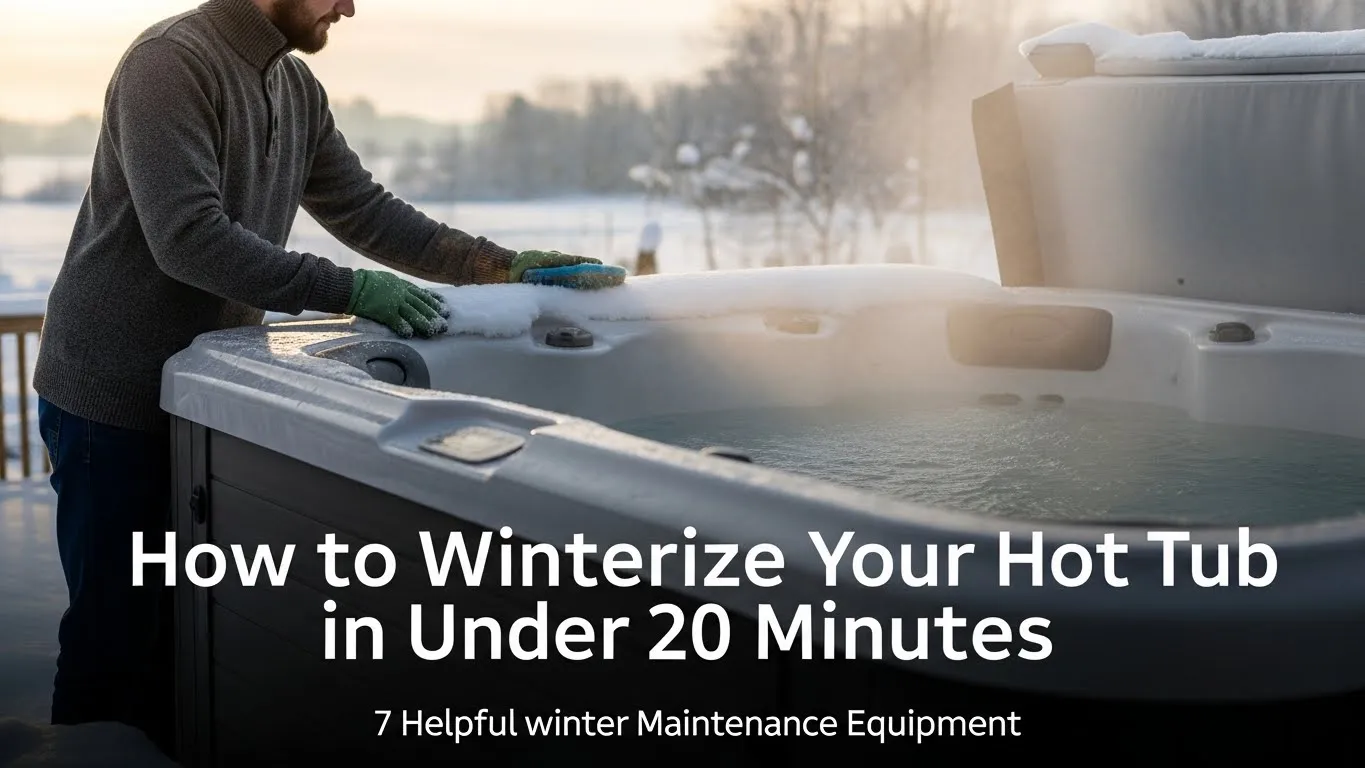
For prevention before the next storm, our winter hot tub care checklist covers cover seals, routine inspections and monitoring. This outage guide is for the moment when those systems are no longer keeping the spa heated.
Should You Drain the Hot Tub?
Usually, do not start draining a filled hot tub simply because the power goes out. Draining the main shell is not the same as winterizing. Water may remain in pump housings, heater tubes, suction lines and jet loops, where it can freeze and crack fittings. A complete winterization requires the exact brand and model instructions.
Jacuzzi’s power-outage advice tells owners not to drain as an early response, while Bullfrog’s outage guide gives the same direction for its spas. Some manufacturers describe emergency draining of particular external equipment lines in extended outages, but those instructions are product-specific. Get your own dealer’s instructions before loosening parts or draining any line.
- Do not remove a drain cap merely to see whether water is still flowing.
- Do not pour automotive or generic RV antifreeze into the soaking water.
- Do not disconnect pumps, open unions or blow through plumbing without the approved procedure.
- If a technician recommends full winterization, obtain a written list of the lines, pumps, drains and equipment they will protect.
If you decide to keep the spa shut down for the season after the emergency, the hot tub winterization sign-off guide explains what must be verified before calling that job complete. The key difference is planned and complete line clearing, not a partially empty shell.
Can Backup Power Protect the Spa?
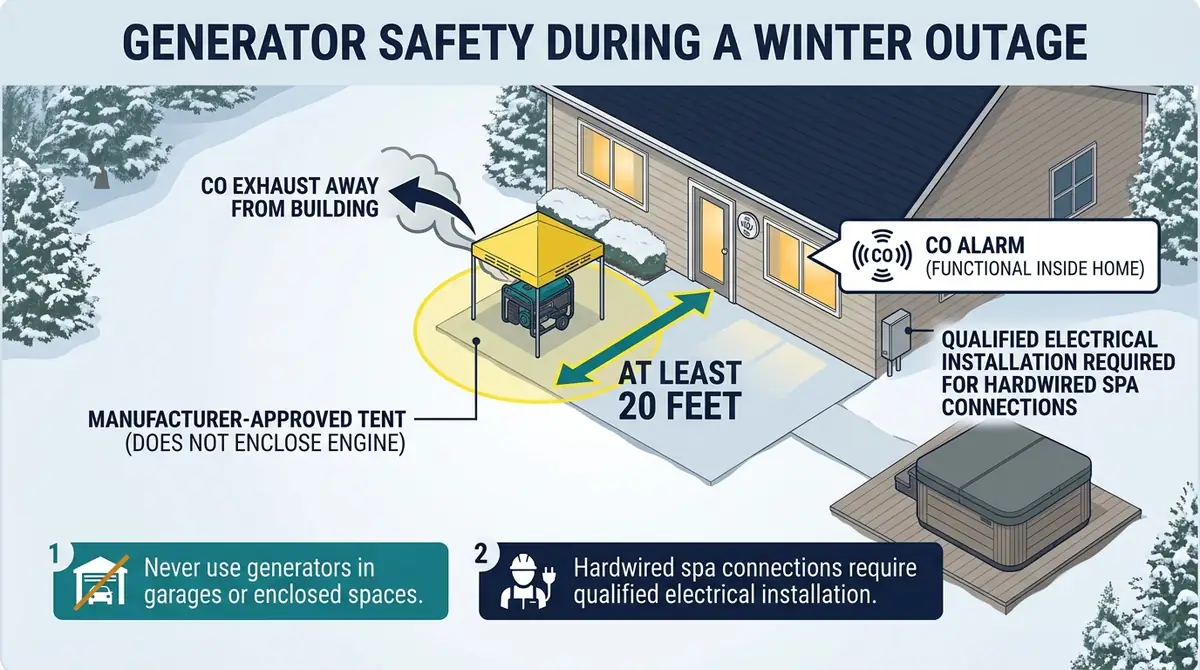
A generator, properly designed home battery or other backup system may be useful, but it is not a plug-and-play fix for a hardwired spa. The electrician needs the spa’s voltage, required amperage, heating and pump loads, GFCI arrangement, and transfer equipment requirements. A small backup device that powers lights does not automatically support a hot tub heater or pump.
The Electrical Safety Foundation International warns against connecting generators directly to home wiring without a correctly installed transfer switch because electricity can backfeed into utility lines. An electrician should design and install any compatible connection, confirm grounding and electrical protection, and explain how power transfers back safely.
- Keep engines outdoors. The CDC winter-storm safety guidance says generators should be at least 20 feet from doors, windows and vents, away from rain and snow. Never run one in a home, garage, porch, shed or enclosed area.
- Use working carbon monoxide alarms. Generator exhaust can enter buildings even when the engine seems far from living space.
- Never backfeed a receptacle. Do not use an improvised cord, bypass a GFCI or connect a generator to spa wiring yourself.
- Do not overload equipment. Have a qualified installer verify generator capacity against the actual spa’s nameplate and simultaneous heating and pump demands.
- Keep water and electrical cords apart. Wet outlets, improperly protected extension leads and outdoor connections create shock hazards.
Some manufacturers provide brand-specific temporary warming instructions for an equipment cabinet. Those may involve heat sources that create their own fire and shock risks. We do not recommend placing space heaters, incandescent work lights, hot water or improvised submersible heating elements inside a spa cabinet as a universal fix. Ask your dealer what is approved for your exact spa and electrical situation.
For normal running-cost planning after the outage, our hot tub electricity usage calculator can help estimate consumption. It is not a generator-sizing tool or an emergency electrical design.
What If Pipes or Equipment May Already Be Frozen?
A warm-looking shell is not a reliable test for plumbing. Treat the spa as possibly frozen if you find ice near fittings, a swollen or cracked pipe, a leak, no normal flow, or a pump that hums or struggles after power returns. Stop use and arrange an inspection.
- Do not force a pump to start. Ice can block flow and damaged fittings can leak as the equipment warms.
- Do not pour boiling water onto cold parts. Sudden temperature changes and unsafe contact with wiring can create more damage.
- Do not use a torch, hair dryer, portable heater or heat gun on unknown plumbing. The equipment compartment may contain sensitive plastics, insulation and wiring.
- Keep the spa out of service until checked. A qualified technician can inspect lines, unions, pumps, heater passages and electrical safety before a normal start.
If the spa shows unexpected odors, a tripped breaker, water inside electrical spaces or active leaking, keep people away and request an electrician or service technician. For other symptoms, see our hot tub troubleshooting reference as a way to describe the problem, not as permission to restart suspected frozen parts.
What to Check When Power Returns
Electricity returning to the house does not prove the spa is ready to use. If an outage was long, weather was severe, or equipment seems frozen or damaged, have the system inspected before applying power to the spa. If the spa’s electrical disconnect was intentionally switched off, do not automatically switch it on until it is safe to do so.
- Look from outside. Check for water around the cabinet, damage to the cover and any visible signs of leaks or loose fittings. Do not open an electrical cabinet.
- Confirm normal water level. Follow the manual’s fill guidance if needed. Do not energize a system that may be dry.
- Use the manufacturer startup sequence. If the technician has cleared the equipment and the system is safe, check normal display operation, priming, circulation, flow and heating. Stop if there is an error, unusual sound, leak or GFCI trip.
- Retest the water before soaking. Loss of circulation and heat can disrupt water treatment. Use the correct sanitizer system, test supplies and product instructions.
- Record what happened. Save outage duration, faults, service actions and any changed settings so the next event is easier to manage.
For ordinary chlorine systems, the CDC home hot tub water-testing guidance recommends at least 3 ppm free chlorine and pH 7.0 to 7.8. For bromine systems, CDC hot tub safety guidance lists 4 to 8 ppm bromine. Use the product and manufacturer requirements for your particular system. Do not soak until circulation, temperature and water quality are appropriate.
If the outage exposed dirty water, a damaged cartridge or a persistent flow problem, do not guess a chemical dose. Use our hot tub water-care troubleshooting guide and safe filter cleaning guide after the spa is operating normally.
Printable Winter Outage Emergency Log
A technician can act faster when you can describe the fault without trying to remember details in the cold. Use this log while waiting for guidance and continue after power returns. It is a record of what you observed, not a calculator of safe time without heat.
| What to record | Your entry |
|---|---|
| Owner, contact, spa brand/model and date | ________________________ |
| First noticed power or heat loss | ________________________ |
| Utility outage notice or estimated restoration | ________________________ |
| Outside conditions and forecast | ________________________ |
| Last safely known water temperature | ________________________ |
| Display, circulation, heating, warnings and water level | ________________________ |
| Cover condition and visible leaks | ________________________ |
| Dealer or electrician contacted; time and advice | ________________________ |
| Model-specific steps approved and person responsible | ________________________ |
| Restoration, flow/leak checks and water tests | ________________________ |
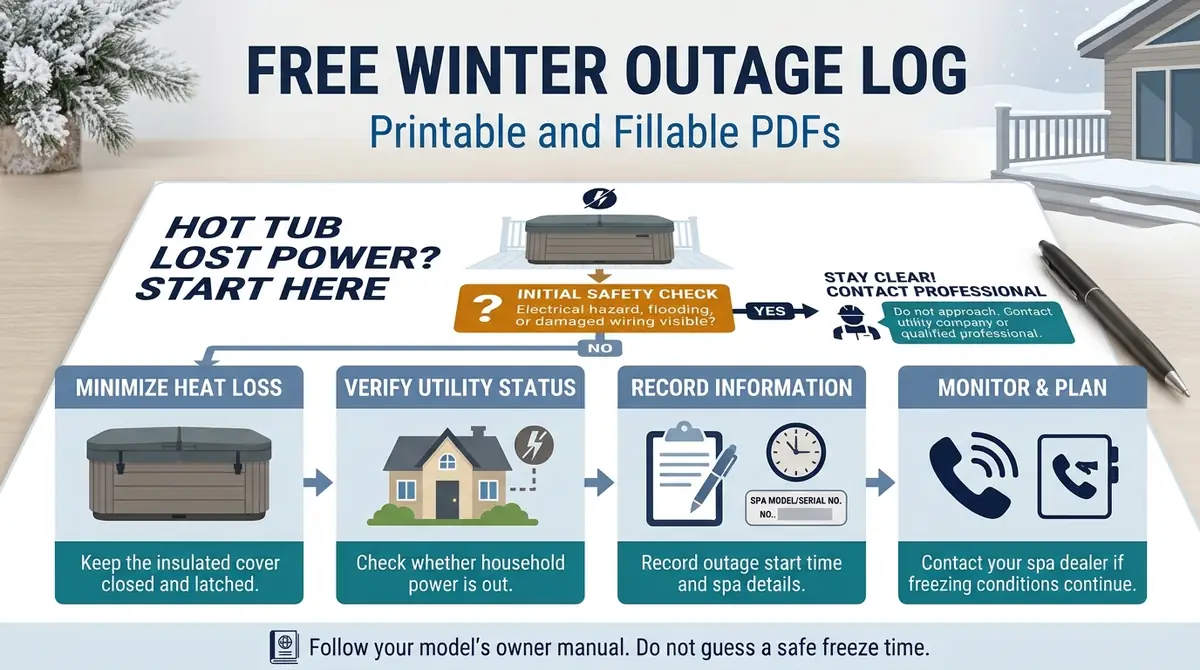
Keep the completed log beside your spa manual and service records. Only record details you can observe safely. Do not open the cover or equipment compartment just to fill a blank on the worksheet.
Common Hot Tub Power-Outage Questions
Will my hot tub freeze overnight if the power goes out?
It is possible for vulnerable components to freeze before you expect, but no single overnight prediction fits every spa. Keep the cover closed, document the outage and contact your dealer about your model and forecast.
Should I turn the hot tub breaker off during a blackout?
Manufacturer guidance differs. Some dealers recommend isolating equipment in certain outage or surge situations, while others describe different startup needs. Follow your actual owner manual or electrician’s instruction, especially if there is damage, moisture or a tripping GFCI.
Can I put a space heater inside the hot tub cabinet?
Do not treat that as a general homeowner repair. Although some manufacturer instructions describe controlled equipment-bay warming, heat sources near insulation, wiring and plastic can be hazardous. Contact the dealer for a procedure approved for your model and circumstances.
Can I just pour hot water into the hot tub?
Do not assume that warming the main shell protects every line. Jacuzzi documents a particular hot-water method for some outage situations, but it is not a universal instruction and can create handling, water-level and sanitation problems. Ask your dealer first.
Will automatic freeze protection work without electricity?
Normally no. Sensor logic, circulation and electric heating require an operating power supply and functional equipment. A powered display alone does not prove every pump or heater is working.
What if my spa loses heat but the power is still on?
Treat it as an equipment failure during freezing weather, not as a harmless thermostat issue. Record any error message, stop soaking, leave the cover closed and call your spa service provider.
Can I restart the spa as soon as the lights come back?
Not if you suspect frozen plumbing, leaks, electrical damage or a pump fault. Have the system checked first, then follow the owner’s restart and water-care instructions.
A Short Plan Before the Next Storm
Keep the spa model number, local dealer contact, owner manual, utility outage link and emergency log in one place. Know who can visit the property if you are away, and have an electrician explain what backup power is realistically compatible with the spa before an outage occurs.
A hot tub with reliable winter care is still vulnerable when power or circulation fails. The safest response is to preserve heat, avoid risky improvised repairs, and get model-specific help promptly. That approach protects the people nearby as well as the equipment.