Best Wood for a Sauna: Cedar, Aspen, Hemlock & Spruce

The best wood for a sauna depends on what you are building. A board that works well on a wall may be less comfortable on a bench, while timber suited to an indoor hot room may not be the right choice for an exposed backyard exterior. Picking one wood for everything can lead to uncomfortable seating, unnecessary expense or preventable maintenance.
For most homeowners, aspen and alder are sensible bench materials, while spruce, cedar, hemlock and sauna-rated aspen products deserve a look for interior paneling. The product grade, finish and supplier instructions matter as much as the species name. Wood near the heater must also respect the heater manufacturer’s clearance requirements.
Use the comparison and buying worksheet below to select each surface separately. Manufacturer examples are included for context, but there is no universal species, treatment or board size that suits every sauna.
What Is the Best Wood for a Sauna?
Quick answer: Start with low-density, low-resin sauna-rated boards for surfaces that touch skin, such as seats and backrests. Choose wall and ceiling paneling for its approved hot-room use, appearance, upkeep and cost. Treat exterior cladding as a separate weather-exposure decision.
Harvia describes aspen, alder, heat-treated aspen and spruce among its sauna material options; Thermory sells distinct wall panels and bench boards rather than assuming one board belongs everywhere. These are examples of why the complete product specification matters. See Harvia’s sauna design guidance and Thermory’s wall and bench material range.
| Material | Useful starting application | What to check before buying |
|---|---|---|
| Aspen | Benches, backrests, interior panels | Supplier-approved sauna grade, board profile, color and finish |
| Alder | Benches, backrests and panels | Availability, visible knots, grade and color variation |
| Western red cedar | Interior wall paneling and selected sauna-rated benches | Aroma preference, grade, product instructions and local cost |
| Spruce | Traditional wall and ceiling paneling; specified bench products | Knots, resin pockets and whether the particular board is sold for bench use |
| Hemlock | Some prefabricated interior sauna cabins | Exact grade and manufacturer’s sauna-use specification |
| Thermally modified wood | Selected sauna panels and benches; certain rated exterior products | Whether it is designed for indoor sauna use or separately rated for exterior exposure |
This is a shopping screen, not a species safety certification. For example, Thermory offers some sauna bench profiles made from spruce, so a rule that all spruce is unsuitable for benches would be too broad. Conversely, a random construction-store spruce board is not automatically a sauna bench board.
Cedar vs Aspen vs Hemlock vs Spruce
Aspen: a practical choice for skin-contact surfaces
Aspen’s pale, even appearance makes it easy to match with light paneling. Its popularity for seats comes from a combination of comparatively low density, smooth finishing options and low resin. Use a product made for sauna benches: board profile and surface quality affect comfort just as much as the species.
If the look feels too plain, contrast it with darker paneling rather than switching every exposed seat to a wood selected only for color. Thermally modified aspen offers another appearance, but verify the manufacturer’s finish and care instructions.
Alder: warmer color without a strongly aromatic room
Alder is commonly sold in sauna bench and wall-panel formats. Its reddish or warm-brown tone can soften a modern interior without relying on an added fragrance. Check whether the quote specifies natural alder or thermally modified alder; those are different product options and may require different care.
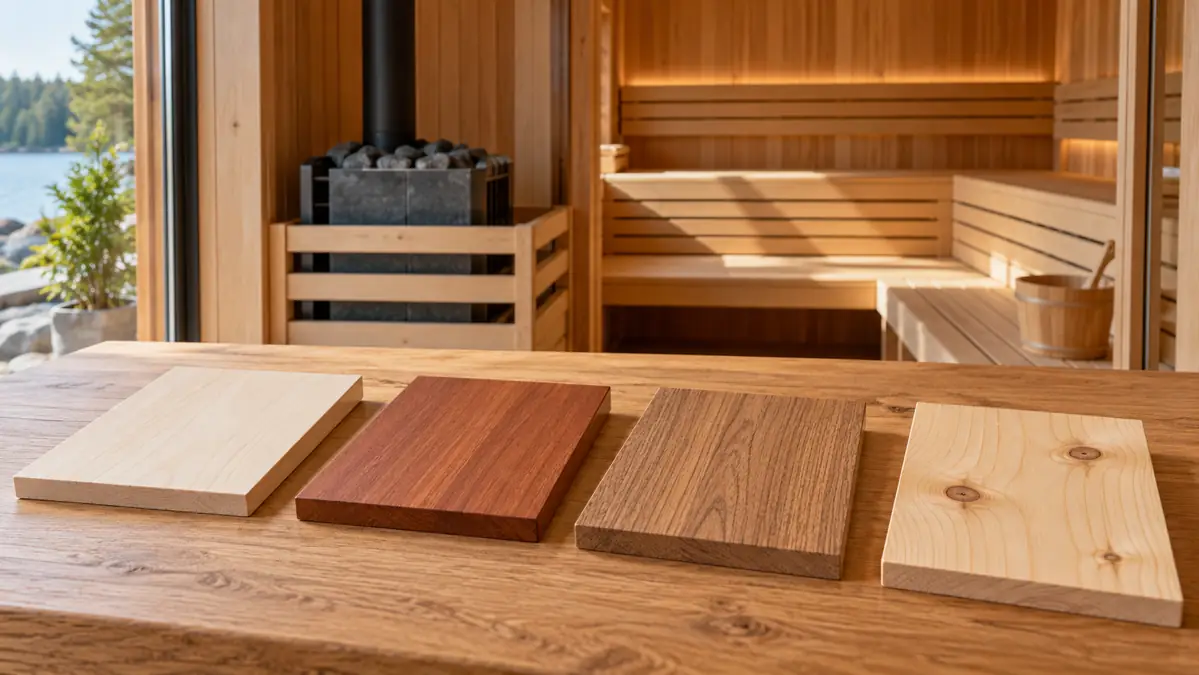
For a coordinated installation, request samples for both benches and wall panels. Even the same species may look different when profiles, treatments and lighting change.
Cedar: classic aroma, with personal tradeoffs
Western red cedar is familiar in North American sauna kits, in part because of its appearance and distinctive scent. Some users like that fragrance; others prefer a more neutral sauna environment. A family sensitive to wood aromas should inspect a sample or compare with aspen or hemlock before ordering.
Do not assume any item labeled cedar has a suitable interior finish or appropriate construction grade. Check the supplier’s exact panel and bench specifications, including whether the material is intended for high-temperature use.
Spruce: common for traditional paneling
Spruce is a familiar wall and ceiling option in Finnish-style saunas. Some grades contain visible knots or resin pockets, so ask where the exact board is intended to be installed. Avoid positioning knotty construction lumber at places where hot resin or rough edges might contact skin.
Sauna-manufacturer bench boards can have different specifications from general-purpose spruce lumber. Compare the named product, not just its wood species.
Hemlock and thermally modified choices
Hemlock appears in many prefabricated sauna specifications, particularly when buyers want a lighter wood with less pronounced aroma. But hemlock sold for unrelated building work should not be treated as equivalent to a tested cabin material.
Thermally modified products use controlled processing to alter wood properties and appearance. Thermory distinguishes interior sauna products from products intended for outdoor exposure. A dark, modified panel is not automatically exterior cladding, and an exterior decking board is not automatically approved for a hot room.
Best Wood for Sauna Benches and Backrests
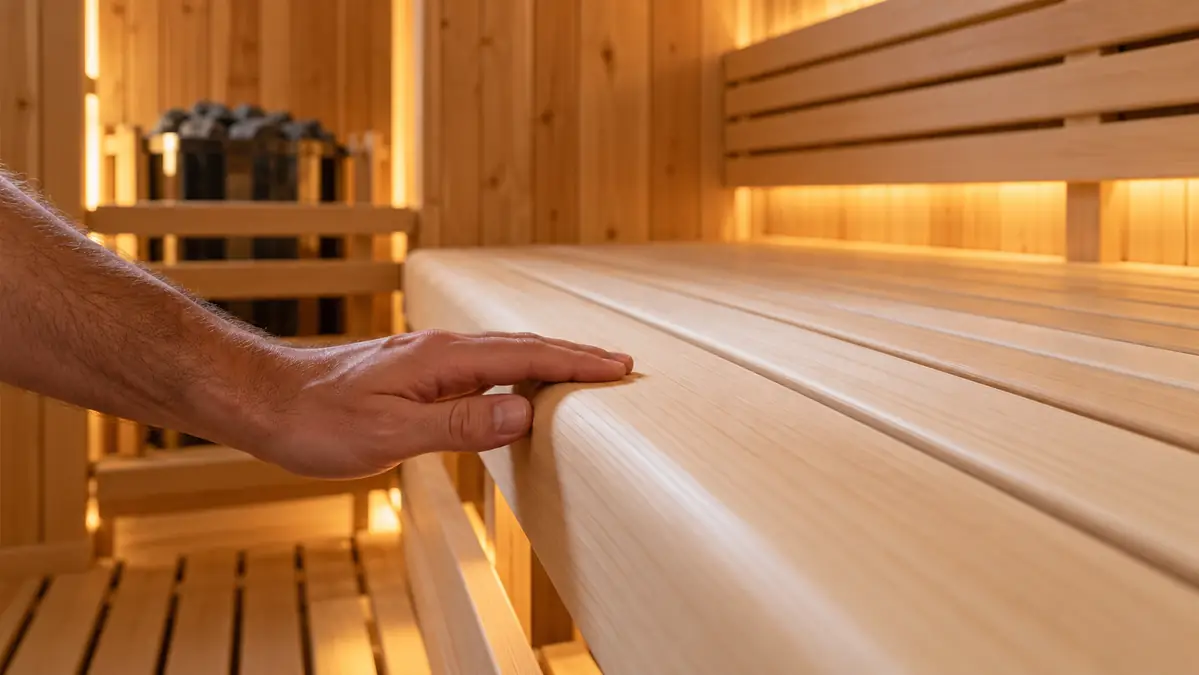
Seats, backrests, footrests and frequently touched rails need the most attention. Their surfaces contact bare skin or towels for much longer than a wall. Look for a low-density, smooth sauna bench board, rather than selecting purely for resistance to outdoor weather.
- Inspect the actual face: knots, splinters, checks and sharp arrises are more important than a showroom photograph.
- Check fastener exposure: accessible screw or nail heads can become uncomfortable when hot; use the bench maker’s approved concealed-fixing detail.
- Confirm cleaning instructions: the seating finish must tolerate the routine the manufacturer recommends, without leaving an unsuitable film.
- Check structural support: board thickness, unsupported spans and bench framing must match a tested design or qualified builder’s plan.
- Use a towel: a clean seat towel improves everyday hygiene, but does not make a defective or unsuitable bench safe.
Harvia notes that comparatively porous, lower-density woods are often used for sauna benches because they are more comfortable against skin. Read Harvia’s bench material questions before prioritizing color alone.
Best Wood for Sauna Walls and Ceilings
Walls and ceilings can accommodate a wider visual range than seats. Start with products sold explicitly as sauna paneling, then compare profiles, fastening method, wood grading, and whether the paneling is prefinished. Do not assume a generic interior wall finish is suitable under sauna heat.
Walls also form part of a larger building assembly. Paneling does not replace correctly planned insulation, vapor control or ventilation. The sauna insulation guide covers what belongs behind the decorative wood so you can keep the material decision separate from the wall assembly.
Ask how the ceiling paneling and trim will meet heater clearances, lighting products and sensor locations. When there is an apparent conflict between a decorative plan and the heater installation manual, the manufacturer’s safety distances take priority.
Best Wood for Outdoor Saunas
Outdoor saunas involve two different environments: the heated interior and the weather-facing structure. An interior bench may never see rain, while exterior siding must tolerate rain, sunlight, drainage conditions and local climate. A single purchase order should clearly separate these product roles.
Thermory explicitly notes that certain sauna wall panel products are intended for indoor applications rather than exterior use. An outdoor sauna can have a durable exterior cladding and a different species of wood on the benches without looking mismatched.
- Specify interior hot-room paneling independently of exterior siding.
- Specify a weather-rated exterior system, including flashing and compatible fasteners.
- Check the treatment and maintenance schedule for exterior surfaces against supplier instructions.
- Leave drainage, roof protection and the base to the project plan; wood selection cannot fix poor site preparation.
For structure and weather planning, use the outdoor sauna guide. A wood-species decision is only one part of protecting a backyard sauna.
Sauna Wood to Avoid or Verify Carefully
Avoid putting pressure-treated lumber, unknown coated furniture panels, unsuitable adhesives or general household paints on the exposed hot-room seating or lining simply because they are available locally. The hot room is not an ordinary indoor room, and products not specified for that environment can behave unpredictably with heat.
A seller’s phrase such as ‘heat resistant’ is not enough. Ask for the actual intended use, finish information and installation instructions. For structural members hidden behind the finished assembly, the engineer or builder should specify the complete construction rather than copying rules for exposed seating.
Sauna wood oil, wax and cleaning products are not interchangeable with ordinary furniture finishes. Use the finish approved for the exact sauna surface and follow the instructions for curing and first use.
Calculate Sauna Wall and Ceiling Board Quantities
A sauna wood quantity estimate helps you compare quotes, but it is only for wall and ceiling lining. Estimate benches, framing, structural supports and heater guards from approved drawings and supplier specifications rather than a surface-area formula.
| Input | How to calculate it |
|---|---|
| Net area to panel | Wall perimeter × finished lining height − door/window areas + ceiling area; keep the same units. |
| Usable board coverage | Installed face width (not nominal board width) × supplied board length. |
| Board quantity | Round up [net panel area × (1 + your project cutting allowance)] ÷ usable coverage per board. |
| Quoted material cost | Whole boards × supplier price per board. Add separately quoted delivery, fixings and tax. |
Download the Sauna Wood Paneling Estimator (Excel). Enter wall and ceiling dimensions, actual usable board coverage, a project-specific cutting allowance and supplier price. The spreadsheet estimates whole boards and material cost; it does not size bench supports or heater clearances.
Calculate wall and ceiling products separately if their profiles or lengths differ. The cutting allowance is your planning input, not a universal percentage; check it against the board layout and supplier before buying.
Sauna Wood Buying Checklist
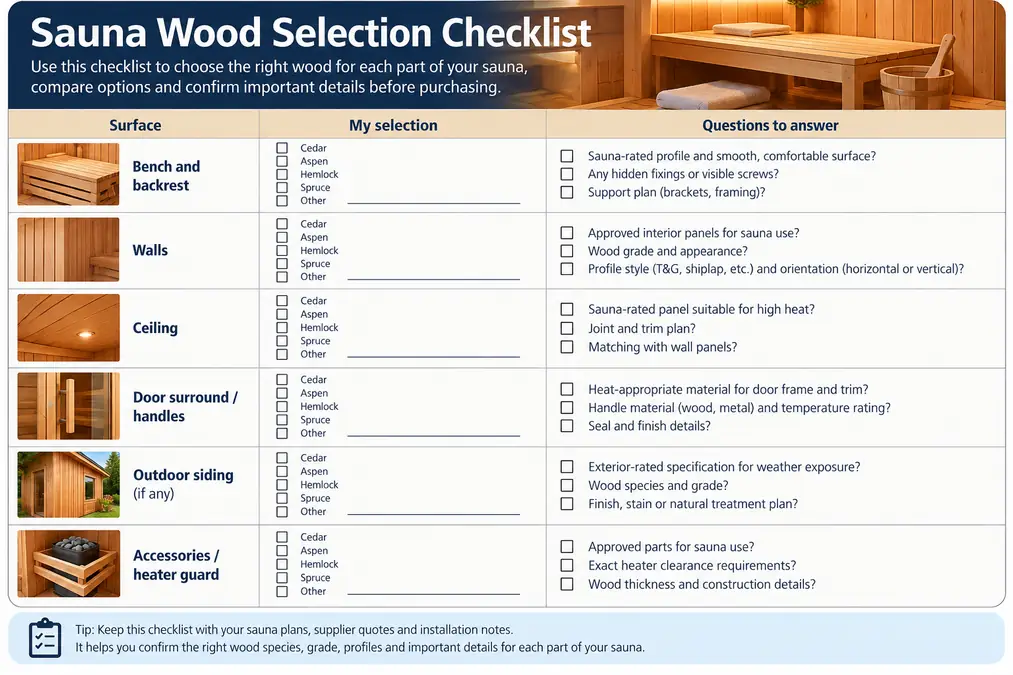
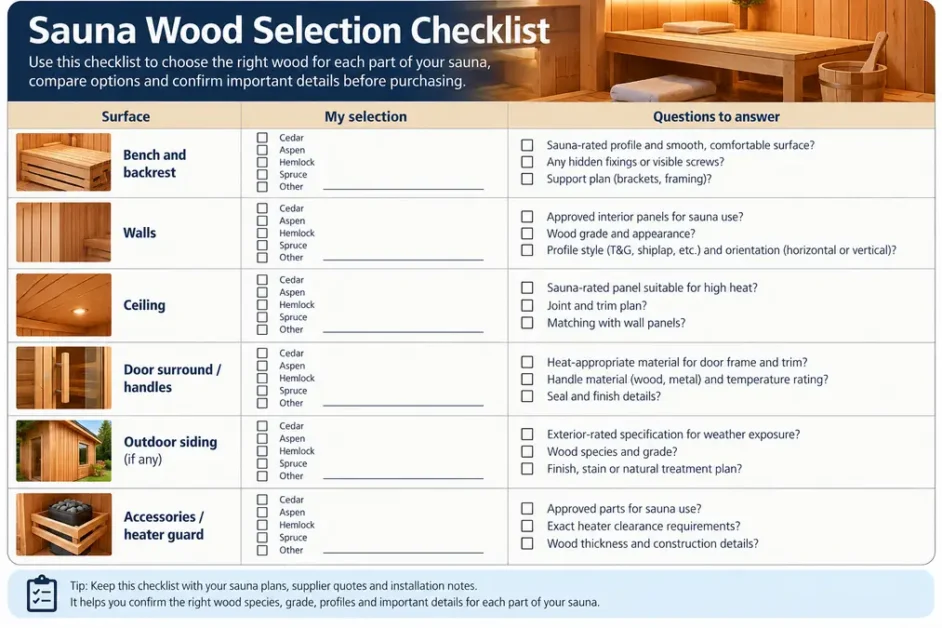
Download the Sauna Wood Selection & Purchase Checklist (PDF). Print the one-page worksheet to record bench wood, wall panels, board grades, supplier details and final purchase checks.
Before paying a deposit, complete this worksheet for each surface. It prevents a common quoting problem: one contractor prices the entire room as an unspecified timber package, while another includes higher-grade seating, trim and hardware.
| Surface | My selection | Questions to answer |
|---|---|---|
| Bench and backrest | __________ | Sauna-rated profile? Comfortable face? Hidden fixings? Support plan? |
| Walls | __________ | Approved interior panels? Grade? Profile and orientation? |
| Ceiling | __________ | Sauna-rated panel? Joint and trim plan? |
| Door surround / handles | __________ | Heat-appropriate material and handle details? |
| Outdoor siding (if any) | __________ | Exterior-rated specification, weather details and finish? |
| Accessories / heater guard | __________ | Approved parts and exact heater clearance requirements? |
- Draw or measure each surface area and convert to the supplier’s listed board units. Add a separately identified allowance for offcuts based on the actual layout instead of inventing a universal waste percentage.
- Ask for an itemized quote that separates wall paneling, ceiling, benches, trim, fasteners, finish and delivery.
- Request sample pieces where tone, texture or aroma are important.
- Check compatibility with the sauna and heater manufacturer’s installation requirements.
- Record care and replacement instructions alongside the final order.
A useful budget comparison looks at the delivered material package and long-term cleaning, not just the price per board. The home sauna installation guide covers the wider installation decisions that affect the total project.
Common Sauna Wood Mistakes
Treating every surface as the same
A beautiful wall material may be unpleasant as a seat, and a premium bench board can be an unnecessary expense on every wall. Put the higher-touch material where it matters rather than copying one specification around the whole room.
Choosing by a wood name without the grade
Two suppliers can sell boards of the same species with different knots, profiles, treatments and tolerances. Compare actual product sheets and samples instead of accepting an ambiguous line item such as ‘cedar interior.’
Using interior panels outdoors
A covered roof does not make every exterior wall a dry indoor environment. Verify the siding’s exposure rating, the weatherproof assembly and the local conditions separately.
Ignoring the build details
Excellent timber will not correct exposed hot fasteners, inadequate bench support or a heater installed outside its documented clearance. Resolve those items before ordering custom board lengths.
FAQs About Sauna Wood
Is cedar or aspen better for a sauna?
Aspen is a useful neutral, low-resin choice for benches. Cedar can work well in approved interior applications when you want its characteristic aroma; choose by surface and the exact product.
Can I use spruce for sauna benches?
Some manufacturers sell dedicated spruce sauna bench boards, but generic knotty spruce lumber should not be assumed suitable. Check the board’s intended use and finish.
Do sauna walls and benches need to match?
No. A contrast between wall panels and low-density bench wood can be practical and attractive, provided each component is appropriate for its position.
Can I use ordinary varnish on sauna wood?
Do not apply ordinary furniture varnish inside the hot room without explicit approval for that use. Use the sauna material supplier’s recommended treatment, if any.
Choose the Wood by Surface, Not by Hype
The best wood for a sauna is a combination of carefully specified materials: comfortable and sound benches, appropriate hot-room lining and weather-suitable exterior cladding where needed. Start by identifying the six surfaces in the worksheet, then ask suppliers to confirm the actual board profiles, grades and compatible finishes before you buy.