
Sauna Financing Options: Loans, Monthly Payments & What to Compare

A home sauna can be a sizable purchase once the cabin, heater, delivery, electrical work, and installation are added together. Financing can spread that expense over time, but a low monthly payment does not automatically mean a low-cost deal.
Sauna financing may be available through retailer installment plans, buy now, pay later providers, credit cards, personal loans, or home-equity borrowing. The useful comparison is the complete one: how much you are borrowing, the APR, fees, repayment term, monthly payment, promotional conditions, and total amount repaid.
This page is for general financial education, not individualized financial advice. Financing terms, eligibility, rates, and provider policies can change, so review the actual disclosure before accepting an offer.
Go To Section
Can You Finance a Home Sauna?
Yes. Many sauna retailers offer payment plans at checkout, and buyers may also use general-purpose borrowing such as a credit card or personal loan. Approval, APR, fees, available terms, and credit effects depend on the specific provider and applicant.
The first step is not choosing a lender. It is calculating the amount you actually need to pay. Use the home sauna cost guide to separate the product price from electrical work, delivery, site preparation, assembly, permits, and other project costs.
Financing the sauna vs. financing the whole project
A checkout plan may cover only the products in the retailer’s cart. An electrician, contractor, concrete installer, or permit office may need to be paid separately. That means a buyer can finance the cabin and still face several cash expenses before the sauna is usable.
- Product cost: cabin or kit, heater, controls, stones, accessories.
- Project cost: delivery, installation, electrical work, site preparation, permits, and other property-specific work.
Before borrowing, write down which costs are covered by the financing offer and which must be paid outside it.
Sauna Financing Options Compared
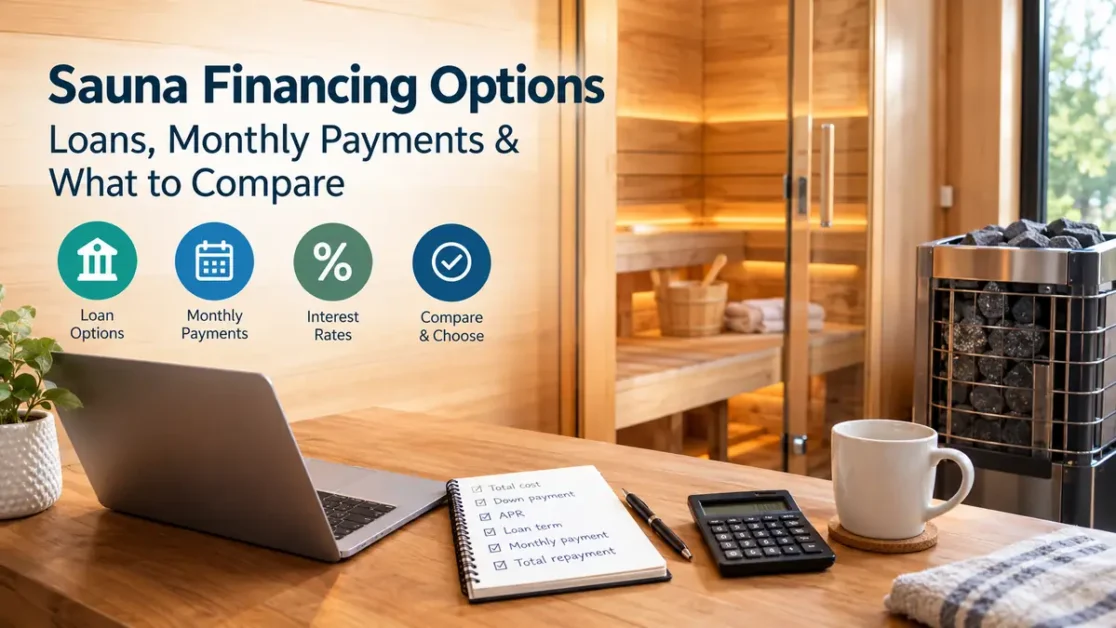
No financing method is best for every buyer. A useful comparison focuses on cost, flexibility, risk, and how easily the financing matches the actual project.
| Financing option | Where it usually comes from | Potential advantage | Main issue to check |
|---|---|---|---|
| Retailer installment plan | Sauna seller or checkout provider | Convenient at purchase | APR, term, fees, product-only coverage |
| BNPL | Checkout provider | Short scheduled payments may be simple | Late fees, credit effects, repayment schedule |
| 0% promotional credit card | Card issuer | Potential interest-free promotional period | End date, post-promo APR, minimum payment |
| Deferred-interest promotion | Store or card issuer | No interest if offer conditions are fully met | Retroactive interest risk if balance remains |
| Personal installment loan | Bank, credit union, online lender | Defined repayment schedule | APR, origination fee, total repayment |
| Home-equity borrowing | Bank or lender | May accommodate larger projects | Your home secures the debt |
| Cash plus partial financing | Mixed | Reduces the amount borrowed | Do not drain necessary cash reserves |
If you have not chosen the sauna itself yet, use the home sauna buying guide first. Financing should support a sound purchase decision, not make an unsuitable sauna appear affordable.
Retailer Financing and Buy Now, Pay Later
Checkout financing is common in the current sauna market. The process is usually simple: choose the sauna, select a financing option at checkout, review the terms offered to you, then accept or decline.
The Consumer Financial Protection Bureau describes buy now, pay later as a type of installment loan. A common version splits a purchase into a small number of payments, but longer online installment products can work differently and may involve hard credit inquiries or credit reporting. Review the exact loan details before applying and again before accepting. See the CFPB’s BNPL explanation.
Short installment plans vs. longer monthly plans
Do not treat every checkout plan as the same product. A short pay-in-four arrangement and a multi-year installment loan can differ in interest, fees, credit checks, credit reporting, and total borrowing cost.
Questions to answer before accepting
- What is the APR, if any?
- Are there origination, documentation, late, or other fees?
- How many payments are required and when are they due?
- Is a down payment required?
- Does the application involve a hard credit inquiry?
- Is payment history reported to credit bureaus?
- What happens after a missed payment?
- Can the balance be paid off early without extra cost?
- Does the financing cover only the sauna purchase or other installation costs too?
The CFPB notes that many BNPL products charge late fees even when they do not charge interest, and unpaid debt may eventually affect credit if it is reported by a lender or debt collector. See the CFPB’s BNPL fee guidance.
0% APR and Promotional Financing: Read the Wording Carefully
A true 0% promotional APR and a deferred-interest offer can produce very different results when a balance remains at the end of the promotion.
With a true 0% promotional APR, interest generally does not accrue during the promotional period; after it ends, the regular rate applies to the remaining balance according to the account terms. A deferred-interest offer may use wording such as “no interest if paid in full” by a specific date. If the required balance is not fully paid under the offer’s conditions, interest that was deferred can be added. The CFPB explains the distinction in its promotional financing guidance.
Calculate the payoff target before buying
If a promotion is genuinely interest-free for a fixed period and you want the balance gone before it expires, a simple planning check is:
Promotional purchase balance ÷ number of promotional months = monthly payoff target
For example, a hypothetical $6,000 balance over 12 months at a true 0% promotional APR would require $500 per month to clear the purchase in 12 equal payments. This is a planning example, not a financing quote. Actual minimum payments, due dates, and account terms control.
Do not assume the card’s minimum payment will retire a promotional balance before the promotion ends. CFPB guidance specifically warns that minimum payments may not be enough for that purpose.
Personal Loans for a Sauna
A personal installment loan can be used for a sauna project when the lender permits the use of funds. These loans are generally repaid in periodic installments, and the total cost can include both interest and fees.
The CFPB lists possible personal-installment-loan charges such as origination, documentation, optional insurance, and late fees. It recommends reviewing the loan disclosure and comparing offers rather than focusing on one number. See the CFPB’s personal loan fee guidance.
Why the monthly payment can mislead
Stretching a loan over more months can reduce the monthly payment while increasing the amount paid over the life of the loan. Compare at least these four figures together:
- Amount financed
- APR
- Fees
- Total of all scheduled payments
A hypothetical $6,000 loan at 12% APR for 36 months works out to about $199.29 per month and about $7,174.29 in total scheduled payments, assuming a standard fully amortizing loan with no extra fees. That is roughly $1,174.29 above the amount borrowed. The example shows why a smaller payment should not be evaluated by itself.
Should You Use Home Equity for a Sauna?
Home-equity borrowing can provide access to a larger credit line, but it changes the risk profile because your home secures the debt. A sauna is a discretionary purchase, so the collateral risk deserves more weight than the size of the monthly payment.
The CFPB explains that a HELOC lets you borrow against available home equity and warns that if you cannot keep up with the payments, you could lose your home. Its HELOC guidance was reviewed in August 2026. Read the CFPB’s HELOC explanation before treating home equity as a routine checkout substitute.
A lower rate does not settle the decision
Even if secured borrowing offers a lower rate than an unsecured option, compare the fees, repayment structure, potential rate changes where applicable, and the consequence of putting your home behind a discretionary purchase. A lower APR can reduce financing cost without making the underlying risk irrelevant.
What Does a Financed Sauna Really Cost?
The purchase price and financing cost are separate layers. A clean way to plan the decision is:
Amount financed + interest + financing fees = financing repayment
Then add any project costs you will pay separately:
Financing repayment + cash-paid installation/site costs = estimated project outlay
This distinction matters when a retailer finances the cabin but not the electrician, foundation, delivery upgrade, or contractor. For electrical planning, use the sauna electrical requirements guide and get the exact model requirements before requesting a local quote.
Monthly-payment method
For a standard fixed-rate amortizing loan, the monthly payment depends on the amount financed, periodic interest rate, and number of payments. You do not need to calculate it by hand when the lender provides a disclosure, but the inputs are useful when comparing options.
- Project or purchase amount
- Down payment
- Amount financed
- APR
- Loan term
- Any fees added to or deducted from the loan
Use the lender’s actual disclosure for the final decision. An online estimate cannot account for every fee, payment convention, or term in a real offer.
Sauna Financing Comparison Worksheet
Put each real offer on one row. This prevents a small monthly payment from hiding a longer term, higher APR, or extra fees. You can also download the printable two-page worksheet to compare offers away from the screen.
| Item | Option A | Option B | Option C |
|---|---|---|---|
| Sauna/project price | $_____ | $_____ | $_____ |
| Down payment | $_____ | $_____ | $_____ |
| Amount financed | $_____ | $_____ | $_____ |
| APR | _____% | _____% | _____% |
| Term | _____ months | _____ months | _____ months |
| Monthly payment | $_____ | $_____ | $_____ |
| Origination/other fees | $_____ | $_____ | $_____ |
| Promotional end date | _____ | _____ | _____ |
| Deferred-interest condition? | Yes / No | Yes / No | Yes / No |
| Early-payoff restriction/fee? | _____ | _____ | _____ |
| Total scheduled repayment | $_____ | $_____ | $_____ |
| Separate cash project costs | $_____ | $_____ | $_____ |
| Estimated total outlay | $_____ | $_____ | $_____ |
When two offers look close, compare the total repayment and the terms that create financial risk. Do not choose from the monthly-payment row alone.
7 Sauna Financing Mistakes to Avoid
- Comparing only monthly payments. A longer term can make a payment look easier while increasing total repayment.
- Financing before calculating installation costs. Product financing may leave electrical, delivery, foundation, or contractor costs outside the loan.
- Assuming every “no interest” offer is true 0% APR. Read for deferred-interest language and the exact payoff deadline.
- Ignoring fees. Origination, documentation, late, and other charges can materially change the borrowing cost.
- Using a promotional card without a payoff plan. Know the monthly amount required to clear the intended balance before the promotion ends.
- Using home-secured borrowing without weighing the collateral risk. A sauna is discretionary; your home is not.
- Financing upgrades simply because they fit the payment. Judge lighting, audio, premium finishes, controls, and other extras by value, not by the small amount they add per month.
When Financing a Sauna May Not Make Sense
Financing deserves extra caution when the purchase would strain the normal monthly budget, high-cost debt is already a problem, the project still has unknown installation expenses, or a long repayment term is being used mainly to make an unaffordable purchase look manageable.
Waiting and saving can be a legitimate alternative. It may also give you time to confirm the final model, electrical requirements, site work, and full installed cost before money is committed.
Do not forget ownership costs after the financing decision. Electricity or fuel, cleaning, stones, exterior maintenance, and repairs continue after the purchase. The sauna cost-to-run calculator helps estimate ongoing energy expense separately.
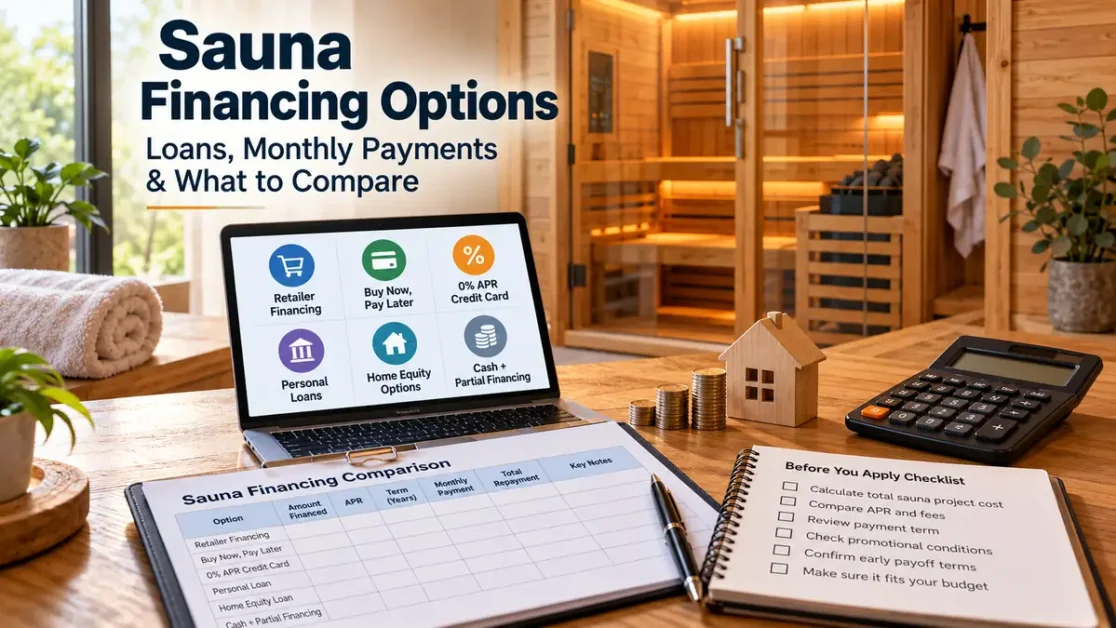
Before You Apply: Sauna Financing Checklist
- Exact sauna or short list chosen
- Full installed project cost estimated
- Electrical and site work quoted where needed
- Cash contribution decided
- Amount to finance calculated
- APR checked
- Loan or promotional term checked
- Origination and other fees checked
- Monthly payment compared with the normal household budget
- Total scheduled repayment calculated
- Promotional end date written down
- Deferred-interest wording checked
- Credit inquiry/reporting terms reviewed
- Early-payoff terms reviewed
- Separate installation costs accounted for
- Alternative of waiting and saving considered
If a term is unclear, get the answer from the lender or card issuer before signing. A financing page, retailer calculator, or estimated payment should not replace the actual agreement.
FAQs
Can you make monthly payments on a sauna?
Often, yes. Some sauna retailers offer checkout installment plans, and buyers may have other borrowing options. The available APR, term, fees, and approval requirements depend on the provider and applicant.
Do sauna companies offer financing?
Many current sauna sellers advertise financing or installment options through third-party providers. Availability can change, so verify the retailer’s live checkout terms rather than relying on an old financing article or advertised monthly payment.
Can I finance sauna installation too?
It depends on how the financing is structured. Retailer checkout financing may cover only items purchased from that seller, while a separate loan may provide funds that can be used more broadly if the lender’s terms permit it.
Is 0% sauna financing always interest-free?
No. A true 0% APR promotion is different from deferred interest. Read the offer language carefully, especially phrases such as “no interest if paid in full,” and understand what happens if a balance remains after the promotional period.
Is a personal loan better than retailer financing?
Neither is universally better. Compare the real offers using APR, fees, term, total repayment, credit effects, and whether the financing covers the costs you actually need to pay.
Can I use a HELOC to buy a sauna?
A HELOC can generally be used for permitted expenses under its terms, but it is secured by your home. CFPB guidance warns that falling behind on repayment can put the home at risk, so that consequence should be weighed carefully for a discretionary purchase.
Does financing a sauna affect your credit?
It can, depending on the product. Some BNPL plans may not use hard inquiries or report routine payment history, while longer installment loans may do both. Read the provider’s credit inquiry and reporting terms before applying.
Compare the Full Cost Before Signing
Start with the completed sauna project cost, not an advertised monthly payment. Then compare financing options using the amount borrowed, APR, fees, term, promotional conditions, total repayment, and the consequences if the plan does not go as expected.
A financing option earns its place only when the sauna already fits your home, the project costs are understood, and the repayment structure fits your budget without hiding expensive terms. That keeps the financing decision separate from the excitement of choosing the sauna itself.