
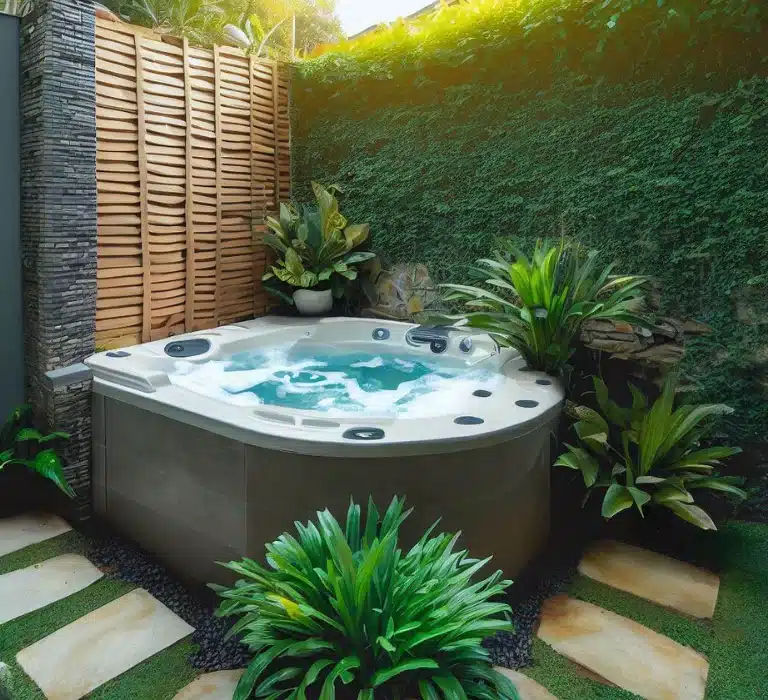
8 Hot Tub Setup Ideas for a Better Backyard Spa

A good hot tub setup starts with the parts you cannot easily change later: location, foundation, electrical access, drainage, service clearance, and the route from your house to the spa.
Once those are right, privacy screens, lighting, seating, landscaping, and a pergola can turn a basic hot tub into a backyard space you actually want to use year-round.
Before buying décor or building a surround, make sure the setup works when the tub is full, the cover is open, a technician needs access, and you are walking outside on a cold or wet night.
Hot Tub Setup Checklist Before You Start
Use this checklist before deciding where the spa will sit.
| CheckWhat to Plan | |
|---|---|
| Foundation | Flat, stable surface approved for your spa model |
| Filled weight | Tub + water + occupants |
| Electrical | Correct circuit and GFCI protection for your model |
| Delivery | Gate width, turns, stairs, rooflines, branches and obstacles |
| Drainage | Water should not collect around the cabinet or foundation |
| Service access | Equipment panels must remain accessible |
| Cover clearance | Leave room for the cover and cover lifter |
| Privacy | Check neighbor, street and upstairs-window sightlines |
| Walking path | Provide a stable, well-lit route from the house |
| Local rules | Check permits, setbacks, HOA rules and electrical codes |
Hot Spring, Jacuzzi, and Bullfrog all emphasize foundation preparation, delivery access, electrical requirements, and service access before installation.

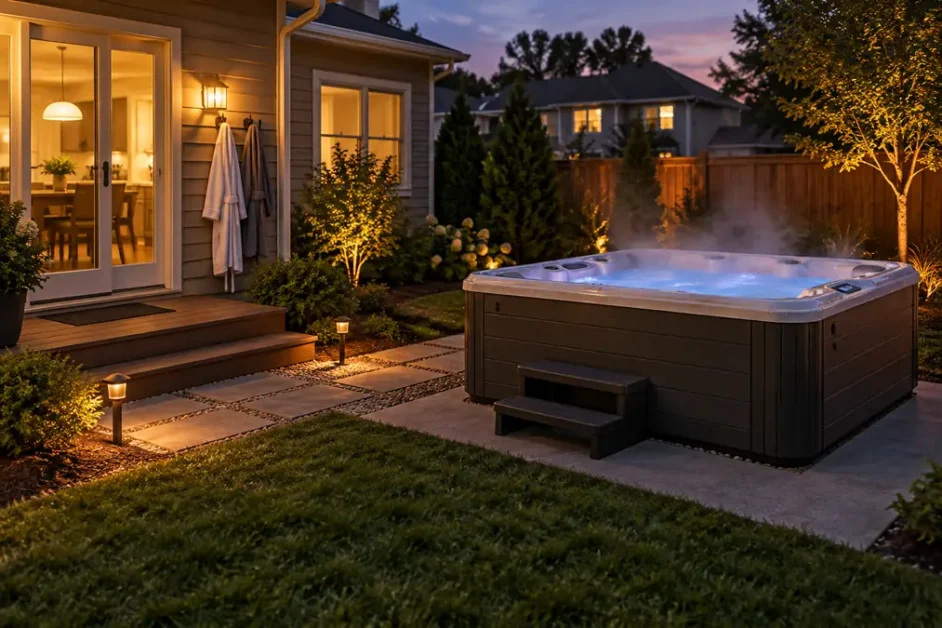
1. Put the Hot Tub Close Enough to the House That You Will Use It
A hot tub at the far end of the yard can look beautiful in summer and become inconvenient when it is cold, raining, or snowing.
For many homes, a location near a patio door or back entrance is more practical.
Consider the complete trip:
house → changing area → hot tub → towels → house
A shorter route usually means:
- less walking on cold or wet surfaces
- easier access to towels and robes
- simpler lighting
- easier supervision
- less temptation to skip the hot tub because getting there is inconvenient
Do not place it so close to the house that you block doors, windows, drainage, electrical equipment, or required service access.
Best for
Homeowners who expect to use their spa frequently throughout the year.
Avoid if
The location creates drainage problems, blocks an exit, makes electrical installation difficult, or prevents technicians from reaching the spa equipment.
2. Build the Setup Around Privacy Sightlines
Privacy is one of the most important parts of a comfortable hot tub area.
You do not necessarily need to surround the entire spa with a six-foot wall. Start by identifying the specific places from which someone can see the tub.
Check:
- neighboring windows
- second-story windows
- nearby decks
- sidewalks
- roads
- gates
- shared property lines
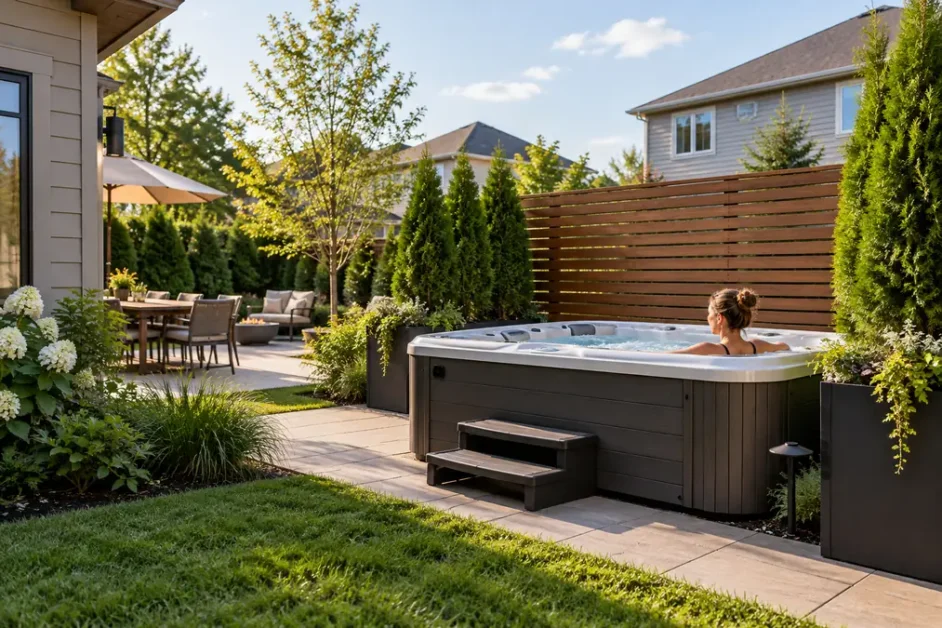
Then block those sightlines without unnecessarily closing in the entire backyard. If you need more screening options, these hot tub privacy ideas cover curtains, plants, screens, and fencing.
Current backyard-spa design results repeatedly emphasize targeted privacy screens, pergolas, fences, lattice panels, and plants rather than completely enclosing the space.
Good privacy options
- horizontal slat screens
- lattice panels
- privacy fencing
- tall planters
- evergreen shrubs
- outdoor curtains
- pergola side panels
- trellises with climbing plants
A screen on one exposed side may provide more privacy than fencing the entire tub.
Do not forget wind
The same screen that blocks a neighbor’s view can also reduce cold wind around the spa.
Position it carefully so the area still has ventilation and does not trap excessive moisture.
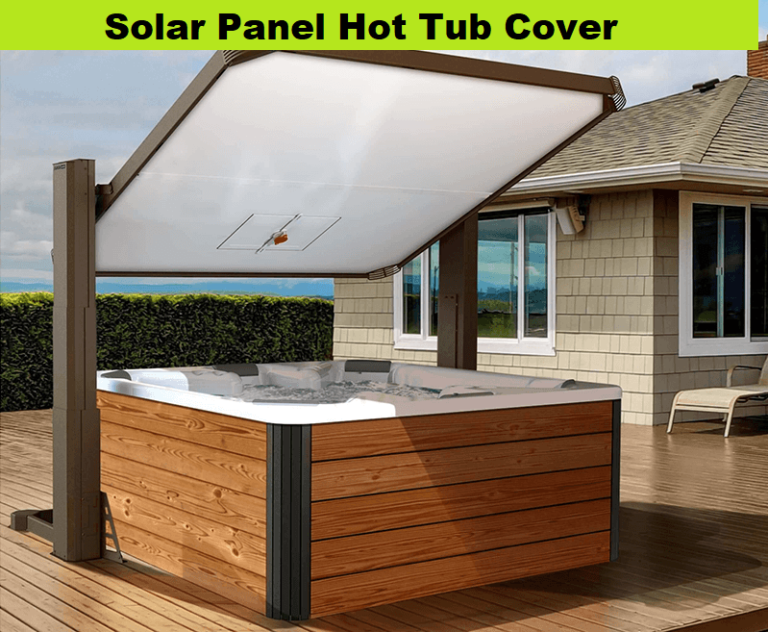
3. Add a Pergola or Roof for a More Usable Spa Area
A pergola visually turns a hot tub into its own outdoor room.
It can also provide:
- partial shade
- light rain protection
- a structure for privacy screens
- a place for suitable outdoor lighting
- wind reduction when paired with side panels
- a more finished backyard layout
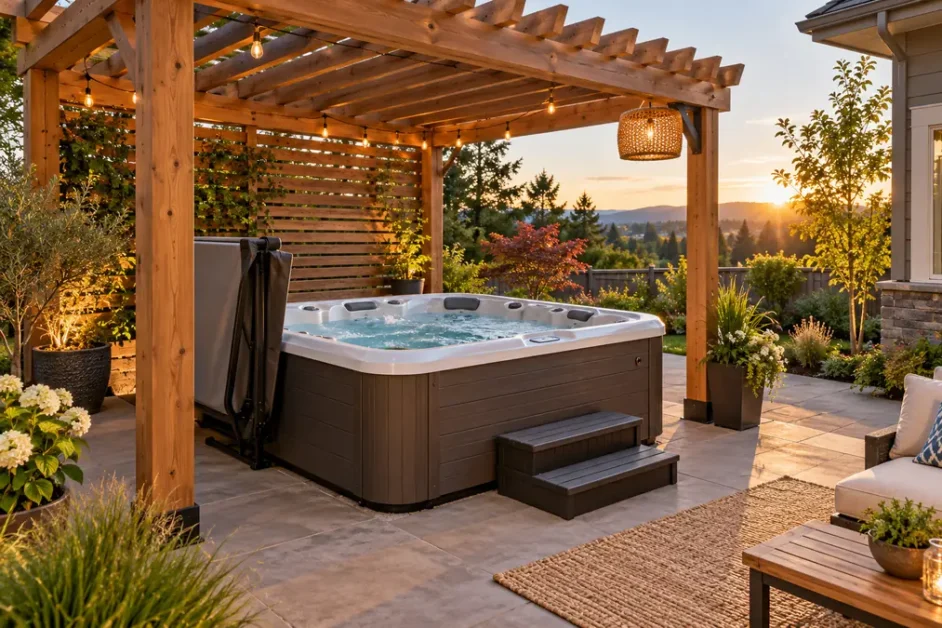
Pergolas and covered hot tub areas remain a prominent theme in current hot tub design results because they combine appearance with practical weather protection.
Open pergola
Best when you want:
- airflow
- sky views
- partial shade
- a defined spa area without full enclosure
Louvered or covered pergola
Better when rain and strong sun are bigger concerns.
Enclosed gazebo
Provides the most weather protection, but it requires more planning for moisture, ventilation, electrical equipment, access, and local building rules.
Before building overhead structures, verify clearances and requirements for your specific spa and local codes.
4. Use a Proper Hot Tub Base Instead of Setting the Spa on Bare Ground
The foundation is more important than the decorations around it.
A filled hot tub can weigh several thousand pounds. Bullfrog notes that some portable spas can reach about 6,000 pounds before adding occupants. For a common permanent base option, see how to prepare a concrete patio for a hot tub.
The base must provide consistent support without settling unevenly.
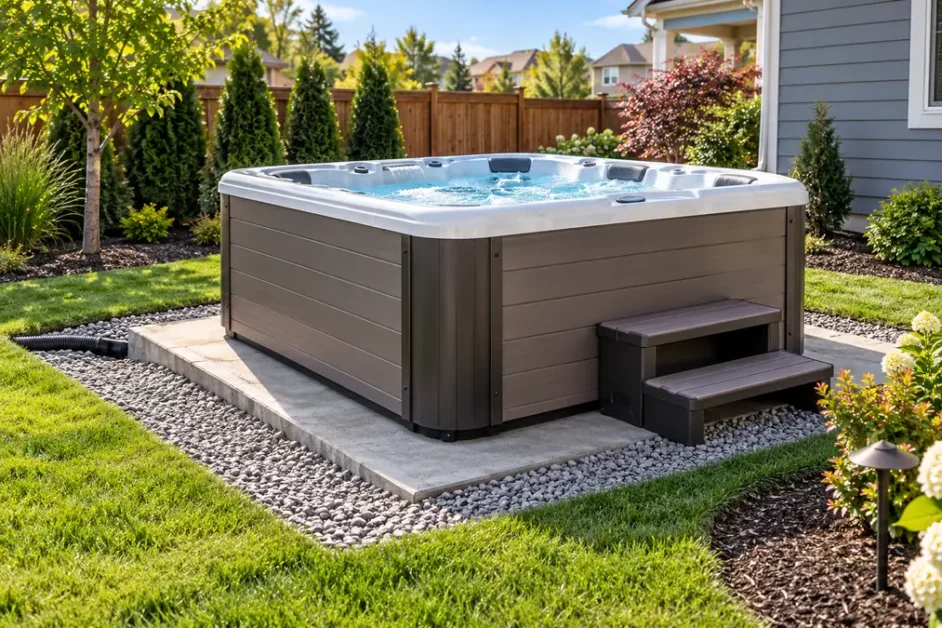
Common hot tub foundation options
| BaseAdvantagesWatch For | ||
|---|---|---|
| Reinforced concrete | Stable, durable, low maintenance | Permanent and more labor-intensive |
| Properly installed pavers | Attractive and easy to integrate with patios | Sub-base preparation matters |
| Compacted crushed rock/gravel | Good drainage and comparatively simple installation | Must be prepared and compacted correctly |
| Modular spa pad | Fast installation for compatible spas | Follow manufacturer requirements |
| Reinforced deck | Excellent for integrated layouts | Must be structurally evaluated for the filled load |
Hot Spring lists concrete, reinforced decks, stone pavers, composite bases, and modular spa pads among possible foundation choices depending on the spa model. Jacuzzi likewise stresses a level foundation capable of distributing the filled weight.
Can a hot tub sit on grass?
Do not place a full-size portable spa directly on lawn or loose soil unless the manufacturer specifically provides a system designed for that installation.
Soil can settle and shift, creating uneven support.
Should the hot tub base slope for drainage?
The area around the spa should manage rain and splash water, but the surface supporting the spa must comply with the manufacturer’s levelness requirements.
Do not intentionally build a sloped hot tub foundation without checking the owner’s manual.
5. Integrate the Hot Tub With a Deck Without Blocking Service Access
A deck can make a freestanding hot tub feel built-in without requiring an in-ground spa. If you are deciding how much of the project to handle yourself, compare DIY hot tub deck work vs. hiring a contractor.
Popular layouts include:
- tub beside a deck
- deck built to the height of the spa rim
- partially recessed spa
- spa positioned in a dedicated deck corner
- lower spa platform connected to a larger entertaining deck
The biggest mistake is building the deck so tightly around the cabinet that nobody can reach the pumps, controls, plumbing, or access panels.
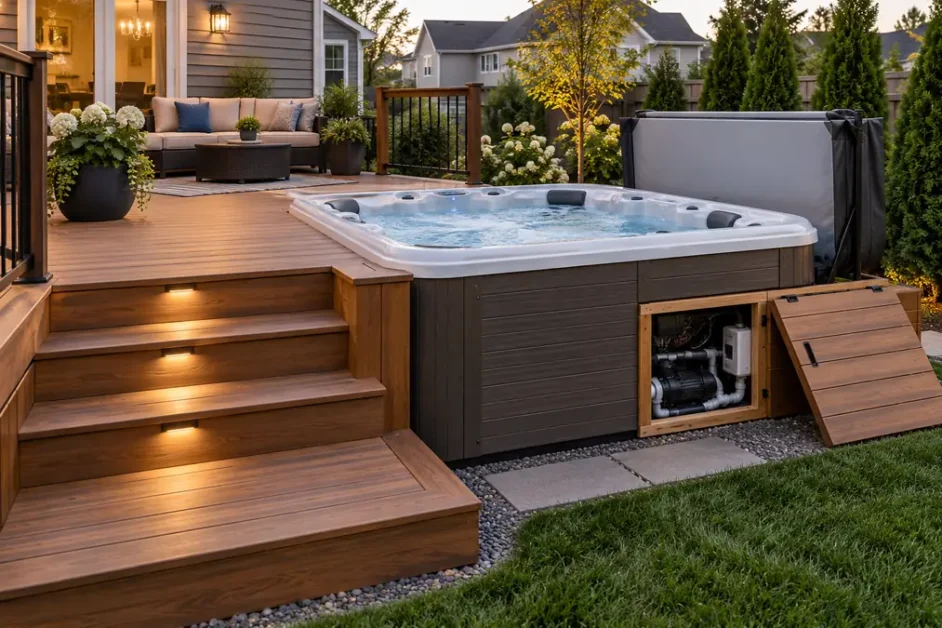
Before enclosing the spa
Find out:
- Where is the main equipment panel?
- Which cabinet panels may need to be removed?
- How much clearance does the hot tub cover lifter require?
- Can a technician work around the spa?
- Could the tub ever need to be moved or replaced?
Your dealer or owner’s manual should answer these questions before framing begins.
Can you put a hot tub on an existing wooden deck?
Possibly, but do not assume an ordinary residential deck can safely carry it.
The structure must support the hot tub, water, occupants, and any concentrated loads associated with the installation.
Jacuzzi recommends consulting a contractor or structural engineer for elevated installations, while Bullfrog specifically calls for verifying the deck’s load-bearing capacity.
6. Build a Safe, Low-Glare Lighting Plan
Hot tub lighting has two jobs:
- help people move safely
- create a comfortable atmosphere
Bright floodlights pointed directly at the spa usually accomplish the first job while ruining the second.
Layer several smaller light sources instead. For fixture types and placement ideas, compare these hot tub lighting options.
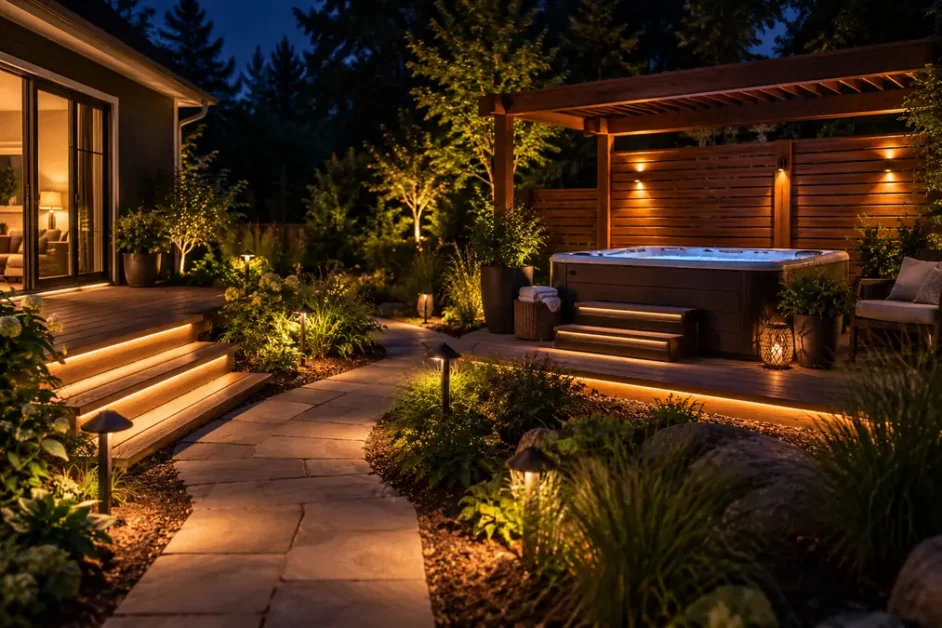
Useful hot tub lighting locations
- steps
- walkways
- deck edges
- entry gates
- towel or seating areas
- privacy screens
- pergola structures
- nearby landscaping
Choose outdoor fixtures suitable for their location and keep electrical installations compliant with applicable codes around water.
Avoid trip hazards
The route between the house and spa deserves as much attention as the hot tub itself.
Check the path at night.
Look for:
- steps that disappear in shadows
- hoses
- exposed conduit
- uneven pavers
- loose gravel
- slippery surfaces
- poorly lit corners
Good lighting should make the route obvious without shining directly into someone’s face while soaking.
7. Add a Dry Landing Zone for Towels, Robes and Seating
A small dry area next to the spa can improve the setup more than an elaborate entertainment system.
Useful additions include:
- robe hooks
- towel storage
- a weather-resistant bench
- a small side table
- covered storage
- spa steps with a hot tub handrail when appropriate
- a place for sandals
- a waterproof container for frequently used accessories
The goal is to avoid getting out of the tub and realizing your towel is across the yard.
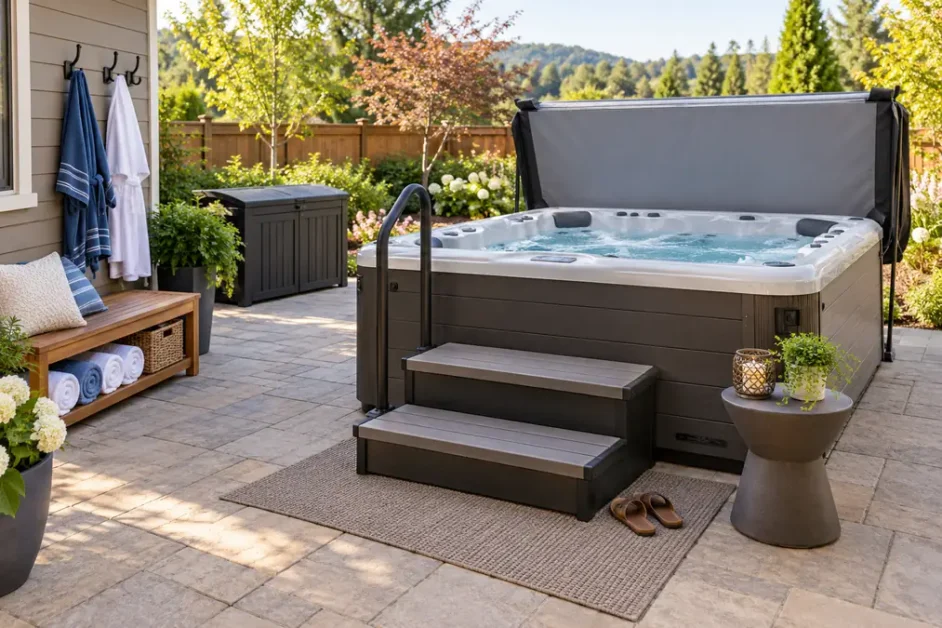
Keep furniture outside the splash zone
Outdoor seating is useful, but leave enough open space to:
- enter and exit safely
- operate the cover
- access spa controls
- reach service panels
- walk around the tub
A crowded spa area often looks better in photos than it works in everyday use.
8. Use Landscaping to Make the Hot Tub Feel Like Part of the Yard
Landscaping softens the large rectangular cabinet of a portable spa and helps the area feel intentional.
Plants can also provide useful privacy.
Good options depend on your climate, but the design principles stay similar.
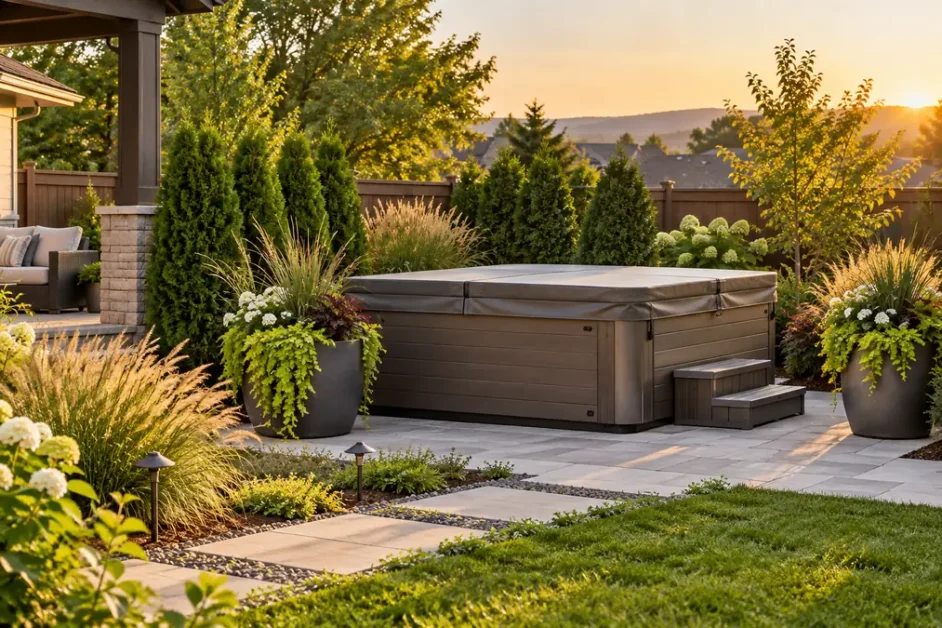
Choose plants that create structure without creating constant cleanup
Look for plants that:
- do not shed excessive leaves or flowers
- tolerate the local climate
- stay manageable at mature size
- do not have aggressive roots near hardscape
- provide privacy where you need it
Evergreen shrubs, ornamental grasses, and plants in large containers can work well because they provide screening without permanently closing the area.
Be careful with trees directly above the spa
Overhanging branches can drop:
- leaves
- pollen
- seeds
- insects
- bird debris
That means more cover cleaning, filter cleaning, and water maintenance.
Position trees and tall plants so you get the benefit of greenery without creating unnecessary debris.

Where Should You Put a Hot Tub in Your Backyard?
The best location balances convenience, safety, privacy, installation cost, and the view.
Before committing to a location, compare your options using this table.
| Question Why It Matters | |
|---|---|
| How far is it from the house? | Affects year-round convenience |
| Can the tub be delivered there? | Tight gates and turns may prevent access |
| Is the foundation suitable? | Protects the spa structure |
| How difficult is the electrical run? | Can affect installation complexity and cost |
| Where will drained water go? | Helps prevent pooling and foundation problems |
| Can neighbors see the spa? | Affects privacy |
| Is the equipment side accessible? | Required for service |
| Where will the cover open? | Needs physical clearance |
| Does it block a walkway or exit? | Affects everyday safety |
| Is the view worth preserving? | Influences orientation |
Hot tub owners discussing real installations commonly struggle with exactly these tradeoffs: closeness to the house versus a better view, electrical routing, drainage, slope, privacy, and future service access.

Hot Tub Electrical Setup: Plan It Before the Pad and Deck Are Finished
Do not leave electrical planning until the hot tub arrives.
Depending on the model, a portable spa may use a plug-in electrical connection or require a dedicated hardwired circuit. If you are planning the circuit, this guide to hot tub amperage requirements explains common power needs.
Hot Spring states that its hot tubs may require either 110V or 220V service depending on the model. Jacuzzi notes that its U.S. installations must meet NEC plus state and local electrical requirements.
For hardwired installations, use a qualified electrician familiar with spas and outdoor wet-location requirements.
Coordinate these three people early
- hot tub dealer
- electrician
- deck/patio contractor
They need to agree on:
- final spa orientation
- equipment-panel location
- approved electrical-entry point
- conduit route
- disconnect/GFCI location
- pad or deck work
Routing electrical after concrete or finished decking is installed can create unnecessary demolition or exposed conduit.
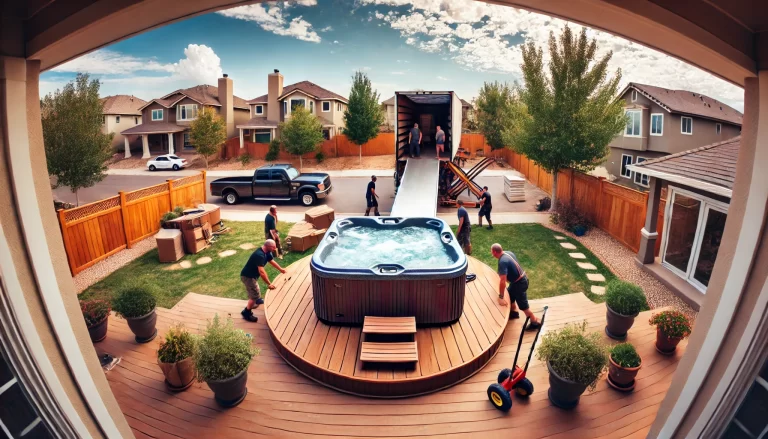
Plan the Delivery Route Before Delivery Day
A perfect spa location is useless if the tub cannot reach it.
Measure the actual delivery route, not just the final pad.
Check:
- gate width
- side-yard width
- narrow turns
- stairs
- retaining walls
- air-conditioning units
- roof overhangs
- gutters
- electrical meters
- fences
- tree branches
Jacuzzi specifically recommends identifying delivery obstacles such as overhanging branches, gutters, electrical meters, stairs and other restrictions before the installer arrives.
If access is tight, send measurements and photos to the dealer before delivery day. For difficult relocations or narrow access routes, review the steps for moving a hot tub safely.
DIY vs Professional Hot Tub Setup
Not every part of the project requires a contractor, but some jobs should not be treated as weekend experiments.
| TaskDIY May Be ReasonableProfessional Help Makes Sense | ||
|---|---|---|
| Privacy screens | Yes, for simple freestanding designs | Structural or permitted construction |
| Landscaping | Yes | Major grading or drainage work |
| Path lighting | Solar/low-voltage systems where appropriate | Line-voltage electrical work |
| Gravel pad | Possible with correct preparation | Difficult grades or uncertain soil |
| Concrete pad | Skilled DIYers may attempt it | Often easier to have professionally prepared |
| Deck reinforcement | No guesswork | Contractor/structural engineer |
| Hardwired spa electrical | No | Licensed electrician |
| Pergola/gazebo | Simple kits may be DIY | Large structural/permitted installations |
The best DIY approach is to handle the decorative work yourself while getting qualified help for structural and electrical work.
Common Hot Tub Setup Mistakes
Avoid these before they become expensive to correct.
Choosing the prettiest location instead of the most usable one
A great view does not compensate for a difficult walk, impossible electrical run, or inaccessible service panel.
Forgetting the cover lifter
Leave space for the cover to open and store.
Building around removable cabinet panels
Your pump and control area will eventually need service.
Putting the tub on an inadequate deck
Have the structure evaluated for the actual filled spa.
Ignoring drainage
Rain, splash water, and draining the spa need somewhere appropriate to go.
Hiding electrical planning until the end
Coordinate wiring before pouring concrete or closing decks.
Overcrowding the area with décor
Keep safe entry, exit, walking, and service paths clear.
Hot Tub Setup FAQs
What is the best base for a hot tub?
A reinforced concrete pad is one of the most common durable options, but it is not the only acceptable base. Depending on the spa manufacturer, properly prepared pavers, compacted crushed rock, modular spa pads, or a structurally reinforced deck may also work. Always follow the foundation requirements for your specific model.
What does a hot tub need to sit on?
It needs a stable foundation that provides continuous support and can carry the filled weight of the spa and its occupants. Bare lawn, loose soil, and an unverified deck are poor choices for a full-size portable spa.
Can a hot tub sit on a wooden deck?
Yes, if the deck has been designed or verified to support the required load. An existing deck should not automatically be assumed strong enough. For elevated installations, have its capacity checked by a qualified professional.
How close should a hot tub be to the house?
There is no single distance that works for every property. A location close enough for convenient year-round access is useful, but the spa must still meet manufacturer instructions, local setbacks, electrical rules, drainage needs, and service-clearance requirements.
Does a portable hot tub need plumbing?
Most self-contained portable hot tubs do not require permanent household plumbing. They are typically filled with a garden hose and later drained according to the manufacturer’s instructions and local rules. Hot Spring specifically describes portable spas as self-contained vessels that do not require special plumbing.
Where should you not put a hot tub?
Avoid locations that cannot support the filled weight, collect standing water, block exits, prevent service access, interfere with the cover, create delivery problems, or conflict with electrical and local-code requirements.
Also think carefully before placing the spa directly beneath heavy tree cover or where falling debris will constantly enter the water.
Can you put a hot tub under a pergola?
Yes, a pergola is a popular way to add shade, privacy and definition to a hot tub area. Plan the structure around ventilation, electrical safety, service access, cover movement and local permitting requirements.
What can I safely put in hot tub water?
Use only products approved for hot tubs and compatible with your spa’s water-care system. Do not assume ordinary bath salts, bubble bath, essential oils, or household aromatherapy products are safe for spa plumbing, filters, surfaces, or water chemistry.
Build the Practical Setup First
The best hot tub setup is not necessarily the one with the most features.
Start with a stable foundation, convenient location, safe electrical installation, drainage, delivery access, privacy, and enough room to maintain the spa.
Then add the elements that improve how you actually use the space: a privacy screen where the neighbor can see you, subtle pathway lighting, a pergola if weather protection matters, hooks for robes, a dry place for towels, and landscaping that makes the spa feel connected to the rest of the yard.
Those details make the difference between a hot tub that simply occupies part of the backyard and one that becomes part of your routine.




2 Comments
Comments are closed.