
Hot Tub Cover Snow Protection: Safe Removal & Winter Damage Prevention

Snow can build up on a hot tub cover faster than you expect, especially when an overnight storm turns light flakes into dense, wet snow. You may be wondering whether the cover can hold the weight, which tool to use, or what to do when ice freezes the lid shut.
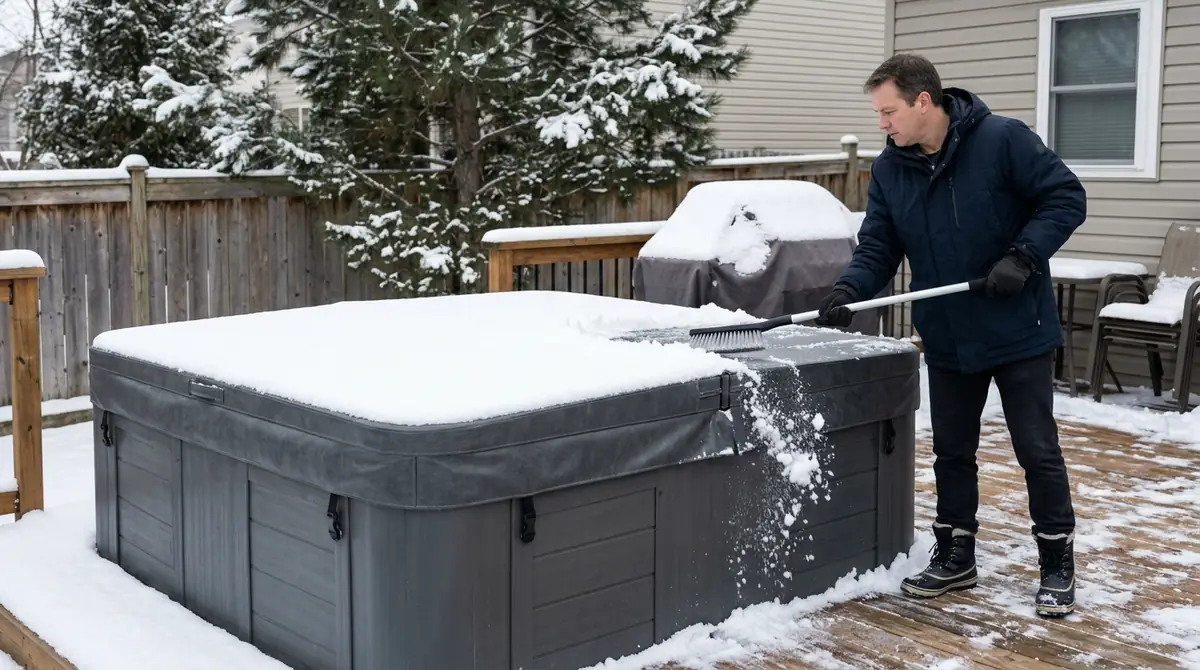
For most standard insulated spa covers, the practical first step is to brush away accumulated loose snow with a soft tool while standing on stable ground. Never stand on the cover, pry at bonded ice, or force a frozen cover lifter. Check the instructions for your actual cover before attempting to thaw ice.
This guide shows you how to remove snow safely, understand why wet snow is different, spot damage, and decide when the cover needs repair or replacement.
How much snow can a hot tub cover hold?
There is no universal safe snow depth for every hot tub cover. The limit depends on the cover design, foam cores, reinforcement, age, condition, and the manufacturer’s specifications. Never treat a general snow-depth estimate as your model’s load rating.
Snow depth is not the same as snow weight. Powdery snow and compacted wet snow can be very different. The National Weather Service explains snow water equivalent as the depth of water that would remain if the snow melted. That helps explain why equal snow depths can place different loads on a cover.
Example: why snow weight matters
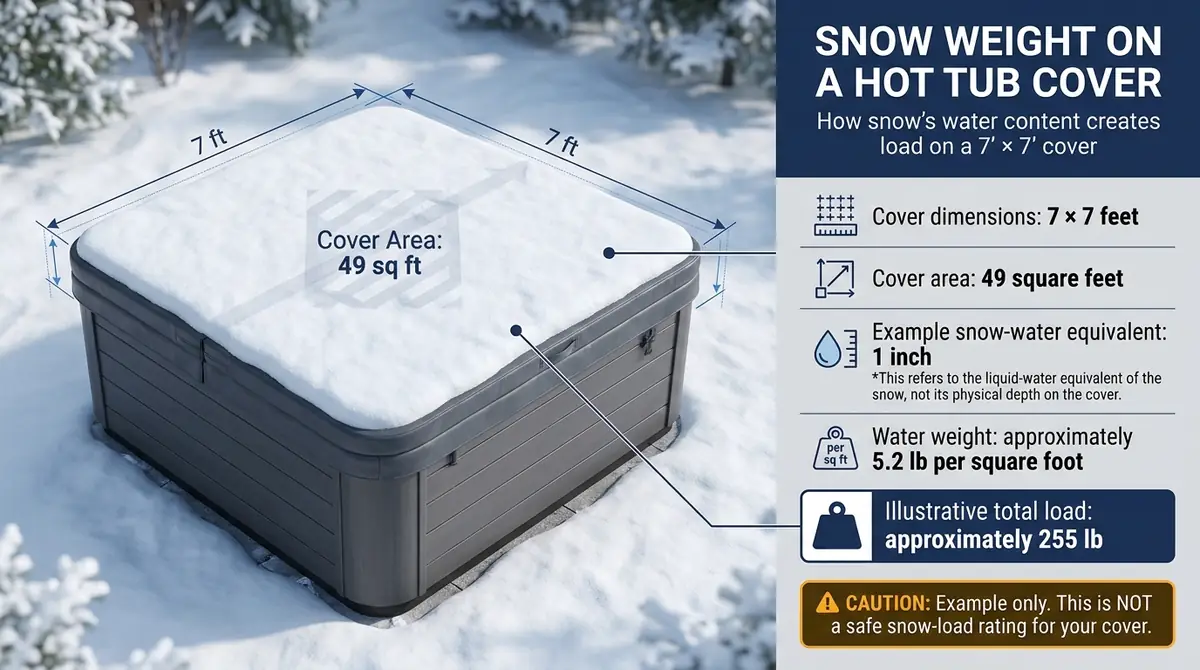
Consider a cover measuring 7 by 7 feet, an area of 49 square feet. If the snow resting on it has a liquid-water equivalent of 1 inch, the approximate load is 49 × 5.2 = 255 pounds. The conversion uses water’s approximate density of 62.4 pounds per cubic foot: one inch of water over one square foot weighs about 5.2 pounds.
| Example measurement | Amount |
|---|---|
| Cover dimensions | 7 × 7 ft |
| Cover area | 49 sq ft |
| Snow-water equivalent | 1 inch |
| Approximate weight | 255 lb |
This is an illustration, not a tested limit for your cover. Do not estimate the rating from cover dimensions or assume 1 inch of snow-water equivalent is acceptable.
When should you remove the snow?
Clear accumulated snow when you can do so safely, especially after wet snowfall, drifting, freezing rain, or repeated thaw-and-freeze conditions. A light dusting does not automatically mean immediate failure, but there is little reason to let it build up.
Look for sagging, shifted seams, bent lifter components, or water collecting in the middle. If the cover is already deformed, do not add your weight or try to force it open. For wider winter maintenance, see our winter hot tub care guide.
How to remove snow from a hot tub cover safely
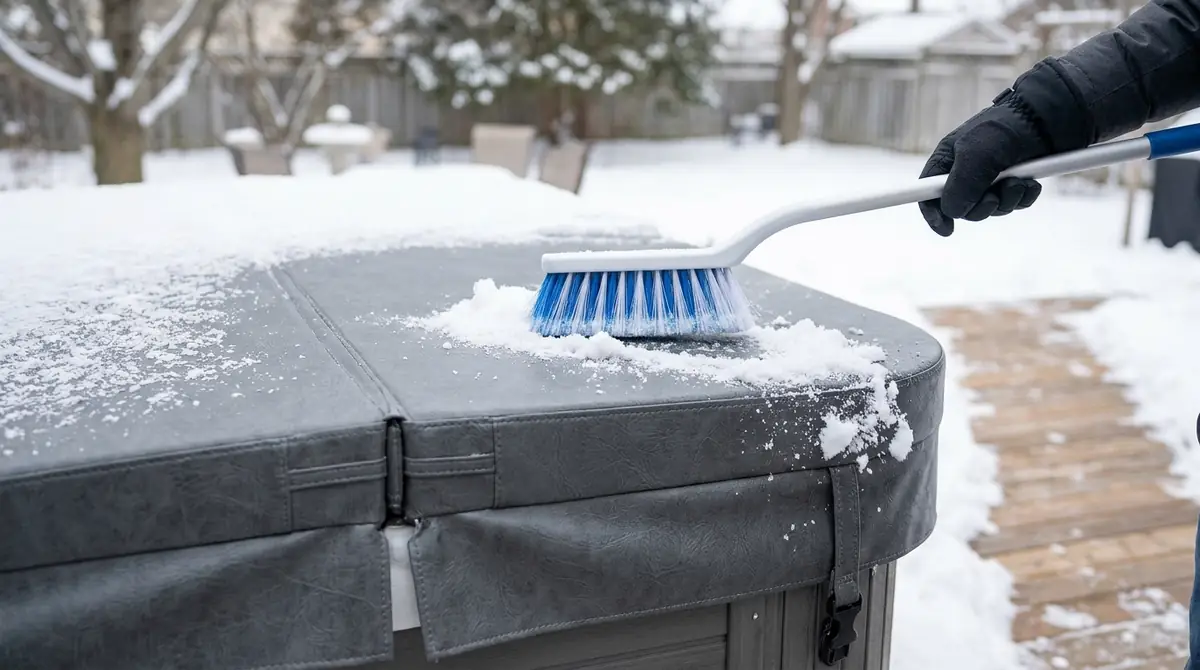
Use a clean, soft-bristle snow brush or a smooth foam-headed tool approved for the cover material. The Hot Spring winter maintenance guidance recommends regularly brushing snow away and using warm water for ice instead of prying.
Step 1: Make the approach safe
Clear a walking path and standing area beside the spa. Wet deck boards and shaded paving can be slippery even when the snow looks loose. Stop if you cannot stand securely without reaching across the tub. Our cold-weather hot tub safety checklist covers access and winter slip hazards.
Step 2: Choose the right tool
Use soft bristles or a smooth foam head; check that the brush is free of grit and sharp attachments. Avoid metal shovels, garden rakes, hard scrapers, stiff wire brushes, and other tools that could puncture or scrape the cover.
Step 3: Brush a little at a time
Stand beside the spa. Gently move loose snow toward the nearest edge, working only as far as you can comfortably reach. Do not push down on the center seam or use the cover for leverage. If you cannot reach a section, use a suitable longer tool or seek help rather than climbing onto a chair or the spa.
Step 4: Clear edges without pulling frozen hardware
Pay attention to the cover skirt, corners, latches, and hinge. Snow and ice can hide damage or keep the lid from opening. Do not pull on straps that are trapped in ice.
Step 5: Check the fit and secure the cover
Once the loose snow is off, look for damage and confirm that the cover sits evenly on the rim. Check the latches and any barriers that prevent unsupervised access. The Consumer Product Safety Commission recommends layers of protection around spas, including secure access barriers.
What to do when ice freezes to the cover
Do not chip, scrape, pry, or force ice away from the cover. Pulling a frozen cover can damage its skin, seams, straps, hinge, and lifter. Hot Spring advises loosening ice with warm water rather than trying to break it off with a tool. See its spa cover replacement and care guidance.
If your particular cover manufacturer allows it, carefully use a small amount of warm, not boiling, water to loosen ice at the affected area. Keep runoff away from electrical components and people, and watch for water refreezing on the patio. Allow the ice to release rather than pulling it loose.
If you cannot control the runoff, weather is too severe, the lid remains frozen, or the cover is damaged, leave it closed and contact the manufacturer or spa dealer. Do not use heat guns, torches, sharp tools, or boiling water as shortcuts.
Is the cover frozen to the hot tub rim?
Check whether ice is bonding the cover to the rim or whether a strap, latch, or cover-lifter joint is frozen. The correct procedure can vary by manufacturer. Never try to lift the cover by its skirt or locking straps. Some model manuals explicitly warn that pulling on them can tear the material.
Best snow-removal tools: what to use and avoid
| Tool | Recommendation | Why |
|---|---|---|
| Clean, soft-bristle snow brush | Use | Suitable for gently moving loose snow |
| Smooth foam-headed snow tool | Use if compatible | Avoids exposed sharp edges |
| Soft microfiber cloth | Use for small areas | Gentle surface cleaning |
| Metal shovel or ice chisel | Avoid | May puncture or tear the cover |
| Stiff wire brush | Avoid | Abrasive on surface material |
| Heat gun, torch, or boiling water | Avoid | Can damage material and create hazards |
A suitable soft brush is usually all you need for fresh snow. For surface dirt and care between storms, see how to clean your hot tub cover.
How to prevent snow and ice damage all winter
Inspect the cover before the forecast turns bad
Check for cracking seams, sagging foam, warped edges, loose straps, and a poor seal. A worn cover may need attention before the next storm, not after it.
Keep the cover properly fitted and secured
The closed cover should sit evenly, with latches and locking systems working as intended. Do not leave it unsecured after cleaning. Never assume that an ordinary insulating cover is a substitute for fencing or other access barriers.
Do not use a frozen cover lifter
Brush snow away before opening the lid. Check for ice around hinges, pivot points, and gas springs. If the mechanism binds, stop and follow the manufacturer’s instructions rather than forcing it.
Be cautious with tarps and extra protection
A compatible weather protector may keep dirt off the cover, but it does not automatically improve its structural snow-load rating. Follow model-specific instructions. Some manufacturers specify particular winterization methods for an unattended, drained spa; those instructions should not be copied to a different model or a spa that remains in normal operation.
Inflatable tubs need different treatment
An inflatable or lightweight lid is not equivalent to a reinforced insulated hard-shell cover. Use the inflatable spa manufacturer’s winter and cover instructions, not a rigid-cover load rating. Our inflatable hot tub winter insulation guide covers related seasonal choices.
How to recognize cover damage after a winter storm
Once you can inspect it safely, look for water collecting in a sag, cracks in the outer skin, a warped hinge, broken locking straps, or a cover that feels much heavier than it did before. An unusually heavy cover can indicate waterlogged foam.
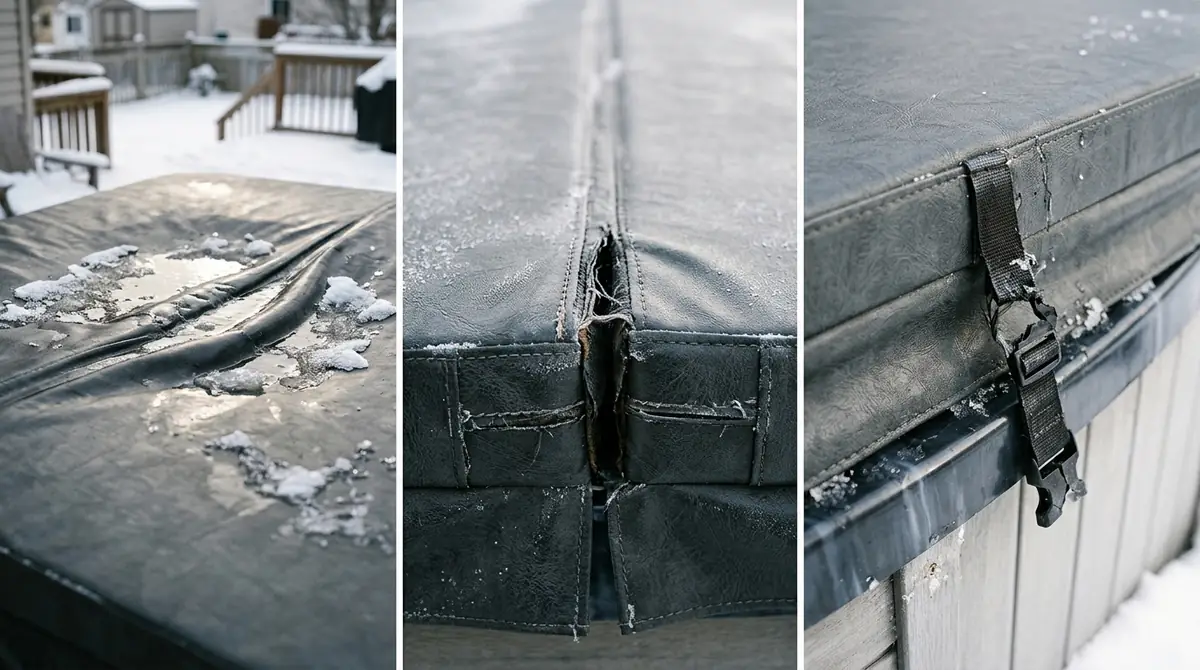
| What you find | Why it matters | Next step |
|---|---|---|
| Dirt only, no damage | Routine upkeep | Clean with an approved product |
| Small outer-skin tear | Water may enter the core | Ask the cover maker about repair |
| Broken locking strap | Safety and security problem | Repair or replace approved hardware |
| Sagging center or cracked foam | Possible structural failure | Arrange evaluation |
| Increasing cover weight | Possible waterlogged insulation | Assess replacement |
| Frozen or bent lifter | Mechanism may be damaged | Stop using it and seek service |
For a deeper repair-versus-replacement decision, see our waterlogged hot tub cover guide.
Call a qualified professional if you find major deformation, broken internal foam, damaged lifter hardware, an unsafe access path, or any sign of water around electrical equipment. Never open a damaged electrical compartment to investigate.
Tailored action plan: before and after a snowstorm
Before snow arrives
- Check the forecast for snow, freezing rain, and icy conditions.
- Inspect the cover fit, seams, hinges, and locking straps.
- Set a clean, soft snow brush where it is easy to reach.
- Clear the walking route and arrange help if you cannot reach the spa safely.
- Find the manual for your specific cover and lifter.
After light snowfall
- Approach only when footing is secure.
- Brush loose snow away gently while standing beside the tub.
- Check corners, hinge, and latches.
- Confirm the cover is seated and secured.
After wet snow, ice, or freezing rain
- Check the cover without putting weight on it.
- Remove loose snow without disturbing bonded ice.
- Follow model-specific thawing instructions; never pry.
- Inspect for deformation and hardware damage.
- Contact the dealer if the cover will not release safely.
If you find damage
Photograph the affected area, record the model and cover age, review warranty terms, and request repair or replacement guidance. Do not operate a visibly damaged or frozen lifter.
Free printable snow and ice cover checklist
Free download: Hot Tub Cover Snow & Ice Safety Checklist (PDF). Print this one-page worksheet to record your spa and cover details, identify snow or ice problems, follow a safe removal checklist, inspect for damage, and choose your next step. Keep a copy with your winter maintenance records.
Frequently asked questions
Can I leave snow on my hot tub cover overnight?
A small dusting does not automatically mean damage, but avoid leaving accumulated snow in place. Remove it as soon as conditions allow you to work safely, particularly if it is wet or drifting.
How many inches of snow is safe for a spa cover?
There is no one-size-fits-all answer. Snow moisture, not only depth, affects weight. Use the manufacturer’s rating if provided; never invent one.
Can I use a shovel on a hot tub cover?
A hard or metal shovel can damage the surface. Choose a clean soft-bristle brush or a manufacturer-approved foam tool for loose snow.
How do I get thick ice off the cover?
Do not chip it off. Follow the cover manufacturer’s thawing guidance. Hot Spring advises warm water rather than prying, but runoff can refreeze and make paths unsafe.
Should I open the cover while it is covered with snow?
Remove the loose snow and check for bonded ice first. Do not force a frozen hinge, latch, or cover lifter.
Does a cover prevent the hot tub from freezing during a power outage?
It slows heat loss but cannot guarantee freeze protection during a prolonged outage. Read what to do during a hot tub power outage in freezing weather and follow your model’s instructions.
Will a tarp increase my cover’s snow capacity?
No extra snow-load capacity should be assumed from adding a tarp or protective cap. Only use weather protection compatible with the cover and model.
When should I replace a storm-damaged cover?
Seek professional evaluation if the foam core is broken, the cover sags badly, waterlogging makes it unusually heavy, or damage prevents a secure fit and closure.
The winter routine that protects your cover
Remove loose snow with a gentle tool, inspect the cover after storms, and avoid trying to force off bonded ice. A secure, undamaged cover helps reduce heat loss and protect access to the spa.
Before the next storm, check your cover, clear the path, and place a suitable snow brush nearby. That small routine makes winter maintenance safer and more manageable.