

Hot Tub GFCI Keeps Tripping? Causes, Safe Checks & What to Do

Your hot tub worked yesterday. Today the breaker trips as soon as you turn it on—or it runs normally until the heater starts. Resetting the switch might restore power briefly, but the problem comes back.
If your hot tub GFCI keeps tripping, stop using the spa and do not keep resetting it. Possible causes include a damaged heater, pump motor, moisture intrusion, faulty wiring, or a defective GFCI. Trip timing gives a technician useful clues, but it does not confirm the failed part.
This guide explains what you can safely observe without opening electrical equipment, what different trip patterns suggest, and what to record before calling a qualified professional.
What to Do Immediately When Your Hot Tub GFCI Trips
A ground-fault circuit interrupter (GFCI) disconnects power when it senses an electrical imbalance associated with a ground fault. Around water, that protection is essential. The Electrical Safety Foundation International explains how GFCIs help prevent electric shock.
First, keep everyone out of the spa. Do not use it while the electrical problem remains unresolved.
- From a safe, dry location, look for smoke, sparks, burning smells, damaged cords, or water around electrical equipment.
- If you see a hazard, stay clear. Do not touch a wet or damaged disconnect, outlet, or control enclosure.
- Do not keep resetting a GFCI that trips again. Leave the circuit off and arrange qualified service.
- Write down when the trip occurred: at startup, while heating, when jets started, or after rain.
- Locate the owner’s manual, brand, model, serial number, and any error code recorded before power was lost.
For one isolated trip with no visible hazards, a single reset may be permitted by the model’s instructions. If the GFCI trips again, stop. Never bypass it or install a larger breaker to prevent trips.
If the pump has stopped but the GFCI is not repeatedly tripping, our spa pump reset guide covers that separate troubleshooting situation.
GFCI Trip Versus Ordinary Circuit-Breaker Trip
The distinction affects what a professional will check.
- GFCI trip: The device detects a current imbalance that can indicate electrical leakage.
- Overcurrent trip: A breaker responds to overload or short-circuit conditions.
- Combined GFCI breaker: One device can provide both types of protection.
You might not be able to tell which protection operated simply by looking at the breaker position. The electrician can determine that from the actual device and installation.
Some hot tubs are 120-volt plug-and-play models; many full-size models use a dedicated 240-volt circuit. Our hot tub amperage and breaker guide explains why the spa’s installation manual, not seating capacity, determines electrical requirements.
When the GFCI Trips: Symptom and Safe Next-Step Chart
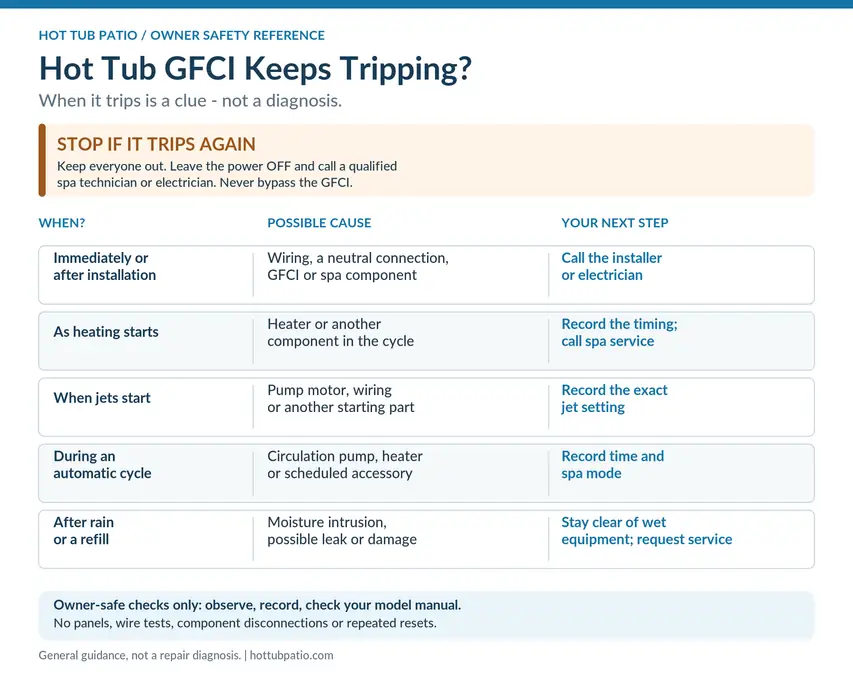
Treat the timing as a clue—not a diagnosis. The following chart helps you describe the problem without attempting electrical testing.
| When the GFCI trips | Possible cause | Safe next action |
|---|---|---|
| Immediately, especially after installation | Wiring, neutral connection, GFCI, or spa component | Leave off; call the installer or electrician |
| As heating starts | Heater or another component on the same cycle | Record the timing; call spa service |
| When jets start | Pump motor, wiring, or equipment starting together | Record the exact jet setting |
| During an automatic filtration cycle | Circulation pump, heater, or scheduled accessory | Record the time and spa mode |
| After rain or refilling | Moisture intrusion, possible leak, or damage | Stay clear of wet equipment; request service |
An immediate trip after installation is different from a trip that starts after years of normal use. A trip during heating makes the heater worth investigating, but it does not prove the heater is faulty.
The GFCI Trips as Soon as Power Is Restored
A persistent ground fault, incorrect wiring, damage, or a failing protective device could be responsible. Contact the installer if the spa is new. Otherwise, use a licensed electrician or qualified spa technician.
Hot Spring lists faulty components, incorrect wiring, and GFCI problems among causes of repeat trips in its GFCI troubleshooting information. Its description includes electrical isolation tests that belong to trained professionals, not a homeowner.
The GFCI Trips When the Heater Starts
The heater may have a damaged element or electrical insulation issue. Another component may also switch on during the heating cycle. Tell the technician when the trip occurs; do not disconnect heater wires to investigate.
The GFCI Trips When Jets Start
An electric pump motor, its wiring, or associated equipment may be involved. Note whether the event follows a particular jet setting or pump speed. Do not open the motor housing or run equipment outside its normal conditions.
The GFCI Trips After Rain or a Refill
Water may have reached a component, connection, or enclosure. A plumbing leak may also be present. Record any visible water from a safe location, but do not open electrical cabinets. A dry patio later does not guarantee that internal equipment is safe.
The GFCI Trips Only During an Automatic Cycle
Some spas start circulation, filtration, heating, or other accessories automatically. Record the time and displayed mode. The coincidence is useful for diagnosis but cannot identify a component by itself.
Safe Checks You Can Make Without Opening the Spa
You do not need a multimeter, screwdriver, or wire access to collect helpful information.
Identify the Device and Review the Manual
Check existing labels and your owner’s manual to determine whether a GFCI breaker, GFCI receptacle, or manufacturer-supplied protected cord is used. Do not handle unsafe equipment to read a label.
Read the manual’s sections on electrical supply, permitted GFCI reset procedures, startup, and error messages. A thermal cutoff or water-flow fault is not the same as a GFCI trip.
Look for External Water or Damage
From a safe, dry location, note standing water near the equipment side, overflow after filling, damaged exterior panels, exposed or damaged cords, or runoff reaching an electrical installation.
A visible plumbing leak is useful information, but it does not prove the leak caused the trip. Do not open the equipment compartment while a ground fault is suspected.
Write Down What Changed
Was the hot tub recently installed, moved, drained, repaired, or restarted after a power outage? Did someone replace a pump or heater? Did the trip begin during a storm or freezing weather?
Record the change rather than attempting to reverse electrical work yourself.
Review the Plug-and-Play Electrical Setup
Certain portable 120-volt spas use a factory cord and a specifically required dedicated receptacle. If a damaged plug, adapter, extension cord, or uncertain connection is involved, stop using the setup and consult an electrician.
See our extension cord safety guide for related precautions.
Six Possible Causes of Repeated GFCI Trips
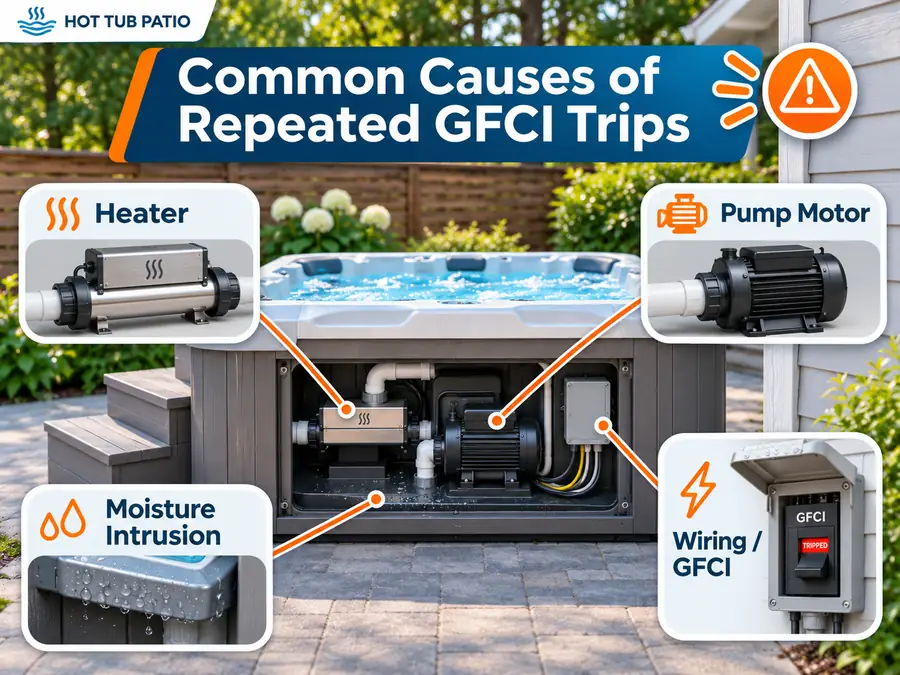
1. Damaged Heating Element
A hot tub heater operates near water but must maintain proper electrical insulation. Damage, corrosion, or insulation failure can create electrical leakage.
A trip that follows a call for heat puts the heater on the technician’s inspection list. A professional can check the heater and related circuits using appropriate tests. Do not disconnect it yourself or operate the spa with exposed electrical parts.
2. Pump Motor or Circulation Equipment Fault
Pump motors can develop electrical faults through wear, moisture intrusion, or wiring damage. A trip that occurs when a jet or circulation pump starts may point toward that circuit.
Note which pump setting was selected. Do not touch motor terminals, open a housing, or run a pump dry.
3. Moisture Intrusion
Rain, splashing, condensation, overflow, or plumbing leaks can introduce water into electrical areas. The problem may be intermittent: the spa works when dry and trips after rain.
Equipment that has been wet may remain unsafe even after surfaces appear dry. Inspection and repair may be necessary before the circuit is energized again.
4. Wiring or Connection Problem
Wrong neutral connections, damaged conductors, incorrect grounding, or unsuitable electrical connections can trip a GFCI. Installation details vary by model. Bullfrog Spas’ official troubleshooting FAQ specifically flags improper load-neutral wiring on newly installed spas and warns that high-voltage diagnosis requires a qualified electrician or service technician.
If the issue started during a new installation or after electrical work, contact the licensed installer. For related planning advice, see our hot tub wiring mistakes guide.
5. Defective GFCI
A protective device can fail, but repeated tripping should never be treated as proof that the GFCI needs replacing. The connected equipment or wiring may have a real fault.
An electrician should evaluate the device and circuit. The ESFI GFCI testing guide covers routine manufacturer-appropriate TEST and RESET operation; that routine is not permission to repeatedly energize a faulted spa.
6. Overload or Different Breaker Fault
Sometimes an ordinary circuit breaker is tripping rather than ground-fault protection. An overload, short circuit, or supply problem could be involved.
A larger breaker is not a solution. The breaker, wiring, control configuration, and spa manual must all agree, and a qualified electrician should check the installation.
Who Should Fix It: Electrician or Spa Technician?
Call a Licensed Electrician If:
- The spa has never worked correctly since installation.
- The supply wiring, GFCI, disconnect, plug, or receptacle is in question.
- The breaker itself appears damaged or its rating may be wrong.
- You need the electrical installation verified against the spa manual and local requirements.
Call a Qualified Spa Technician If:
- Trips seem linked to the heater, jets, or circulation cycle.
- There is a possible cabinet leak or equipment fault.
- Error codes or unusual pump noises accompany the failure.
- The problem started after a component repair.
Some faults require both professionals. Our guide to hiring a hot tub electrician explains what to ask before booking electrical work.
Do not open the electrical control box to disconnect components one by one. Some manufacturer technical instructions describe isolation tests, but those tests involve electrical exposure and must be performed by trained personnel.
Tailored Action Plan: What to Do Based on Your Situation
| Situation | Next safe action | Help needed |
|---|---|---|
| One isolated trip, no hazard visible | Follow the owner’s manual for a single permitted reset; stop if it repeats | Dealer or technician if recurring |
| Repeated immediate trip | Leave the power off | Electrician or qualified spa technician |
| Trip follows heating or jets | Record the exact cycle and error code | Spa technician |
| Trips after rain or refill | Keep clear of wet equipment; document visible leaks | Technician or electrician |
| Smoke, burning smell, sparks, or wet disconnect | Stay clear; do not touch the equipment | Emergency help or electrician |
| Power loss during freezing weather | Keep the insulated cover secured; seek model-specific advice promptly | Spa dealer or technician |
Freezing conditions make the situation more urgent because the spa may lose freeze protection. Avoid a rushed drain: water can remain trapped in the plumbing. See our hot tub power outage guide for freezing weather for that separate emergency.
Printable Hot Tub GFCI Technician Fault Log
Free printable PDF: Use the one-page Hot Tub GFCI Technician Fault Log to record the spa model, trip timing, symptoms, and questions to ask a professional. This worksheet is for observations only, not electrical testing.
Free PDF · One US Letter page · Print and write. If the GFCI trips again, leave the spa off and contact a qualified electrician or spa technician.
You can also record the key facts directly from this checklist before calling for service.
Spa Details to Record
- [ ] Brand, model, and serial number
- [ ] 120V or 240V system, if known
- [ ] Date and approximate time of the first trip
- [ ] Heater, jet, filtration, or startup activity before it occurred
- [ ] Recent installation, service, refill, rain, or power outage
- [ ] Exact control-panel error code, if one appeared
- [ ] Any visible water, damage, or unusual noise
Incident Log
| Date and time | What the spa was doing | Weather or recent changes | Notes |
|---|---|---|---|
| __________ | __________ | __________ | __________ |
| __________ | __________ | __________ | __________ |
| __________ | __________ | __________ | __________ |
Record events that already occurred. Do not intentionally restart a repeatedly tripping spa to fill in more rows.
Six Questions for Your Technician
- Which component or circuit caused the trip, and how was it confirmed?
- Does the supply-side work require a licensed electrician?
- Were moisture and plumbing leaks checked?
- Are the proposed replacement parts approved for this spa model?
- Will GFCI protection be verified before the spa is returned to service?
- Is the repair covered by warranty, and what should prevent a recurrence?
Mistakes to Avoid
Resetting repeatedly. A trip that comes back means the problem remains unresolved. Repeatedly re-energizing potentially faulty equipment can be dangerous.
Assuming the heater must be bad. Heating-related timing is a clue, not a confirmed fault.
Disconnecting live or potentially energized components. Turning the spa off at the topside controller may not isolate electrical power. Leave wire tests and component isolation to qualified professionals.
Upsizing the breaker. A higher breaker rating can leave wiring and equipment inadequately protected. Follow the manufacturer’s approved electrical requirements.
Assuming wet equipment is fine after it dries. Hidden corrosion or damage may remain even after visible moisture disappears.
How to Reduce Future GFCI Problems
Keep water from draining toward exterior electrical equipment, address plumbing leaks promptly, and have visibly damaged cords, outlets, or disconnects inspected.
Use the spa manufacturer’s approved equipment and maintenance schedule. Follow the GFCI manufacturer’s instructions for routine testing. Keep a record of component replacements and unusual shutdowns so a technician can spot patterns if the problem returns.
Frequently Asked Questions
Why does my hot tub GFCI trip immediately?
Possible causes include a persistent ground fault, incorrect wiring, a damaged component, or a faulty protective device. If it trips again after a single manual-permitted reset, stop using the spa and arrange qualified diagnosis.
Can a bad hot tub heater trip the GFCI?
Yes. Electrical leakage from a failed heating element can cause a trip. The fact that the breaker operates during heating does not prove the element is the cause.
Why does the breaker trip when I turn on the jets?
A pump motor or its wiring may be involved, but another component may start at the same time. Record which jet setting coincides with the trip.
Can rain cause GFCI trips?
Yes. Water intrusion into electrical components or connections can cause a ground fault. Keep clear of wet equipment and arrange inspection.
Is one GFCI reset safe?
An isolated single reset may be allowed when no hazards are present and the owner’s manual permits it. Never keep resetting a breaker that trips repeatedly.
How can I tell whether the GFCI is faulty?
The trip pattern alone cannot confirm it. A licensed electrician can evaluate the protective device and determine whether it is responding to a genuine electrical fault.
What should I do if the spa trips the GFCI in winter?
Stop using the spa, secure the insulated cover to retain heat, and contact the dealer promptly for model-specific freeze guidance. Do not attempt electrical repairs or an impulsive drain.
Getting the Spa Running Safely Again
A repeatedly tripping GFCI is an electrical warning. Keep everyone out of the water, observe only what is safe from outside the equipment, and share the timing, symptoms, and fault log with a qualified professional.
The goal is not just to make the breaker stay on. It is to correct the underlying problem so the hot tub can be used safely again.