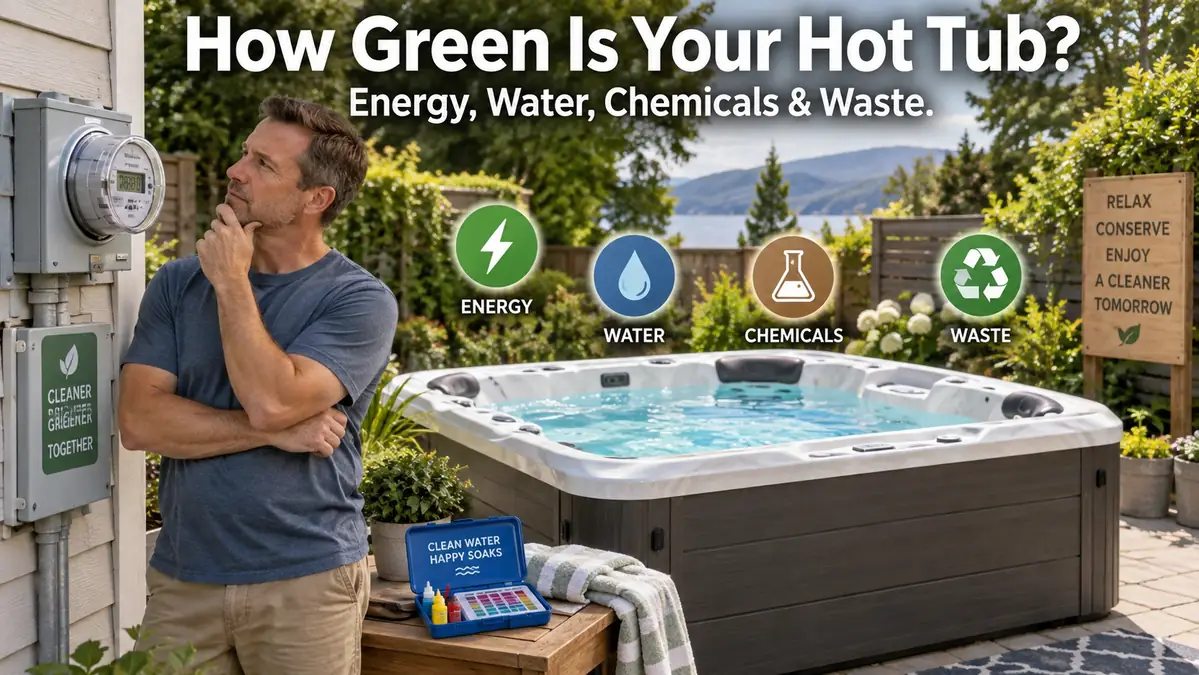
Environmental Impact of Hot Tubs: Energy, Water, Chemicals & Waste

A hot tub uses electricity, hundreds of gallons of water, water-treatment products, replacement parts, and eventually creates material that needs to be repaired, recycled, or disposed of. That gives every spa an environmental footprint, but the size of that footprint varies widely.
The environmental impact of hot tubs depends heavily on insulation, climate, water-care habits, electricity source, spa size, equipment efficiency, and how long you keep the tub in service.
For most current owners, the practical goal is not replacing a working hot tub with something marketed as “green.” It is reducing wasted heat, unnecessary water changes, excess chemical use, and premature equipment replacement.
How Much Environmental Impact Does a Hot Tub Have?
A hot tub’s environmental impact comes from energy use, water consumption, water treatment, manufacturing, replacement parts, transportation, and end-of-life waste.
There is no useful single carbon-footprint number that applies to every hot tub. A well-insulated 300-gallon spa running on a relatively low-emission electric grid can have a very different operating footprint from a poorly insulated 500-gallon spa exposed to freezing wind.
Electricity itself also has different environmental impacts across the United States. The EPA’s Power Profiler uses regional electricity-generation data because emissions vary according to the fuels and generation methods used in each area.
A better way to look at your spa is to separate its footprint into areas you can actually control.
| Impact area | What causes it | How much control an owner has |
|---|---|---|
| Heating | Maintaining hot water and replacing lost heat | High |
| Pumps and filtration | Circulation, filtration, and jet operation | Medium to high |
| Water use | Filling, top-offs, evaporation, draining | High |
| Water treatment | Sanitizer, shock, balancing chemicals | Medium |
| Wastewater | Disposal of treated spa water | High |
| Manufacturing | Shell, frame, foam, pumps, electronics | Low after purchase |
| Replacement parts | Covers, pumps, heaters, filters, controls | High over time |
| End-of-life waste | Shell, insulation, cabinet, electronics | Medium |
This is why reducing waste from an existing spa can sometimes be more meaningful than replacing it simply to buy a newer model.
1. Electricity and Heating Are Major Ongoing Factors
Keeping several hundred gallons of water warm around the clock takes energy.
The environmental effect depends on two things:
- How much electricity the spa uses
- How that electricity is generated where you live
California treats portable electric spa efficiency seriously enough to require qualifying models to meet energy-performance standards and use an established test procedure. The California Energy Commission separates standard, inflatable, exercise, and combination spas when evaluating portable spa efficiency.
Heat loss creates extra heater runtime
A heater does not only replace heat lost while you are soaking.
Heat escapes through:
- the cover
- the shell and cabinet
- exposed plumbing
- evaporation
- air leaks
- wind exposure
- opening the cover
- cold ground beneath the spa
A worn or waterlogged cover can make the heater run more frequently just to maintain the same set temperature.
Before considering expensive equipment changes, work through our guide to lowering hot tub energy use. Improving insulation and stopping heat loss usually deserves attention before replacing a working heater.
Your electric grid changes the carbon side of the equation
Two identical hot tubs using the same number of kilowatt-hours can have different electricity-related emissions if they operate in different regions.
EPA’s eGRID tracks regional generation mixes and emissions, and its Power Profiler lets U.S. households compare their area’s electricity profile with national data.
That means “uses less electricity” and “has a lower carbon footprint” are closely related, but they are not exactly the same measurement.
Measure before making upgrades
Check your utility data rather than assuming the spa caused a large electric bill.
A simple monthly calculation is:
Spa electricity cost = estimated spa kWh × electricity price per kWh
Our hot tub energy savings calculator can help you compare changes using your own numbers.
2. Pumps, Jets, and Filtration Use Electricity Too
The heater gets most of the attention, but it is not the only electrical load.
Hot tubs may also use electricity for:
- circulation pumps
- jet pumps
- air blowers
- filtration cycles
- ozone systems
- UV systems
- controls
- lighting
- freeze protection
A common mistake is trying to minimize heating costs while leaving filtration settings unnecessarily aggressive.
Filtration still needs to meet the requirements of your specific spa and water-care system. The goal is not to run the pump as little as possible. It is to avoid running equipment longer than the manufacturer recommends for your actual usage.
Clean filters matter here too. Restricted flow can hurt water quality and put additional strain on circulation equipment.
3. How Much Water Does a Hot Tub Use?
A hot tub uses far less water than a swimming pool because of its smaller volume, but repeated draining and refilling can still add up.
A simple calculation makes the impact easier to see.
For a 400-gallon hot tub:
- 1 complete refill = 400 gallons
- 2 complete refills = 800 gallons
- 3 complete refills = 1,200 gallons
- 4 complete refills = 1,600 gallons
That does not include top-offs caused by evaporation, splashing, filter cleaning, or leaks.
The best goal is not to keep old water indefinitely. It is to avoid wasting usable water because chemistry or filtration was poorly maintained.
Follow your spa manufacturer’s guidance and replace water when condition, dissolved buildup, contamination, or maintenance needs justify it.
Our guide on when to change hot tub water explains the practical signs that fresh water is needed.
Evaporation matters too
Every gallon that evaporates eventually needs replacing.
Keeping the cover closed when the spa is not being used reduces both:
- water loss
- heat loss
That gives a good spa cover both an energy and water-conservation role.
For more water-focused ideas, see these water-saving options for hot tub owners.
4. Draining a Hot Tub Can Become a Water-Pollution Problem
The environmental issue is not only how much water you drain. Where that treated water goes matters too.
Hot tub water can contain chlorine, bromine, salts, cleaning products, balancing chemicals, and other substances that should not automatically be sent into a street gutter or storm drain.
Rules differ by location.
For example, Portland prohibits heated, chlorinated, or salt-treated pool and hot tub water from entering its stormwater system under normal conditions. Its guidance directs residents toward approved sanitary sewer or on-site options and sets specific conditions where other discharge might be allowed.
EPA-approved product labeling for some spa sanitizers similarly directs operators to contact local sanitary-sewer and storm-drain authorities before discharging treated spa water and warns against discharging into gutters, storm drains, or natural waters unless local authorities allow it.
Before draining your spa
Check your local city, county, sewer utility, or stormwater authority.
Do not assume that:
- a storm drain is connected to a treatment plant
- treated water is safe for plants
- saltwater can go anywhere ordinary water can
- leaving the cover open for a day automatically makes the water suitable for discharge
Local requirements take priority.
5. Hot Tub Chemicals Have an Environmental Tradeoff
Water treatment creates an obvious environmental question: can you just use fewer chemicals?
Not if doing so makes the water unsafe.
CDC recommends that hot tub water have at least 3 ppm free chlorine, or 4 to 8 ppm bromine, with pH between 7.0 and 7.8. Proper disinfectant and pH control help limit the spread of germs in warm recreational water.
Environmental goals should never be achieved by deliberately operating below safe sanitizer levels.
The better target is wasted chemical
Chemical waste often comes from:
- adding products without testing first
- repeatedly correcting large chemistry swings
- excessive organic contamination from bathers
- dirty filters
- using unnecessary products
- incorrect dosing
- allowing water to become so difficult to manage that it must be drained early
Testing first helps you add what the water actually needs.
Showering before soaking helps the water too
CDC recommends showering before entering a hot tub. Sweat, dirt, body products, and other contaminants increase the burden placed on disinfectant.
A short pre-soak shower is a small habit with several benefits:
- less body oil enters the water
- less lotion reaches the filter
- sanitizer has less contamination to deal with
- water can be easier to maintain
- scum buildup may be reduced
That is a more useful environmental strategy than trying to eliminate sanitizer.
6. Can You Use Fewer Hot Tub Chemicals Safely?
Some systems can help reduce chemical demand, but they do not automatically replace the need for residual sanitizer.
Examples include:
- ozone
- UV treatment
- mineral systems
- enzymes
- improved filtration
- automated monitoring
- manufacturer-approved salt systems
Their roles are different.
Ozone and UV act on water passing through treatment equipment. Enzymes can help break down some organic contamination. Mineral systems may work alongside a traditional sanitizer.
None of those facts means every hot tub can safely become “chemical free.”
If you want to compare supplemental systems and products, read our eco-friendly hot tub water-care alternatives, but continue following your spa manufacturer’s sanitation requirements and verified water-safety guidance.
7. Manufacturing and Materials Are Part of the Footprint
The environmental impact of a hot tub begins before it reaches your patio.
A typical portable spa can contain a combination of:
- acrylic or molded plastic
- fiberglass reinforcement
- polyurethane or other insulation
- composite or wood cabinet materials
- PVC plumbing
- pumps and electric motors
- heaters
- steel or other structural material
- printed circuit boards
- sensors and wiring
Producing, transporting, and assembling those materials requires energy and resources.
There is no reliable universal figure for the manufacturing footprint of every spa. Construction methods, factories, material sourcing, transport distance, spa size, and expected lifespan differ too much.
Some manufacturers now highlight recycled materials, water reuse during manufacturing, longer component life, or regional manufacturing as sustainability measures. Those claims should be checked model by model rather than assumed across the entire hot tub industry.
8. Hot Tub Lifespan Changes the Environmental Calculation
Keeping durable equipment in useful service can prevent premature replacement of a large manufactured product.
A pump failure does not automatically mean the whole spa needs to be discarded.
Depending on condition and repair economics, individual components such as these can often be replaced:
- pumps
- heater elements
- sensors
- control packs
- topside controls
- jets
- seals
- plumbing sections
- covers
Hot tub longevity varies widely by construction and maintenance, so there is no single lifespan that applies to every model. Proper chemistry, freeze protection, leak repair, filter maintenance, and cover care can all influence how long components remain usable.
Our hot tub lifespan guide covers the factors that determine when repair still makes sense and when replacement becomes more practical.
Repair can be an environmental decision too
Before replacing an older tub, compare:
repair cost + likely remaining life
against:
replacement cost + expected efficiency improvement + disposal of the old spa
A newer spa may use less electricity, but manufacturing a complete replacement also consumes resources.
The best answer depends on how inefficient or damaged the existing tub actually is.
9. What Happens to an Old Hot Tub?
Hot tubs are awkward to recycle because they are made from several materials bonded or assembled together.
The shell is only one part of the disposal problem.
An old spa may also contain recyclable or separately handled components such as:
- electric motors
- pumps
- heater assemblies
- wiring
- steel frames
- control boards
- electronic sensors
Electronics may qualify for local e-waste programs, while motors and metal frames may have scrap value.
The acrylic, fiberglass, foam, composite panels, and other bonded materials are harder to recover in many areas.
Before paying someone to haul an old hot tub away, ask:
- Do you dismantle the spa before disposal?
- Are motors and metal separated for recycling?
- Are electronics sent to an e-waste facility?
- Does the dealer offer a trade-in or take-back program?
- Can usable parts be salvaged?
The available recycling streams vary by location, so check with your municipal waste authority rather than assuming every component belongs in household trash.
10. Are Inflatable Hot Tubs Better for the Environment?
Not automatically.
Inflatable spas use less structural material than many large acrylic hot tubs and can be transported in a much smaller package. That sounds favorable at first.
The environmental tradeoff can change once you consider:
- insulation performance
- heater runtime
- climate
- usable lifespan
- puncture or liner replacement
- pump-unit replacement
- recyclability
- frequency of use
California’s portable-spa efficiency rules even classify inflatable spas separately from standard spas, reflecting meaningful design and performance differences between spa types.
A small inflatable spa used occasionally in mild weather could have a very different footprint from one kept at high temperature through a freezing winter.
The same is true for acrylic spas. Size alone does not determine the answer.
11. Can Solar or Alternative Heating Reduce the Impact?
Sometimes.
Solar thermal systems can use sunlight to contribute heat directly to spa water, while rooftop photovoltaic panels can supply electricity used by the spa.
Our solar hot tub heating guide explains the difference and the equipment involved.
Heat pumps are another option for some compatible systems because they transfer available heat rather than producing all of their heat through electric resistance.
Gas, propane, and wood-fired systems change the energy source rather than eliminating environmental impact.
This is why an alternative heater should be judged on:
- local climate
- source of electricity
- fuel source
- heater efficiency
- installation impact
- frequency of use
- expected lifespan
- heat loss from the tub
Switching fuels without fixing poor insulation can leave the biggest problem untouched.
12. How to Make an Existing Hot Tub More Environmentally Friendly
You do not need to rebuild your backyard to make a meaningful improvement.
Start with the areas producing avoidable waste.
- Inspect the cover. Replace a badly fitted, damaged, or waterlogged cover that is allowing unnecessary heat loss.
- Check insulation and cabinet gaps. Stop cold air from freely moving around heated plumbing where the spa design allows it.
- Track electricity use. Compare utility data before and after changes.
- Use an appropriate temperature. Do not maintain hotter water than you actually want to use.
- Follow the correct filtration schedule. Avoid excessive pump runtime while still meeting the manufacturer’s water-care requirements.
- Clean filters on schedule. Good flow supports filtration and equipment performance.
- Test before adding chemicals. Avoid unnecessary corrections and overdosing.
- Shower before soaking. Reduce the organic load entering the water.
- Keep the cover closed. Reduce evaporation and heat loss at the same time.
- Repair leaks quickly. A slow leak wastes both heated and treated water.
- Extend useful water life safely. Do not drain simply because the calendar changed if the water remains manageable and manufacturer guidance allows continued use.
- Dispose of drained water correctly. Follow local wastewater rules.
- Repair serviceable components. Avoid replacing the whole spa because one component failed.
- Recycle components where local facilities accept them.
Small changes work best when they address something you can measure.
13. What to Look for When Buying a Lower-Impact Hot Tub
Environmental performance should be part of the buying decision before the spa reaches your patio.
Ask the dealer for specific information instead of relying on an “eco-friendly” label.
Ask about energy performance
Find out:
- tested standby energy use
- insulation design
- base insulation
- cover insulation
- circulation-pump operation
- programmable filtration
- cold-weather performance
California requires energy-performance certification for covered portable electric spas sold there, making its appliance-efficiency system one useful reference point when comparing models.
Buy the size you will actually use
A larger spa means more water to fill and more mass to keep warm.
If two people will use the tub most of the time, buying seven seats solely because the tub looks impressive may create unnecessary water and heating demand for years.
Check repairability
Ask:
- Are pumps replaceable?
- Can technicians access the plumbing?
- Are control components still likely to be available years from now?
- Can the cabinet be repaired?
- What parts are covered by warranty?
- Does the dealer service the spa after the warranty expires?
A product that remains repairable has a better chance of staying out of the waste stream.
Ask what happens at end of life
Some dealers remove old spas when delivering replacements.
Ask what they actually do with them.
Removal and recycling are not the same thing.
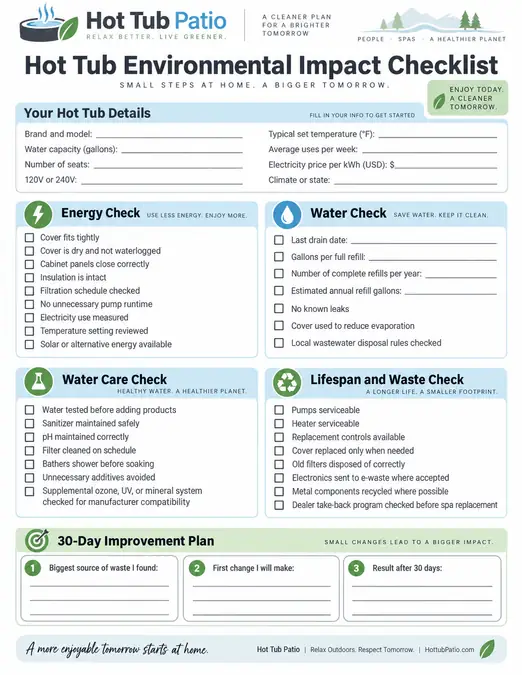
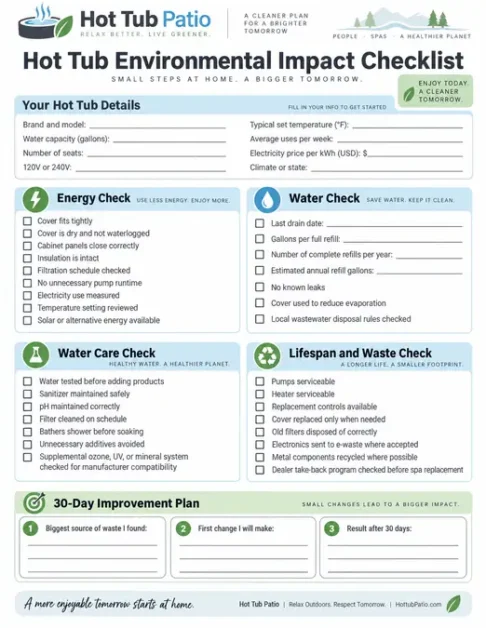
Tailored Action Plan: Reduce Your Hot Tub Footprint in 30 Days
You can get a clearer picture of your own spa without buying new equipment.
Week 1: Measure your baseline
Record:
- hot tub capacity
- set temperature
- electricity rate
- estimated spa electricity use
- outdoor temperature
- filter-cycle settings
- water level
- sanitizer and pH readings
Take a photo of the electricity meter or save your utility data.
Week 2: Stop obvious heat and water loss
Inspect:
- cover fit
- cover condition
- cabinet panels
- visible insulation
- plumbing leaks
- water-level changes
- wind exposure
Correct simple losses before changing equipment.
Week 3: Tighten the maintenance routine
For seven days:
- shower before soaking
- test before dosing
- clean the filter if due
- keep the cover closed whenever the tub is empty
- record every chemical addition
- note any water added to the spa
This gives you a better idea of where your water and treatment products are actually going.
Week 4: Compare the numbers
Compare electricity and water use with your baseline.
Then prioritize upgrades in this order:
stop waste → improve maintenance → repair weak components → consider equipment upgrades
That sequence helps prevent spending thousands of dollars on technology before fixing a leaking cover, unnecessary filtration cycle, or water-management problem.
For other owner worksheets and practical tools, browse our hot tub calculation tools.
Downloadable Resource
Frequently Asked Questions
Are hot tubs bad for the environment?
Hot tubs use electricity, water, treatment products, and manufactured materials, so they do have an environmental footprint. The size of that footprint varies greatly with insulation, climate, electricity source, maintenance, spa size, and lifespan.
Do hot tubs use a lot of electricity?
Heating can be a significant household electrical load because a hot tub maintains warm water continuously. Actual consumption depends heavily on climate, insulation, water temperature, cover condition, spa size, and usage.
What part of a hot tub has the biggest environmental impact?
For an operating electric spa, heating and heat loss are major ongoing factors because lost heat must continually be replaced. Manufacturing, water, chemicals, replacement parts, and disposal also matter across the full life of the tub.
Is it better for the environment to turn a hot tub off?
Not necessarily. Frequent cooling and reheating can be inconvenient and may not produce the savings owners expect. Long shutdowns also require planning for sanitation and freeze protection. Focus first on reducing heat loss and using appropriate controls.
How can I reduce hot tub water waste?
Use a well-fitting cover, repair leaks quickly, maintain filtration and chemistry correctly, and avoid unnecessary complete water changes. Always replace water when contamination or manufacturer guidance makes it necessary.
Can I use hot tub water on my lawn?
That depends on the chemicals in the water and your local wastewater rules. Do not assume treated spa water is suitable for irrigation. Check sanitizer, salt, pH, and local discharge requirements before draining onto landscaping.
Can I drain hot tub water into a storm drain?
Many U.S. municipalities restrict or prohibit discharging chlorinated, brominated, heated, salty, or chemically treated spa water into storm drains. Check with your local wastewater or stormwater authority before draining.
Is a saltwater hot tub better for the environment?
Not automatically. Salt systems generate sanitizer from salt, but the spa still uses electricity, water, filtration, and treatment equipment. Saltwater can also affect wastewater-disposal options in some jurisdictions.
Do ozone and UV systems eliminate the need for chlorine or bromine?
Do not assume they do. Supplemental systems can reduce contaminant load in compatible setups, but hot tub water still needs an effective sanitation strategy. CDC recommends at least 3 ppm free chlorine or 4 to 8 ppm bromine for hot tubs.
Is an inflatable hot tub more eco-friendly than an acrylic spa?
There is no universal answer. Inflatable spas use less structural material, but insulation efficiency, heater runtime, service life, climate, repairability, and disposal all affect the full environmental comparison.
Is repairing an old hot tub greener than replacing it?
Repairing a serviceable spa can extend its useful life and avoid replacing a large manufactured product. Replacement may make more sense when the old spa is badly damaged, difficult to repair, or substantially inefficient, so compare both operating performance and remaining lifespan.
Reduce Waste Before Replacing the Spa
A lower-impact hot tub is mostly about using less energy to replace lost heat, keeping usable water longer without compromising sanitation, dosing chemicals accurately, repairing equipment when practical, and disposing of water and components responsibly.
Start by measuring your own spa rather than chasing a generic environmental score. Fix the cover, stop leaks, test before dosing, review filtration, and track energy use for a month. Those steps reveal where your hot tub’s environmental footprint can actually be reduced.