Alternative Hot Tub Heating Methods: Heat Pumps, Wood, Gas & Solar

The standard electric resistance heater works well for most portable hot tubs, but it is not the only way to keep spa water warm. High electricity prices, slow recovery times, off-grid locations, and cold-weather use are pushing more owners to look at alternative hot tub heating methods.
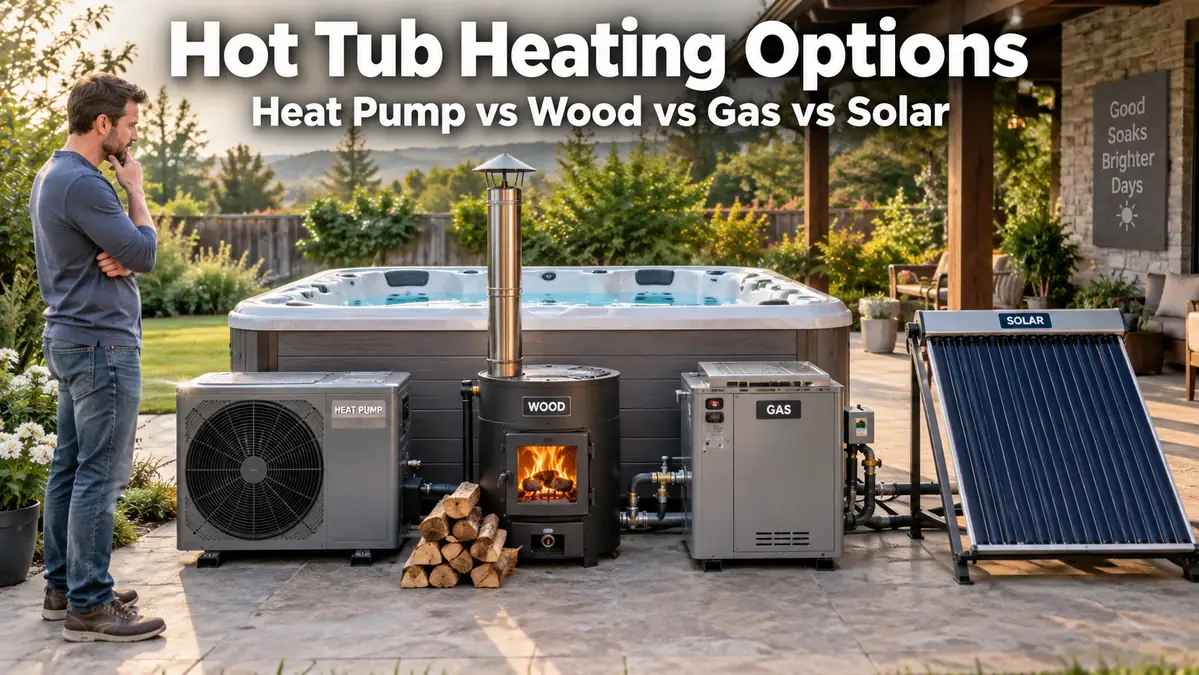
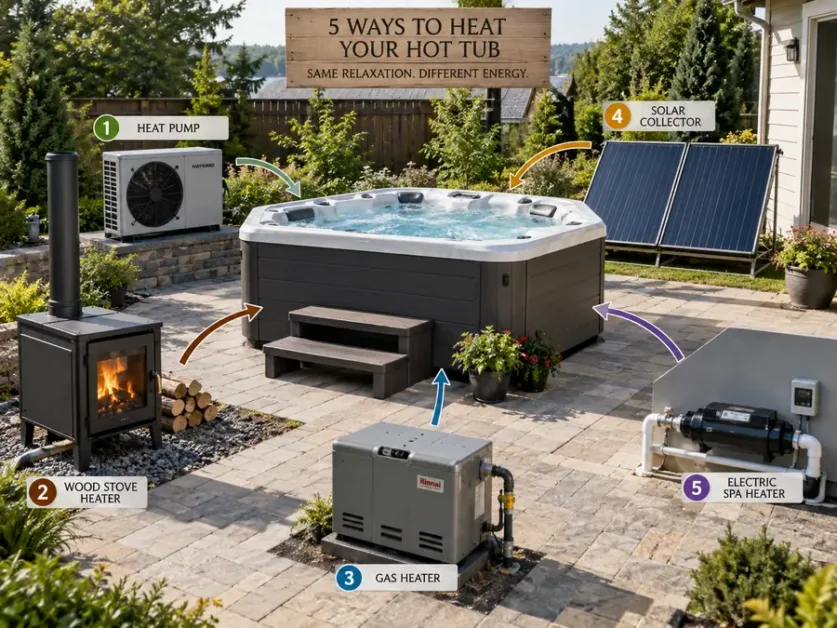
Heat pumps, wood-fired heaters, propane or natural gas systems, solar thermal collectors, and hybrid setups can all work in the right situation. The catch is that not every heating method can be safely connected to every hot tub.
The best place to start is not asking which heater is cheapest. Start with what type of hot tub you own, how often you use it, your climate, and whether the manufacturer supports an external heating system.
Quick Comparison of Hot Tub Heating Options
Here is the practical difference between the main choices.
| Heating method | Best fit | Heat-up speed | Operating efficiency | Hands-on effort | Retrofit difficulty |
|---|---|---|---|---|---|
| Electric resistance | Most portable spas | Moderate | Lower | Very low | Already built in |
| Air-source heat pump | Compatible spas used regularly | Moderate | High in suitable conditions | Low | Moderate to high |
| Wood-fired heater | Wooden, custom, cabin, off-grid tubs | Moderate to fast | Depends on wood supply and system | High | Moderate |
| Natural gas or propane | Custom and in-ground spas | Fast | Depends on heater and fuel price | Low | High |
| Solar thermal | Sunny locations, supplemental heating | Weather dependent | High when solar heat is available | Low | Moderate to high |
| Hybrid system | Owners wanting efficiency plus backup | Flexible | Potentially high | Low to moderate | High |
These are relative comparisons rather than guaranteed costs. Climate, insulation, water volume, heater size, local fuel prices, cover quality, and how often the spa is opened can change the result substantially.
Start With the Type of Hot Tub You Own
A heating method that makes sense for a cedar tub may be a poor choice for a factory-built acrylic spa.
Portable acrylic hot tubs
Most portable spas are designed around an integrated electric heater, circulation system, temperature sensors, flow protection, and electronic control pack.
Adding another heater can interfere with:
- water flow
- temperature sensing
- freeze protection
- high-limit protection
- automated filtration
- manufacturer warranties
- control-board operation
A heat pump designed to integrate with compatible spa controls is much different from connecting a random external water heater.
Balboa, for example, currently offers its Clim8zone II specifically for spa applications. It provides 4 kW of heating capacity, can heat or cool the spa water, operates across a listed ambient range of 23°F to 109°F, and integrates with compatible Balboa BP control systems and supported interfaces.
120V plug-and-play spas
A 120V spa usually has limited heating capacity compared with a larger 240V system. Switching voltage alone does not create free heat. The real questions are heater output, insulation, outdoor temperature, circulation requirements, and how much heat the tub is losing.
For many plug-and-play owners, improving heat retention may make more financial sense than redesigning the plumbing.
Our guide to lowering hot tub energy use covers insulation, covers, filtration schedules, and other changes worth checking before replacing the heating system.
Inflatable hot tubs
Inflatable spas are even less suited to major heating-system modifications.
External plumbing changes can create issues with:
- low-flow pumps
- proprietary fittings
- temperature controls
- warranty coverage
- freeze protection
- leaks around modified connections
Before spending heavily on another heater, improve ground insulation, use the factory cover correctly, block wind, and check whether the spa is losing heat faster than the heater can replace it.
Wooden and custom hot tubs
Wooden tubs give you far more flexibility.
Depending on the design, they may use:
- wood-fired heaters
- electric spa packs
- gas heaters
- heat exchangers
- heat pumps
- solar assistance
- combinations of two heating systems
That flexibility is one reason alternative heating methods appear more frequently in cedar tubs, stock-tank builds, and custom installations.
In-ground spas
Purpose-built pool and spa heaters are common in this category.
The U.S. Department of Energy defines consumer pool heaters as equipment intended for nonpotable water in swimming pools, spas, hot tubs, and similar applications. That distinction matters because equipment designed for recirculating spa water is not the same thing as a household water heater.
1. Air-Source Heat Pumps
A heat pump is the alternative worth examining first if your biggest problem is electricity consumption.
Instead of producing heat directly through an electric resistance element, a heat pump uses electricity to move heat from the surrounding air into the water. The Department of Energy explains the same basic principle for heat-pump systems: energy is transferred rather than created directly through resistance heating.
That can make heat pumps attractive for spas that stay warm for long periods.
Where heat pumps make the most sense
They are especially interesting when:
- electricity rates are high
- the hot tub runs throughout most of the year
- the spa has good insulation
- the equipment area has sufficient airflow
- you want both heating and summer cooling
- your control system supports integration
- you expect to own the spa long enough to recover the upgrade cost
Heat pumps tend to make less sense when a spa is rarely used or the installation cost is high compared with the tub’s value.
Cold weather changes the calculation
Heat-pump performance depends partly on ambient air conditions.
That does not mean every heat pump stops working as soon as temperatures fall. Equipment capabilities vary significantly. Balboa lists a 23°F lower ambient operating limit for the Clim8zone II, for example. Other heat-pump systems may have different limits.
The key is checking the specifications for the actual spa heat pump you are considering rather than assuming that general HVAC heat-pump performance applies to your spa.
Owners in very cold areas may still benefit from a system that uses the heat pump during milder weather while retaining resistance heat as backup.
Do not forget airflow
A heat pump needs access to outdoor air.
Hiding one inside a tightly enclosed hot tub cabinet can hurt performance unless the equipment was specifically designed for that arrangement. You also need space for service access and a plan for condensation.
Image suggestion:
A compact spa heat pump installed beside an acrylic hot tub with arrows showing outdoor air entering the unit and heated water returning to the spa.
2. Wood-Fired Hot Tub Heating
Wood heating makes the most sense when the hot tub itself is designed around it.
A wood-fired system can be particularly appealing for:
- remote cabins
- off-grid properties
- wooden soaking tubs
- areas with inexpensive firewood
- owners who use the tub occasionally
- situations where rapid heating from cooler water matters more than maintaining 102°F around the clock
The tradeoff is convenience.
Someone has to prepare the fire, add wood, watch the temperature, and let the system cool safely after use.
Our wood-fired hot tub guide goes deeper into costs, advantages, drawbacks, and ownership considerations.
Owners interested in building the tub itself can also see our wood-fired hot tub construction guide.
Temperature control needs more attention
An electric spa controller can cycle a heater on and off automatically.
A wood fire does not respond that way.
Water can continue gaining heat while the fire remains active, so temperature monitoring matters. The U.S. Consumer Product Safety Commission advises that hot tub water should never exceed 104°F.
Use an accurate thermometer and follow the heater manufacturer’s circulation and operating instructions.
3. Natural Gas and Propane Heating
Gas heating is attractive when fast recovery matters.
Purpose-built pool and spa heaters are available in both natural gas and propane configurations. Pentair, for example, currently offers spa-capable MasterTemp models in both fuel types, including equipment intended for smaller bodies of water such as spas.
This type of system is much more common with custom spas than with self-contained portable acrylic tubs.
Natural gas can work well when
- the property already has natural gas service
- a properly sized gas line can reach the equipment area
- rapid heating is important
- the spa is part of a pool and spa equipment system
- the owner does not want to keep water at soaking temperature continuously
Propane can work where natural gas is unavailable
Propane provides similar combustion-based heating without requiring municipal natural gas service.
The downside is storing fuel on the property and dealing with propane delivery and local installation requirements.
Gas heating is not a casual retrofit
Fuel supply, combustion clearances, exhaust, plumbing flow, electrical controls, and local codes all matter.
Use equipment specifically designed for pool or spa water and have gas installation handled according to the manufacturer’s requirements and applicable local codes.
A household tankless water heater should not automatically be treated as a substitute for a spa heater simply because both devices heat water.
4. Solar Thermal Hot Tub Heating
Solar thermal heating uses sunlight to warm fluid or water passing through a collector.
It is different from photovoltaic solar panels.
Solar thermal: sunlight becomes heat.
Solar PV: sunlight becomes electricity.
Solar thermal can reduce how much work your main heater has to do, particularly in a sunny climate.
The Department of Energy identifies solar heating as an energy-efficient option for pool heating, while system performance depends heavily on collector exposure, climate, and system design.
Why solar works better as assistance than your only heater
A hot tub has a demanding target temperature.
You may want 100°F to 104°F water:
- after sunset
- during winter
- on cloudy days
- when outdoor temperatures are low
Those are exactly the conditions when available solar heat may be limited.
For most owners, the more practical approach is:
solar thermal + conventional backup
The solar system supplies heat whenever conditions are favorable. The primary heater takes over when solar output falls short.
Heat retention still matters
Collecting free solar heat does little good if the tub loses it quickly.
A tight, insulated cover and protected equipment area may improve the economics of every heating method discussed here.
5. Solar PV Plus Electric or Heat-Pump Heating
Rooftop solar does not change how an electric resistance heater works.
A 5.5 kW resistance heater still requires roughly the same electrical input while operating. The difference is where that electricity comes from.
Solar PV becomes especially interesting when you can run a spa heater during periods of strong solar production.
Solar PV plus resistance heating
This is the simplest concept:
solar panels → home electrical system → spa heater
The benefit depends on:
- solar-system size
- time-of-use electricity rates
- net metering rules
- household electricity demand
- battery capacity
- when the heater actually runs
Solar PV plus a heat pump
Combining solar electricity with a heat pump can reduce grid electricity demand further because the heat pump transfers environmental heat into the water instead of relying entirely on resistance heating.
This setup deserves serious consideration for an owner who already has rooftop solar and uses the spa regularly.
A large battery system does not automatically make overnight hot tub heating cheap. Spa heating is a substantial continuous load, so battery capacity and other household loads need to be included in the calculation.
6. Hybrid Hot Tub Heating
A hybrid setup combines two heat sources instead of asking one system to handle every condition.
Common examples include:
- heat pump + electric resistance backup
- wood + electric holding heat
- solar thermal + electric backup
- solar thermal + gas heater
- solar PV + heat pump
- gas + heat pump in some custom systems
Hybrid heating becomes useful when the cheapest heating source is not always the most convenient one.
Example: heat pump plus resistance backup
The heat pump can handle most temperature maintenance when outdoor conditions are favorable.
The existing resistance heater can help when:
- outdoor temperatures fall below the heat pump’s effective range
- the spa needs faster recovery
- the heat pump is unavailable
- demand temporarily exceeds heat-pump output
Recent hot tub owners researching heat pumps are asking exactly this question: can the heat pump handle normal operation while resistance heat remains available for extreme cold or faster recovery?
That is often a more useful question than asking which technology should completely replace the other.
What Is the Cheapest Way to Heat a Hot Tub?
There is no single cheapest heating method for every owner.
You need to separate three different costs:
- Purchase and installation cost
- Cost of producing each unit of heat
- Total ownership cost over several years
A wood-fired heater may have inexpensive fuel for someone with easy access to firewood but require much more labor.
A heat pump may cost more initially but reduce electricity consumption during regular operation.
A gas system may heat rapidly but require expensive gas-line and equipment work.
Solar heat may have minimal fuel cost but cannot guarantee heat whenever you want to soak.
Our guide to monthly hot tub running costs can help you understand the other expenses that affect the final number.
A simple payback test
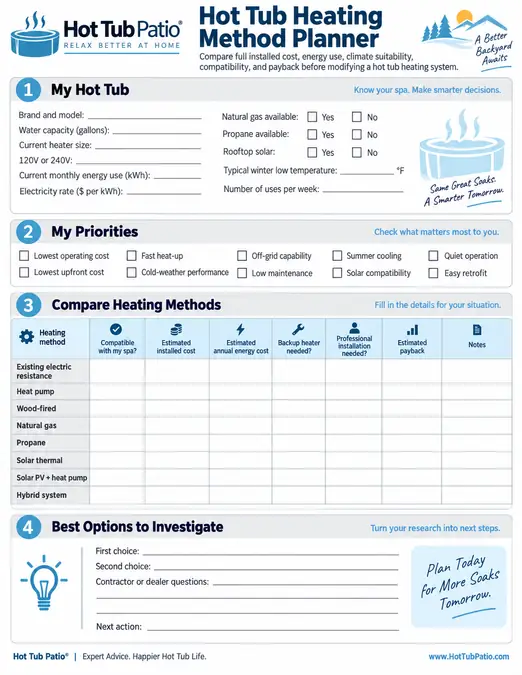
Before changing heaters, estimate:
Annual savings = current annual heating cost – expected annual heating cost
Then:
Simple payback = installed upgrade cost ÷ estimated annual savings
Do not buy a $4,000 heating upgrade to solve a $200 annual problem.
Insulation may change the decision completely.
Which Heating Method Works Best in Cold Weather?
Cold weather increases the amount of heat your hot tub loses to the environment.
That makes insulation and the cover more important regardless of the heater.
For cold climates, compare systems this way:
| Situation | Heating approach worth investigating |
|---|---|
| Well-insulated portable spa | Existing electric heater or compatible heat pump with backup |
| High electricity prices | Heat pump with cold-weather capability |
| Remote cabin | Wood-fired system or suitable hybrid |
| Custom spa with gas available | Purpose-built gas spa heater |
| Sunny but cold location | Solar assistance plus reliable backup |
| Extreme winter climate | Heater with dependable low-temperature capability and freeze protection |
If your spa stays outdoors through freezing weather, our winter hot tub care guide covers the other steps needed to protect the system.
Can You Retrofit an Existing Hot Tub With Another Heater?
Sometimes, but the answer depends on the spa.
A proper evaluation should cover:
- hot tub make and model
- control pack
- existing heater rating
- circulation-pump flow
- plumbing diameter
- available electrical capacity
- equipment space
- airflow
- freeze protection
- temperature-sensor location
- high-limit protection
- warranty restrictions
Do not disable safety switches because an external heater does not work with the original controller.
That is a sign the components are not integrating correctly, not a problem to bypass.
Factory-supported integration is preferable
Products designed for spa integration have a major advantage because controls, temperature requests, flow, and heater operation can work together.
A generic heater may require separate pumps, relays, thermostats, or heat exchangers.
By the time those components are added, the retrofit may cost more than expected.
Hot Tub Heating Decision Matrix
Use this as a starting point before requesting equipment quotes.
| Your situation | First option to research | Second option |
|---|---|---|
| High electricity rate, daily spa use | Heat pump | Hybrid heat pump + resistance |
| Mild climate | Heat pump | Solar-assisted heat pump |
| Very cold climate | Compatible cold-weather heat pump + backup | Existing resistance system |
| Off-grid cabin | Wood-fired | Wood + electric or solar hybrid |
| Natural gas already beside equipment area | Gas spa heater | Gas + heat pump hybrid |
| Rooftop solar already installed | Heat pump | Existing electric heater scheduled around solar production |
| Wooden soaking tub | Wood-fired | Hybrid wood + electric |
| Inflatable hot tub | Improve insulation first | Factory heating system |
| Standard portable acrylic spa | Check factory heat-pump compatibility | Improve efficiency before modifying |
| Custom in-ground spa | Gas or heat pump | Hybrid system |
Run a 30-Day Heating Cost Test Before Buying Anything
A heater upgrade should solve a measured problem.
Use your electric meter, smart energy monitor, or utility data to establish a baseline.
For 30 days, record:
- average outdoor temperature
- spa set temperature
- electricity use
- number of soaking sessions
- days the cover was opened
- filter cycles
- unusual weather
- estimated heating cost
Avoid changing several variables at once.
If you replace the cover, reduce the set temperature, change filtration, and add insulation during the same test, you will not know which improvement produced the savings.
After establishing your baseline, compare it with the estimated savings and installed price of the alternative heater.
That gives you a much better decision than choosing equipment from an advertised efficiency percentage alone.
Common Heating Mistakes to Avoid
Choosing a heater before fixing heat loss
A poorly insulated tub can waste energy regardless of the heater attached to it.
Inspect the cover, cabinet insulation, exposed plumbing, equipment compartment, and wind exposure first.
Assuming faster means cheaper
Gas and high-output heaters can recover temperature quickly, but heat-up speed alone does not tell you operating cost.
Comparing fuel prices without efficiency
One unit of electricity and one unit of natural gas cannot be compared only by price.
The heating equipment converts or transfers energy differently.
Ignoring pumps and controls
An alternative heater may still need electrical power for:
- circulation
- filtration
- controls
- valves
- freeze protection
“Wood-fired” or “gas heated” does not automatically mean the entire hot tub can operate without electricity.
Buying a heat pump without checking low-temperature performance
Look at the manufacturer’s operating envelope, not just the advertised heating capacity.
Removing the factory heater too soon
Keeping resistance heat as backup may make more sense than eliminating it entirely.
Tailored Action Plan
For most existing hot tub owners, use this order before spending money on another heating system:
- Identify the spa type. Record the manufacturer, model, gallons, voltage, control pack, and heater output.
- Measure the real problem. Use 30 days of utility data instead of guessing from the total electric bill.
- Check heat retention. Inspect the cover and insulation before replacing working equipment.
- Calculate your energy rate. Note electricity cost per kWh and, if relevant, natural gas or propane prices.
- Define how you use the tub. Daily users and occasional weekend users need different heating strategies.
- Check your winter conditions. Compare your coldest normal temperatures with the heater manufacturer’s operating limits.
- Ask the spa manufacturer or dealer about compatibility. Find out whether a heat pump or external heat exchanger can be integrated without bypassing safety controls.
- Get complete installed prices. Include plumbing, electrical work, controls, pads, gas lines, permits, and equipment.
- Calculate payback. Compare the installed price with realistic yearly savings.
- Keep backup heat when it solves a real problem. Hybrid systems can be more practical than forcing one heater to work under every condition.
For vacation rentals, cabins, and other income properties, add one more calculation: heating cost per occupied night. A system with higher installation cost may make financial sense if the spa is used heavily and energy savings repeat across many bookings.
For homeowners who want to compare upgrades before buying equipment, our hot tub calculation tools can help with the numbers behind ownership and maintenance.
Downloadable Resource
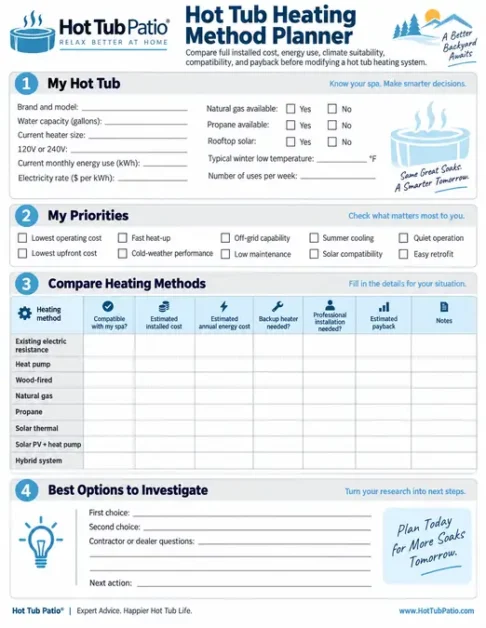
Choosing the Right Heating Method
Alternative hot tub heating is most useful when it solves a specific problem.
A heat pump deserves serious consideration for compatible spas that run frequently and face high electricity rates. Wood is useful for purpose-built tubs and off-grid properties. Gas and propane provide strong heating capacity for suitable custom systems. Solar works best as part of a broader energy strategy, while hybrid heating can provide efficiency without giving up backup heat.
Before replacing anything, measure your current energy use and fix obvious heat loss. A better cover or insulation may save more money per dollar spent than changing the heater.
For a broader look at cutting consumption without sacrificing water temperature, use our hot tub energy-saving guide.
Frequently Asked Questions
Can I add a heat pump to my existing hot tub?
Possibly. Compatibility depends on the spa’s plumbing, circulation flow, controls, electrical supply, and manufacturer support. Spa-specific heat pumps exist, but they are not universal bolt-on upgrades.
Can I heat a hot tub without electricity?
A purpose-built wood-fired hot tub can heat water without an electric heating element. Pumps, filtration, controls, and freeze protection may still require electricity depending on the design.
Is propane faster than an electric hot tub heater?
A properly sized purpose-built gas or propane spa heater can provide much higher heating output than the small resistance heaters found in many portable spas. Actual heat-up time depends on heater output, water volume, starting temperature, and heat loss.
Can solar panels completely heat a hot tub?
Solar can contribute significantly in favorable conditions, but relying on solar alone becomes difficult when you need hot water at night, during cloudy weather, or through winter. A backup heater provides more dependable temperature control.
Do hot tub heat pumps work below freezing?
Some models can operate below 32°F, but operating ranges vary by product. Check the actual manufacturer’s minimum ambient temperature and heating capacity under cold conditions before buying.
Is wood cheaper than electricity for heating a hot tub?
It can be when firewood is inexpensive or readily available, but labor, chimney or heater costs, cleanup, and storage should be included. Local electricity prices and the tub’s insulation can change the comparison.
Can I use my home’s tankless water heater for my hot tub?
Do not assume a domestic tankless heater is suitable for recirculating chemically treated spa water. Use equipment approved for the application and follow the hot tub and heater manufacturers’ installation requirements.
What is the most efficient way to keep a hot tub warm?
Start by reducing heat loss with good insulation and a well-fitting cover. For compatible systems, a heat pump can reduce the electricity needed for heating compared with direct resistance because it transfers heat rather than generating all of it directly.