Hot Tub vs Cold Shower After a Workout: Which Should You Choose?

Your workout is finished, your legs feel tired, and you have two options: sink into a warm hot tub or take a cold shower. Which actually helps? There is no universal winner. A comfortable warm soak can be relaxing, while a cool shower may feel refreshing. Neither should be treated as a guaranteed muscle-growth or recovery treatment.
The key distinction is one people often miss: most athletic recovery research on “cold therapy” examines cold-water immersion, usually submerging large parts of the body for several minutes—not a brief shower. Similarly, a hot tub is a full-body heat exposure, not simply a warm rinse.
Quick comparison: hot tub or cold shower after exercise?
| Your goal | Hot tub | Cool shower |
|---|---|---|
| Feel relaxed | Warm buoyancy and moderate jets may feel soothing | Refreshes and cools skin; less of a lingering heat load |
| Cool off after training | Not appropriate until body temperature and breathing normalize | A lukewarm-to-cool rinse is a practical option |
| Support muscle growth | Not proven to increase muscle protein synthesis | No good evidence a normal shower suppresses gains |
| Manage soreness | May improve perceived comfort; outcomes differ by person | Brief cool water may feel pleasant; don’t assume plunge-study effects |
| Avoid extra heat stress | Adds heat, especially in high water temperatures | Usually more convenient after vigorous exercise |
| Cost and convenience | Requires safe water chemistry and maintenance | Accessible with an ordinary shower |
The first decision: are you still overheated?
If you are breathing hard, sweating heavily, feeling flushed or lightheaded right after a demanding workout, do not jump straight into a hot tub. Your body is already working to shed heat. Walk, rest in a comfortable area, drink water, and let your breathing and temperature settle. Choose lukewarm or comfortably cool water when ready.
A hot tub should never exceed 104°F (40°C) according to CDC, and many adults prefer lower settings. For people with heart or blood-pressure conditions or a history of fainting, ask for individual clinical guidance before high-heat or extreme-cold routines.
What a hot tub can—and cannot—do after a workout
It can feel good for muscle tension
Warm water and buoyancy can make the body feel supported and may temporarily ease the sense of stiffness. Gentle jets can be pleasant, but a stronger jet setting does not guarantee quicker muscle repair. Some people enjoy a short soak later in the day as a wind-down ritual. That is a comfort benefit, not a substitute for an evidence-based recovery program.
It does not guarantee more muscle growth
If you lift weights to gain muscle, the things that matter most remain appropriate training, nutrition, sleep and recovery time. Research on hot-water immersion and resistance exercise has not established that a single soak directly increases muscle growth. See our hot bath after strength training analysis for a closer look at the studies.
Its heat can be too much immediately after hard exercise
A hot tub adds a second heat exposure, which may worsen lightheadedness or dehydration. Start only when you are well, stable and cooled down. If you feel uncomfortable in the water, end the session rather than staying to reach a target time. See how long to stay in a hot tub for conservative duration guidance.
What a cold shower can—and cannot—do after a workout
A comfortable cool rinse can help you feel fresher
After a hot run or gym session, lukewarm or cool water may feel like a convenient way to remove sweat and cool the skin. You can adjust the water and stop at any time. There is no requirement to use the coldest possible setting.
Cold showers are not the same as cold plunges
Studies reporting short-term soreness or recovery benefits typically involve cold-water immersion under controlled conditions. A 2026 umbrella review found outcome-specific immersion effects with often low-certainty evidence; it should not be quoted as proof that a quick shower has the same results.
What about cold water and muscle gains?
A 2024 meta-analysis found that immediate cold-water immersion after resistance training may modestly reduce muscle hypertrophy gains. Most studies used repeated immersion protocols close to the workout; results do not establish that briefly rinsing under an ordinary cold shower prevents growth. If muscle gains are your top priority, don’t assume a daily ice bath is harmless just because cold exposure is trendy.
Which should you choose for different workouts?
| Workout or situation | Conservative choice | Why |
|---|---|---|
| Heavy strength session | Rest and a normal shower; optional brief warm soak later | Prioritize adaptation, nutrition and avoiding extra heat stress |
| Hard outdoor run in hot weather | Cooldown and comfortably cool shower | Avoid adding heat while already overheated |
| Gentle yoga, stretching or walking | Either option if comfortable and healthy | Comfort and convenience can drive the decision |
| Back-to-back competitions | Discuss individualized recovery plan with qualified staff | Immersion studies are goal- and protocol-specific |
| When dizzy or unusually weak | Neither extreme; seek cooling, rest and help | Symptoms override the routine |
A practical post-workout recovery routine
- Finish exercise and return toward normal breathing with an appropriate cooldown.
- Drink water according to thirst, sweating and personal medical needs; replenish food and electrolytes as appropriate for a long or unusually sweaty session.
- Check for symptoms: if dizzy, nauseated, overheated, confused, or feeling faint, stop and address those first.
- Choose a lukewarm or pleasantly cool shower if you want a quick, low-effort way to wash sweat away.
- Only consider a short hot tub soak after you have cooled, feel fully well, and have checked temperature and water quality.
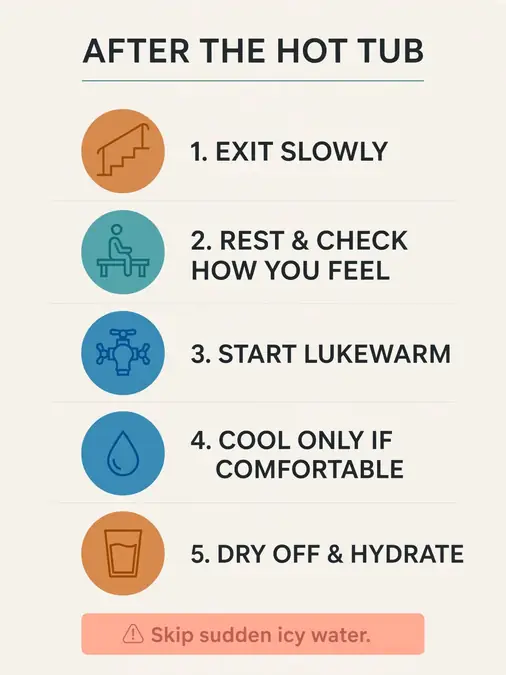
- Exit slowly, dry off, hydrate and sleep rather than extending recovery rituals indefinitely.
Risks and who should seek medical advice
Avoid very cold water shocks if you have a heart condition, abnormal heart rhythms, poorly controlled blood pressure, poor circulation or reduced cold sensation. Cleveland Clinic recommends consulting a clinician before cold plunges with these risks. While a shower isn’t full immersion, an icy shock can still provoke an abrupt response. Avoid hot tubs if a clinician has advised against heat exposure or if you are ill, impaired or dehydrated.
Pregnancy requires individualized hot-tub guidance; children under five should not use hot tubs per CDC. Never use alcohol to unwind in the spa after training. Seek emergency care for chest pain, collapse, severe shortness of breath or confusion.
Five common recovery myths
- “Every cold shower kills gains.” Incorrect leap from specific immersion protocols to everyday showers.
- “More hot water means faster muscle repair.” A pleasant feeling is not proof of faster adaptation.
- “You must alternate hot and cold.” Contrast is optional and may be inappropriate for some people.
- “If athletes do it, it is safe for everybody.” Health conditions and technique matter.
- “Recovery equipment matters more than sleep.” Training load, sleep, food and hydration remain foundational.
Frequently asked questions
Should I use a hot tub immediately after lifting?
Only after cooling down fully and checking that you feel well. There is no proof a hot tub immediately afterward boosts muscle growth. Skip extra heat if you are already overheated.
Is a cold shower better for sore legs?
It might feel refreshing, but evidence for soreness often comes from cold immersion rather than showers. Choose a temperature you tolerate and don’t force a shock.
Will a cold shower ruin my muscle gains?
Evidence of reduced hypertrophy relates mainly to repeated cold-water immersion soon after strength training. It does not show that an ordinary brief shower cancels strength gains.
Can hot tubs help after running?
They can feel relaxing when you have recovered from exertion, but avoid them while still overheated or lightheaded, especially after exercise in hot weather.
Should I alternate hot tub and cold shower?
No. Alternating heat and cold is not required and may be unsuitable for people with circulatory or blood-pressure risks.
How long should I stay in the hot tub after exercise?
There is no universally safe exercise-specific time. Many healthy adults use short sessions, but lower temperature and leaving early are sensible; follow medical and manufacturer guidance.
Bottom line
Choose based on your actual need, not wellness slogans. If you’re still hot, start with cooling and rest. If you’re fully recovered and want relaxation, a brief, moderate hot tub soak can be an option. Neither a hot tub nor a cold shower is essential to recovering well from exercise.