After-Soak Chlorine Calculator: Test-First Dose Guide

After a hot tub soak, test free chlorine before deciding how much sanitizer to add. Three bathers staying 45 minutes do not tell you the chlorine dose: sweat, lotions, water age, existing chlorine, and your actual spa sanitizer all affect what happens next. This calculator uses measured water conditions and the directions on your specific product label instead of a made-up “scoops per person” formula.
If your tub uses bromine, this is not the right calculator. If you use a chlorine sanitizer that is approved for your spa, enter its labeled dose information below and treat the result as a starting estimate that must be checked with another water test. Chlorine products and spa systems differ, so do not bypass the label to make the number look convenient.
After-Soak Chlorine Calculator
Enter your spa’s actual water volume, a fresh free chlorine (FC) reading and pH reading, your intended FC target, and the allowed upper FC level specified by your spa/product instructions. Then copy the exact product-label dose. If the product label does not provide the needed information, the calculator cannot make up a dose.
Hot Tub After-Soak Chlorine Calculator
Enter a fresh free-chlorine test and copy the dose information from your spa sanitizer label. This calculator has no default chemical dose.
Privacy: entries are calculated in your browser; this form does not submit your values to Hot Tub Patio. The result is not a water-safety certificate. Keep bathers out during treatment, circulate as directed, and retest before entry.
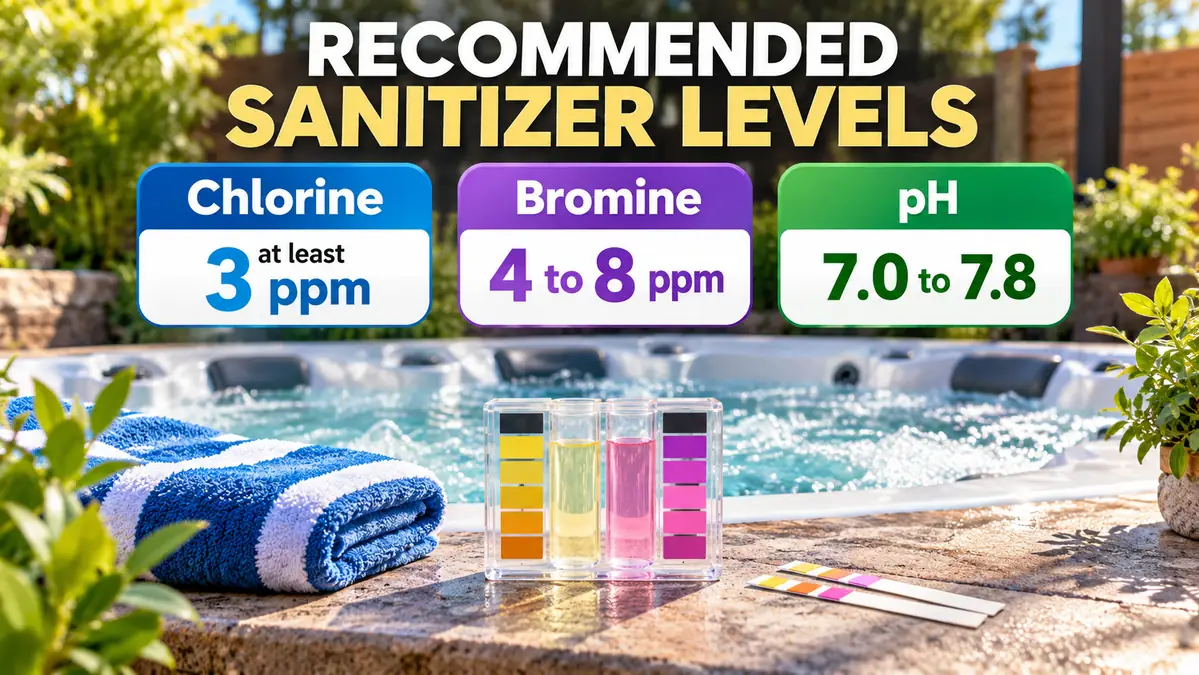
Safety baseline: CDC recommends at least 3 ppm free chlorine and pH 7.0–7.8 in hot tubs. This calculator does not assume that any arbitrary FC value up to 10 ppm is acceptable for your particular spa. Check your manufacturer’s upper limit and product directions. CDC’s home pool and hot tub water guidance explains these figures.
What to Check Before Adding Chlorine After a Soak
Your water might be clear and still have too little sanitizer. Or it might look slightly foamy while the free chlorine level remains inside the product’s operating range. Appearance alone is not a usable dose measurement. Test first, particularly after several people have used a small spa.
- Actual water volume: Use the tub’s rated water capacity at its normal fill level, not the outside cabinet dimensions. A 375-gallon spa and a 500-gallon spa should not receive the same label-scaled quantity automatically.
- Free chlorine, not total chlorine: Check the test kit’s instructions so you enter the right result. Combined chlorine and free chlorine are not interchangeable.
- pH: If it is outside 7.0–7.8, stop using this routine calculator and follow the spa’s approved balancing directions. Chlorine effectiveness changes with pH.
- Product’s spa directions: Check that the specific sanitizer is labeled for hot tub or spa use, and copy the exact dose, volume basis, measurement unit, and maximum application limits.
- Water condition: Repeated zero-FC readings, unusual smell, persistent cloudiness, slime or contamination demand troubleshooting, not an automatic extra scoop.
For help choosing a reliable testing method, see our guide to testing hot tub water with strips. A drop-based kit can be useful when you need a more precise free-chlorine reading; follow the kit directions and measurement range.
How the Two Calculator Modes Work
| Mode | Label information required | What the result means |
|---|---|---|
| Measured FC rise | A stated product dose, gallons treated, and the FC increase (ppm) that dose produces | An estimated amount needed to close the tested FC gap; actual results require retesting |
| Label after-use rate | A labeled after-use sanitizer amount per stated volume of water | The label’s amount scaled to your tub volume, without predicting the final FC |
Mode 1: The Product Label States a Chlorine Rise
Some labels or manufacturer dosing charts specify that a given quantity raises free chlorine by a stated number of ppm in a known water volume. This makes proportional scaling possible. The calculator multiplies the label quantity by the ratio of your water volume to the label volume and then by the ratio of the measured FC shortfall to the labeled rise.
Example using hypothetical label values only: Suppose a product’s actual spa label said 10 grams per 500 gallons raises free chlorine 2 ppm. If a 375-gallon spa tested 2 ppm and the target was 3 ppm, the math would be 10 × (375 ÷ 500) × (1 ÷ 2) = 3.75 grams. Those numbers are a mathematics example, not the directions for any real sanitizer. Do not use them unless your own product directions establish the same rate and permit the amount.
Mode 2: The Label Provides an After-Use Rate
Some approved spa products provide an explicit dose after normal use but do not tell you how many ppm that dose will raise the water. In that case, use the label’s quantity and gallons basis. The calculator scales the quantity to your volume; it cannot promise you will reach 3 ppm. You still need to retest and follow the product’s directions for any further action.
The tool deliberately does not convert a chlorine percentage alone into an automatic dose or translate between teaspoons, dry ounces, and fluid ounces. Weight and volume are not interchangeable. If the label’s required measurements are unclear, ask the spa dealer or product manufacturer before dosing.
After-Soak Hot Tub Chlorine Routine
- Finish the soak and keep people out. Close the spa to bathers while you test and treat the water. Never put sanitizer into an occupied tub.
- Test FC and pH. Use your test kit as directed. If free chlorine is zero, confirm the result and follow corrective treatment procedures rather than using a normal maintenance estimate.
- Read the exact sanitizer label. Check spa suitability, required protective precautions, dosage instructions, any maximum and circulation/cover guidance.
- Measure and add only as the label instructs. Do not mix dry chemicals, combine chemicals in a bucket, or pour incompatible products into the same feeder.
- Circulate, wait according to the instructions, and retest. Do not assume a fixed 20-minute wait is safe for every chemical. Verify FC and pH are within the applicable range before anyone gets back in.
After an unusually busy soak, chlorine demand may continue while the filter removes bather waste. It can help to check the sanitizer reading again later according to your spa’s recommended testing routine. If you regularly host a full spa, our hot tub party water-care guide explains how to reduce the cleanup burden without preloading unnecessary chemicals.
Dichlor, Liquid Chlorine, and Non-Chlorine Shock Are Not the Same
Products vary by active ingredient, intended use, and labeling. The word “chlorine” alone is not a dosing instruction. In particular, the CDC advises against cyanuric acid and stabilized chlorine products (such as dichlor or trichlor) in hot tubs because cyanuric acid slows disinfection. If your spa manufacturer recommends a particular sanitizer system, check that recommendation against current public-health guidance and consult a qualified pool/spa professional about appropriate options.
Liquid chlorine products may have different concentrations and intended applications; household products should not be assumed appropriate for spa disinfection. This tool therefore asks for a spa-specific product label rate, not just a chemical name or percent available chlorine.
Non-chlorine shock based on potassium monopersulfate (MPS) is different from a registered chlorine sanitizer. EPA distinguishes non-pesticidal oxidizers from products making microorganism-control claims. EPA’s shock-labeling guidance explains why an oxidizer should not be treated as a substitute for an EPA-registered disinfectant. If you are specifically using MPS, follow our separate non-chlorine shock calculator.
When a Routine Dose Calculator Is the Wrong Fix
You cannot calculate your way around a contaminated or poorly maintained spa. Stop routine use and work through the underlying problem when water is persistently cloudy, smells strongly, has a repeated zero-FC reading, or shows slime or unusual discoloration.
- Free chlorine reads zero: Keep the spa out of service; confirm the result, inspect circulation and water condition, and follow an approved corrective treatment plan before retesting.
- FC is already at your target or too high: Do not use this tool to add more sanitizer. Recheck the product’s upper limit and your test method.
- pH is outside range: Correct the balance as your spa manufacturer instructs; do not treat a chlorine estimate as a substitute.
- Strong contamination or a fecal incident: Do not use a normal after-soak dose. CDC provides separate hot tub contamination response guidance, including draining and cleaning for fecal events.
- Water is chronically cloudy despite repeated dosing: Check filter and circulation function, sanitizer testing, and whether draining/refilling or specialist service is needed.
If you are solving persistent cloudy water or need a documented corrective shock treatment rather than an ordinary sanitizer top-up, start with our chlorine shock troubleshooting guide. Keep those heavy-treatment instructions separate from the small adjustments in this calculator.
Quick After-Soak Decision Checklist
| Your finding | Next action |
|---|---|
| FC and pH inside permitted range | No automatic extra dose; follow the product’s routine and retest when needed |
| FC below selected target, pH in range | Use verified spa label directions; consider the calculator if all label inputs are known |
| No label dose or maximum instructions available | Do not guess a dose; contact manufacturer or spa professional |
| FC reads zero, very high, or uncertain | Pause use; verify testing and follow corrective directions |
| Water is cloudy, slimy, or unusually colored | Investigate the cause rather than relying on a routine calculator |
Frequently Asked Questions
How much chlorine should I put in my hot tub after two people use it?
The number of bathers cannot determine a safe chemical dose. Test free chlorine and pH, read the product’s directions for your water volume, and add only what those measurements and the approved instructions support.
What if my hot tub reads zero chlorine after soaking?
Keep people out, repeat the test if needed, and investigate sanitizer demand, filtration, and water condition. Use the product’s corrective directions or a qualified spa professional; this routine calculator blocks zero-FC inputs because one estimated maintenance addition cannot establish safe water.
Can I use dichlor in the after-soak calculator?
CDC advises against cyanuric acid and stabilized chlorine products, including dichlor, in hot tubs. Confirm any product’s exact registration, spa-label directions, and compatibility with the hot tub manufacturer’s approved system before use.
Can non-chlorine shock replace chlorine after a soak?
Do not assume so. Many non-chlorine shock products are oxidizers rather than disinfecting sanitizers. Follow the specific product label and keep an approved sanitizer residual; see the chlorine versus bromine sanitizer comparison if you are reconsidering the primary system.
How soon can I use my hot tub after adding chlorine?
There is no one waiting time appropriate for every product and dose. Follow its label’s circulation and reentry instructions, and test again to make sure FC and pH meet the operating requirements before entering.
Use Test Results and the Product Label Together
The most useful answer after a soak is not a scoop count; it is a fresh sanitizer result, a checked label, and a second test after treatment. Save your spa volume and product’s actual dosing chart where you can find them, and leave the tub closed to bathers whenever water parameters or clarity are questionable.