Hot Tubs for Anxiety Relief: What Helps, What Doesn’t & How to Soak Safely

When anxiety leaves your shoulders tight, thoughts racing, and body unable to settle down, sitting quietly in warm water can feel like a welcome break.
But hot tubs do not treat or cure anxiety disorders.
What they can offer is a comfortable setting for relaxation, slower breathing, reduced muscle tension, fewer distractions, and possibly better sleep. Those effects may make a hot tub useful as part of your broader self-care routine.
There is much stronger evidence for treatments such as psychotherapy, including cognitive behavioral therapy, than for hot tubs themselves. The National Institute of Mental Health also lists exercise, mindfulness, adequate sleep, relaxation techniques, and social support among useful strategies for managing stress and anxiety.
If you want the broader science behind warm water, buoyancy, massage, and recovery, see our complete hot tub therapy guide.
Can a Hot Tub Actually Help With Anxiety?
A hot tub may help you feel calmer temporarily, particularly when anxiety shows up as muscle tension, restlessness, stress, or difficulty winding down. There is not strong evidence that hot-tub soaking itself treats an anxiety disorder.
That distinction matters.
Think of a hot tub more like:
- a quiet walk
- breathing exercises
- calming music
- meditation
- a warm bath
- a screen-free bedtime routine
These activities can support relaxation without replacing professional mental health care when it is needed.
Warm-water immersion may be particularly useful when anxiety feels physical.
You may notice:
- tight shoulders
- a clenched jaw
- back tension
- restlessness
- difficulty sitting still
- trouble switching off before bed
Warm water may make those sensations feel easier to tolerate while giving you a defined period away from work, screens, notifications, and other stressors.
Why a Hot Tub May Feel Calming
The benefit is probably not one magical chemical or hormone.
It is the combination of warmth, physical comfort, reduced distractions, and deliberate downtime.
Warm water can ease physical tension
Stress and anxiety often come with muscle tension.
Sitting in warm water may help tight muscles feel more relaxed, particularly around the neck, shoulders, back, and legs.
Cleveland Clinic notes that hot-tub soaking can help with muscle relaxation and that the physical relaxation may contribute to a calmer overall state. The evidence is not strong enough to say a hot tub directly switches anxiety off.
Buoyancy lets your body rest
Water supports part of your body weight.
Instead of continually holding yourself upright against gravity, you can settle into the seat and let the water support you.
For someone who feels physically tense all day, that change can make relaxation easier.
It creates a boundary from everyday stress
There is also a much simpler explanation for why soaking feels good:
You stopped what you were doing.
No inbox.
No laundry.
No commuting.
No endless scrolling.
A 10- or 15-minute soak can become a deliberate transition between a stressful part of your day and whatever comes next.
NIMH includes relaxing activities, mindfulness, adequate sleep, and intentionally taking time for healthy activities among useful self-care strategies.
The Problems People With Anxiety Actually Run Into
A hot tub is relaxing for some people.
For others, the physical sensations of heat can create an entirely different response.
“My thoughts are still racing even in the hot tub”
Warm water cannot force your thoughts to stop.
Trying too hard to “clear your mind” can sometimes make you more aware that your mind is busy.
Instead, give your attention something simple to return to.
Notice:
- how the water feels against your skin
- where your body touches the seat
- the sound of circulating water
- your natural breathing
- three things you can see around you
You are not trying to eliminate every thought.
You are simply giving your attention somewhere else to land.
“The jets actually make me feel more tense”
Turn them down.
Hydrotherapy does not require every jet to be running at maximum pressure.
If powerful jets feel overstimulating:
- lower the jet pressure
- use only one jet zone
- move away from direct jets
- switch to circulation mode
- turn the jets off
Some people find still warm water more relaxing than aggressive massage.
“Heat makes me feel dizzy, and then I panic”
This is an important problem to recognize.
Hot water can lower blood pressure enough to cause lightheadedness in some people, particularly during longer or hotter sessions. Cleveland Clinic specifically warns that prolonged soaking can lead to dizziness and, in some cases, fainting.
For someone who is sensitive to bodily sensations, suddenly feeling hot or lightheaded may also make it harder to relax.
If this happens:
- Get out of the tub.
- Move carefully rather than standing up suddenly.
- Sit somewhere safe.
- Cool down.
- Drink water if appropriate.
- Do not immediately get back in.
For your next soak, try a lower temperature and shorter session.
Our guide to hot tubs and body temperature explains overheating and warning signs in more detail.
“I feel calm while soaking, but the anxiety comes right back”
That does not mean the soak failed.
A hot tub may provide temporary relaxation, not remove whatever is causing or maintaining the anxiety.
If worry is persistent, makes you avoid normal activities, interferes with work or relationships, or feels difficult to control, professional treatment deserves priority.
NIMH identifies psychotherapy and medication as the main treatments for generalized anxiety disorder, with CBT being one of the best-studied psychotherapy approaches.
Try This Anxiety-Friendly Hot Tub Routine
You do not need aromatherapy, special lighting, expensive speakers, or a complicated wellness ritual.
Start simple.
Step 1: Use a comfortable temperature
There is no medically established hot-tub temperature specifically for anxiety.
CDC guidance says hot tub water should not exceed 104°F (40°C).
If heat itself makes you uncomfortable, do not aim for 104°F just because the tub can reach it.
Try a lower setting.
Our best hot tub temperature guide can help you adjust the water for comfort rather than maximum heat.
Step 2: Put the phone somewhere else
Scrolling while soaking defeats one of the biggest advantages of the hot tub: creating a boundary from stimulation.
Try 10 minutes without:
- news
- social media
- work messages
- short-form video
You do not have to become perfectly mindful.
Just give your brain fewer inputs.
Step 3: Start with the jets low
Sit comfortably for the first few minutes.
Then decide whether jets improve the experience.
If they do, use them.
If they make you feel overstimulated, turn them off.
Step 4: Let your breathing stay easy
Do not force huge breaths or complicated breath-holding exercises if those make you uncomfortable.
You can simply let your breathing become slower and easier.
NIMH includes breathing exercises and relaxation practices among strategies that may help people cope with stress and anxiety.
Step 5: Relax one tense area at a time
Notice where you are holding tension.
Try:
- dropping your shoulders
- unclenching your jaw
- relaxing your hands
- letting your legs rest
- softening your forehead
The goal is physical relaxation, not forcing yourself to “stop being anxious.”
Step 6: Finish before you feel overheated
More time is not automatically better.
If you start feeling:
- dizzy
- nauseated
- unusually weak
- lightheaded
- excessively hot
get out.
A 10-Minute Routine for Racing Thoughts
If your main problem is overthinking, try this simple structure.
| Time | What to do |
|---|---|
| Minutes 0–2 | Get comfortable and adjust the jets |
| Minutes 2–4 | Notice where your body feels tense |
| Minutes 4–6 | Let your breathing slow naturally |
| Minutes 6–8 | Notice sounds, water, temperature, and surroundings |
| Minutes 8–10 | Sit quietly without checking your phone |
Afterward, ask yourself:
Do I feel more settled than I did 10 minutes ago?
You do not need a dramatic change.
Moving from an 8/10 stress level to a 6/10 may still make the routine worthwhile.
Hot Tubs, Anxiety, and Sleep
This is where the evidence becomes more interesting.
Anxiety and poor sleep often feed each other. NIMH notes that persistent anxiety may contribute to sleep problems, and maintaining a regular sleep routine is one of its recommended self-care strategies.
Warm-water bathing before bed also has research behind it.
A systematic review and meta-analysis found that passive warm-water heating approximately 1–2 hours before bedtime was associated with improvements in sleep measures, including shorter time to fall asleep under certain conditions. The research studied warm baths and showers rather than anxiety-specific hot-tub therapy, so it should not be interpreted as proof that hot tubs treat anxiety.
More recent real-world research also found an association between before-bed hot-water bathing and several measures of better sleep among older adults, although observational research cannot prove that the bathing caused the improvement.
If bedtime anxiety is your main problem
Try:
- Finish your soak around 1–2 hours before bed.
- Put your phone away during the soak.
- Keep lighting low afterward.
- Avoid returning to work or stressful tasks.
- Follow roughly the same bedtime each night.
The hot tub becomes one part of a consistent wind-down routine rather than an emergency response when you cannot sleep.
What If Heat Makes Your Anxiety Worse?
Then forcing yourself to sit in hotter water is unlikely to make the experience more therapeutic.
Some people are particularly sensitive to:
- feeling overheated
- dizziness
- changes in heartbeat awareness
- sweating
- lightheadedness
- feeling trapped
- strong jets
- enclosed surroundings
If those sensations resemble what you experience during panic, they may make the soak uncomfortable rather than calming.
You can experiment with:
| Problem | Try this |
|---|---|
| Water feels oppressively hot | Lower the temperature |
| Feeling trapped | Sit near the exit |
| Strong jets increase tension | Reduce or disable jets |
| Lightheaded when leaving | Shorten the session and rise slowly |
| Silence increases overthinking | Use quiet music or an audiobook |
| Music feels overstimulating | Keep the environment quiet |
| Night soaking feels isolating | Soak with someone you trust |
There is no requirement that relaxation has to look the same for everyone.
Can a Hot Tub Stop a Panic Attack?
A hot tub should not be relied on as a treatment for a panic attack.
Panic attacks can involve strong physical sensations such as fear, rapid breathing, sweating, dizziness, and a racing heart. Heat may be relaxing for one person but uncomfortable for another.
NIMH identifies CBT as a well-studied treatment for panic disorder and notes that treatment can include learning different ways to respond to the physical sensations associated with panic.
If you suddenly feel panicked while in the hot tub, getting out safely may be more appropriate than trying to remain in the heat until the feeling passes.
Avoid Using Alcohol to “Relax More”
Alcohol and hot tubs are a poor combination.
CDC recommends not drinking alcohol before or during hot-tub use.
Alcohol can also interfere with sleep quality and may affect anxiety differently from one person to another.
If your purpose is winding down, use the hot tub itself as the transition rather than combining the soak with alcohol.
Be Careful With Aromatherapy Products
The old advice to simply pour essential oils into the hot tub is not a good general recommendation.
Products not designed for spas can:
- foam
- leave oily residue
- affect filters
- coat the waterline
- interfere with water care
If you enjoy scents, use only products specifically approved for your spa and follow the hot tub manufacturer’s instructions.
A scent diffuser positioned safely away from the water may also provide aroma without adding anything to the spa.
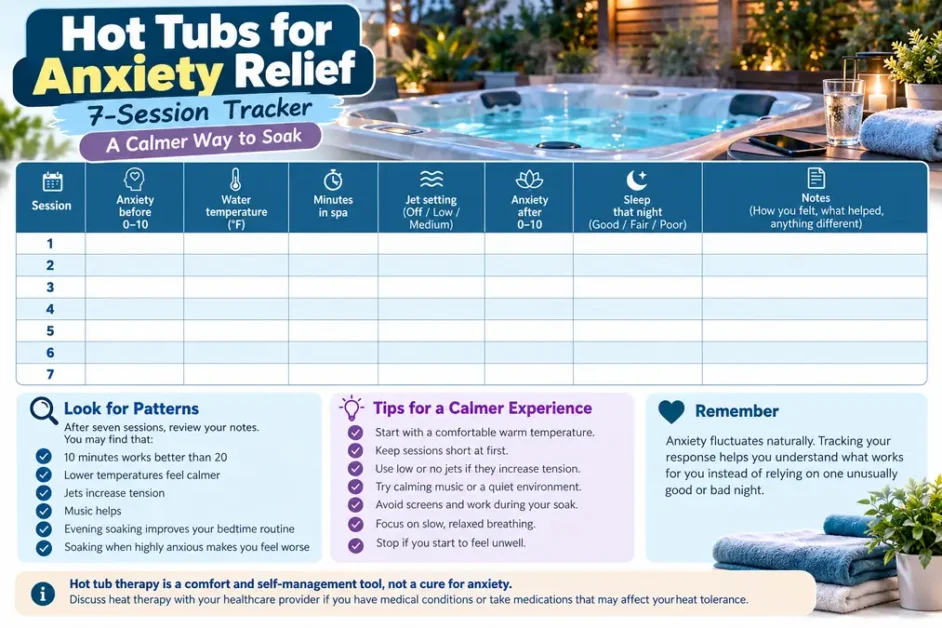
Track Whether the Routine Actually Helps
Anxiety fluctuates naturally.
Without tracking it, it is easy to assume a routine is helping or failing based on one unusually good or bad night.
Try this for seven sessions:
| Session | Anxiety before 0–10 | Water temp | Minutes | Anxiety after 0–10 | Sleep that night | Notes |
|---|---|---|---|---|---|---|
| 1 | ||||||
| 2 | ||||||
| 3 | ||||||
| 4 | ||||||
| 5 | ||||||
| 6 | ||||||
| 7 |
Look for patterns.
Maybe:
- 10 minutes works better than 20
- lower temperatures feel calmer
- jets increase tension
- music helps
- evening soaking improves your bedtime routine
- soaking when highly anxious makes you feel worse
That information lets you personalize the routine instead of following generic advice.
When a Hot Tub Is Not Enough
A relaxing soak can support self-care.
It is not a substitute for mental health treatment when anxiety is persistent or disruptive.
NIMH recommends seeking professional help when anxiety begins interfering with everyday life, causes avoidance, or feels consistently difficult to manage. Evidence-based options can include psychotherapy and medication, depending on the person and type of anxiety.
Think of the hot tub as one tool in a much larger toolbox.
A hot tub can support relaxation, but persistent anxiety may need professional care. The National Institute of Mental Health explains anxiety symptoms and evidence-based treatment options, including psychotherapy and medication.
Hot Tubs for Anxiety Relief FAQs
Can a hot tub help with anxiety?
A hot tub may temporarily help you relax, release muscle tension, reduce distractions, and prepare for sleep. It should not be considered a treatment or cure for an anxiety disorder.
Can a hot tub make anxiety worse?
Yes. Heat, dizziness, strong jets, or feeling overheated may be uncomfortable for some people, particularly if physical sensations tend to trigger panic. Try cooler water, shorter sessions, or stop soaking if the experience consistently makes you feel worse.
What is the best hot tub temperature for anxiety?
There is no medically established anxiety-specific temperature. Choose a comfortably warm setting and never exceed the CDC hot-tub maximum of 104°F (40°C).
How long should I stay in a hot tub for relaxation?
There is no specific clinical soak duration for anxiety. Start conservatively, especially in hotter water, and leave immediately if you feel dizzy, nauseated, faint, or excessively hot.
Can hot tubs help with racing thoughts?
They may provide a quiet environment where you can reduce distractions and practice relaxation or mindfulness, but warm water cannot directly stop racing thoughts. Pairing a short soak with a screen-free routine may be more useful than relying on the heat alone.
Is a hot tub good before bed if anxiety keeps me awake?
Warm-water bathing about one to two hours before bedtime has been associated with improvements in sleep in research, so a hot tub may fit into a relaxing nighttime routine. It is not a treatment for insomnia or an anxiety disorder.
Can I use essential oils in my hot tub for anxiety?
Do not add ordinary essential oils directly to spa water unless your hot tub manufacturer specifically approves them. Use spa-compatible aromatherapy products according to their instructions.
Should I use strong jets for anxiety relief?
Not necessarily. Some people enjoy massage jets, while others find strong pressure overstimulating. Adjust the jets according to what actually makes your body feel more comfortable.
Make the Hot Tub a Pause, Not a Cure
The best reason to use a hot tub for anxiety relief is not that warm water can cure anxiety.
It cannot.
The value is simpler: a hot tub can give you a quiet, comfortable place to put the phone down, release some physical tension, slow the pace of your evening, and practice relaxing without another task demanding your attention.
Keep the temperature comfortable, avoid excessive heat, use jets only if they feel good, and pay attention to how you feel during and after the session.
If anxiety continues to interfere with sleep, work, relationships, or everyday activities, use the soak as supportive self-care while getting appropriate professional help.