
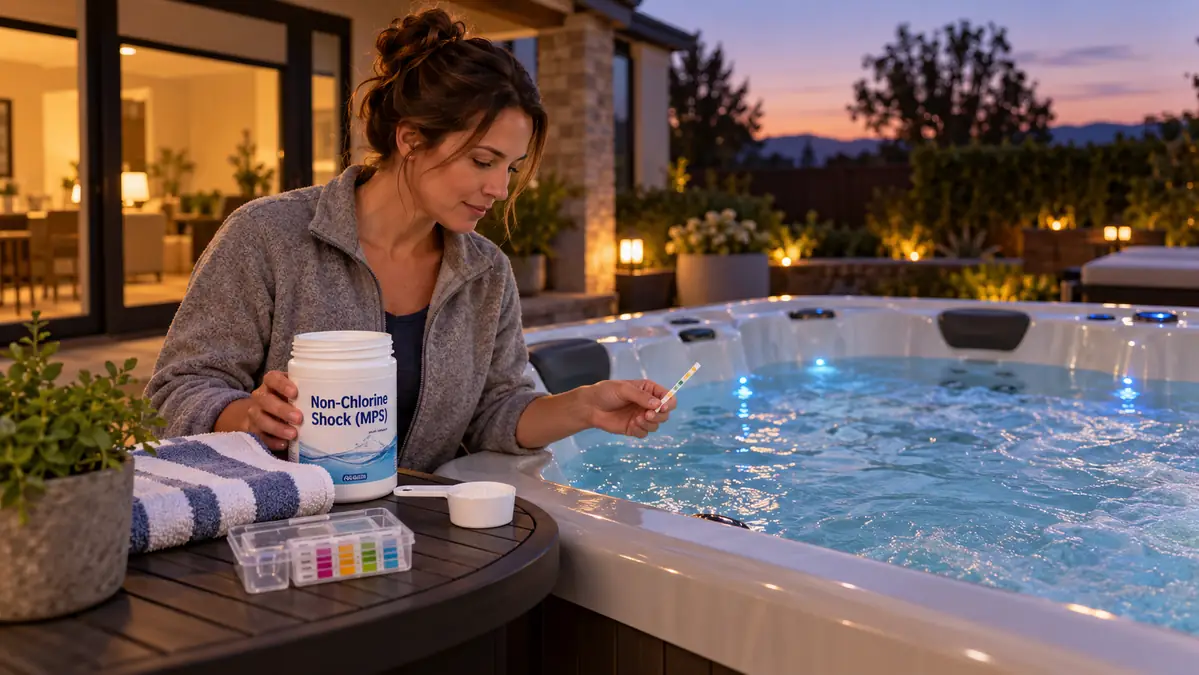
Non-Chlorine Shock Calculator for Hot Tubs (MPS Dose Guide)

Non-chlorine shock can be useful when your hot tub has picked up sweat, body oils, lotions, and other bather waste but you do not want to add more chlorine. The dosing problem is that MPS products do not all use the same concentration or label rate.
This calculator solves that problem by scaling the dose printed on your own product label to the actual gallon size of your hot tub. It does not guess a universal MPS dose, and it does not replace chlorine or bromine.
Non-Chlorine Shock Calculator for Hot Tubs
Enter your hot tub volume, then copy the routine or heavy-use dose from your MPS label. The calculator scales that rate to your spa.
Hot Tub MPS Dose Calculator
Scale the dose on your non-chlorine shock label to your spa volume.
Dose for your hot tub
Before dosing: confirm you copied the correct label rate for your intended use. Product instructions and spa-manufacturer directions take priority over this calculator.
Formula: label dose × (your spa gallons ÷ label reference gallons). If the label says 2 oz treats 300 gallons and your tub holds 450 gallons, the scaled dose is 3 oz.
If you are unsure of your spa capacity, use our hot tub volume calculator first. A wrong gallon estimate can throw off every chemical dose that follows.
Why This Calculator Uses the Product Label Instead of a Universal MPS Dose
Potassium monopersulfate, usually shortened to MPS, is sold in different formulations and with different treatment directions. That makes a single “X ounces per 300 gallons” rule unreliable across every product.
For example, one current MPS product lists 2 ounces per 300 gallons for spas, while another current MPS product lists 17 grams per 1,000 liters. Those rates are not interchangeable. The safest calculation is to scale the instructions on the container you actually own.
This is also why the calculator does not ask for “MPS percentage” and invent a dose from active ingredient strength alone. The finished product label already accounts for its formulation and intended use.
What Non-Chlorine Shock Does in a Hot Tub
MPS is an oxidizer. It helps break down organic waste such as sweat, oils, cosmetics, and other material left behind by bathers. That can reduce the load on your regular sanitizer and help water recover after normal use.
MPS is not a replacement for chlorine or bromine. A manufacturer maintenance guide from Master Spas specifically notes that oxidizer/non-chlorine shock does not disinfect water for bacteria. Your sanitizer still has to stay in the proper range.
For a public-health baseline, the CDC recommends at least 3 ppm chlorine, 4–8 ppm bromine, and pH 7.0–7.8 in hot tubs. Test before assuming that an MPS dose has made poorly sanitized water safe. See the CDC’s hot tub safety guidance for current targets.
| MPS can help with | MPS should not be relied on for |
|---|---|
| Oxidizing bather waste | Replacing chlorine or bromine |
| Routine post-soak oxidation when the label calls for it | Correcting zero sanitizer by itself |
| Reducing organic load after heavier use | Treating suspected biological contamination on its own |
| Supporting clearer water when filtration and sanitizer are already working | Fixing a dirty filter, badly unbalanced water, or old water |
How to Use the MPS Calculator Without Overdosing
- Find your actual hot tub volume. Check the owner’s manual or calculate the gallons. Do not assume a “6-person” spa always holds the same amount of water.
- Read the MPS label. Find the dose for the situation you are treating, such as routine maintenance or heavy use.
- Enter the label rate exactly. If the label says 1.5 oz per 500 gallons, enter 1.5 and 500. If it gives grams, keep the calculator in grams.
- Use the calculated amount as a scale, not permission to ignore the label. Follow the label for circulation, cover position, application method, and re-entry time.
- Retest the water before the next soak. Confirm sanitizer and pH are where they belong.
Do not convert a weight dose into tablespoons unless the product manufacturer provides that conversion. Dry chemical density varies, so an ounce by weight is not automatically the same as a fluid ounce or a fixed number of tablespoons.
MPS vs. Chlorine Shock: Which One Should You Use?
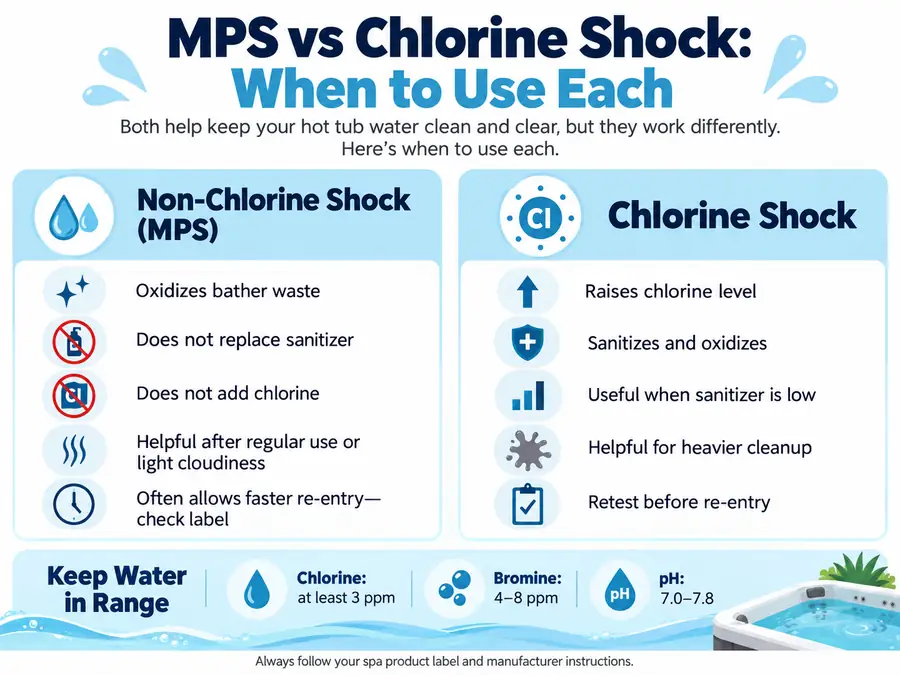
Use MPS when your sanitizer is already in range and your main job is oxidation. Use a chlorine-based treatment when the water-care problem requires increasing chlorine as well as oxidizing contaminants, or when your sanitizer system specifically calls for it.
Our chlorine shock guide for hot tubs covers the chlorine side in more detail. If you are comparing complete sanitizer systems rather than shock products, see chlorine vs. bromine for hot tubs.
| Situation | Better starting point | Why |
|---|---|---|
| Sanitizer is already in range after a normal soak | MPS if your water-care program calls for it | Oxidizes bather waste without intentionally raising chlorine |
| Free chlorine is low | Correct the sanitizer first | MPS does not replace a disinfectant residual |
| Water is mildly dull after heavier use | Test first, then follow the MPS or shock label | The right treatment depends on sanitizer level and the product system |
| Water is strongly cloudy, slimy, or contamination is suspected | Stop soaking and troubleshoot | This may require sanitizer correction, filter cleaning, system treatment, or a drain/refill |
Non-Chlorine Shock Hot Tub Checklist
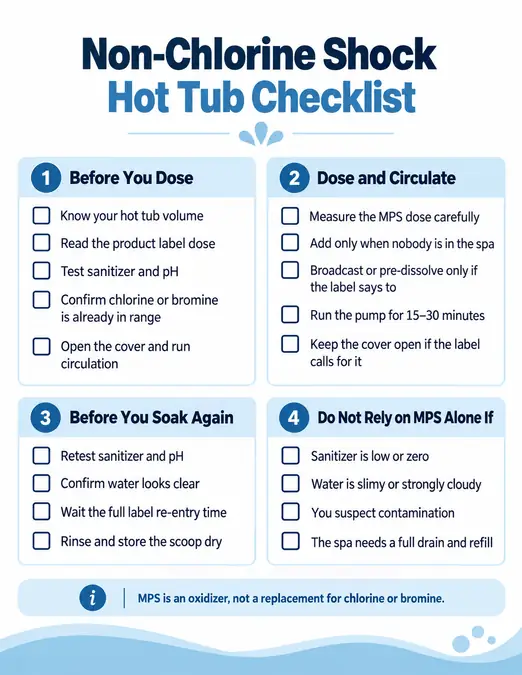
Free printable: Keep the steps beside your spa supplies with the downloadable Non-Chlorine Shock Hot Tub Checklist (PDF).
Before You Dose
- Confirm the hot tub volume.
- Read the exact MPS dose on your product label.
- Test sanitizer and pH.
- Make sure chlorine or bromine is already in the correct operating range for your system.
- Make sure nobody is in the water while you add chemicals.
Dose and Circulate
- Measure the calculated amount carefully with a clean, dry measuring tool.
- Broadcast or pre-dissolve only as directed by the label.
- Run circulation for the amount of time specified by your product or spa manufacturer.
- Follow the label’s instructions about leaving the cover open.
Before You Soak Again
- Wait the full re-entry time on the product label.
- Retest sanitizer and pH.
- Do not use the spa if the water is still cloudy, slimy, or outside the proper sanitizer/pH range.
How Long After MPS Can You Use the Hot Tub?
There is no single waiting time that applies to every non-chlorine shock. Some current manufacturer programs allow re-entry after roughly 15 minutes, while other products direct 30 minutes or more. Follow the exact label on your container and retest your sanitizer and pH before soaking.
A fast re-entry claim does not mean the sanitizer can be ignored. MPS may oxidize waste quickly, but chlorine or bromine still has to be present at the level required by your water-care system.
Why MPS Can Make Combined Chlorine Tests Look Wrong
If you use a DPD chlorine test and the combined-chlorine result suddenly looks high after adding MPS, the oxidizer itself may be affecting the test. Taylor Technologies states that monopersulfate reacts with DPD Reagent #3 and can cause false total- and combined-chlorine readings.
For accurate testing in the presence of MPS, Taylor recommends a monopersulfate interference remover with compatible DPD test kits. This matters because an owner can otherwise keep adding chemicals to “fix” a reading that is partly test interference.
When MPS Is Not the Right Fix
Non-chlorine shock is useful, but it should not become the answer to every water problem. Stop and troubleshoot instead of adding more MPS when:
- chlorine or bromine is low or zero;
- the water is strongly cloudy, green, or slimy;
- the filter is dirty or flow is restricted;
- pH is well outside the proper range;
- you suspect contamination or someone used the spa while ill;
- the water is old and no longer responds normally to treatment.
Use the hot tub water-care troubleshooting guide when the problem goes beyond routine oxidation. If the water is simply cloudy, the cloudy hot tub water guide walks through sanitizer, pH, filtration, and contamination checks in the right order.
MPS Dose Examples Using the Calculator
| Label says | Your spa volume | Calculated dose |
|---|---|---|
| 2 oz per 300 gal | 225 gal | 1.5 oz |
| 2 oz per 300 gal | 350 gal | 2.3 oz |
| 2 oz per 300 gal | 450 gal | 3 oz |
| 15 g per 250 gal | 400 gal | 24 g |
These examples show the math only. They are not universal dosing recommendations. Replace the example rate with the treatment rate printed on your own MPS product.
For other water-care calculators, visit the Hot Tub Patio calculation tools hub.
Frequently Asked Questions
How much MPS do I put in a 300-gallon hot tub?
Use the dose printed on your MPS label. If your label specifically says 2 oz per 300 gallons, the dose for a 300-gallon spa is 2 oz; a different product may specify a different rate.
Can I use MPS instead of chlorine or bromine?
No. MPS is primarily an oxidizer, not a substitute for maintaining a disinfectant residual. Keep chlorine or bromine in the range required by your spa and sanitizer system.
How often should I use non-chlorine shock?
Follow your product and sanitizer-system instructions. Some programs call for MPS after use, some weekly, and some only after heavier bather loads, so a fixed schedule does not fit every spa.
Can MPS be used in a bromine hot tub?
Many bromine water-care programs use non-chlorine oxidizer, but the exact role and dose depend on the system. Follow the bromine system instructions and continue testing the bromine residual rather than treating MPS as the sanitizer.
How long should I wait after adding MPS?
Use the re-entry time on your product label. Current products differ, so do not assume every non-chlorine shock has a 15-minute wait.
Can MPS affect chlorine test results?
Yes. Taylor Technologies says monopersulfate can interfere with DPD total- and combined-chlorine testing. A compatible interference-removal reagent can help separate the MPS effect from the chlorine result.
Use the Label Rate, Then Let the Calculator Do the Scaling
The most reliable MPS dose starts with two numbers: your actual hot tub volume and the treatment rate printed on the product you own. Enter those values into the calculator, measure carefully, circulate as directed, and retest before the next soak.
That approach is more dependable than copying a generic dose chart because it keeps the math tied to the formulation and directions you are actually using.