Commercial Sauna Cost: Equipment, Installation & Operating Expenses

A gym owner receives a sauna quote for the room and heater, then discovers the electrical work, air handling, building changes, delivery and permits are separate. The first price may be useful, but it is not the amount the business must budget to open the sauna.
Quick answer: Commercial sauna cost is the sum of equipment, site preparation, professional installation, approvals and ongoing operation. There is no dependable single price for every gym, hotel or spa.
A small retrofit in an already suitable room and a large custom installation in a new building have different scopes, and even two prices described as “turnkey” can include different work.
This guide is for US commercial operators who need a defendable preliminary budget, a consistent way to compare supplier quotes, and an operating-cost calculation. It does not replace site-specific design, professional engineering or the selected manufacturer’s installation instructions.
How Much Does a Commercial Sauna Cost?
Start by separating three prices: the equipment package (the sauna room and listed components), the installed price (the equipment plus specified site and labor work), and the full project budget (installed work, permits, taxes, contingencies and any business-specific additions). Unless a proposal defines all three, its headline price cannot tell you how much cash the project will require.
Published examples demonstrate how wide the scope can be. The figures below are vendor descriptions checked on November 16, 2026, not independent US averages or firm bids for your location.
| Published example | Advertised amount | What it does and does not represent |
|---|---|---|
| Woods & Water commercial container Model R | $38,113 advertised base price | The seller lists a base container without a stove; upgrades, freight, site work and applicable tax cost extra. |
| Woods & Water commercial container Model A | $44,865 advertised base price | A second container configuration from the same supplier, not a completed installed project. |
| Woods & Water commercial container Model X | $59,265 advertised base price | Larger/different base package; exclusions still apply. |
| LIT Method custom commercial sauna guidance | $30,000–$150,000 seller-stated range | A commercial provider’s broad 2026 planning range for custom projects; scope, size and finishes vary. Not a market survey. |
Sources: Woods & Water published pricing and LIT Method’s supplier-side cost guidance. Both companies sell sauna-related services.
Prices are changeable, regional and not directly comparable.
If one proposal covers only a cabin and another includes construction, neither is necessarily overpriced. Ask for a line-by-line scope and compare the same deliverables.
For the different priorities in a home purchase, see our home sauna cost breakdown; a commercial installation needs an additional operating and facility review.
Three questions to ask before using any advertised price
- Is the figure for equipment alone, equipment delivered, or equipment installed and commissioned?
- Does the package include a heater approved for the intended duty, its controller, safety provisions and all listed room components?
- Are site work, accessible design, permits, inspection, taxes, utility changes and contractor coordination priced separately?
What Is Included in Commercial Sauna Equipment Cost?
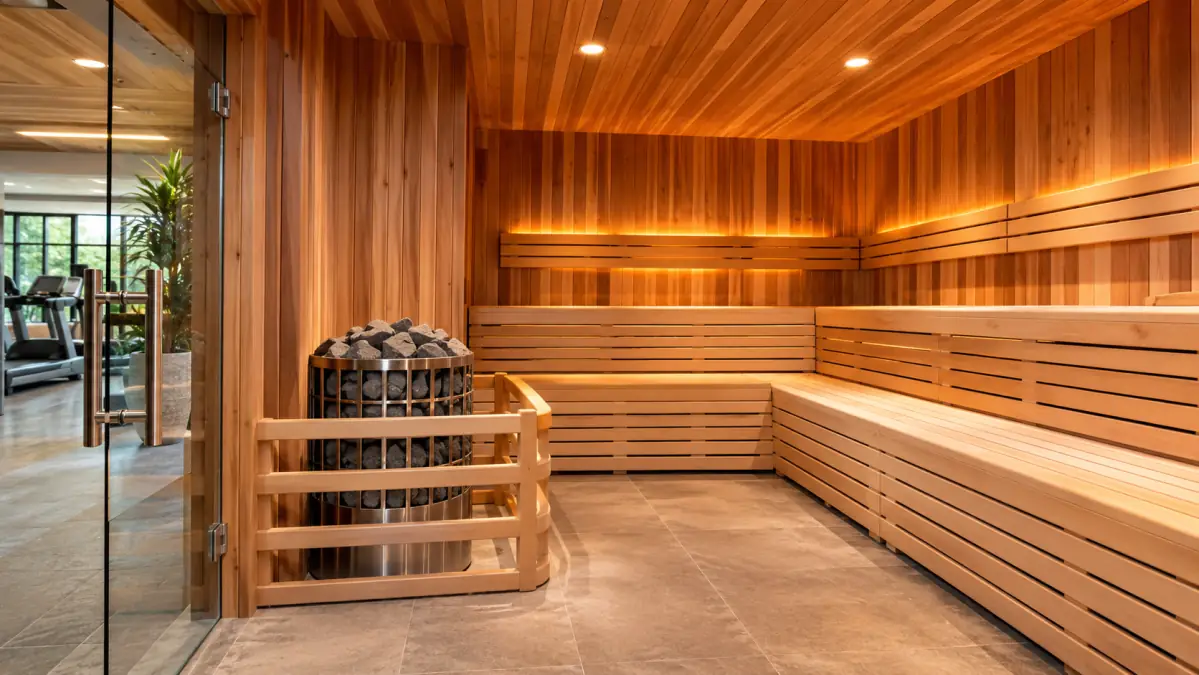
A supplier may sell a complete prefabricated room, components for a custom-built room, or a manufactured outdoor unit. Even if the footprint appears identical, the scope can differ: benches, glazing, control panels, heater stones, lighting, doors, guarding and shipping may be included, optional or omitted.
Request an itemized schedule of what arrives on site.
Prefabricated package versus custom room
A prefabricated room can simplify product specifications and assembly, but it still has to fit the real space. Check ceiling height, door maneuvering clearance, deliveries through existing corridors, floor conditions and whether the facility’s utility services are suitable.
A custom-built room offers more layout flexibility but introduces coordination among the sauna specialist, architect or contractor, electrical trade and building operator.
Do not assume a residential product is appropriate because its manufacturer calls it a six-person sauna. Check the intended public or commercial use, permitted hours, ventilation conditions, serviceability and warranty in writing.
Capacity is a planning input, not proof of suitability.
Heaters, controls and serviceable components
Commercial operation may involve frequent door opening, longer business hours and many guests using the room. Those are reasons to inspect equipment duty specifications rather than choosing only by rated power.
For example, Harvia describes its Qube Pro series as designed for large commercial saunas and continuous professional operation; that claim applies to the manufacturer’s specified models, not to all sauna heaters.
A useful heater quotation identifies the exact model, its appropriate room-volume range, compatible controls, access for replacement parts and the installation manual. It also identifies what the seller supplies versus what an electrician must obtain and install.
Our sauna heater buying guide explains heater selection, while the model-specific manual remains controlling for technical requirements.
Commercial Sauna Installation Costs and Hidden Expenses
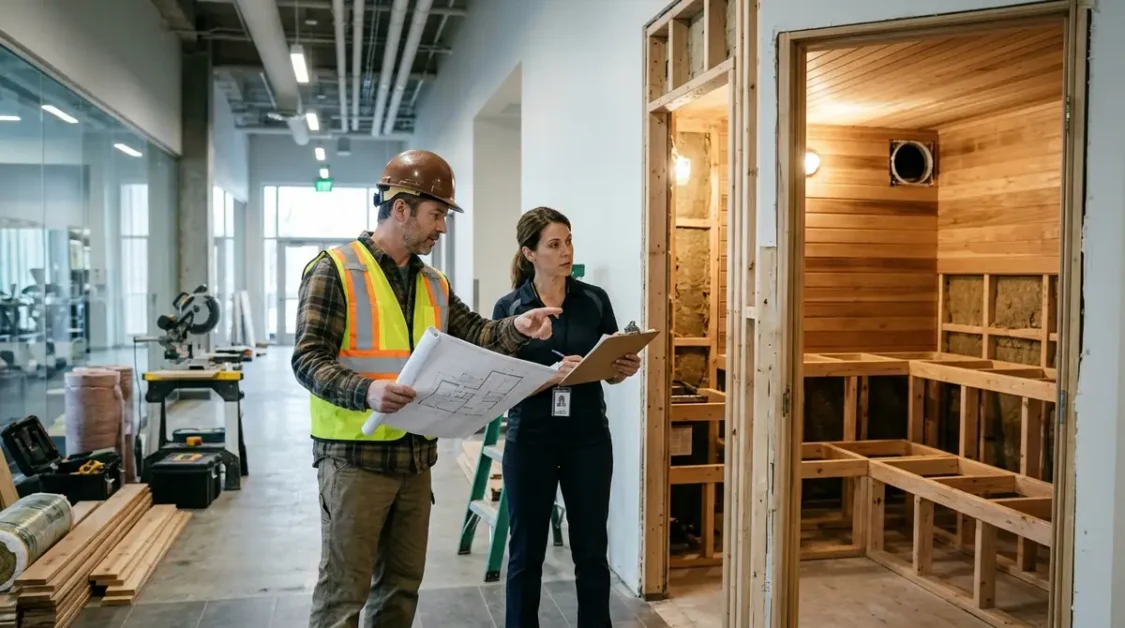
The building around the sauna often drives the difference between the advertised equipment price and the owner’s final budget. A vacant, planned-out room with confirmed power and ventilation can be a different undertaking from a retrofit in a busy hotel where delivery must happen after hours and existing systems need alteration.
Electrical supply and qualified installation
Request the manufacturer’s actual electrical requirements for the selected heater and controls, then have the facility’s qualified electrical professional evaluate the service, distribution, wiring route, protection and local requirements. Avoid extrapolating a breaker size from another sauna’s advertised kilowatt rating.
More than one heater, special controls, or a long cable route may change the scope. A written proposal should identify whether distribution upgrades and commissioning are included.
Ventilation, moisture and surrounding construction
The room designer must coordinate air movement, surfaces and any moisture management with the manufacturer and facility plan. A proposal for a new enclosure may include framing, insulation, finish work and vapor-control details; a retrofit may require demolition and repairs.
Confirm who evaluates the existing space and who accepts responsibility for ventilation design. An equipment quote that says “ventilation by owner” leaves a real cost line unresolved.
Floor, foundation, delivery and access
Indoor projects should confirm floor condition, cleanability, wet-area details and any drainage requirements. Outdoor projects may add foundation, grading, pathways, weather protection and power routing.
Before ordering, confirm packaged dimensions and weight, hallway and doorway access, freight handling, unloading equipment, stairs and the site delivery schedule. These are easy to overlook because they may never appear in a sauna product listing.
Permits, accessibility and inspections
Commercial venues should review building, fire, electrical, health and accessibility responsibilities with the authorities and licensed professionals who govern the project. The US Access Board’s sauna and steam-room guidance describes accessibility provisions for benches, turning space, doors and operable controls when applicable.
It is not a substitute for a jurisdiction-specific compliance review. Ask who prepares drawings, applies for permits, schedules inspections and fixes any failed inspection items.
| Cost category | What to request from the team | Common quote gap |
|---|---|---|
| Electrical | Selected equipment schedule and licensed electrical proposal | Panel/service changes, controls or final testing excluded |
| Ventilation | Design responsibility, ducts/vents, inspection scope | Only sauna room supplied; building air handling omitted |
| Room / foundation | Site condition assessment and construction scope | Demolition, floor, drainage or structural work unpriced |
| Accessibility | Applicable design review and plan details | Door, bench, route and clear-space changes unpriced |
| Delivery / commissioning | Freight terms, unloading, setup and acceptance test | Remote delivery or contractor coordination omitted |
Monthly and Annual Commercial Sauna Running Costs
The ongoing budget belongs in the purchase decision. Electricity is one part, but cleaning, inspections, replaceable components, repairs and unavailable booking time can affect the real business cost.
None of those should be represented as a universal per-month amount without a documented operating pattern.
Estimate heater electricity rather than guessing from the label
An electric heater’s kilowatt rating describes a power level, not a measured monthly electricity bill. To build a planning estimate, separate warm-up from holding time.
For each period, multiply rated heater power by hours and an assumed average fraction of full power; then multiply by the operating days and electricity tariff. Confirm whether multiple heaters share operation, whether other equipment uses power and whether your tariff includes demand or time-of-use charges.
Planning formula: monthly heater kWh = heater kW × [(warm-up hours/day × warm-up duty fraction) + (holding hours/day × holding duty fraction)] × operating days/month. Estimated energy charge = monthly kWh × local $/kWh.
Add relevant fixed charges and demand charges separately. A duty fraction is an explicit assumption until supported by logged operation or a meter, not a manufacturer’s guarantee.
For context, the US Energy Information Administration reported a national average commercial electricity price of 14.47 cents per kWh in August 2026. That is a historical national average, not a business’s current contracted rate or complete utility bill.
Location and billing structure can materially change the result.
A transparent example, not an observed operating cost
Suppose, purely for illustration, that a hypothetical 12-kW heater warms for one hour at an average 90% of rated power, then holds for six hours at an assumed 45%. At 26 operating days, the estimate is 1,123.2 kWh per month.
Applying the August 2026 national commercial average of $0.1447/kWh gives about $162.53 for the energy component, before demand charges, other equipment, cleaning, taxes, repairs or any rate variation.
Changing any of those assumptions changes the result. This is not a promised cost for a 12-kW installation.
Budget for recurring work and disruption
- Cleaning: Include labor, approved cleaning products, textiles and the time required between operating periods.
- Maintenance: Budget inspections, heater stones or other consumables, elements and controls as specified by the supplier.
- Warranty and service: Read commercial-use exclusions and identify local repair coverage, parts availability and support response times.
- Business impact: If a broken heater closes a bookable amenity, note the risk without pretending there is a universal dollar value for lost revenue.
The existing sauna running-cost calculator explains the underlying electricity arithmetic. The worksheet in this article adds commercial installation expenses, operating assumptions and supplier comparisons.
How Budgets Differ for Gyms, Hotels and Wellness Studios
Two businesses buying similar sauna rooms can arrive at different ownership costs. Their operating hours, cleaning standards, staffing, surroundings, guest patterns and access requirements may differ.
The useful comparison is the cost drivers, not an unsupported claim that one industry always pays a fixed percentage more.
| Facility | Questions that affect the estimate | What to verify first |
|---|---|---|
| Gym / fitness club | Extended hours, repeated guest entry, cleaning shifts, wear and tear | Commercial equipment approval, duty pattern, service access |
| Hotel / resort | Variable demand, guest access, existing spa facilities, renovation windows | Construction disruption, accessibility and approvals |
| Recovery / booking studio | Reserved sessions, turnaround time, downtime sensitivity | Session schedule, staffing, control system, warranty response |
| Outdoor commercial venue | Weather exposure, site access, utilities, paths and foundations | Base, electrical route, climate suitability, permits |
Before you select a configuration, write down the actual operating task: daily open hours, intended number of users, location, room volume, cleaning and maintenance access, and who will supervise the facility. A specification that matches those constraints makes contractor proposals more comparable.
Commercial Sauna Budget Worksheet: Build a Comparable Quote
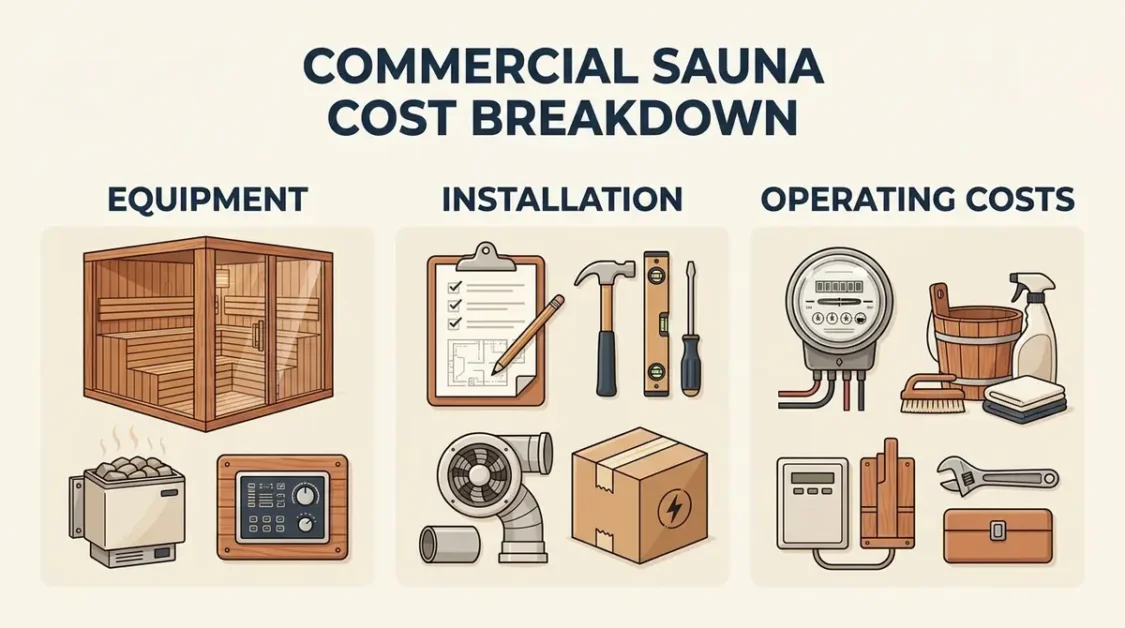
Use a worksheet with one line per major cost. For each supplier, record an amount or an explicit status: included, separately priced, excluded or not applicable.
A blank cell means the supplier has not clarified the item. Entering zero for an unknown cost creates an artificially low total.
| Capital line item | Amount / status to record | Verification needed |
|---|---|---|
| Room and benches | Supplier quote or explicitly included | Model, dimensions, capacity, finishes |
| Heater and controls | Separate or included cost | Commercial use, power, matching components |
| Electrical and ventilation | Qualified-trade quotation | Site constraints and responsibility |
| Room preparation and access | Contractor scope | Floor, doors, structure, delivery route |
| Permits and commissioning | Written allowance or formal quote | Approvals, acceptance testing |
| Tax, contingency and other fees | Explicit basis | What remains uncertain |
Use this five-step budget workflow
- Record site and operating requirements before requesting prices. Keep the description identical across suppliers.
- Get equipment and professional-installation amounts as separate named items; record what each vendor excludes.
- Enter monthly operating assumptions: rated heater kW, hours, duty-cycle assumptions, days open, actual utility tariff and non-energy expenses.
- Compare complete project subtotals only after missing lines have been reconciled. Use a contingency based on your project team’s uncertainty review, not an invented site-wide rule.
- Save dated proposals and source documents. Recheck volatile prices and specifications immediately before approval.
Download the free commercial sauna budget worksheet (Excel, .xlsx) to enter capital spending, monthly energy and operating expenses, supplier quotations and source notes. Its worked example is hypothetical, not measured energy use or an actual contractor quote.
The checklist above also works without downloading anything. Verify every project assumption and quote with the relevant professionals before committing funds.
How to Reduce Project Cost Without Cutting Safety
The strongest savings can come from defining the project early, before construction and orders lock in the wrong assumptions. A design that fits the real room and uses verified existing infrastructure may avoid some rework.
That does not justify skipping professional electrical assessment, altering safety clearances, or buying an unsuitable heater.
- Standardize the bid: Send every supplier the same room dimensions, operating hours, finish expectations and responsibility list.
- Check utilities early: Confirm with qualified trades what the building can support before selecting an equipment package.
- Separate essential and optional finishes: Aesthetic upgrades should be visible line items, not hidden in a bundled quote.
- Compare serviceability: Replacement parts, accessible components and a clear commercial warranty may be worth more than a small headline price difference.
- Require written exclusions: A cheap bid with unresolved permits, deliveries or commissioning is not yet comparable.
When choosing contractors, our sauna installer hiring checklist covers written scope, trade qualifications, references and change-order responsibilities.
Commercial Sauna Budget Mistakes That Lead to Surprises
Treating purchase price as total project cost
A package can exclude nearly every item needed to get the room operating. List the installed scope before comparing totals; otherwise you risk choosing the bid with the most exclusions.
Ordering before checking the building
A fixed room footprint or advertised heater may not fit an existing doorway, electrical distribution system, finished floor or ventilation design. Have the site and selected technical documentation reviewed before a nonrefundable order.
Assuming commercial approval from seat count
Guest capacity is not an equipment duty rating. Ask the vendor for commercial-use documentation and warranty wording, rather than inferring suitability from the size of a consumer sauna.
Using the national electric rate as the final bill
Average $/kWh data can provide context but does not capture a local business tariff’s structure. Time-of-use periods, demand charges, other loads and actual heater cycling may matter.
A meter and current utility tariff are stronger evidence than a rounded online estimate.
Leaving operations and maintenance to later
Decide how the room will be cleaned, supervised, inspected and repaired. Check whether maintenance access is practical, who can supply the heater parts and how long replacement service may take.
A commercial sauna should be evaluated as an operating facility, not just as a purchase.
Frequently Asked Questions
How much does a commercial sauna cost to install?
The total depends on the equipment package, building conditions, qualified-trade work and approvals. Published package and custom-project prices are useful context, but a complete local quote is needed for an actual budget.
How much electricity does a gym sauna use?
Estimate it from rated heater power, warm-up time, holding period, actual cycling and opening days. Check the result against the facility’s tariff and any measured use; kW is not the same as monthly kWh.
Can a residential sauna be used in a commercial gym?
Only if the manufacturer permits the intended use and the installed system meets applicable facility and local requirements. Check commercial warranty exclusions and duty specifications before purchasing.
Does a commercial sauna always need three-phase power?
No single electrical arrangement applies to every commercial product or site. The chosen heater, market, building supply and applicable rules determine the design; the manufacturer’s documents and a qualified electrician are the correct starting points.
What ongoing costs should be budgeted besides electricity?
Cleaning labor, supplies, scheduled service, replacement components, insurance allocation and any downtime allowance belong in the ownership model. Use your actual quotes and operating plan rather than generic industry percentages.
What should a commercial sauna supplier quote include?
At minimum, request exact models, included room components, rated use, controls, delivery, site and trade work, excluded items, permits, commissioning, schedule, payment terms, warranty and service contact.
Build the Full Budget Before Ordering
A commercial sauna budget becomes useful when the supplier’s package price, the building contractor’s scope and the operating assumptions are visible together. Gather the actual equipment documentation, have the site checked by the appropriate professionals, and use the same scope list to compare proposals.
Do not approve an apparent bargain until the unexplained items have been priced or explicitly assigned.