Does Homeowners Insurance Cover a Hot Tub? Damage & Liability

You added a hot tub to your backyard, and now you’re checking your homeowners policy. Is the spa insured if a storm damages it? What if a guest slips near it? And would your insurer pay for a failed heater?
Homeowners insurance may cover a hot tub, but it isn’t automatic or unlimited. The answer depends on how the spa is installed, which section of your policy applies, what caused the damage, your coverage limits, and any exclusions. Guest injuries are a separate liability question.
Start with the quick coverage table below, then use the eight-question insurance worksheet to get answers from your own insurer in writing. The examples describe common U.S. homeowners policies, not a promise that your particular spa is insured.
Does Homeowners Insurance Cover a Hot Tub? The Short Answer
Sometimes. Homeowners insurance generally distinguishes dwelling or attached structures, other structures, personal property, and personal liability. The National Association of Insurance Commissioners (NAIC) explains these coverage categories, while NJM’s pool and hot tub insurance guide shows how installation and policy type can change the result.
| What happened? | Where coverage might apply | What decides the answer |
|---|---|---|
| A covered storm damages a permanently installed outdoor spa | Other structures, or another property section if attached | Installation, cause of loss, exclusions, limit and deductible |
| A portable or inflatable spa is stolen or damaged | Possibly personal property | Named-peril rules, property definitions and exclusions |
| A guest is injured and holds the homeowner responsible | Potentially personal liability; medical payments may be separate | Circumstances, legal responsibility, exclusions and liability limits |
| A pump wears out or the heater stops working | Often not a covered homeowners loss | Mechanical-breakdown exclusion; look at warranty or service contract |
| Floodwater damages an outdoor hot tub | Usually excluded from standard homeowners insurance | Flood exclusion and the separate flood policy’s own terms |
The first step isn’t asking whether your brand is covered. Tell the insurer whether the spa is attached, permanently installed, freestanding, or portable. Then ask which specific policy section and peril would apply.
Built-In, Freestanding, and Inflatable Spas: Why Installation Matters
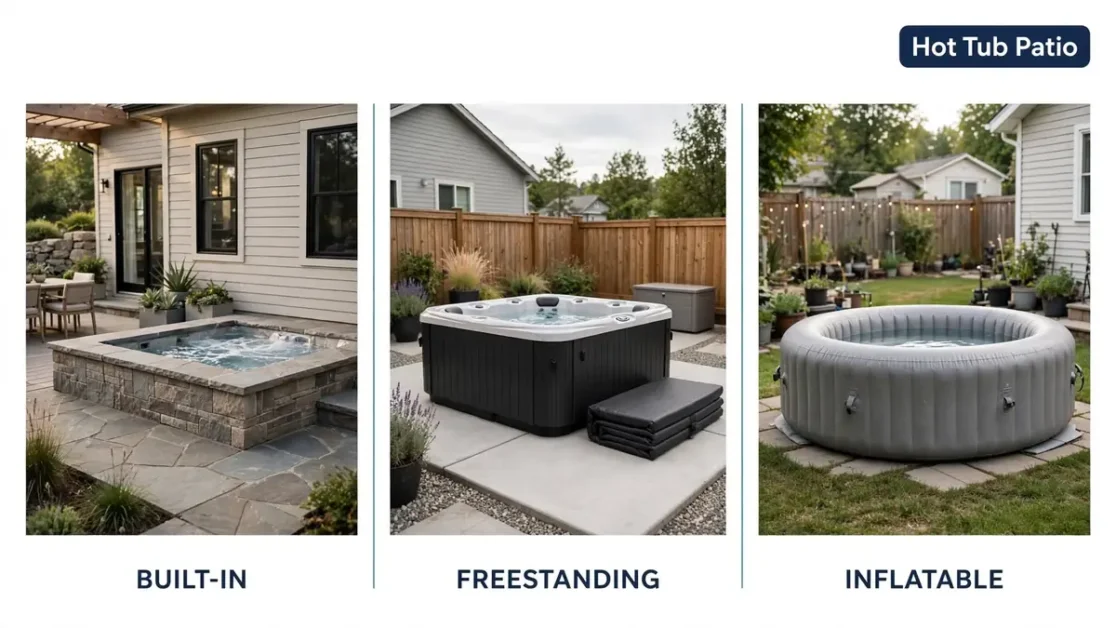
An identical hot tub can be treated differently depending on how it is installed. Even if two owners paid the same amount, the policy category and settlement rules may not match.
| Spa setup | Possible policy classification | What to confirm |
|---|---|---|
| Built into a house or attached structure | Could fall under dwelling coverage | Is it legally and physically part of an insured attached structure? |
| Permanently installed, detached backyard hot tub | Often considered other structures | Does the policy define it as a covered structure? |
| Freestanding hot tub on a patio or deck | May be treated as other structures or property, depending on permanence | Does its foundation or connection make it permanent under this policy? |
| Inflatable or removable portable hot tub | May fall under personal property | Which causes of loss are covered for removable outdoor equipment? |
| Hot tub in a vacation rental or business setting | May require different insurance or endorsements | Does rental/business use change eligibility or liability coverage? |
NJM’s published explanation treats permanently installed hot tubs as other structures for its discussed policies, while portable pools can fall under personal property. That is a helpful example, not a nationwide classification rule.
Before planning a new spa, review our hot tub installation guide so you can document the location, base, and work done.
What do HO-3 and HO-5 mean here?
In a commonly used HO-3 policy, dwelling and other-structure coverage often applies to causes of loss unless specifically excluded, while personal property may be covered only for named causes such as fire or theft. Some HO-5 policies extend broader cause-of-loss coverage to personal property as well, subject to exclusions.
A broader form is not the same as coverage for everything. A hot tub can still be subject to exclusions for wear, flood, or maintenance-related loss. The policy language and state-specific endorsements decide.
Which Kinds of Hot Tub Damage Might Homeowners Insurance Cover?
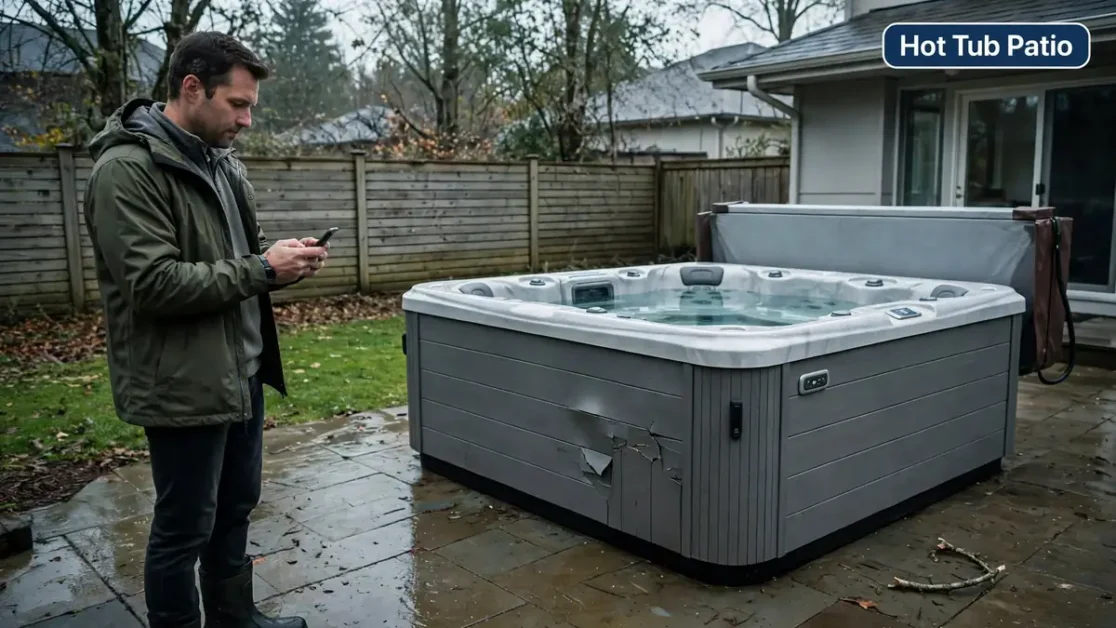
A claim should be evaluated by both the cause of loss and the property section. The following examples are starting points for a conversation with the insurer, not claims decisions.
| Loss scenario | Typical insurance question | Practical first step |
|---|---|---|
| Lightning or a covered fire damages the spa | Is this cause of loss covered for this spa classification? | Document the scene and contact the insurer |
| Wind or hail damages a cabinet or cover | Are the spa, cover and accessories covered under the same section? | Photograph damage before safe cleanup |
| Theft or vandalism | Is the item covered as personal property or a structure? | Record the police report if one is required |
| Falling tree branch strikes a detached spa | Was this a covered falling-object event under this policy? | Photograph the branch and damage; avoid unsafe handling |
| Motor failure without an outside event | Is ordinary mechanical breakdown excluded? | Check equipment warranty before paying |
| A slow leak or years of corrosion | Does wear, seepage or inadequate maintenance apply? | Review maintenance and service history |
The California Department of Insurance’s consumer guide explains the distinction between common covered causes of loss and excluded events such as gradual seepage, flood, and wear. Do not assume an outdoor cover or portable accessory receives the same treatment as the spa shell.
Does Homeowners Insurance Cover Hot Tub Freeze Damage?
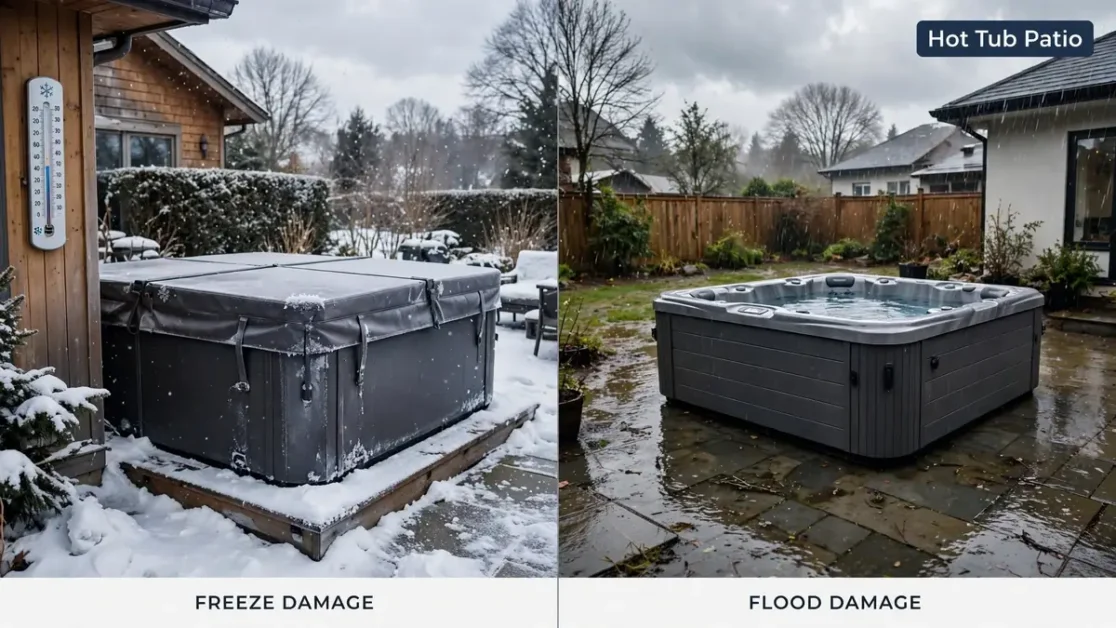
It depends on the exact freeze and water-damage clauses. Some policies or endorsements address frozen hot tub piping differently from frozen household plumbing. A power outage or unexpected cold snap does not, by itself, guarantee payment.
For example, NJM explains that freezing exclusions for pools do not necessarily apply in exactly the same way to hot tubs, which may operate year-round. Meanwhile, the NAIC’s burst-pipe guidance says policies often require reasonable precautions to keep plumbing from freezing, particularly in unoccupied homes.
Two different losses need two different questions
- The spa itself freezes and cracks. Ask whether the insurer covers damage to the spa’s pipes, shell, heater, and equipment when freezing is the direct cause.
- Water escapes and damages the house. Ask separately whether the resulting indoor water damage might be covered, even if replacing the failed spa component isn’t. Coverage can differ for the source of the leak and the damage it caused.
Do not drain or open electrical components in unsafe conditions solely to document a claim. Protect the spa according to the owner’s manual and follow our winter hot tub care and freeze-protection guide to plan before temperatures fall.
When speaking with the insurer, specify whether the home was occupied, whether the spa was operating, whether power failed, and what steps were taken. Keep power-outage notices, maintenance records, or service invoices if relevant.
Does Flood Insurance Cover an Outdoor Hot Tub?
Do not assume it does. Standard U.S. homeowners policies generally exclude flooding. The separate National Flood Insurance Program (NFIP) also excludes outdoor hot tubs and spas that are not bathroom fixtures, along with swimming pools and their equipment.
The federal NFIP coverage explanation specifically lists hot tubs among outdoor property that its standard building and contents coverage does not protect.
A separate private flood policy could have different terms, but coverage must be confirmed in writing. Buying an NFIP policy for the house does not automatically insure the backyard spa.
Ask the agent which policy, if any, would cover flood damage to the spa itself, its pumps and controls, and a surrounding deck. Avoid relying on a general statement that “the property has flood insurance.”
What If Someone Gets Hurt in Your Hot Tub?
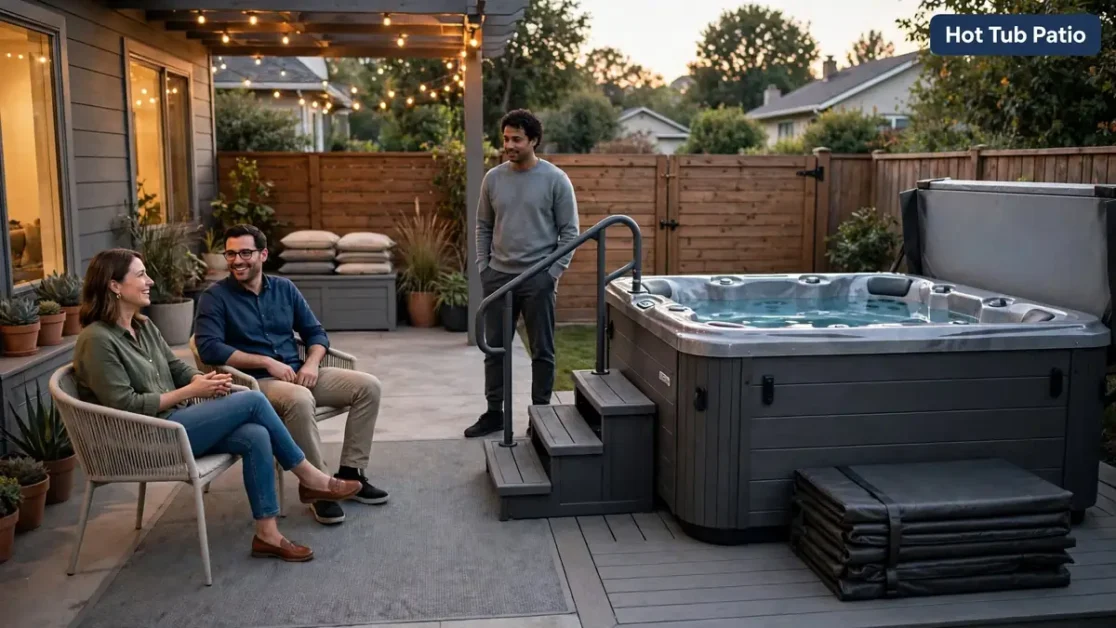
Damage to the spa is one issue. A guest injury is another. Standard homeowners policies often include personal liability protection and a separate medical-payments-to-others section, but coverage depends on the incident and policy wording.
| Coverage | May respond to | Key limitation |
|---|---|---|
| Personal liability | A covered claim alleging the homeowner was legally responsible for another person’s injury or property damage | Exclusions and liability limits still apply |
| Medical payments to others | Some minor medical expenses for qualifying non-household visitors, sometimes without determining fault | Separate eligibility rules and generally smaller limits |
| Personal umbrella liability | Additional covered liability above underlying limits | Requires its own policy, conditions and exclusions |
The NAIC homeowner coverage overview describes liability and medical payments as separate categories.
The Insurance Information Institute’s umbrella explanation notes that an umbrella can add liability protection after applicable underlying coverage is exhausted.
Situations worth discussing before inviting guests
A wet step, an unlocked cover, a child accessing the spa without supervision, or a hot tub used by paying guests can raise different questions.
A claim is not automatically covered just because the accident occurred on your property; the liability provisions, circumstances and exclusions matter.
Ask what barriers or locking-cover features are required by the insurer, and check local rules. Our hot tub safety and proper usage guide covers general precautions, but an insurer’s underwriting requirements must be confirmed independently.
Liability insurance does not replace attentive supervision. Never assume a locking cover or fence alone makes a spa safe for children.
Do You Have to Tell Your Insurance Company About a Hot Tub?
Contact your insurer before installation or as soon as you realize the spa was never disclosed. Do not guess whether notice is mandatory. Ask what information is required under your policy and whether any coverage change must be endorsed.
The NAIC specifically recommends discussing new pools and hot tubs with an insurance professional, including questions about liability, fences, gates, covers and premium changes.
- Explain the hot tub type, location and installation method.
- Provide the make/model and approximate replacement cost if requested.
- Share whether it is permanently installed, wired, enclosed, or used by paying guests.
- Ask whether any inspection, fence, gate, locking cover, permit or other condition applies.
- Request written confirmation of the coverage section, limits, exclusions and any premium change.
The need for a permit or inspection varies by location and installation. See our hot tub permit overview to organize the right local questions before construction.
Will a Hot Tub Increase Homeowners Insurance Costs?
It might, but there is no universal premium increase that applies to every hot tub owner. Some insurers may evaluate the spa as added property value, a liability exposure, an underwriting concern, or a reason to require safety measures.
The result may be no quoted change, a higher premium, additional conditions, greater liability limits, an endorsement, or a refusal to insure the risk under a particular form. State, carrier, claims history and property details matter.
Request two written quotes if available: your current policy with the spa disclosed, and a version with the additional liability or property protection you are considering. Compare deductibles, valuation rules, exclusions and limits, not just the final premium.
If you are still deciding what to buy, our hot tub buying guide can help you separate purchase costs from installation and long-term ownership costs.
How to Check Your Policy Before a Loss
You don’t have to wait for a cracked shell or guest injury to find the right answers. Follow a short documentation process while everything is working.
- Find the declarations page. Note the insurer, policy number, effective dates, property limits, liability limit and deductible.
- Locate the complete contract. Look for Coverage A (dwelling), B (other structures), C (personal property), E (personal liability), F (medical payments), plus endorsements and exclusions. Labels vary by policy.
- Describe the spa accurately. Use photos showing the deck or slab, whether the spa is attached, and where pumps and controls are housed.
- Ask about exact scenarios. A hailstorm, pump breakdown, frozen pipe, flooded backyard and guest injury are not the same type of claim.
- Keep the response in writing. Save the email alongside the declarations page, any endorsement and the installation records.
If a loss is already in progress, follow insurer reporting instructions and take reasonable, safe steps to prevent further damage. Photograph evidence when possible, avoid unsafe electrical work, and keep receipts. Do not delay a required claim notice while trying to determine coverage yourself.
Hot Tub Warranty vs. Homeowners Insurance
These products answer different questions. A homeowner might have both and still find that neither covers a particular loss.
| Question | Manufacturer warranty | Homeowners insurance |
|---|---|---|
| What is the main purpose? | Covered product defects during stated warranty periods | Covered property damage or liability caused by insured events |
| Pump fails from a manufacturing defect | Possibly, under equipment terms | Often not, if it is mechanical breakdown alone |
| Storm destroys the spa cabinet | Often outside a defect warranty | Possibly, if cause and property are insured |
| Guest claims an injury | Not a typical product repair claim | May involve personal liability, subject to policy terms |
| Where do you start? | Model-specific manufacturer or dealer warranty | Insurer, policy declarations and endorsements |
For questions about equipment defect periods, transfers and repair claims, use our hot tub warranty coverage and claims guide. This insurance article focuses on damage and liability risks under a separate contract.
Tailored Action Plan: Match the Questions to Your Hot Tub
| Your situation | Do this first | Confirm in writing |
|---|---|---|
| Planning a built-in hot tub | Send the site plan to your insurer before work begins | Classification, limit, permit and safety conditions |
| Already own a freestanding spa | Send photos and a model description | Other-structures or property treatment, exclusions, deductible |
| Own an inflatable hot tub | Confirm whether it counts as personal property | Covered causes of loss, outdoor-use limitations and value basis |
| Host family or friends | Review liability, medical payments and child-access controls | Limits, cover requirements, guest-injury provisions |
| Rent your home or host paying guests | Disclose the use and ask about commercial or home-sharing restrictions | Whether a different policy or endorsement is required |
| Live where freezing or flooding is a concern | Ask the insurer about both events separately | Freeze conditions, flood exclusion and any separate coverage |
The easiest win is to get a written answer before a repair bill or a claim deadline makes the conversation urgent.
Original Worksheet: Eight Questions for Your Homeowners Insurer
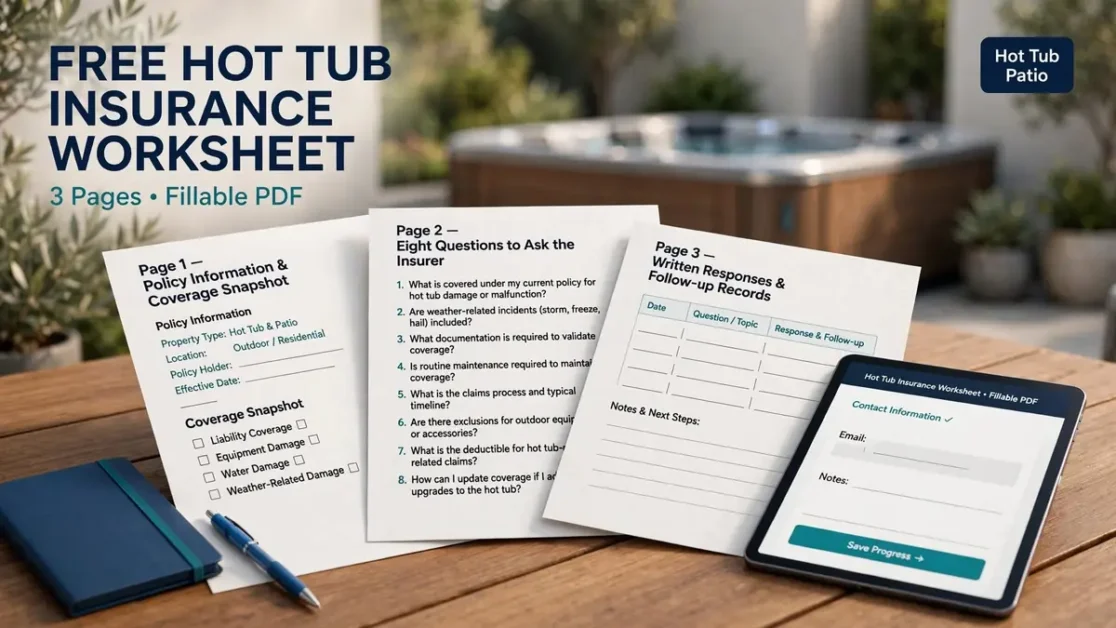
Use this worksheet with your own declarations page and a photograph of the installed spa. It records what the insurer actually tells you, rather than giving generic “yes/no” answers that might not apply.
| Ask your insurer | What to write down |
|---|---|
| 1. Is this exact hot tub treated as dwelling, other structures, personal property, or an endorsement? | Coverage section and policy clause |
| 2. Which events cover damage to the spa, its pump, cover, heater and controls? | Named causes, covered parts and exclusions |
| 3. Does freezing damage count, including a power outage or a vacant home? | Conditions, mitigation duties and exceptions |
| 4. Does any policy cover floodwater damage to the outdoor spa? | Policy name and written exception, if any |
| 5. What protection applies if a guest gets hurt? | Liability and medical-payments limits and exclusions |
| 6. Are a locking cover, fence, gate, permit or inspection required? | Exact safety conditions and deadline to comply |
| 7. What are the deductible, claim valuation and premium change? | Dollar limits, ACV/RC basis and new premium |
| 8. Does rental use change coverage, and is an umbrella policy appropriate? | Business/home-sharing restrictions and umbrella terms |
Insurance response record: Insurer __________ | Policy number __________ | Spa type __________ | Agent __________ | Date __________ | Endorsement/form number __________ | Written confirmation saved: Yes / No
Keep a copy of this table with the policy, your spa’s purchase receipt, installation photos and any permit or inspection records. When the insurer gives a condition or exclusion, ask for the exact wording.
Free downloadable companion: Use our three-page fillable Hot Tub Insurance Coverage Worksheet (PDF) to record your policy snapshot, the eight insurer questions, supporting documents and a dated contact log. Save the insurer’s written answers with your insurance records. This worksheet is for organizing information, not confirming coverage.
If you need a basic household guest policy, our hot tub rules for guests offers a separate set of usage expectations. Guest rules help with safe use but do not determine insurance coverage.
Common Mistakes That Leave Owners Guessing
- Assuming a covered house means a covered hot tub. Ask whether the spa falls under the property’s covered structures or possessions.
- Treating a product breakdown as storm damage. The cause of loss matters. A failed heater and a lightning-damaged heater are different questions.
- Buying flood insurance and assuming it covers the outdoor spa. Standard NFIP terms specifically exclude outdoor hot tubs that are not bathroom fixtures.
- Forgetting liability limits. Property coverage for the spa says nothing by itself about a guest-injury claim.
- Relying on a verbal answer. Request the policy form, limit, condition or endorsement in writing.
- Leaving rental use out of the conversation. Short-term rentals may require different coverage than a personally used home.
Frequently Asked Questions About Hot Tub Homeowners Insurance
Are inflatable hot tubs covered by homeowners insurance?
They may be treated as personal property, but this depends on the insurer and policy. Ask which events are insured for portable outdoor equipment and what deductible and limits apply.
Does homeowners insurance cover a hot tub damaged by a storm?
Potentially, if the storm is a covered cause of loss and the policy covers the spa in its particular location and configuration. Check the cover, cabinet, pump and accessories separately where relevant.
Does it cover a hot tub heater or pump that stops working?
Mechanical breakdown and wear are commonly excluded. If a covered event such as a fire caused the failure, the insurer may assess it differently. Check the manufacturer’s equipment warranty as well.
Will homeowners insurance pay for a hot tub leaking into my house?
The cost of the failed spa part and resulting house damage can be treated differently. Coverage may depend on whether the release was sudden and accidental or gradual, along with your policy’s water-damage and maintenance exclusions.
Does insurance cover a guest injury in a hot tub?
A covered liability or medical-payments provision may apply, but that is not automatic. Who was injured, what happened, legal responsibility, and policy exclusions matter.
Does homeowners insurance cover a hot tub on a deck?
Maybe. Ask how the insurer classifies both the spa and deck, and how their limits and damage exclusions work. A freestanding spa on a deck is not automatically part of the dwelling.
Does flood insurance cover an outdoor hot tub?
The standard National Flood Insurance Program generally excludes hot tubs that are not bathroom fixtures. A separate private flood policy may have different terms; verify rather than assuming coverage.
Must I tell my insurer about a new hot tub?
You should contact the insurer before installation or immediately if the spa was never disclosed. Ask what notice your policy requires and whether there are safety or underwriting conditions.
Does a locking cover guarantee insurance coverage?
No. A cover may satisfy one insurer requirement, but it does not eliminate all risks or override limits and exclusions. Follow local safety requirements and supervise children closely.
Get the Coverage Answer Before You Need a Claim
A hot tub can be insured against some property losses and still have important gaps for breakdowns, freezing, flooding or liability. The safest financial planning step is to get the insurer to classify your exact spa and answer specific incident questions in writing.
Use the eight-question worksheet with your policy declarations. Save the reply, note any additional costs or required safety measures, and revisit the discussion whenever the installation or how you use the spa changes.
Sources reviewed November 13, 2026: NAIC homeowners insurance coverage types; NAIC hot tub and backyard attraction guidance; NJM coverage for pools and hot tubs; NAIC frozen-pipe water-damage guidance; NFIP coverage exclusions; Insurance Information Institute umbrella liability guidance; California insurance consumer guide. This article provides general U.S. insurance education, not a policy interpretation, coverage determination or legal advice. Check your own policy and applicable state rules.