Hot tub not heating, jets barely moving, breaker tripping, or an unfamiliar error code on the display? Start with the symptom, not a replacement part. A low water level, clogged filter, control setting, or power interruption can resemble a larger failure.
Use the symptom chart below to choose a safe first check and recognize when to stop. Keep the owner’s manual handy because control messages and reset procedures vary by manufacturer. If a breaker trips again, there is a burning smell, or the spa overheats, stay out of the water and arrange qualified service.
Once the problem is fixed, a consistent hot tub water-maintenance routine can help reduce avoidable water and filter issues.
Hot Tub Troubleshooting Quick Symptom Finder
Match the symptom to a safe first check. If a stop condition applies, do not keep restarting or operating the spa.
| Problem | First safe check | Possible cause | Stop / Call a professional when |
|---|---|---|---|
| No power | Check display lock and accessible breaker or GFCI status | Power interruption or lock mode | Protection trips again or damage is visible |
| Not heating | Check set temperature, heat mode, water level, and filter | Flow restriction, setting, or heating fault | Heating remains faulty after manual-approved checks |
| Heats slowly | Check the cover, operating mode, and set temperature | Heat loss, lower-power mode, or reduced circulation | A fault code appears or performance remains abnormal |
| Weak jets | Check water level and user-accessible jet controls | Low water, closed control, or dirty filter | Pump hums, grinds, or stops circulating |
| Unusual noise | Record sound without opening the cabinet | Air or mechanical trouble | Grinding, burning smell, leak, or repeated shutdown |
| Visible leak | Note water-level change and visible wet area | Seal, plumbing, or shell leak | Water reaches electrical areas or leaking persists |
| Cloudy or smelly water | Test sanitizer and pH; check filter condition | Water chemistry or filtration | Treatment is outside safe conditions; do not soak |
| White flakes | Review water test results and visible deposits | Scale or other deposits | Cause is uncertain or material returns |
| Error code | Photograph display and check the exact model manual | Model-specific flow, sensor, or temperature fault | Manual requires service or protective shutdown persists |
| Breaker or GFCI trip | Record when the trip happens; leave power off | Possible electrical fault | Any repeat trip; do not bypass or repeatedly reset |
Hot Spring’s manufacturer troubleshooting chart similarly distinguishes owner checks from problems that require service.
What Is the Best Way to Troubleshoot a Hot Tub?
The fastest way to troubleshoot a hot tub is to identify the main symptom first, such as no power, heating problems, weak jets, leaks, cloudy water, or an error code. Start with the simplest checks including the breaker, GFCI outlet, water level, filters, and control settings before assuming a major component has failed.
Many hot tub owners are surprised to discover that a dirty filter, low water level, or tripped breaker is responsible for what initially appears to be a costly repair.
Before You Start Troubleshooting
Taking a few simple precautions helps protect both you and your hot tub while making the diagnosis easier.
Keep Electrical Equipment Closed
Use external checks first: the display, error codes, water level, user-accessible filters, and normal controls. Do not open a control box or electrical panel, inspect wiring or fuses, disconnect pumps or heaters, or use a multimeter for beginner troubleshooting.
For a recurring breaker or GFCI trip, burning smell, wet electrical equipment, or visible damage, leave the spa off and contact a qualified electrician or spa service technician. Switching off a breaker does not make internal electrical testing an owner task.
Gather a Few Basic Tools
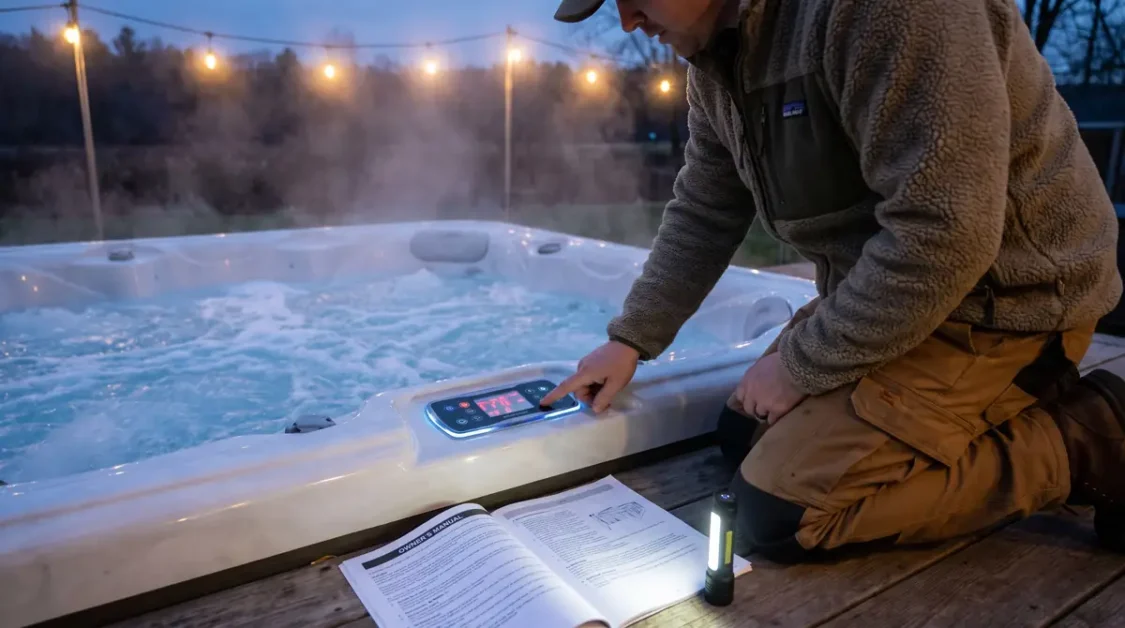
For external checks, have the owner’s manual, a flashlight, a towel, a water-test kit, and a phone to record error codes. You do not need electrical testing tools or cabinet-opening tools.
Start With the Simple Checks First
A common mistake many hot tub owners make is assuming the most expensive part has failed.
Instead, always check these items first:
- Is the breaker tripped?
- Is the GFCI reset?
- Is the water level above the highest jet?
- Are the filters dirty?
- Is the control panel showing an error code?
- Did the problem begin after draining or refilling the spa?
Working through these simple questions often solves the problem without replacing any parts.
Hot Tub Won’t Turn On
A hot tub that won’t power on is one of the most common service calls, but the cause is often much simpler than a failed control system.
Start with the easiest possibilities before assuming major electrical components have failed.
Check the Breaker and GFCI
From the normal accessible controls, note whether the breaker or GFCI tripped. Follow the owner’s manual if it permits a single reset and there is no sign of burning, moisture damage, or other danger. If it trips again, leave it off and arrange professional service; never bypass electrical protection.
See our hot tub GFCI keeps tripping guide for safe symptom logging.
Verify the Spa Has Power
Check for an area power outage, the visible display, and user-accessible disconnect indications. Look for obvious cord damage without touching damaged parts. Do not open disconnect boxes or inspect internal wiring; ask a licensed electrician or spa technician to check the supply.
Reset the Hot Tub
Record error codes first, then follow only the reset procedure for your exact model. Never keep resetting a breaker that trips, an overheat shutdown, or a persistent flow warning.
Check for Spa Lock or Child Lock
Some control panels include a safety lock that disables operation.
If the display lights up but none of the buttons respond:
- Check the owner’s manual.
- Look for a lock symbol.
- Follow the unlock procedure for your specific model.
Many owners mistake a locked control panel for an electrical failure.
Internal Fuses Are a Technician Check
A blank display or nonresponsive pump can involve an internal fuse, control system, power supply, or another fault. Owners should not open the control box or inspect or replace fuses. Share the model and symptoms with a qualified technician.
When the Control Board May Be the Problem
A blank display even when accessible power indications seem normal can have several causes, including a control board, transformer, or wiring issue. Have a technician test before replacing components.
Hot Tub Won’t Heat
Before approving heater replacement, compare symptoms in our hot tub heater repair and replacement guide.
If your hot tub powers on but the water never reaches the set temperature, the heating system may not actually be the problem.
Restricted flow can stop heating, but control settings, sensors, and heater failures can cause similar symptoms.
Check the Water Flow First
Modern heaters only operate when enough water flows through the heating chamber.
Reduced circulation often causes:
- Slow heating
- Heating that stops after several minutes
- Flow-related error codes
- Heater shutting off unexpectedly
Start by confirming the circulation pump is running normally.
Inspect the Filter
Dirty filters are one of the most common causes of heating complaints.
When filters become clogged:
- Water flow decreases.
- Pressure switches remain open.
- The heater shuts down to protect itself.
Clean and reinstall the filter according to the owner’s manual. Do not operate normally without a filter unless the manufacturer explicitly calls for a supervised diagnostic test.
If it does, clean or replace the filter before looking for more complicated problems.
Check the Water Level
Water should remain above the highest jet opening.
Low water allows air into the plumbing system, reducing circulation through the heater.
Signs include:
- Weak jet pressure
- Bubbling noises
- Heater cycling on and off
- Temperature rising very slowly
Adding water is often enough to restore normal circulation.
Look for an Air Lock
Heating problems frequently appear after draining and refilling the spa.
Air trapped inside the plumbing prevents proper circulation.
Common signs include:
- Pump running quietly but little water movement
- Weak or no jet pressure
- Heater not activating
- Gurgling sounds
After refilling, follow the model’s owner-accessible priming procedure. Do not loosen pump unions or open the equipment compartment as a beginner troubleshooting step.
Pressure Switch Problems
Most hot tubs use a pressure or flow switch to verify water movement before energizing the heater.
If this switch stays open, the heater remains off even though everything else appears to work normally.
Possible causes include:
- Dirty filters
- Weak circulation pump
- Air lock
- Faulty pressure switch
Flow-related error codes often point toward this area.
Thermostat or Temperature Sensor Problems
A faulty temperature sensor may incorrectly tell the control board that the water is already hot enough.
Possible symptoms include:
- Water never reaches the set temperature
- Display temperature doesn’t match actual water temperature
- Heater cycles inconsistently
Temperature sensors generally require testing with specialized equipment before replacement.
Heating Element Failure
Heating elements eventually wear out after years of use.
Signs of a failed heater include:
- Water remains cold despite proper circulation
- Breaker trips when heating starts
- Burn marks inside the heater housing
- No measurable temperature increase after extended operation
Replacing a heater element is usually straightforward for experienced technicians but should always be performed with power disconnected.
The CDC recommends checking disinfectant and pH in hot tubs. Avoid using water that has not been properly treated; follow your spa manual and chemical product labels.
Hot Tub Water Problems
Many hot tub issues that seem like equipment failures are actually caused by unbalanced water chemistry. Changes in sanitizer, pH, or calcium levels can affect water clarity, create odors, and even reduce heating efficiency.
If equipment seems to be operating normally, test water quality before assuming a hardware fault. For deeper help, follow our water-care troubleshooting guide.
Cloudy Water
Cloudy water is one of the most common problems hot tub owners face. It usually develops when sanitizer levels drop, filters become dirty, or pH moves outside the recommended range.
Common causes include:
- Low sanitizer
- Dirty filter
- High pH
- Heavy bather load
- Poor circulation
Try these steps:
- Test the water chemistry.
- Adjust sanitizer and pH as needed.
- Clean or rinse the filter.
- Shock the water if contaminants are high.
- Run the circulation pump for several hours.
If the water doesn’t clear after these steps, read our guide to fixing cloudy hot tub water for a complete troubleshooting process.
Green Water
Green water usually indicates algae growth or very low sanitizer levels. In some cases, metals such as copper can also discolor the water.
Possible causes include:
- Little or no sanitizer
- Algae growth
- Metals in the source water
- Poor filtration
To correct the problem:
- Shock the spa.
- Balance the water chemistry.
- Brush all interior surfaces.
- Clean the filter thoroughly.
- Drain and refill if the water remains green after treatment.
Brown Water
Brown or rusty-looking water often points to metals or organic debris rather than algae.
Possible causes include:
- Iron in well water
- Rust from aging components
- Dirt entering the spa
Start by testing your source water. If metals are present, use a metal sequestrant designed for hot tubs before adjusting other chemicals.
Foamy Water
Foam usually appears after lotions, sunscreen, body oils, or detergent residue enter the water.
Common sources include:
- Laundry detergent left in swimsuits
- Body oils
- Cosmetics
- Low sanitizer
Reduce foam by:
- Showering before soaking.
- Rinsing swimsuits with clean water only.
- Maintaining proper sanitizer levels.
- Shocking the spa after heavy use.
Persistent foam may indicate it’s time to drain and refill the water.
Bad Odors
A properly maintained hot tub should have very little odor.
Strong smells often indicate:
- Low sanitizer
- Biofilm inside plumbing
- Organic contamination
- Dirty filters
Shock the water, clean the filters, and inspect for biofilm if unpleasant odors continue.
White Flakes
White flakes floating in the water can resemble tissue paper but are often calcium scale breaking loose from plumbing or the heater.
Possible causes include:
- High calcium hardness
- Scale buildup
- Biofilm residue after line cleaning
Test calcium hardness before adding more chemicals. If scale continues forming, a drain and refill may be necessary.
Common Hot Tub Error Codes
Most modern hot tubs display error codes when the control system detects abnormal operating conditions. E02, E90, FLO, DR, and OH are not universal across brands and controllers. Use the exact model manual to interpret each code.
Always record the error code before resetting the spa. It provides valuable information if additional troubleshooting is needed.
FLO or Flow Errors
Flow errors indicate that water isn’t moving through the heater properly.
Common causes include:
- Dirty filters
- Low water level
- Air lock
- Circulation pump problems
Begin by cleaning the filter and confirming the water level before investigating more complex components.
E02 Error
An E02 error often relates to inadequate water circulation or flow restrictions.
Check for:
- Dirty filters
- Closed valves
- Air trapped in the plumbing
- Weak circulation pump
If your inflatable spa displays this code, see our Coleman SaluSpa E02 error code guide for model-specific troubleshooting.
E90 Error
The E90 code is commonly found on inflatable hot tubs and usually indicates poor water flow.
Before replacing any parts:
- Clean the filter cartridge.
- Inspect the inlet and outlet screens.
- Confirm the pump is circulating water.
- Use the model’s documented, owner-accessible priming procedure if applicable.
For detailed instructions, visit our Intex E90 error code troubleshooting guide.
OH or Overheat Errors
An overheat error means the water temperature has exceeded the system’s safe operating range.
Possible causes include:
- Dirty filters
- Poor circulation
- Faulty temperature sensor
- Pump failure
Do not enter the water during an overheat warning. Follow the owner’s manual for cooling and arrange service if the warning persists or returns.
Dry or DR Errors
Dry or DR errors indicate that the heater isn’t receiving enough water.
Common reasons include:
- Low water level
- Air lock
- Blocked plumbing
- Circulation pump failure
Correct the water flow issue before resetting the spa to prevent heater damage.
Hot Tub Keeps Tripping the Breaker
A recurring breaker or GFCI trip is a safety warning. Keep people out of the spa, leave power off, and do not bypass electrical protection or open the control box.
Record whether the trip happened during startup, heating, jets, or at random. This helps a qualified technician or electrician but does not identify a failed part by itself.
Our GFCI troubleshooting guide includes a safe fault log and service questions.
Troubleshooting Inflatable Hot Tubs
Inflatable hot tubs share many of the same problems as acrylic spas, but their integrated pump units introduce a few unique issues.
Fortunately, many can be diagnosed without special tools.
Air Leaks
If the spa gradually loses air, inspect:
- Inflation valve
- Seams
- Air hose connections
- Pump inflation port
A spray bottle filled with soapy water makes small leaks easier to locate because escaping air creates visible bubbles.
Inflation Problems
If the spa won’t inflate properly:
- Confirm inflation mode is selected.
- Inspect the inflation hose.
- Check for damaged valve seals.
- Make sure the pump isn’t overheating.
Avoid overinflating the spa, especially during hot weather, because expanding air increases internal pressure.
Pump Errors
Integrated pump units may display error codes before shutting down.
Start with these checks:
- Clean the filter cartridge.
- Verify proper water level.
- Remove debris from intake screens.
- Restart the pump after allowing it to cool.
Many pump errors are caused by restricted water flow rather than electronic failures.
Heating Problems
Inflatable hot tubs typically heat more slowly than permanent spas.
If heating stops completely:
- Check the filter.
- Confirm water is circulating.
- Inspect for flow-related error codes.
- Verify the cover is fully closed during heating.
Heat loss from an open or poorly fitted cover can make it seem like the heater isn’t working.
Water Loss
Water loss doesn’t always indicate a plumbing leak.
Check for:
- Splash-out after heavy use
- Evaporation from an uncovered spa
- Loose drain cap
- Pump connection leaks
Dry the area completely before looking for fresh water. This makes it much easier to identify the actual source.
DIY Repairs vs. When to Call a Professional
Many hot tub problems can be solved with basic troubleshooting, but electrical repairs and major component replacements should be left to qualified technicians.
| Problem | DIY Friendly | Professional Recommended |
|---|---|---|
| Dirty filter | ✓ | |
| Low water level | ✓ | |
| Owner-accessible priming in the model manual | ✓ | |
| Water balancing | ✓ | |
| Opening plumbing unions or equipment compartment | ✓ | |
| Jet cleaning | ✓ | |
| Heater replacement | ✓ | |
| Control board replacement | ✓ | |
| Pump motor rebuild | ✓ | |
| Electrical wiring repairs | ✓ | |
| Persistent breaker trips | ✓ | |
| Refrigerant or specialized equipment | ✓ |
When in doubt, choose safety over convenience. Replacing the wrong part can become much more expensive than paying for an accurate diagnosis.
If your spa is operating normally after repairs, following a regular hot tub water-maintenance routine can help reduce the chances of future breakdowns.
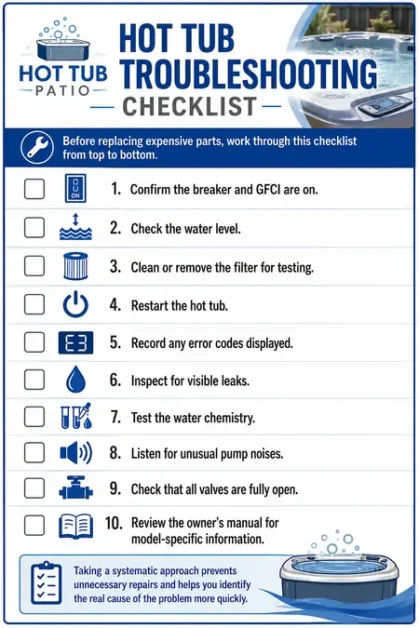
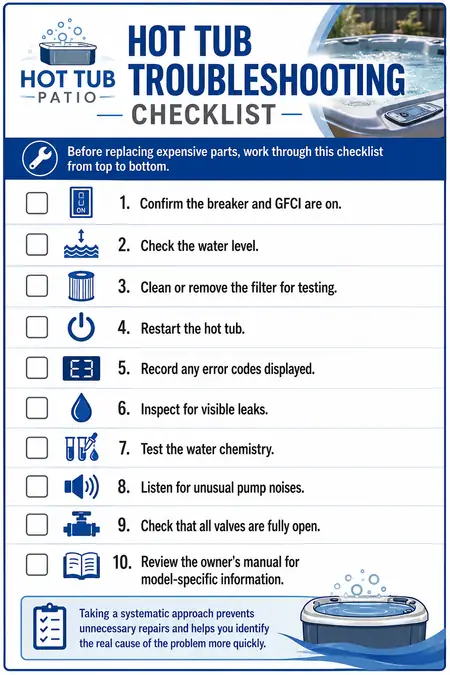
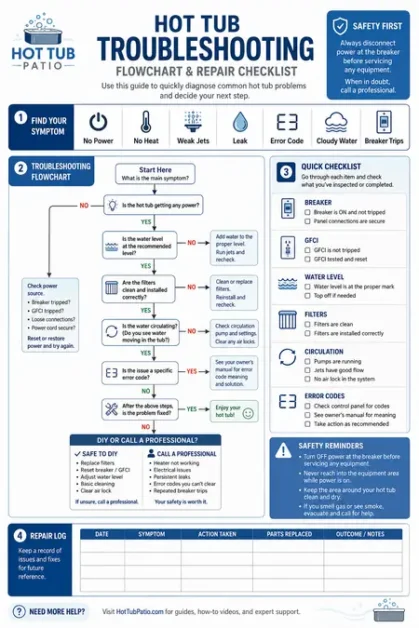
Hot Tub Troubleshooting Checklist
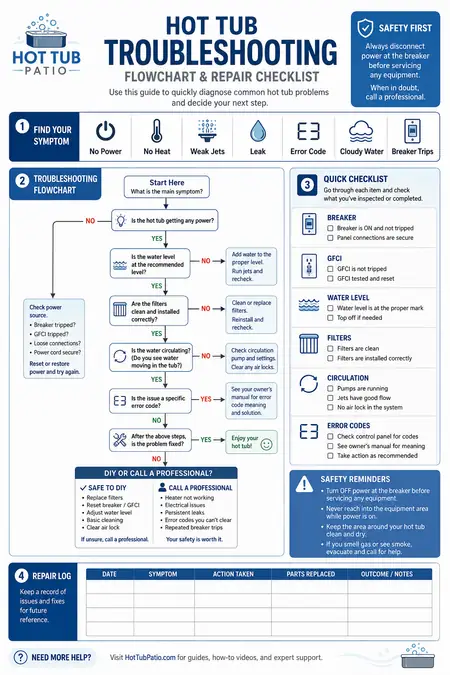
The downloadable checklist artwork is retained as originally created. If its instructions differ from the updated on-page checklist or your model manual, follow the updated safety guidance and model-specific manual.
Before replacing expensive parts, work through this checklist from top to bottom.
- □ Note breaker and GFCI status; stop if protection trips again.
- □ Check the water level.
- □ Clean and reinstall the filter according to the manual.
- □ Follow only model-approved reset steps when no safety warning is present.
- □ Record any error codes displayed.
- □ Inspect for visible leaks.
- □ Test the water chemistry.
- □ Listen for unusual pump noises.
- □ Check only user-accessible jets and valves described in the owner’s manual.
- □ Review the owner’s manual for model-specific information.
Taking a systematic approach prevents unnecessary repairs and helps you identify the real cause of the problem more quickly.
Tailored Action Plan
When your hot tub develops a problem, resist the temptation to replace parts immediately. A structured troubleshooting process usually leads to a faster and less expensive repair.
Use this simple workflow:
- Identify the primary symptom.
- Complete the basic safety checks.
- Eliminate the easiest causes first, such as low water, dirty filters, or a tripped breaker.
- Record any error codes before resetting the spa.
- Test one possible solution at a time instead of changing multiple things at once.
- Keep a small maintenance and repair log with dates, symptoms, and completed repairs.
- Contact a qualified technician if electrical components or major equipment require testing.
Keeping notes about previous problems can help identify recurring issues before they become expensive repairs.
Downloadable Resource
Frequently Asked Questions
What is the most common problem with a hot tub?
Water chemistry issues are the most common hot tub problems. Low sanitizer, dirty filters, or unbalanced pH often lead to cloudy water, odors, weak circulation, and heating problems. Testing the water and cleaning the filter are good first steps.
Why won’t my hot tub heat up?
A hot tub may stop heating because of a clogged filter, low water level, air lock, faulty pressure switch, circulation problem, or failed heating element. Always check water flow before assuming the heater needs replacement.
Why are my hot tub jets weak?
Weak jets are usually caused by dirty filters, low water levels, air trapped in the plumbing, or partially closed diverter valves. Cleaning the filter and checking the water level often restores normal jet pressure.
Why does my hot tub keep tripping the breaker?
A breaker may trip because of a faulty heater, damaged pump motor, moisture inside electrical components, or damaged wiring. If the breaker continues to trip after a reset, leave the spa powered off until the cause is identified.
Can I troubleshoot a hot tub myself?
Many common problems can be diagnosed at home, including dirty filters, low water levels, air locks, and basic water chemistry issues. Electrical repairs and major component replacements should be handled by a qualified spa technician.
How do I know if my hot tub pump is failing?
Signs of a failing pump include loud grinding noises, weak jet pressure, overheating, water leaks around the pump, or a motor that hums without circulating water. These symptoms usually become more noticeable over time rather than appearing suddenly.
What should I check before calling a technician?
Before scheduling a service visit:
- Confirm the breaker and GFCI haven’t tripped.
- Check the water level.
- Clean the filter.
- Record any error codes.
- Restart the spa.
- Inspect for visible leaks.
Completing these simple checks may solve the problem or help the technician diagnose it more quickly.
How often should I inspect my hot tub for problems?
A quick visual inspection once a week helps catch small issues before they become expensive repairs. Look for leaks, unusual noises, weak jet pressure, and changes in water clarity while performing your normal spa routine.